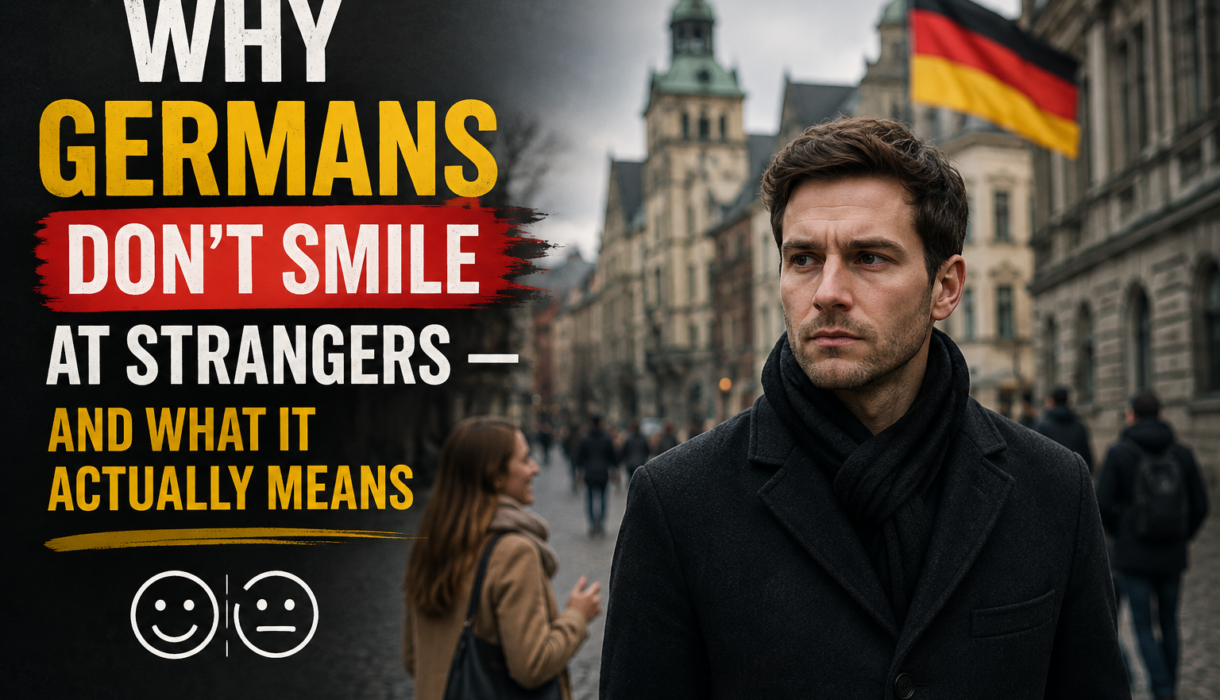

Travelers visiting Germany often notice a subtle social phenomenon almost immediately: passing strangers on the sidewalk, in train stations, or at grocery checkouts rarely offer polite smiles or casual eye contact. To visitors accustomed to “polite” facial gestures common in North America or Latin America, this reserved demeanor can easily feel cold, unwelcoming, or dismissive. However, attributing this baseline neutral expression to rudeness is a fundamental cultural misunderstanding. In reality, the absence of casual smiling in German public spaces stems from a deeply ingrained social framework centered on authenticity, personal privacy, and respect for public boundaries.
The Value of Emotional Authenticity
In German culture, facial expressions—particularly smiles—carry intentional emotional weight rather than serving as performative social lubrication. A smile is viewed as a genuine reflection of warmth, affection, or joy reserved primarily for friends, family, and loved ones. When someone flashes a smile without genuine joy behind it, local social norms often perceive it as artificial or superficial (aufgesetzt). Consequently, maintaining a neutral expression toward strangers is not a sign of hostility; it is a manifestation of honesty, signaling that one is not pretending to share a personal connection that does not yet exist.
Respecting Personal Spheres in Public Spaces
Another essential pillar of German social etiquette is the concept of respecting individual space (Privatsphäre). Public spaces—such as trains, buses, and streets—are viewed as places where individuals deserve the freedom to focus on their own thoughts without uninvited social demands. Making unexpected eye contact or flashing an unsolicited smile can be interpreted as an accidental intrusion into someone else’s mental bubble. By keeping facial expressions neutral, Germans quietly signal respect for your privacy, offering you the same unbothered peace and independence they expect for themselves.
Professional Efficiency Over Casual Pleasantries
This cultural boundary extends directly into daily customer service and professional environments. In many Western cultures, a cashier or service agent is expected to greet customers with broad smiles and cheerful small talk. In Germany, however, professionalism is defined by efficiency, competence, and clarity rather than performative enthusiasm. A grocery cashier demonstrates respect by scanning items quickly, accurately, and without unnecessary delay. Customers appreciate this directness, valuing a smooth transaction over superficial charm.
Winning Genuine Warmth Beyond the Surface
Cross-cultural sociologists often categorize Germany as a classic “peach vs. coconut” culture. While “peach” cultures have a soft outer shell that makes quick friendliness easy to access, “coconut” cultures feature a firmer exterior that takes time to break through. Once a relationship is established—whether through work, shared hobbies, or mutual acquaintances—the outer reserve dissolves completely. The friendships, warmth, and loyalty offered by Germans are exceptionally deep and steadfast precisely because their initial interactions are never faked. Understanding this distinction transforms a perceived cold glance into an appreciation for deep, meaningful human connection.