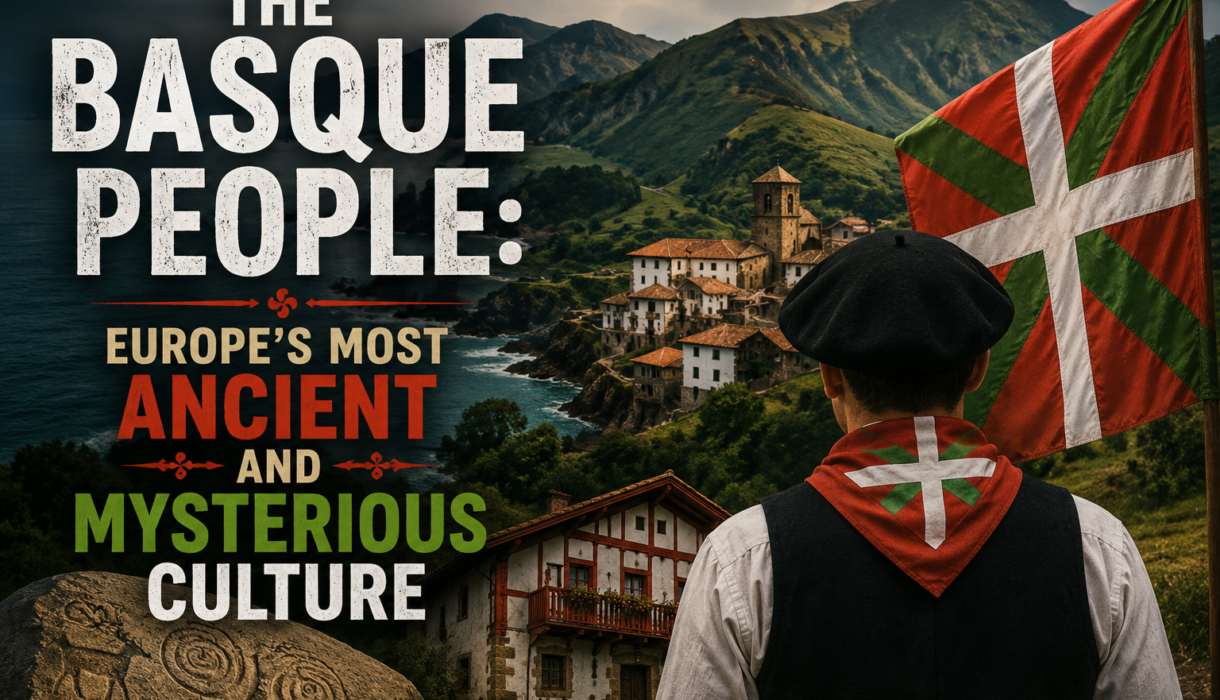

Straddling the rugged Pyrenees mountains along the border of northern Spain and southwestern France, the Basque people represent one of Europe’s most enigmatic societies. Long before the rise of ancient Rome, the emergence of modern nation-states, or the spread of Indo-European languages across the continent, the ancestors of the Basques were already firmly established in their mountainous homeland. Their unique identity has survived millennia of conquest, cultural assimilation, and global trade, preserving a distinct way of life that continues to fascinate historians, geneticists, and travelers alike.
The Enigma of Euskara: Europe’s Lonely Language
At the center of Basque mystery is their language, known natively as Euskara. Unlike virtually every other primary language in Europe—such as Spanish, French, English, or German, which all stem from a shared Indo-European root—Euskara is a true “language isolate”. This means it shares no proven genetic link to any existing language family on Earth. Linguists view Euskara as a living artifact, a rare surviving remnant of the pre-Indo-European tongues spoken across Western Europe thousands of years ago, maintaining its complex structure despite surrounding Romance languages.
Ancient Genetics and Cultural Continuity
Modern genetic research has shed new light on the deep roots of the Basque people. Studies analyzing ancient DNA indicate that the modern Basque population carries remarkable genetic continuity stretching back to early European farmers and Iron Age groups. Because their high-altitude settlements provided natural defense and their distinct language acted as a social boundary, the Basques largely avoided intermarrying with subsequent waves of invaders, including the Romans, Visigoths, and Moors. This centuries-long cultural isolation allowed their ancestral genetic markers, physical traditions, and self-contained community structures to stay preserved over generations.
A Legacy Built on Independence and Innovation
Despite their geographic and linguistic isolation, the Basque people have historically played an oversized role in global trade and maritime navigation. Renowned as elite shipbuilders and legendary mariners, Basque whalers and fishermen ventured deep into the North Atlantic hundreds of years before the age of discovery, leaving an indelible mark on maritime history. Closer to home, their socio-economic system traditionally relied on the baserri—a self-sufficient, stone-built family farmstead passed down intact to a single heir—which fostered a fiercely independent spirit, deep respect for land ownership, and strong community solidarity.
Preserving a Living Heritage in the Modern World
Today, the Basque Country (Euskal Herria) balances its ancient roots with modern dynamism. Cities like Bilbao and San Sebastián have transformed into global hubs for modern architecture and world-class gastronomy, boasting some of the highest concentrations of Michelin-starred restaurants per capita. Meanwhile, traditional rural sports—such as pelota (a fast-paced court game) and stone-lifting—remain wildly popular, demonstrating a continuous pride in physical endurance and ancestral identity. Ultimately, the Basques remain a powerful testament to how a culture can fiercely protect its ancient heritage while thriving in the heart of contemporary Europe.