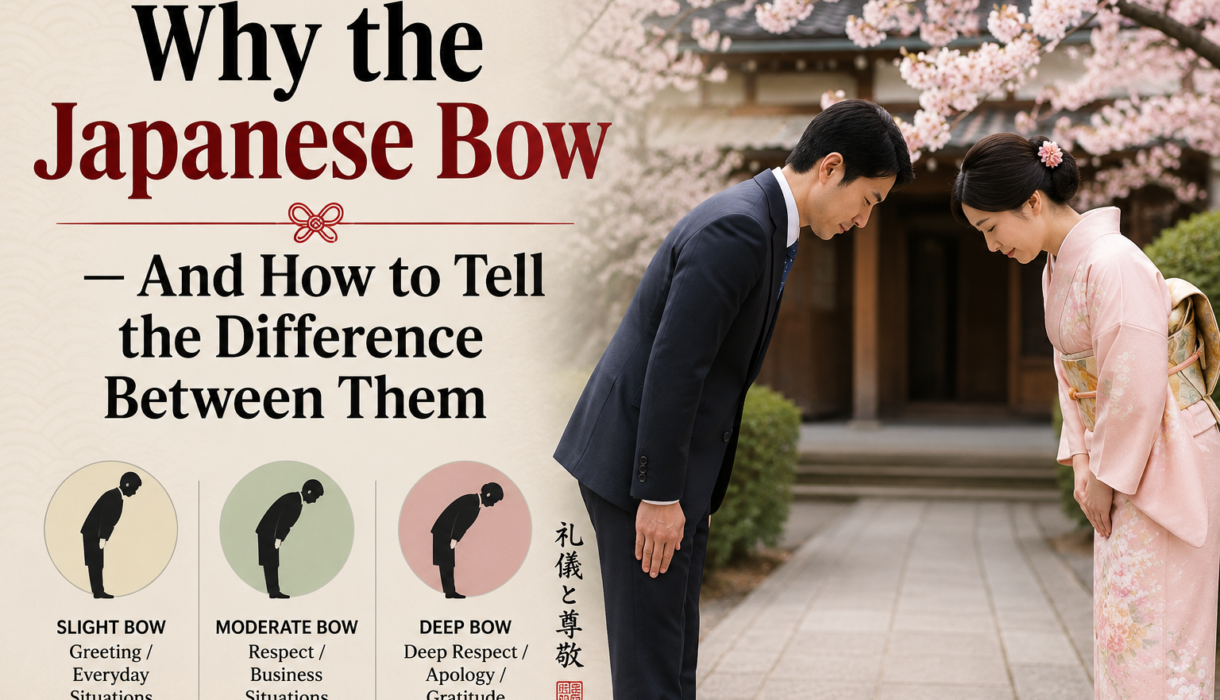

In Japan, the act of bowing—known locally as Ojigi (お辞儀)—is much more than a graceful greeting; it is the cornerstone of the nation’s social fabric. Rooted in centuries of Shinto and Buddhist traditions, bowing originated as a gesture of vulnerability, exposing the neck to show a lack of hostility. Today, it serves as a universal silent language used to demonstrate respect, gratitude, humility, and apology. Because Japanese culture places a high value on harmony (Wa) and social hierarchy, knowing how and when to bow is essential for conveying sincere respect in both everyday interactions and high-level business settings.
1. Eshaku (会釈): The Casual Greeting Bow
The most common and casual form of bowing is Eshaku, executed with a slight 15-degree bend at the waist. This brief, relaxed bow is equivalent to a polite nod or a casual “hello” in Western customs. It is typically used when greeting friends, acquaintances, informal colleagues, or when passing someone of equal social standing in a hallway. While informal, Eshaku maintains a key rule of Japanese etiquette: your eyes should lower naturally with the angle of your head rather than maintaining direct eye contact, which can be perceived as aggressive.
2. Keirei (敬礼): The Professional Respect Bow
When navigating formal business environments or interacting with superiors, Keirei is the standard requirement. Bending at a precise 30-degree angle, this bow communicates explicit respect and deference. It is routinely used when greeting clients, thanking customers, welcoming visitors into an office, or attending official meetings. To execute Keirei correctly, one must keep their back straight and arms resting neatly at their sides (for men) or folded naturally in front of the lap (for women), holding the posture for roughly two to three seconds to show genuine appreciation.
3. Saikeirei (最敬礼): The Highest Mark of Reverence
Saikeirei is a deep, formal bow performed at a 45-degree angle (or lower), reserved for moments of profound reverence, immense gratitude, or deep apology. Because it represents the ultimate display of humility, it is not used in casual daily conversations. Instead, you will see Saikeirei performed in front of royalty, during religious worship at Shinto shrines, or when a business executive delivers a serious public apology for a major error. Holding this deep incline signifies that the speaker acknowledges full responsibility or holds the recipient in the highest possible esteem.
Mastering the Subtle Rules of Ojigi
Beyond angles, the true mastery of Japanese bowing lies in rhythm, posture, and contextual awareness. A proper bow always originates from the hips with a flat back, avoiding a simple bend of the neck or slouching of the shoulders. Furthermore, the duration and depth of a bow often reflect the relationship between two people: if someone bows deeper or holds their bow longer than you, it is customary to match their gesture. Understanding these distinct levels of Ojigi ensures seamless cross-cultural communication, transforming a simple physical gesture into a powerful display of cultural intelligence.