
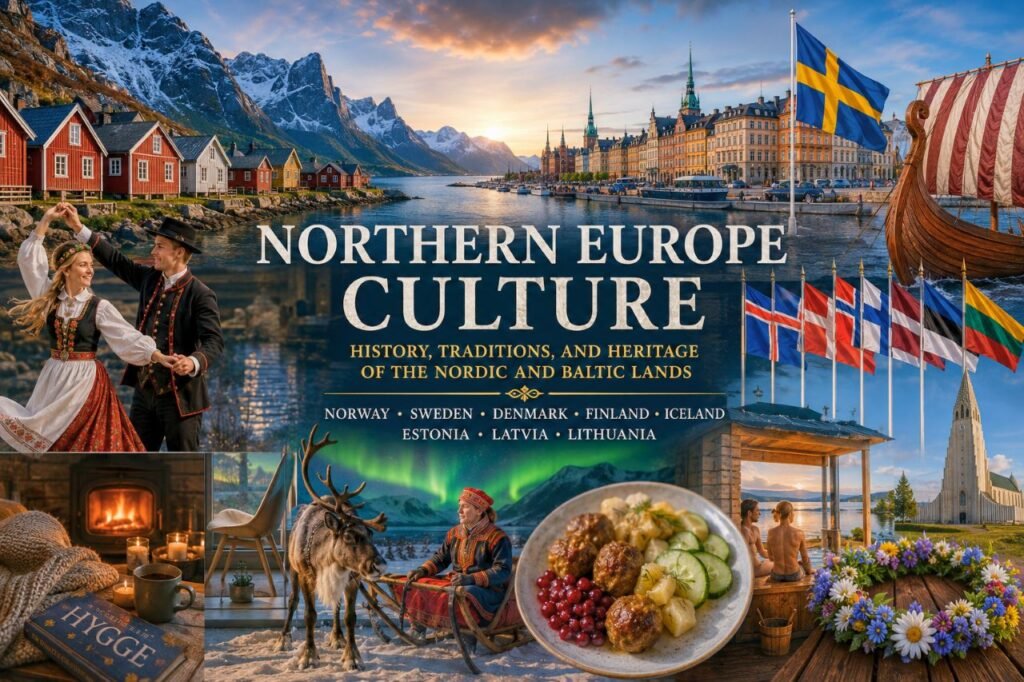
The Culture of Northern Europe is a captivating blend of deep historical heritage, a harmonious relationship with nature, and a pioneering spirit of modern social progress. Encompassing the Scandinavian nations (Norway, Sweden, and Denmark), the broader Nordic realm (Finland and Iceland), and the Baltic states (Estonia, Latvia, and Lithuania), this region is bound together by shared climatic realities, maritime history, and enduring values of community and equality. From the ancient seafaring sagas of the Vikings to the world-renowned lifestyle philosophies of Hygge and Lagom, Northern European life offers a profound celebration of resilience, minimalist design, and social trust.
History & Origins
Northern European culture was forged through millennia of adaptation to cold northern climates, seasonal extremes, and dynamic maritime trade routes.
- Early Settlements & Pagan Origins: Following the retreat of glacial ice sheets, early hunter-gatherer societies settled along the Baltic coastlines and Scandinavian fjords. Indigenous groups, such as the Sámi people of northern Lapland, developed a semi-nomadic culture centered around reindeer pastoralism and shamanic spiritual practices.
- The Viking Age (c. 793–1066 CE): Norse seafarers from present-day Norway, Denmark, and Sweden embarked on extensive trade, exploration, and settlement expeditions across Europe, North America, and Central Asia. They left behind Old Norse literature, heroic sagas, runestones, and a legacy of democratic assembly systems known as the Thing.
- Christianization & Medieval Kingdoms: Between the 10th and 14th centuries, Northern European societies transitioned from pagan Norse and Baltic mythologies to Christianity. Powerful unions emerged, such as the Kalmar Union (1397), which united Denmark, Norway, and Sweden under a single monarch, and the Hanseatic League, which dominated Baltic trade routes.
- Modern Reformation & Social Evolution: The Protestant Reformation in the 16th century shaped the ethical, educational, and institutional foundations of Lutheran Northern Europe. In the 20th century, the region successfully transformed from agrarian rural societies into world leaders in social welfare, technology, and environmental sustainability.
Culture, Traditions & Customs
Life in Northern Europe is governed by seasonal rhythms, warm social gatherings, and centuries-old folk celebrations.
- Midsummer (Midsommar / Jāņi): Celebrated during the summer solstice in late June, Midsummer is one of the region’s most significant holidays. Communities gather outdoors to raise flower-adorned maypoles, weave floral wreaths, sing traditional folk songs, build bonfires, and enjoy festive outdoor feasts.
- Christmas Traditions (Yule / Jōl): Blending ancient winter solstice rites with Christian traditions, Northern European Christmas celebrations center on Christmas Eve (Julafton). Highlights include St. Lucia’s Day (December 13) in Sweden, sauna rituals on Christmas Eve in Finland, and festive markets across the Baltic states.
- Lifestyle Philosophies:
- Hygge (Denmark/Norway): A concept denoting cozy, contented atmosphere, enjoying good food and warmth with loved ones.
- Lagom (Sweden): The philosophy of “not too little, not too much—just right,” emphasizing balance, moderation, and sustainability.
- Sisu (Finland): An indomitable spirit of courage, stoic determination, and resilience in the face of adversity.
- Rites of Passage: Confirmation ceremonies, high school graduation celebrations (such as the Danish Studenterkørsel truck parades), and traditional sauna gatherings serve as vital communal milestones.
Languages & Communication
Language Families
Northern Europe features a distinct linguistic landscape split across major language families:
- North Germanic (Scandinavian) Languages: Norwegian, Swedish, Danish, Icelandic, and Faroese share common Old Norse origins. Swedish, Norwegian, and Danish are mutually intelligible to varying degrees.
- Finno-Ugric Languages: Finnish and Estonian belong to the Uralic language family, characterized by complex agglutinative grammar and unrelated to the Germanic tongues.
- Baltic Languages: Latvian and Lithuanian constitute the eastern branch of the Baltic language family, preserving ancient Indo-European grammatical structures.
- Indigenous Languages: Sámi languages are spoken by the indigenous Sámi population across northern Norway, Sweden, and Finland.
Communication Style
Communication across Northern Europe is generally direct, honest, and low-context. Politeness is demonstrated through respecting personal space, punctuality, and equality rather than grand formal gestures. English proficiency across the region is among the highest in the non-native speaking world.
Geography
Spanning from the North Sea and the Baltic Sea up into the Arctic Circle, Northern Europe features some of the most spectacular physical geography on Earth.

- Scandinavia & Nordics: Characterized by dramatic glacial fjords in Norway, vast pine forests and archipelagos in Sweden, fertile agricultural lowlands in Denmark, thousands of interconnected lakes in Finland, and volcanic landscapes, geysers, and glaciers in Iceland.
- The Baltic States: Feature low-lying rolling plains, extensive peat bogs, dense pine woodlands, and pristine sandy beaches along the Baltic coastline.
- The Northern Lights & Midnight Sun: Due to high latitudes, the region experiences winter polar nights illuminated by the Aurora Borealis, contrasted with perpetual daylight during the summer “Midnight Sun.”
Economy
Northern European economies are globally recognized for combining competitive free-market capitalism with strong social safety nets, often referred to as the Nordic Model.
- Key Sectors: Advanced manufacturing, green technology, clean energy, maritime shipping, forestry, telecommunications, and digital innovation (home to global startups like Spotify and Skype).
- Sustainability Focus: Northern European nations lead the world in renewable energy adoption, circular economy practices, and environmental conservation.
Politics
Northern European political systems prioritize democratic transparency, social trust, gender equality, and institutional integrity.
- Governance Systems: Sweden, Norway, and Denmark operate as stable constitutional monarchies, while Finland, Iceland, Estonia, Latvia, and Lithuania are parliamentary republics.
- Egalitarian Governance: High levels of civic participation, low levels of public corruption, and progressive social legislation consistently place Northern European countries at the top of global happiness and human development indices.
Ethnic Groups
While Northern European countries are historically homogeneous, their demographic makeup has evolved significantly:
- Core Regional Populations: Norwegians, Swedes, Danes, Finns, Icelanders, Estonians, Latvians, and Lithuanians.
- Indigenous Peoples: The Sámi, who have inhabited the northern Arctic regions (Sápmi) for thousands of years, retaining their distinct language, reindeer herding customs, and cultural parliament systems.
- Modern Diversity: Economic growth and humanitarian initiatives have introduced diverse immigrant communities from across Asia, the Middle East, Africa, and Southern Europe, creating vibrant multicultural urban hubs like Oslo, Stockholm, and Copenhagen.
Beliefs & Values
Secularism & Social Ethics
While historically rooted in Lutheran Christianity and Baltic pagan traditions, modern Northern Europe is among the most secular regions in the world. Spiritual identity often takes the form of personal connection to nature rather than strict church attendance.
Core Values
- Equality & Egalitarianism: Social equity, gender parity, and child welfare are fundamental priorities.
- Allemansrätten (Right to Roam): A legally enshrined principle in Sweden, Norway, and Finland granting everyone the freedom to hike, camp, and forage freely in nature, provided they respect the environment.
- Janteloven (Law of Jante): A cultural norm discouraging individual vanity or boasting in favor of collective humility and solidarity.
Food & Cuisine
Northern European gastronomy—celebrated globally as New Nordic Cuisine—focuses on fresh, seasonal, locally foraged ingredients, and traditional preservation methods like smoking, curing, and pickling.
- Iconic Dishes:
- Smørrebrød (Denmark): Traditional open-faced rye bread sandwiches topped with pickled herring, roast beef, or smoked salmon.
- Meatballs (Köttbullar / Lihapullat): Served with creamy gravy, boiled potatoes, and tart lingonberry jam.
- Gravlax: Fresh salmon cured with salt, sugar, and dill, thinly sliced and served on rye crispbread.
- Ruisleipä (Finland): Dense, sour rye bread that forms a staple of daily meals.
- Cepelinai (Lithuania): Large potato dumplings stuffed with spiced minced meat or cottage cheese.
- Coffee Culture (Fika): In Sweden and across the Nordics, Fika is an essential daily social ritual of taking a break with coffee and fresh cinnamon or cardamom buns (Kanelbullar).
Clothing & Symbols

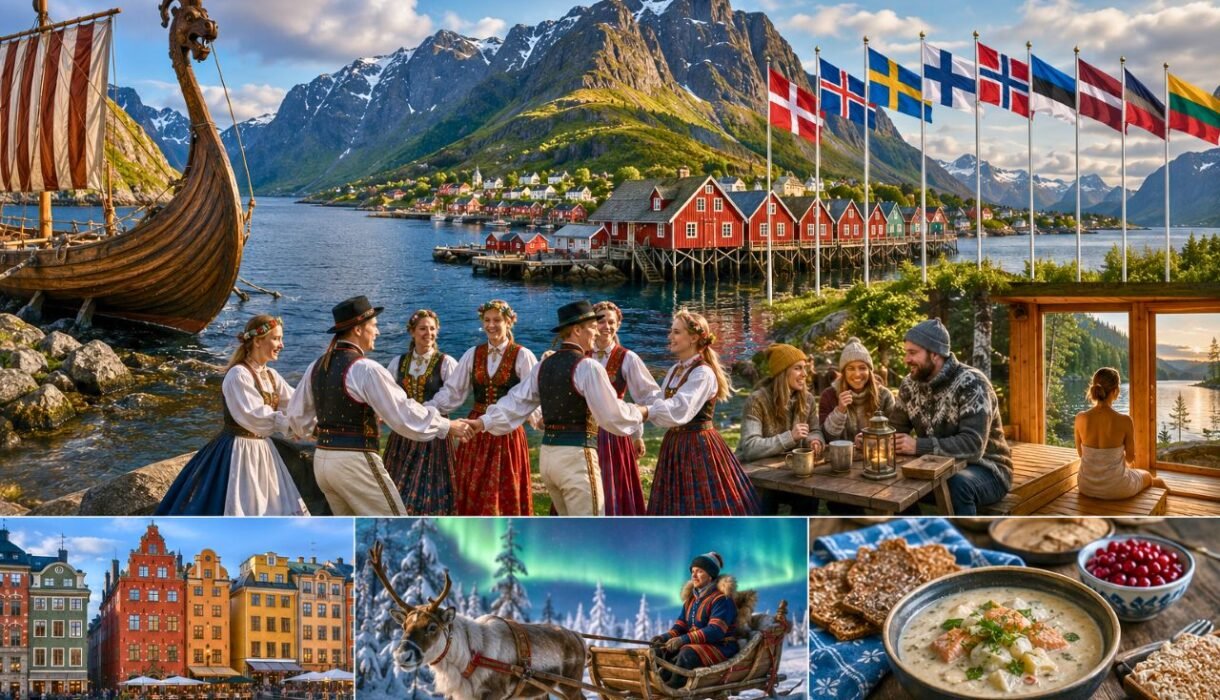
Nordic landscapes and traditions collage,
Traditional Attire & Modern Design
- Bunad / Folk Costumes: Traditional regional folk dresses (Bunad in Norway, Folkdräkt in Sweden) featuring intricate wool hand-embroidery, linen shirts, and silver clasps. They are worn proudly during national holidays and weddings.
- Sámi Gákti: The traditional tunic worn by the Sámi, featuring bright blue cloth accented with red and yellow geometric bands indicating the wearer’s home region and marital status.
- Scandinavian Minimalism: Modern clothing design emphasizes functional, minimalist, high-quality garments tailored for cold weather.
Music, Dance & Art
- Architectural & Interior Design: Globally famous for Scandinavian Design, prioritizing simplicity, clean lines, natural wood materials, and functional beauty.
- Folk Music & Instruments:
- Hardingfele (Hardanger Fiddle): A traditional Norwegian violin featuring sympathetic strings that produce a resonant, haunting sound.
- Kantele: The traditional Finnish plucked zither, central to the performance of national epic poetry such as the Kalevala.
- Performing Arts & Literature: Rich literary traditions ranging from Hans Christian Andersen’s fairy tales and Henrik Ibsen’s theater to modern Nordic Noir crime novels and world-renowned pop music production.
Summary
Northern Europe Culture represents a harmonious synthesis of ancient seafaring heritage, deep environmental reverence, and modern social progressivism. By cherishing simplicity, equality, and connection to community and nature, Northern European society continues to offer a compelling model of sustainable, balanced living for the modern world.
At Best Culture Insight, we see culture as the heartbeat of every society – the way people live, connect, and express their identity.