The Spirit of the Caribbean and the Llanos: A Deep Exploration of Venezuela Culture
Posted in :

Situated on the northern coast of South America, Venezuela is a land of stunning ecological diversity, vibrant colors, and immense cultural pride. Known officially as the Bolivarian Republic of Venezuela, this nation serves as a major geographic and cultural crossroads, seamlessly blending Caribbean flair, Andean heritage, Amazonian wilderness, and the expansive cowboy traditions of the Llanos (the central plains). – Venezuela culture
To step into Venezuelan culture is to experience a society forged in resilience, deep communal bonds, and an infectious, joyful outlook on life. Venezuelans, or Venezolanos, are globally recognized for their warmth, their exceptional expressive hospitality, their profound love for baseball, and a national identity that shines brightest through festive music, shared culinary traditions, and a deep reverence for family.
History & Origins
Before European ships reached its shores, the territory now known as Venezuela was inhabited by numerous indigenous groups. These included the farming Timoto-Cuica in the Andes, the coastal Carib and Arawak tribes, and the Yanomami in the deep southern rainforests. In 1498, Christopher Columbus arrived on the Paria Peninsula, naming the region the “Land of Grace” due to its stunning natural landscapes. A year later, Alonso de Ojeda explored the Gulf of Venezuela, where the indigenous stilt houses built over the water reminded him of Venice, inspiring the name Venezuela (“Little Venice”).

Breathtaking tropical beach in Venezuela featuring palm trees, a clear blue sky, and a sandy shore.
The colonial era transformed the territory into an agricultural hub under Spanish rule, heavily relying on the cocoa and tobacco trade. To meet labor demands, Spanish settlers imported enslaved West Africans, whose rhythmic music, spiritual traditions, and cooking methods merged with indigenous and European cultures.
Venezuela became a cradle of South American liberty when national hero Simón Bolívar, “The Liberator,” led a grueling revolutionary campaign to win independence from Spain, finalized at the Battle of Carabobo in 1821. The discovery of massive oil reserves in the early 20th century transformed Venezuela from a rural agricultural economy into an urbanized petro-state, driving waves of European and regional migration that further enriched its cultural tapestry.
Culture, Traditions & Customs
Family Bonds and Festive Milestones
In Venezuela, the family is the undisputed core of social structure. Multi-generational households are common, and extended family networks provide critical emotional, social, and economic support. Major life milestones blend traditional Catholic sacraments with lively secular parties:
- The Quinceañera: A young girl’s fifteenth birthday marks her transition into womanhood. Families host elegant, formal receptions where the quinceañera dances a traditional waltz with her father, surrounded by a court of family and friends.
- Marriage Customs: Beyond formal church services, Venezuelan weddings feature the lively Hora Loca (The Crazy Hour) late into the reception. Guests put on colorful masks, wigs, and neon accessories as a brass band or DJ plays high-energy music, transforming the formal event into an indoor carnival.
Major Cultural Festivals
- The Dancing Devils of Yare (Diablos Danzantes de Yare): Celebrated on Corpus Christi in San Francisco de Yare, this UNESCO-recognized ritual is a striking display of religious syncretism. Participants dress in bright red costumes and wear grotesque, handcrafted devil masks, dancing backward to drumbeats until they fall prostrate before the Blessed Sacrament, symbolizing the triumph of good over evil.
- Feria de La Chinita: Held in November in Maracaibo, this massive festival honors the Virgin of Chiquinquirá. The city erupts in open-air concerts, street parades, and sporting events, officially kicking off the country’s extended Christmas season.
- The Burial of the Sardine (El Entierro de la Sardina): Celebrated on Ash Wednesday along coastal regions, this playful, carnivalesque mock funeral involves burying a symbolic sardine to mark the end of Carnival and the beginning of Lent.
Languages & Communication
The official language of Venezuela is Spanish, spoken with a fast-paced, highly distinct phonetic cadence influenced by Spain’s Canary Islands and Caribbean trading routes. Under the constitution, dozens of indigenous languages—including Wayuu, Warao, and Pemon—are also recognized as official heritage tongues for their respective peoples.
Venezuelan Spanish is globally recognized for its heavy use of voseo in western regions (like Zulia), warm terms of endearment (mi amor, papi, mami) used even with strangers, and a rich lexicon of colorful idioms.
Popular Venezuelan Expressions:
- “¡Chamo!” / “¡Chama!” – The quintessential Venezuelan slang word for “boy,” “girl,” “dude,” or “friend.”
- “¡Qué nota!” – An expression used to describe an awesome, highly pleasant, or fun situation.
- “Correr la arruga” – A popular idiom meaning to procrastinate or delay solving a problem.
- “Echarle pichón” – An idiomatic phrase meaning to put immense effort, hard work, and dedication into a task.
Geography
Venezuela is divided into four highly diverse geographic regions, each shaping the distinct lifestyle and customs of its inhabitants:
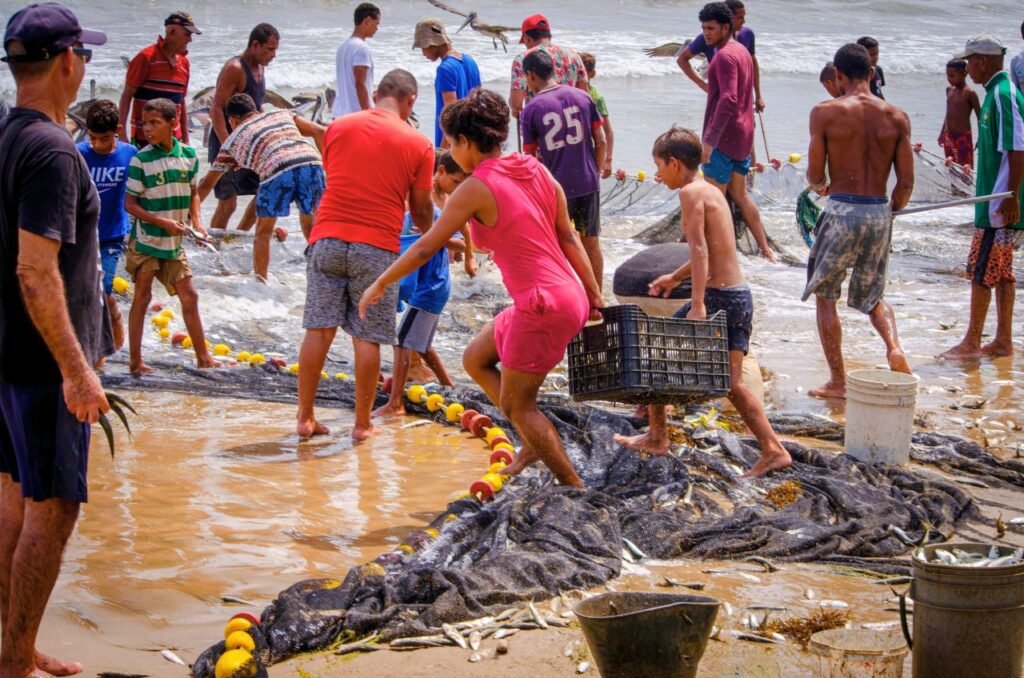
- The Coastal Caribbean Belt: Home to the majority of the population and urban hubs like Caracas, Valencia, and Puerto La Cruz. It features stunning tropical beaches and vibrant fishing communities.
- The Andean Highlands: The northern extension of the Andes mountains, featuring chilly mountain cities like Mérida and San Cristóbal, where agricultural communities cultivate coffee, wheat, and potatoes.
- The Llanos (Central Plains): A vast savanna flanking the Orinoco River, dedicated to cattle ranching and legendary for its rugged cowboy culture.
- The Guayana Region: Located in the south, this ancient landscape features the dense Amazonian rainforest, spectacular flat-top mountains (tepuis), and the historic Angel Falls (Kerepakupai Merú), the world’s highest uninterrupted waterfall.
Economy
Venezuela possesses some of the world’s largest proven oil reserves, a resource that has driven its economy for over a century. Beyond petroleum extraction, the nation’s diverse landscapes support the production of high-quality cocoa, world-class rum, coffee, and agricultural livestock in the central plains. In recent years, economic adjustments have fostered a growing informal market, strong reliance on international remittances, and a resilient entrepreneurial spirit among local artisans and small business owners.
Politics
Venezuela is a federal presidential republic. Executive power is held by the President, who serves as both head of state and head of government, working alongside a unicameral legislature known as the National Assembly. Following independence and various political evolutions throughout the 20th century, the country’s contemporary political framework has been heavily defined by the rise of the “Fifth Republic” and the implementation of social programs. Civic participation is passionate, and national discourse remains highly centered on economic development, sovereignty, and regional integration.
Ethnic Groups
Venezuela’s population is a beautiful testament to centuries of harmonious racial and cultural integration, resulting in a rich multi-ethnic society:
| Major Ethnic / Cultural Group | Population Share | Historic and Social Footprint |
| Mestizo / Mulatto (Mixed) | ~51% | The demographic core of the country, blending European, African, and Indigenous heritages across urban and rural zones. |
| White / European | ~43% | Descendants of Spanish colonial settlers, alongside large mid-20th-century waves of Italian, Spanish, Portuguese, and Lebanese immigrants. |
| Afro-Venezuelan | ~3.6% | Concentrated primarily along coastal states like Miranda and Vargas; deeply shaped national music, culinary arts, and coastal folklore. |
| Amerindian (Indigenous) | ~2.7% | Composed of over 30 distinct ethnic groups who preserve ancestral languages, hunting methods, and intricate basket weaving arts. |
Beliefs & Values
The vast majority of Venezuelans identify as Roman Catholic (roughly 70%), while evangelical Protestant denominations make up a growing 17% of the population. However, spiritual life is uniquely characterized by popular syncretism and folk devotions.
A prime example is the cult of María Lionza, an indigenous mythical queen revered in a spiritual movement centered at the sacred mountain of Sorte. Devotees view her as a protector of nature, frequently invoking her alongside Christian saints and African deities. Furthermore, Venezuelans hold a deep national devotion to Doctor José Gregorio Hernández, the “Physician of the Poor,” a real 19th-century doctor beatified by the Vatican, whom locals pray to for physical healing and miraculous medical interventions.
Food & Cuisine
Venezuelan cuisine is an aromatic, comforting, and incredibly flavorful tradition that revolves around corn, black beans, plantains, and slow-cooked meats.
The Sacred Arepa
The undisputed icon of Venezuelan identity is the Arepa. These round, thick, unleavened patties made from ground-corn dough are grilled, baked, or fried, then split open and stuffed with a limitless variety of fillings. Arepas are eaten daily, crossing all economic barriers and meals from breakfast to late-night snacks.
Popular arepa fillings carry highly creative names:
- Reina Pepiada: A creamy mixture of shredded chicken, mayonnaise, and fresh avocado, named in honor of a Venezuelan Miss World winner.
- Pelúa: A combination of savory shredded beef and sharp yellow cheese, mimicking a “hairy” appearance.
- Domino: A sweet-and-savory pairing of black beans and salty white cheese.
Other Iconic Dishes
- Pabellón Criollo: The traditional national dish. It features a colorful arrangement of seasoned shredded beef, fluffy white rice, savory black beans, and sweet fried plantain slices (tajadas), representing the country’s European, African, and Indigenous roots.
- Hallaca: The absolute centerpiece of Venezuelan Christmas celebrations. It consists of corn dough stuffed with a rich stew of beef, pork, and chicken, garnished with raisins, capers, and olives. The dough is carefully folded in plantain leaves, tied with string, and boiled, making its preparation a multi-generational family event.
- Cachapa: A sweet, thick pancake made from fresh, tender corn kernels, folded over a generous slab of salty, unripened queso de mano (hand-churned cheese).
Clothing & Symbols
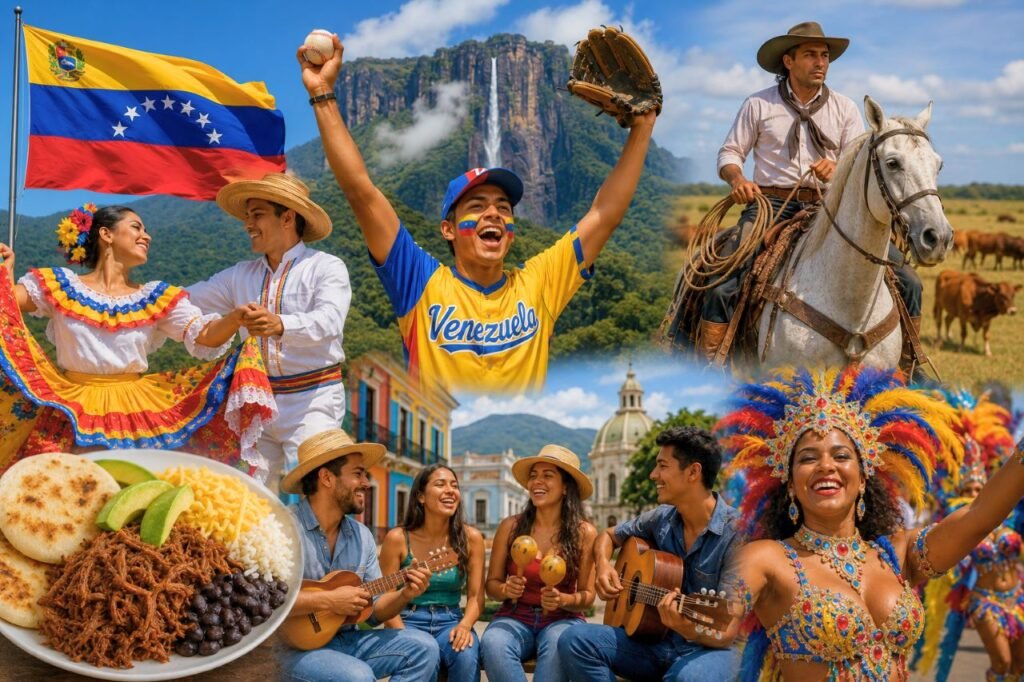
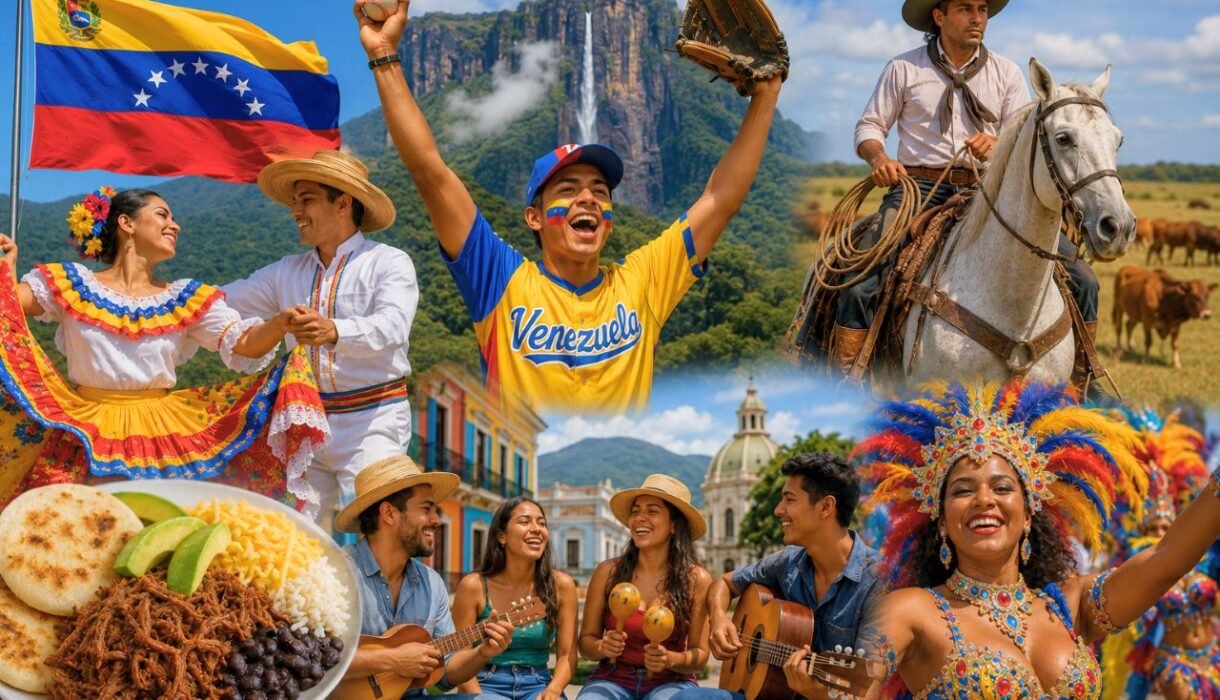
Celebrating Venezuela’s vibrant culture and spirit – Venezuela Culture.
The Elegance of the Liquiliqui
The traditional national attire for Venezuelan men is the Liquiliqui (pronounced lee-kee-lee-kee). This elegant, tailored suit features a structured cotton or linen jacket with a high Nehru collar, closed by decorative metallic buttons, and paired with matching trousers.
Originally worn by cattle ranchers in the plains, the Liquiliqui has evolved into a formal garment worn proudly at weddings, diplomatic events, and cultural ceremonies. Women traditionally wear a multi-layered, off-the-shoulder white blouse paired with a long, flowing tiered skirt adorned with vibrant floral patterns, used to perform national folk dances.
National Symbols
The national flag of Venezuela consists of three horizontal bands of yellow (representing nation wealth and sunshine), blue (representing the Caribbean Sea and Atlantic Ocean), and red (symbolizing the blood spilled for freedom). An arc of eight stars in the center represents the historic provinces that signed the independence act. The national coat of arms prominently features a bundle of wheat (unity), a white horse running free (liberty), and crossed cornucopias symbolizing agricultural abundance.
Music, Dance & Art
The Driving Rhythm of Joropo
The heartbeat of national folklore is the Joropo, a high-energy dance and music style born in the Llanos. The music is driven by a unique acoustic trio: the Arpa Llanera (plains harp), the Cuatro (a small, four-stringed guitar that provides driving syncopation), and Maracas (gourd shakers played with fast, complex wrist techniques).
[ The Core Trio of Joropo Music ]
┌─────────────────────────┬─────────────────────────┬─────────────────────────┐
│ Arpa Llanera │ Cuatro │ Maracas │
│ Leads the melody with │ A small 4-string guitar │ Provide the high-speed, │
│ bright, energetic chord │ driving the syncopated │ syncopated rhythmic │
│ progressions. │ strumming patterns. │ undercurrent. │
└─────────────────────────┴─────────────────────────┴─────────────────────────┘
The dance itself is a lively, rhythmic courtship display where the male dancer performs complex footwork (zapateo) resembling a galloping horse, while the female sweeps gracefully across the floor.
Afro-Venezuelan Drums and Kinetic Art
Along the Caribbean coast, music is dominated by Tambores, heavy African-derived percussion styles centered around hollow wooden drums played with absolute intensity during the Feast of Saint John the Baptist.
In the fine arts, Venezuela achieved international acclaim during the 20th century as a global epicenter for Kinetic and Op Art. Master artists like Carlos Cruz-Diez and Jesús Rafael Soto created monumental public installations that play with light, color, and optical illusions, turning urban spaces in Caracas into living, moving pieces of modern art.
Summary
The culture of Venezuela is a brilliant celebration of diversity, resilience, and creative genius. By beautifully weaving together its indigenous roots, African rhythms, European style, and expansive cowboy folklore, this Caribbean-facing nation has carved out one of the most passionate identities in South America. From the shared joy of making holiday hallacas to the incredible, complex rhythms of a live joropo performance, Venezuela stands proud—inviting the world to discover a rich, warm, and profoundly welcoming cultural heritage.
At Best Culture Insight, we see culture as the heartbeat of every society—the way people live, connect, and express their identity.