Land of 365 Beaches: A Deep Journey Into Antigua and Barbuda Culture
Posted in :

Floating gracefully where the Atlantic Ocean meets the Caribbean Sea, the twin-island nation of Antigua and Barbuda stands as a vibrant cultural beacon in North America’s Caribbean region. Famously celebrated for having 365 distinct, white-sand beaches—one for every day of the year—the essence of this independent state runs vastly deeper than its picture-perfect coastlines. – Antigua and Barbuda culture, North America.

To truly understand Antigua and Barbuda culture is to encounter an energetic, resilient community built on a profound history of survival and self-determination. The people, known warmly as Antiguans and Barbudans, possess a distinctly hospitable, rhythmic, and expressive lifestyle. Their identity is a colorful tapestry woven from West African ancestral traditions, British colonial history, and modern pan-Caribbean connectivity.
History & Origins
The historical foundations of Antigua (named Wadadli by its indigenous people) and Barbuda (Wa’omoni) date back thousands of years before European contact, serving as home to the seafaring Siboney, Arawak, and warlike Carib communities.
The geopolitical landscape shifted dramatically in 1493 when Christopher Columbus sailed past Antigua, naming it after the church of Santa María de la Antigua in Seville, Spain. However, it was British colonization starting in 1632 that permanently altered the islands’ demographic trajectory. Under British rule, the colony was transformed into a highly intensive sugar plantation economy.
To maximize agricultural output, colonial planters imported tens of thousands of enslaved West Africans. These individuals brought complex spiritual traditions, linguistic habits, and musical rhythms with them.
Following the full emancipation of enslaved peoples on August 1, 1834, the population began the generational process of weaving their African heritage together with the institutional frameworks left by the British. After centuries of colonial administration, the twin islands achieved full political independence on November 1, 1981, remaining a proud sovereignty within the Commonwealth.
Culture, Traditions & Customs
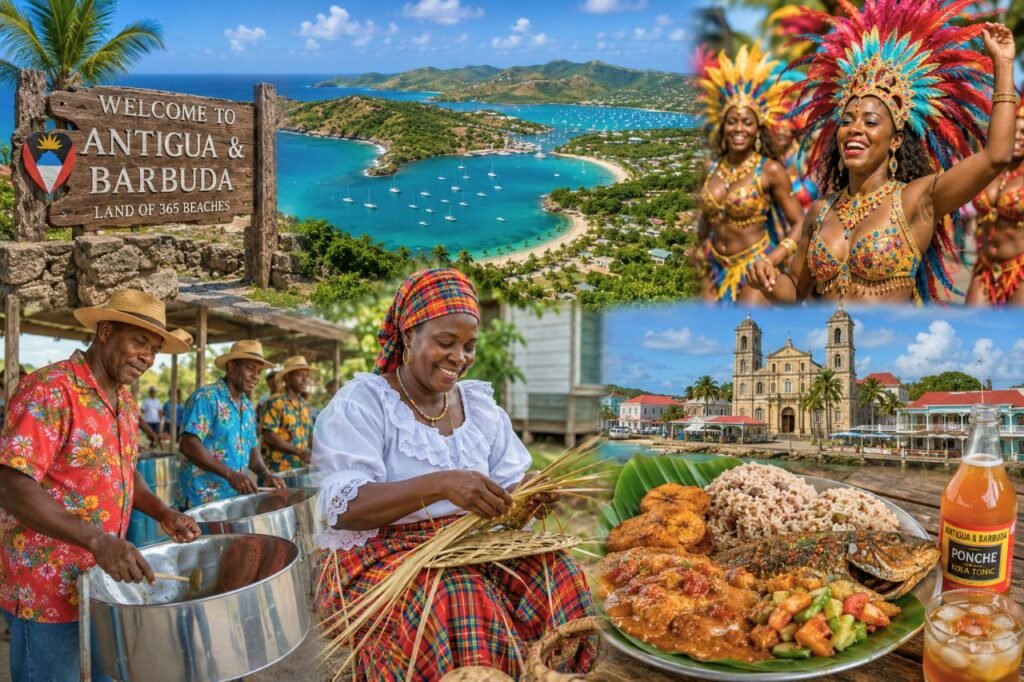
Colorful Antigua & Barbuda getaway collage – Antigua and Barbuda Culture
Community Rites and the Sound of Iron
Family life and community connection are the cornerstones of Antiguan and Barbudan society. Traditional life-cycle milestones, such as Christian baptisms, weddings, and funerals, are major, multi-generational community affairs marked by grand feasts and lively family reunions.
A unique secular custom deeply embedded in neighborhood life is the informal gathering around the Warri Board. Warri is an ancient, strategic mathematical abstract game brought directly from West Africa. Played on a carved wooden hollowed board using large, smooth seeds, the fast-paced game serves as a common social hub where elders pass down oral histories, local neighborhood news, and strategic thinking to younger generations.
The Ultimate Cultural Celebration: Carnival
The absolute peak of the cultural calendar is Antigua’s Carnival, heralded as the Caribbean’s greatest summer festival. Spanning from late July to the first Tuesday in August, this ten-day festival serves a dual purpose: it is an explosion of artistic expression and a profound commemoration of the emancipation of slavery.
- J’ouvert: Happening in the pre-dawn hours of Emancipation Day, thousands of revelers take to the streets covered in paint, mud, and clay. They dance behind massive sound trucks to celebrate the initial moments of freedom.
- Mas (Masquerade): The festival culminates in spectacular street parades where costumed bands perform intricate choreography, wearing massive, feathered headdresses that symbolize the joy and visual energy of the islands.
Languages & Communication
While English is the official language used across the government, courts, school systems, and print media, the true national heartbeat is found in Antiguan Creole. This vibrant, English-based creole language blends English sentence structures with West African grammatical roots and distinct localized idioms.
Creole is spoken universally in casual, daily interactions, serving as a powerful linguistic symbol of national identity and historical independence.
Popular Antiguan Proverbs and Expressions:
- “Me watch ya!” – A casual, widely used phrase used to express profound surprise or shock.
- “Ah cool so!” – A common colloquial expression meaning “Everything is fine,” “All is well,” or “That is perfect.”
- “Ef yo no go a burnham wood, yo no know how crab walk” – If you do not go to the woods, you will not know how crabs walk (You cannot fully understand or judge a situation unless you have personally experienced it).
Geography
The country consists of two primary inhabited islands and several tiny, uninhabited islets like Redonda. The geographic traits of the two main sisters are remarkably distinct:

- Antigua: A roughly circular, low-lying limestone and volcanic island. Its coastlines are jagged and heavily indented, creating an abundance of natural harbors, protective bays, and the 365 white-sand beaches that shield the land from Atlantic waves.
- Barbuda: Located roughly 30 miles north of Antigua, this flat coral island is famous for its massive, untouched pink-and-white sand beaches and the expansive Codrington Lagoon, which houses the largest Frigate Bird colony in the western hemisphere.
Economy
Antigua and Barbuda possesses a high-income service economy largely anchored by luxury tourism and international hospitality. The tourism sector accounts for more than half of the nation’s Gross Domestic Product (GDP).
Beyond tourism, the government has successfully diversified into internet gaming, investment banking, and a globally recognized Citizenship by Investment Program (CIP). On the smaller island of Barbuda, traditional fishing—particularly the export of high-value Caribbean spiny lobster—and small-scale agriculture remain vital cornerstones of community life.
Politics
Antigua and Barbuda is a constitutional monarchy with a parliamentary system of governance. King Charles III serves as the ceremonial head of state, represented locally by a Governor-General.
Executive authority is held by the Prime Minister, who leads the cabinet and is chosen from the majority political party in the bicameral Parliament. Since gaining independence in 1981, the country has maintained a highly stable, competitive democratic system, with political parties actively engaging the public on matters of economic infrastructure, regional development, and environmental protection.
Ethnic Groups
The population profile of the twin islands is deeply rooted in transatlantic migrations, resulting in a cohesive demographic structure:
| Ethnic Group | Population Share | Historical Influence and Legacy |
| African Descent | ~91% | Descendants of West African peoples who form the demographic, political, and cultural core of modern society. |
| Mixed Race | ~4.4% | Representing generations of cross-cultural blending across the Caribbean region. |
| White / Caucasian | ~1.7% | Primarily British descendants, alongside North American and European expatriates. |
| Other / East Indian | ~2.9% | Includes small, influential communities of Syrian, Lebanese, and East Indian merchant families. |
Beliefs & Values
The people of Antigua and Barbuda are deeply spiritual, with a society heavily grounded in Christian values. The vast majority of citizens identify as Protestant, with the Anglican Church holding a historic major presence alongside substantial Methodist, Moravian, Seventh-day Adventist, and Roman Catholic congregations.
Church attendance is high, and Christian morals heavily guide public law, educational curriculum, and neighborhood social standards. Alongside mainstream Christian theology, a small but culturally influential Rastafarian community exists, advocating for pan-African consciousness, natural lifestyles, and deep respect for the physical environment.
Food & Cuisine
Antiguan and Barbudan cuisine is a rich, aromatic fusion of West African cooking methods and local ingredients, resulting in hearty, intensely seasoned comfort foods.
The National Dish: Fungee and Pepperpot
The absolute culinary centerpiece of the nation is Fungee and Pepperpot.
- Fungee: A smooth, savory cornmeal dumpling infused with okra slices, painstakingly turned in a heavy iron pot until it forms a perfect, soft ball.
- Pepperpot: A thick, rich meat stew slow-cooked with pumpkin, squash, eggplant, spinach, okra, and heavily seasoned with thyme, garlic, and hot scotch bonnet peppers. It traditionally features salted pork, beef, and ground provisions, making it a true testament to ancestral survival cooking.
Other Local Specialties
- Ducana: A sweet, dense dumpling made from grated sweet potatoes, coconut, sugar, and spices, wrapped tightly in green banana leaves and boiled. It is traditionally served alongside salted codfish.
- Antigua Black Pineapple: Grown in the fertile volcanic soils of the island’s southern hills, this rare variety is celebrated globally as the sweetest pineapple in the world, prized for its low acidity and crisp flavor.
Clothing & Symbols
The National Dress and Madras Fabric
On national holidays, independence days, and cultural celebrations, the islands display their heritage through the National Dress. The defining feature of this traditional attire is the Madras fabric, a distinctive plaid pattern featuring bright combinations of red, gold, and green.
Women wear a crisp white, off-the-shoulder peasant blouse paired with a long, tiered skirt fashioned from the madras cloth, topped with a starched white apron and a beautifully folded matching headwrap. Men wear smart vests or formal shirts cut from the same madras fabric, paired with crisp long trousers, evoking an aura of historical pride.
National Emblems
The national flag of Antigua and Barbuda is a brilliant piece of modern vexillology. It features a central inverted V-shape of black, light blue, and white, flanked by two bright red triangles. The rising golden sun in the center symbolizes the dawning of a new era of freedom; the black represents the African heritage of the people; the blue represents hope and the Caribbean Sea; and the white symbolizes the sand. The red triangles form a V-shape signifying final victory over colonial rule.
Music, Dance & Art
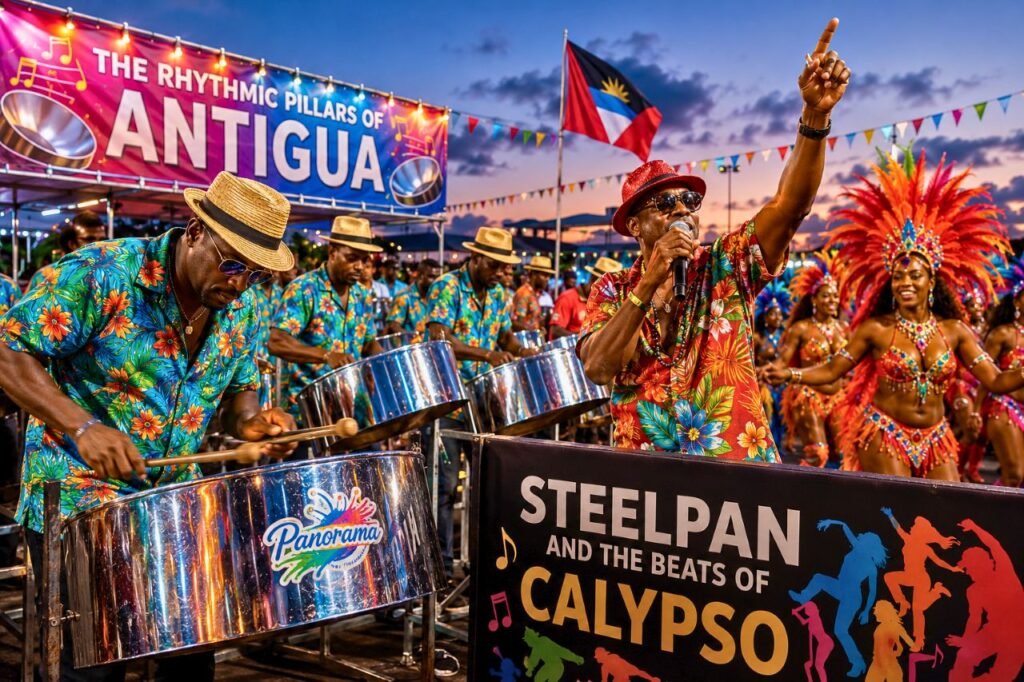
Steelpan and the Beats of Calypso
The musical landscape of the country is ruled by the thunderous, high-energy rhythms of Calypso and Soca. Calypso serves as a melodic newspaper, utilizing sharp satire, humor, and clever lyrics to comment on local politics, social events, and island life.
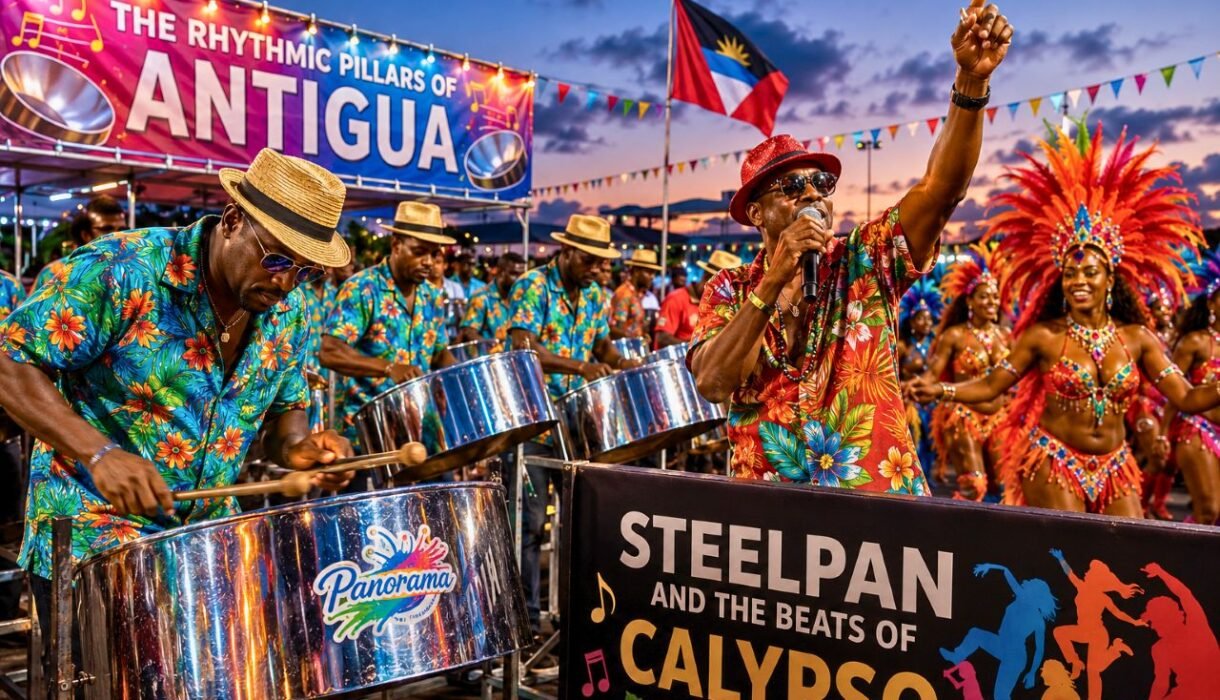
Simultaneously, the melodic heartbeat of the country rests in the Steelpan. Handcrafted from discarded oil drums, these meticulously tuned percussion instruments produce an ethereal, cascading sound. Steelpan orchestras, sometimes featuring over one hundred musicians, rehearse for months to compete in the thrilling annual Panorama competition during Carnival.
[ The Rhythmic Pillars of Antigua ]
┌─────────────────────────┬─────────────────────────┬─────────────────────────┐
│ Calypso │ Soca │ Steelpan │
│ Narrative folk music │ High-tempo dance music │ Ethereal orchestras │
│ heavy with political │ driven by synthetic │ performing complex chords│
│ satire and social news. │ basslines and brass. │ on tuned oil drums. │
└─────────────────────────┴─────────────────────────┘└─────────────────────────┘
Visual Arts and Pottery
In the visual arts, the twin islands are globally known for Seaforth Pottery, a traditional pottery style dating back to post-emancipation eras. Utilizing natural local clays, potters craft functional kitchen items, coal pots, and intricate ornaments that showcase local wildlife and tropical scenes, preserving functional ancestral art methods.
Summary
The culture of Antigua and Barbuda is a powerful celebration of community warmth, artistic innovation, and historic endurance. By successfully blending its West African roots with its colonial history, this twin-island nation has crafted a distinct, resilient identity that extends far beyond its beautiful shores. From the communal strategizing over a warri board to the rich flavor of a slow-cooked pepperpot stew, Antigua and Barbuda continues to stand tall—proudly preserving its cultural diversity and sharing its vibrant heritage with the world.
At Best Culture Insight, we see culture as the heartbeat of every society—the way people live, connect, and express their identity.