The Gaucho Spirit and Secular Grace: A Deep Exploration of Uruguay Culture
Posted in :

Often overlooked in favor of its larger neighbors, Uruguay—known officially as the Oriental Republic of Uruguay—is one of South America’s most progressive, egalitarian, and culturally distinct nations. Nestled between Brazil and Argentina along the Rio de la Plata, this relatively small country has earned the nickname “The Switzerland of South America” due to its high standard of living, robust democratic institutions, and forward-thinking social policies.
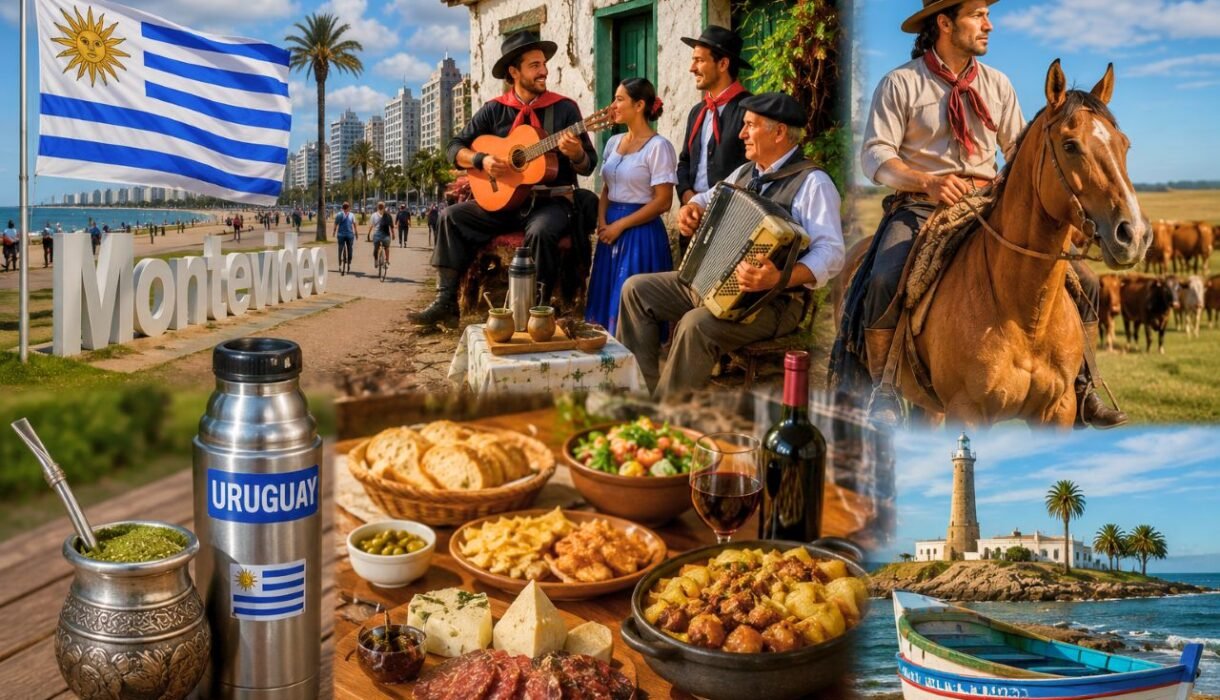
To understand Uruguay culture is to step into a society that balances a relaxed, unhurried pace of life with a deeply rooted intellectual and artistic heritage. From the historic, cobblestone streets of Colonia del Sacramento to the bustling beachfront rambla of Montevideo, Uruguayans, or Orientales, possess a quiet pride. Their culture is uniquely defined by a rural gaucho (cowboy) mythology, an unmatched passion for football, a deep-seated secular worldview, and a communal lifestyle centered around a shared thermos and mate cup.
History & Origins
Before European exploration, the rolling hills and fertile plains of modern-day Uruguay were inhabited by semi-nomadic indigenous groups, most notably the fierce and independent Charrúa people.
The arrival of Spanish navigator Juan Díaz de Solís in 1516 marked the beginning of European contact, though fierce indigenous resistance and a lack of visible gold or silver initially kept colonial powers at bay. Instead, the territory became a highly contested buffer zone:
- The Struggle for Control: Throughout the 17th and 18th centuries, Spain and Portugal fought bitterly over the region. The Portuguese founded Colonia del Sacramento in 1680 as a strategic smuggling port, prompting the Spanish to establish Montevideo in 1726 as a heavily fortified military stronghold.
- The Rise of the Gaucho: During this period of colonial friction, cattle introduced by the Spanish multiplied exponentially across the untamed plains (pampa). This gave rise to the gaucho—independent, highly skilled horsemen of mixed European and indigenous ancestry who came to symbolize raw freedom, bravery, and rugged individualism.
Led by national hero José Gervasio Artigas, Uruguay began its long fight for self-determination. Following intense conflicts involving Argentine provinces and the Empire of Brazil, Uruguay successfully secured its full independence in 1828 through the Treaty of Montevideo.
In the late 19th and early 20th centuries, President José Batlle y Ordóñez implemented sweeping political and social reforms, establishing a highly advanced welfare state, separating church from state, and transforming Uruguay into a model of social stability and secular democracy.
Culture, Traditions & Customs
The Ritual of Mate
If there is a single element that serves as the absolute backbone of Uruguayan daily life, it is Mate (pronounced mah-tay). This traditional, caffeine-rich herbal infusion is made from the dried leaves of yerba mate, packed into a hollowed-out gourd (mate), and sipped through a metal straw (bombilla).

While shared socially in circles across Argentina and Paraguay, Uruguayans have a uniquely personal bond with the drink. It is entirely common to see people walking down busy city avenues, riding bicycles, or sitting in corporate offices with a thermos tucked firmly under one arm and a mate cupped in their hand. It is an icebreaker, a comforting ritual, and a democratic social equalizer that cuts across all age groups and economic backgrounds.
Rites of Passage and the World’s Longest Carnival
- The Quinceañera: Marking a young girl’s fifteenth birthday, this traditional transition into adulthood remains a major family milestone, celebrated with grand formal balls, elegant dresses, and multi-generational family banquets.
- Uruguayan Carnival: Lasting for more than 40 days through January, February, and March, Uruguay boasts the longest Carnival celebration in the world. The streets of Montevideo transform into an expansive theatrical stage filled with two main cultural performances: Tablados (neighborhood stages featuring Murga musical satire groups) and the Desfile de Llamadas (The Call Desfile), a thunderous, rhythmic drum parade rooted in African tradition.
Languages & Communication
The official language of the country is Spanish, spoken with a highly distinct regional twist known as Rioplatense Spanish. Shared with the Buenos Aires region of Argentina, this dialect is instantly recognizable by its rhythmic, Italian-like intonation and specific phonetic traits.
- Yeísmo / Sheísmo: The double “ll” and “y” sounds are uniquely pronounced as a soft “sh” (e.g., playa becomes “plah-shah” and lluvia becomes “shoo-vee-ah”).
- Voseo: Instead of using the standard Spanish pronoun tú for “you,” Uruguayans exclusively use vos, which comes with its own unique verb conjugations (e.g., vos tenés instead of tú tienes).
Along the northern border with Brazil, a fascinating hybrid language known as Portuñol or Riverense has evolved, naturally blending Spanish grammar with Portuguese vocabulary.
Popular Uruguayan Expressions:
- “¡Bo!” – An omnipresent linguistic filler used to grab someone’s attention, similar to “Hey!” or “Dude!”
- “Ta” – A shortened form of está bien, used constantly to mean “okay,” “alright,” or “I understand.”
- “Championes” – The standard, national word for sneakers or athletic shoes.
Geography
Uruguay is characterized by a remarkably uniform, gently undulating landscape. The country is dominated by vast, fertile rolling plains, low-lying hills known as cuchillas, and an extensive network of waterways.
[ The Geographic Belts of Uruguay ]
┌─────────────────────────┬─────────────────────────┬─────────────────────────┐
│ The Interior Pampas │ The Coastal Riviera │ The Rioplatense Hub │
│ Vast, grass-covered │ Sun-drenched Atlantic │ Estuary zone featuring │
│ plains dedicated to │ beaches, sand dunes, and│ historic ports and the │
│ massive cattle ranching.│ towns like Punta del │ cosmopolitan capital │
│ │ Este. │ of Montevideo. │
└─────────────────────────┴─────────────────────────┴─────────────────────────┘
The country’s southern border is defined by the massive Río de la Plata, the widest river estuary in the world, while its eastern front meets the open Atlantic Ocean, creating miles of pristine white-sand beaches. The interior remains sparsely populated, dominated by natural grasslands perfectly suited for livestock grazing.
Economy
Uruguay boasts an advanced, export-oriented economy heavily grounded in commercial agriculture and livestock production. The country possesses a unique geographic advantage, with over 80% of its land base dedicated to grazing and cultivation.
Uruguay is a premier global exporter of top-grade beef, soybeans, cellulose pulp, and dairy products. Notably, the nation has successfully built an advanced global reputation for software development, technical services, and eco-tourism. Furthermore, Uruguay is a global leader in renewable energy, generating over 95% of its domestic electricity from clean wind, solar, and hydroelectric sources.
Politics
Uruguay is a unitary presidential constitutional republic recognized as one of the most stable and transparent democracies in the world. The President serves a five-year term as both head of state and head of government, exercising executive authority alongside a bicameral General Assembly.
Uruguay consistently ranks first in Latin America for democratic index ratings, low levels of public corruption, and press freedom. Voting is legally mandatory for all citizens, fueling high civic engagement and a political tradition characterized by civilized dialogue and institutional continuity across alternating party coalitions.
Ethnic Groups
Unlike many Andean or Mesoamerican nations, Uruguay’s demographic profile is heavily shaped by historic waves of transatlantic European immigration, resulting in a highly homogeneous population structure.
| Major Ethnic / Cultural Group | Population Share | Historical Footprint & Origins |
| European Ancestry | ~88% | Primarily driven by massive waves of Spanish and Italian immigrants arriving during the 19th and 20th centuries, alongside smaller French, German, and Armenian communities. |
| Mestizo | ~8% | Representing individuals of mixed European and indigenous heritage, largely concentrated in the rural interior provinces. |
| Afro-Uruguayan | ~4% | Descendants of enslaved peoples brought to colonial ports; heavily influenced national folklore, culinary arts, and created Candombe music. |
Beliefs & Values
Uruguay stands out as the most secular nation in Latin America. Thanks to the sweeping early 20th-century reforms of José Batlle y Ordóñez, secularism is deeply woven into the national identity. The state officially recognizes no national religion, and church and state are completely separated.
In a unique cultural move, traditional religious holidays have been completely renamed on the official state calendar:
- Holy Week is officially designated as Semana de Turismo (Tourism Week).
- Christmas is officially celebrated as Día de la Familia (Family Week).
- Epiphany is marked as Día de los Niños (Children’s Day).
While Roman Catholicism remains the largest historical denomination, a significant portion of the population identifies as agnostic, atheist, or non-religious. The fundamental values of Uruguayan society center on a deep respect for individual personal liberties, social equality, tolerance, and a commitment to civic duty.
Food & Cuisine
Uruguayan cuisine is a hearty, meat-centric tradition deeply shaped by Spanish and Italian cooking styles, centered around the abundance of high-quality, grass-fed beef.
The Sacred Asado
The cornerstone of Uruguayan culinary culture is the Asado—much more than a barbecue, it is a treasured weekend social ritual. Families and friends gather around a large, specialized brick grill called a parrilla.
Unlike barbecues that use charcoal or gas, an authentic Uruguayan asado is cooked exclusively over the glowing embers of slow-burning native wood (leña). The grill master (asador) coaxes deep flavors out of thick cuts of short ribs (tira de asado), flank steak, sausages (chorizo), and sweetbreads, serving them with simple salads and crusty bread.
Other Iconic Culinary Staples
- Chivito: The ultimate national sandwich. It features a thin, tender slice of filet mignon steak inside a soft bun, piled high with mozzarella cheese, ham, bacon, lettuce, tomatoes, green olives, fried eggs, and mayonnaise, typically served with a mountain of french fries.
- Dulce de Leche: A rich, thick, caramel-like sauce made from slow-cooked sweetened milk. It is found in nearly every Uruguayan dessert, used to fill pastries, spread on morning toast, or enjoyed straight from the jar.
- Ñoquis del 29 (Gnocchi of the 29th): A beloved Italian-inherited custom where families eat potato gnocchi on the 29th day of every month. A coin or bank bill is placed under the dinner plate to attract financial luck, prosperity, and abundance for the coming month.
Clothing & Symbols
The Gaucho Garb and National Emblems
While urban Uruguayans wear contemporary Western clothing, the traditional, historic attire of the countryside remains an endangered icon of pride. The classic Gaucho outfit is built for utility on horseback:
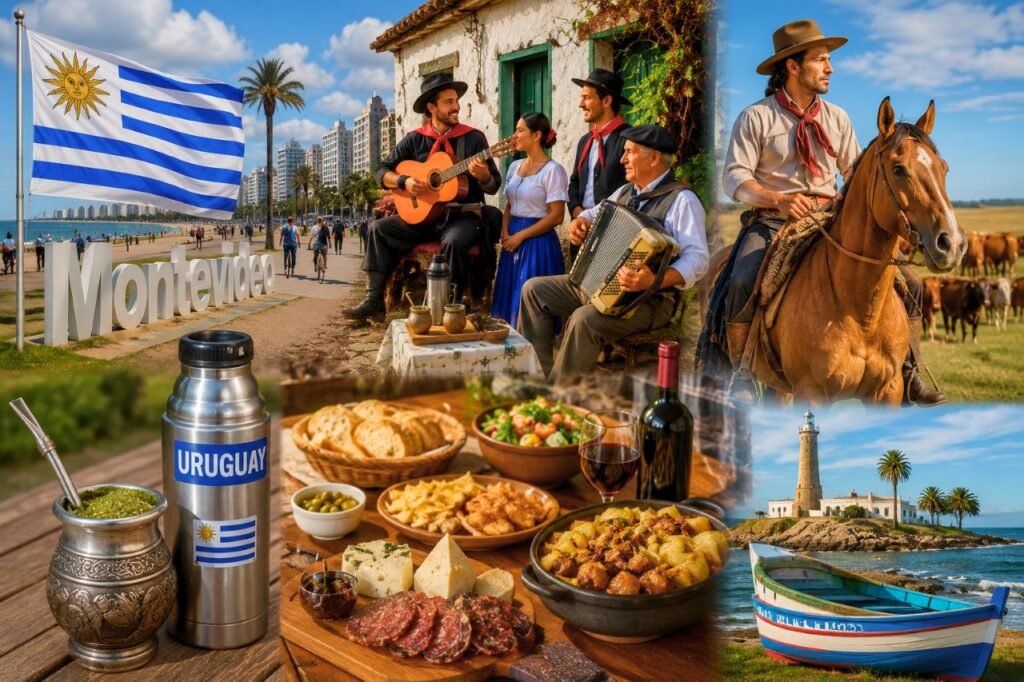
- Bombachas de Campo: Durable, loose-fitting, pleated cotton trousers designed for comfort in the saddle.
- Rastra: A wide leather belt adorned with historic silver coins, used to secure a large knife (facón) at the lower back.
- Poncho and Beret: A lightweight wool poncho to protect against cold southern winds, paired with a traditional felt beret (boina) or a wide-brimmed straw hat.
[ Components of Traditional Gaucho Attire ]
┌─────────────────────────┬─────────────────────────┬─────────────────────────┐
│ Bombachas de Campo │ Rastra │ Facón │
│ Wide, durable pleated │ A decorative leather │ A versatile, long steel │
│ trousers cinched tight │ coin belt worn as a │ knife worn tucked into │
│ at the ankle boots. │ structural centerpiece. │ the lower back belt. │
└─────────────────────────┴─────────────────────────┴─────────────────────────┘
The primary national symbol is The Sun of May (Sol de Mayo), a prominent golden sun featuring sixteen alternating straight and wavy rays, representing the Inca sun god Inti and the dawning of independence. It sits proudly in the upper corner of the national flag alongside nine horizontal stripes of white and blue, which represent the original administrative departments of the young republic.
Music, Dance & Art
The Thunderous Rhythm of Candombe
Recognized by UNESCO as an Intangible Cultural Heritage of Humanity, Candombe is the foundational musical rhythm of Afro-Uruguayan culture. It is driven by three distinct barrel-shaped drums carved from native wood: the chico (highest pitch), the repique (syncopated improvisational drum), and the piano (deep bass drum).
Every weekend, neighborhood drum corps known as comparsas gather to march through historic Afro-descendant quarters like Barrio Sur and Palermo. The drummers strike the skin with one hand and a wooden stick in the other, creating a complex, polyrhythmic soundscape that drives the entire community forward.
Tango and Fine Art
Uruguay shares a deep, historic claim to the creation of Tango alongside Argentina. In fact, the most famous tango song in world history, “La Cumparsita,” was composed by Uruguayan musician Gerardo Matos Rodríguez in Montevideo in 1917.
In the visual arts, the country has produced major world-class masters. Joaquín Torres-García founded Constructive Universalism, a celebrated modern art movement that blended geometric grids with pre-Columbian symbols, turning Uruguay into a major center for Latin American modern art.
Summary
Uruguay culture is a powerful demonstration of how a nation can celebrate its history while confidently looking toward the future. By maintaining a living connection to the gaucho heritage of the interior and the rhythmic heartbeat of candombe, while pioneering secularism, social tolerance, and environmental stewardship, this progressive nation has forged a completely unique path. From the quiet camaraderie of a shared mate to the wood-fired smoke of a neighborhood asado, Uruguay welcomes the world to experience a society defined by peace, stability, and enduring grace.
At Best Culture Insight, we see culture as the heartbeat of every society—the way people live, connect, and express their identity.