The Soul of the Outback: A Deep Dive into the Culture of Australia’s Northern Territory
Posted in :

Australia’s Northern Territory (NT) is a place of profound scale, ancient mystique, and captivating cultural convergence. Often referred to as the “Real Outback” or simply “The Territory,” this vast region boasts a cultural identity heavily distinct from the urbanized coastal hubs of southeastern Australia. Here, life slows down to match the rhythms of a timeless landscape.
The people of the Territory—affectionately called “Territorians”—are defined by their rugged self-reliance, laid-back hospitality, and an unpretentious approach to life. It is a society where the world’s oldest continuous living culture directly intertwines with a thriving, modern, and highly diverse multicultural population, creating an ecosystem found nowhere else on the globe.
History & Origins
The historical foundations of the Northern Territory are anchored in an epic tale of indigenous custodianship and subsequent frontier transformation.
For more than 60,000 years, hundreds of distinct Aboriginal nations have inhabited the NT. Groups such as the Larrakia (the traditional owners of the Darwin region), the Arrernte (of the Central Desert around Alice Springs), and the Yolngu (of Arnhem Land) developed complex social networks, agricultural practices, and resource management systems perfectly attuned to the local climate.
European contact began intermittently with Dutch navigators in the 1600s, but the most enduring early international relationships were forged by Macassan traders from modern-day Indonesia. For centuries before British settlement, the Macassans sailed to the northern coast of the NT every year to harvest sea cucumbers (trepang), trading peacefully with the Yolngu people—a relationship that deeply influenced local language, art, and genetics.
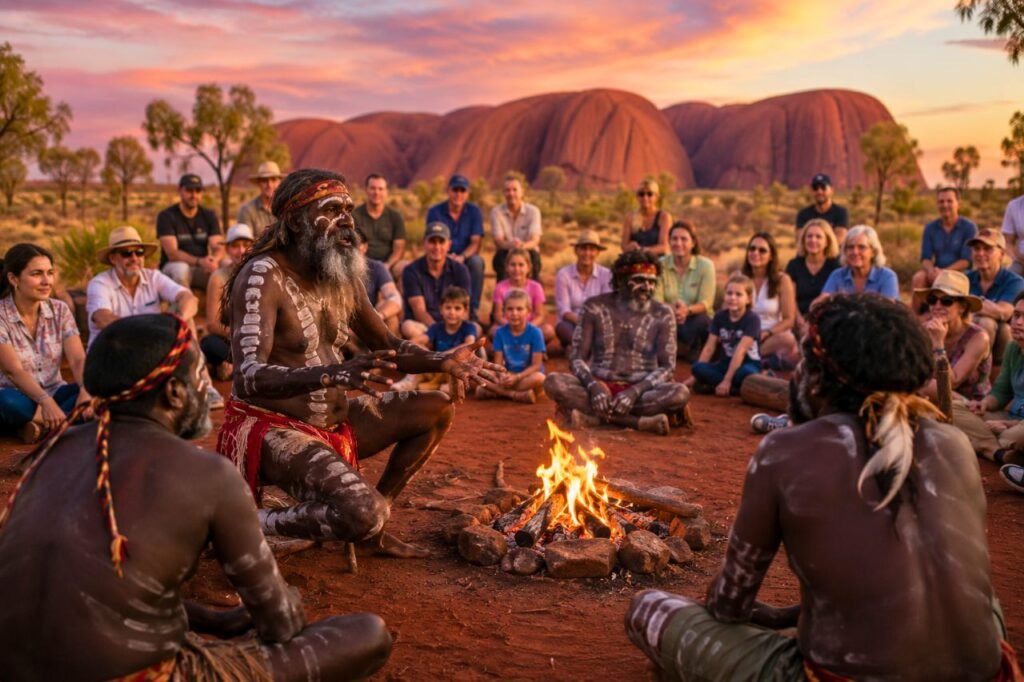
Gathering around the campfire at sunset – Northern Territory
Formal British colonization took root much later, culminating in the establishment of Palmerston (later renamed Darwin) in 1869. The construction of the Overland Telegraph Line in the 1870s and subsequent gold rushes brought a wave of European, Chinese, and Malayan pioneers, permanently shifting the demographic and cultural trajectory of the region.
Culture, Traditions & Customs
Territory customs are a vibrant mixture of deep ancient spirituality and relaxed, community-driven modern traditions.
- Rites of Passage: For Indigenous Territorians, the transition from childhood to adulthood involves sacred, deeply private initiation ceremonies and “Walkabout”—a period of spiritual reflection spent traveling ancestral pathways. For non-Indigenous locals, rites of passage center around outdoor mastery, such as catching one’s first major Barramundi or mastering backcountry driving.
- Welcoming Customs: The Welcome to Country ceremony, delivered by an Elder of the local traditional land, is a vital cultural protocol observed at almost every public gathering, corporate meeting, and festival, ensuring respect is paid to the ancestral spirits.
- Festivals: The local calendar is designed to celebrate the outdoor lifestyle. Every August, the Darwin Festival showcases world-class music, theater, and visual arts under the tropical stars. More eccentric local customs include the Henley-on-Todd Regatta in Alice Springs—a hilarious, chaotic “boat” race held in a completely dry, sandy riverbed where participants carry bottomless boats while running.
Languages & Communication
While English is the official language of government and commerce, communication in the NT is remarkably multilingual. Over 100 Aboriginal languages and dialects are spoken across the territory.
- Indigenous Languages & Kriol: Languages like Pitjantjatjara and Warlpiri remain vibrant first languages in central Australia. Additionally, Aboriginal Kriol (an English-based creole language) has developed into a major language spoken across the northern regions, uniting different language groups.
- Territory Vernacular: The local English dialect relies heavily on informal, colorful colloquialisms:
- “The Wet” and “The Dry”: Refers to the two distinct tropical seasons, replacing the traditional four-season calendar.
- “Never Never”: A term celebrating the vast, isolated, and untamed desert outback.
- “Righto”: A ubiquitous term indicating agreement or acknowledgment.
Geography
The geography of the Northern Territory is immense, covering over 520,000 square miles of pristine wilderness. The territory is culturally and geographically split into two main zones:
- The Top End: The northern tropical zone characterized by monsoonal downpours, massive river systems, mangrove swamps, and lush national parks like Kakadu and Litchfield.
- The Red Centre: The vast southern arid desert interior characterized by striking rust-red sands, spinifex grasses, and sacred geological formations like Uluru and Kata Tjuta.
Economy
The NT economy is built largely around its natural resources and its global cultural appeal.
- Mining & Energy: The Territory holds immense deposits of manganese, bauxite, and gold, alongside a massive liquified natural gas (LNG) export sector based out of Darwin harbor.
- Pastoralism: Massive cattle stations, some larger than small European countries, dominate the interior landscape, exporting premium beef primarily to Southeast Asian markets.
- Tourism: Culturally focused ecotourism is a massive economic pillar, drawing global travelers eager to experience ancient rock art sites, desert landscapes, and tropical wilderness.
Politics
The Northern Territory holds a unique political status as a “territory” rather than a fully fledged Australian state, meaning the federal government retains a higher degree of legislative oversight.
Its political culture is famously fiercely independent and heavily influenced by demographic realities. Given that Aboriginal people make up roughly 30% of the NT population, Indigenous land rights, community housing, and constitutional recognition are central, deeply debated features of local political discourse. Darwin also serves as a vital strategic military hub, hosting rotating international defense forces, which shapes local defense politics.
Ethnic Groups
The Northern Territory is a spectacular multicultural melting pot. Over 30% of the population identifies as Aboriginal or Torres Strait Islander, giving the NT the highest proportion of Indigenous residents of any Australian state or territory.
Darwin’s close geographic proximity to Asia has also fostered a deeply rooted multicultural community. Waves of Greek, Chinese, Filipino, Timorese, and Vietnamese immigrants have shaped the city over the past century. Walking through a local market, you are just as likely to hear Indonesian or Greek as you are to hear English.
Beliefs & Values
The spiritual framework of the Northern Territory is anchored heavily by the ancient concept of The Dreaming (or Altyerrenge in central Australia).
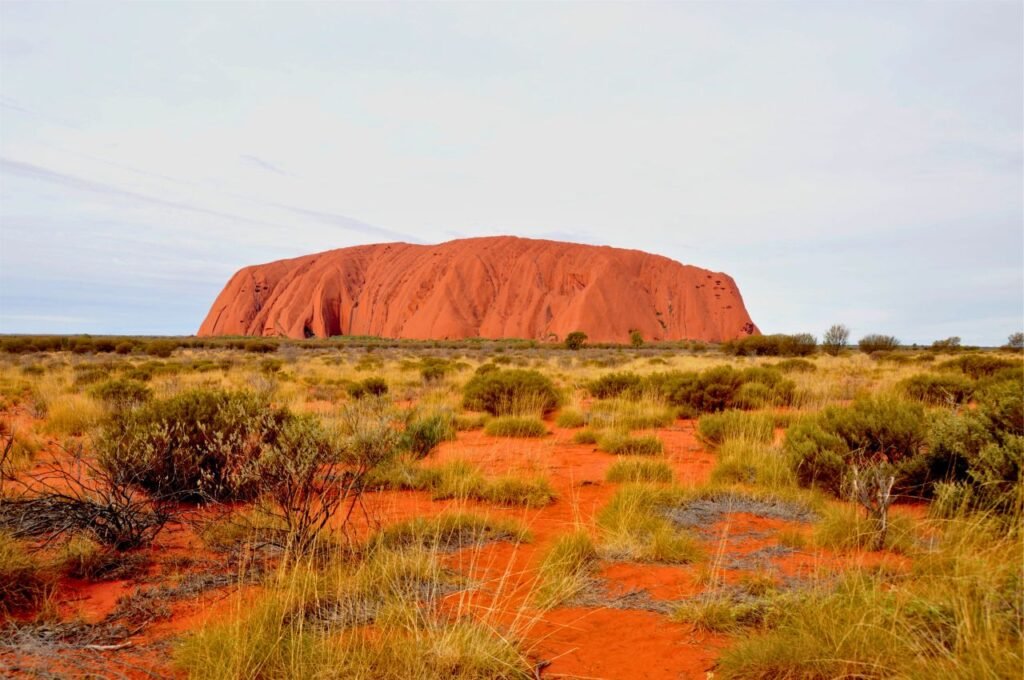
Understanding The Dreaming: Far from being a collection of myths, The Dreaming is an all-encompassing, living worldview. It explains how ancestral beings traveled across the land, creating the rocks, rivers, plants, and animals. These ancestral paths, known as “Songlines,” function as spiritual maps, moral codes, and historical archives that dictate how people must care for the earth and each other.
Among the non-Indigenous population, secularism is highly prevalent. The core moral values revolve around egalitarianism (“a fair go”), profound resilience in the face of extreme weather, and a distinct lack of pretension.
Food & Cuisine
Food culture in the Northern Territory is a direct reflection of its tropical climate, Asian neighbors, and rich abundance of native ingredients.
- Bush Tucker: Traditional Indigenous cooking techniques rely on earth ovens (cooking meat wrapped in paperbark leaves under hot coals). Ingredients like Kakadu plum (the world’s richest natural source of Vitamin C), green ants (which taste like citrus), and kangaroo tail are central to traditional diets and are increasingly embraced by high-end local restaurants.
- Territory Staples: Barramundi (a delicious, prized native silver gamefish) is the absolute king of local menus, usually grilled or fried. Due to the abundant wildlife, camel burgers and buffalo steaks are also common culinary novelties.
- Asian Influence: The iconic Laksa—a spicy, creamy Malaysian noodle soup—is considered the unofficial official dish of Darwin. The city’s multi-ethnic markets serve thousands of bowls of hot Laksa even in the middle of intense tropical heatwaves.
Clothing & Symbols
Given the oppressive heat of the Red Centre and the intense humidity of the Top End, clothing in the NT is driven purely by utility and comfort.
- Attire: Formal corporate attire is virtually nonexistent. “Territory Rig”—consisting of a short-sleeved button-down shirt, neat shorts, and RM Williams leather boots—is fully accepted in corporate boardrooms and parliament. Out in the field, broad-brimmed Akubra hats and durable canvas clothing are essential for sun protection.
- Symbols: The official floral emblem is the Sturt’s Desert Rose, a resilient purple desert wildflower. The animal emblem is the Red Kangaroo, and the state colors are Ochre (representing the earth), Black (representing the people), and White.
Music, Dance & Art
The Northern Territory is a world-renowned powerhouse for visual arts and musical performance.
- Aboriginal Art: The NT is the cradle of the global Indigenous art movement. From the detailed x-ray style rock art paintings of western Arnhem Land to the vibrant, hypnotic dot paintings of the Central Desert, art functions as a vital method for storing and passing down sacred Dreaming stories.
- Instruments & Performance: The Didgeridoo (traditionally known as the yidaki or mago) originated in northern Australia. Its deep, resonant drone provides the rhythmic foundation for traditional dance ceremonies (Corroborees).
- Modern Music: The Territory has produced legendary musical acts, such as the late Dr. G. Yunupingu, a blind Yolngu man whose hauntingly beautiful acoustic songs in his native language achieved global chart success, bridging the gap between ancient culture and modern music.
Summary
The culture of the Northern Territory is a magnificent testament to human adaptability, spiritual endurance, and successful multicultural integration. It is a place that refuses to be tamed or hurried. By beautifully preserving and celebrating the multi-millennial heritage of its First Nations people, while seamlessly welcoming waves of global migration, the Territory offers a deeply authentic cultural landscape that stands as the raw, beating heart of the Australian identity.
At Best Culture Insight, we see culture as the heartbeat of every society—the way people live, connect, and express their identity.