The Rhythm of the Spice Isle: An Elaborate Journey Into Grenada Culture
Posted in :

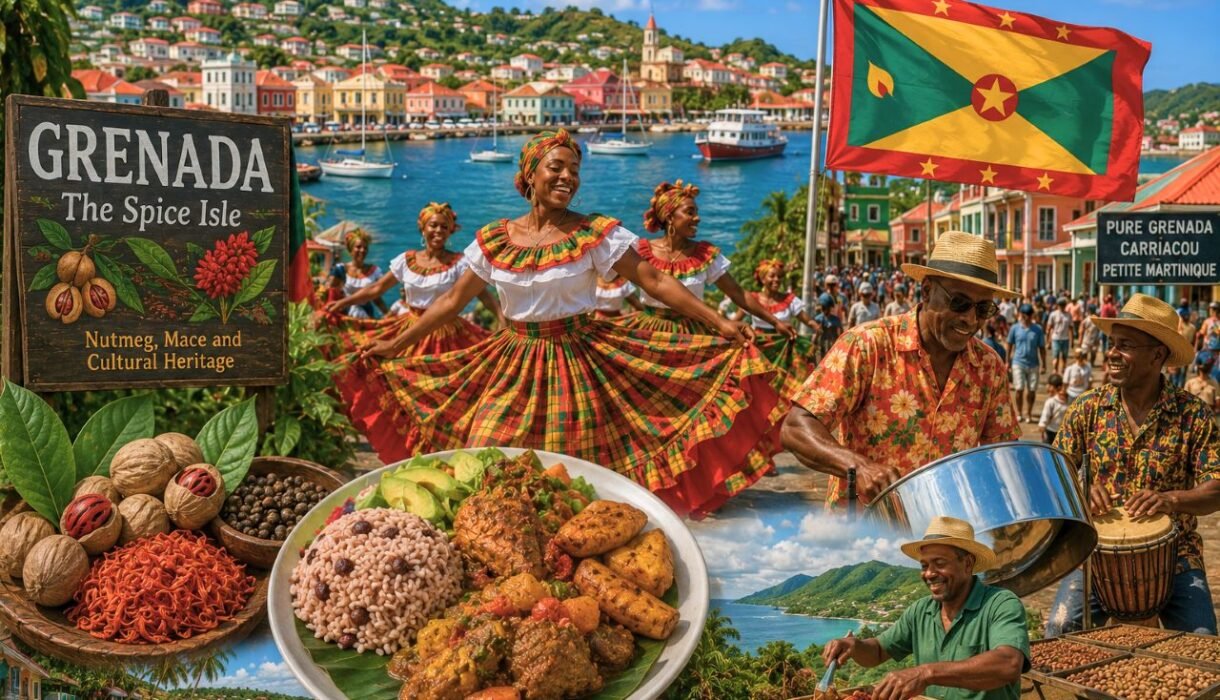
Rising gracefully from the azure depths of the southeastern Caribbean Sea, the tri-island state of Grenada (comprising Grenada, Carriacou, and Petite Martinique) represents one of the most culturally distinctive independent nations in North America’s Caribbean zone. Nationally known as the “Spice Island,” Grenada produces a massive share of the world’s global nutmeg supply, an aromatic heritage that perfumes the very air of the island. – Grenada Culture
To meet the people of Grenada—known proudly as Grenadians—is to experience a community defined by deep warmth, a relaxed maritime lifestyle, and an unyielding spirit of resilience. Grenadian culture is a vibrant, syncretic masterpiece. Over centuries of struggle, migration, and colonial encounter, the islanders have masterfully fused their West African ancestral foundations with French and British colonial lineages, creating a society that expresses itself through explosive musical rhythms, aromatic slow-cooked cuisine, and close-knit village solidarity.
History & Origins
The historical tapestry of Grenada is a narrative of intense resistance, colonial flip-flopping, and cultural survival. The island’s earliest known inhabitants were the indigenous Arawaks, who were later displaced by the highly skilled, seafaring Island Caribs (Kalinago). The Caribs fiercely defended the island—which they named Camahogne—for over a century after Christopher Columbus sighted it in 1498 and named it Concepción.

The Colonial Tug-of-War
French settlers successfully established a permanent colony in 1650, which led to the tragic displacement of the remaining Carib population.
- The Sugar Shift: Under French rule, and later British rule following the Treaty of Paris in 1763, Grenada was transformed into a highly lucrative plantation economy.
- The African Bedrock: To cultivate sugar, cocoa, and spices, European planters forcibly imported thousands of enslaved people from West Africa, primarily from the Yoruba, Ewe, Fon, and Akan cultural groups. These populations brought deeply rooted spiritual frameworks, linguistic structures, and complex percussive traditions that became the definitive blueprint of Grenadian society.
Freedom and Modern Evolution
Grenada experienced a major historic event in 1795: Fédon’s Rebellion. Led by Julien Fédon, a free mixed-race planter inspired by the French and Haitian Revolutions, a massive army of enslaved and free individuals seized control of most of the island, holding off the British military for over a year. Though eventually suppressed, Fédon’s rebellion cemented a national legacy of defiance and thirst for liberty.
Following the full abolition of slavery in 1834, East Indian indentured laborers arrived to work the estates, adding subtle new dimensions to the local demographic and culinary mix. Grenada achieved full independence from Great Britain on February 7, 1974, weathering a complex political revolution and subsequent US military intervention in 1983 to emerge as a stable, proud, and unified democratic island nation.
Culture, Traditions & Customs
Village Solidarity and Family Networks
The foundational cell of Grenadian life is the extended family and the tight-knit rural village network. Multi-generational households are common, with grandmothers (moms) playing a revered, central role in raising children and preserving oral histories. Grenadians practice an informal, beautiful community safety net; it is customary for neighbors to function as surrogate aunts and uncles, looking out for the village youth and sharing excess agricultural harvests freely.
Major Life Milestones
- Birth Customs: Influenced by Christian and West African traditions, newborns are celebrated through christenings. A popular historical folk custom involves burying an infant’s umbilical cord under a newly planted fruit tree (often a nutmeg or cocoa tree) to symbolize the child’s lifelong structural connection to the soil of their homeland.
- Weddings: Traditional Grenadian weddings are massive, multi-day community celebrations. Following a formal church service, the entire village is effectively invited to a grand reception filled with steelpan music, roasted meats, and a highly prized spiced fruit cake soaked in local overproof rum for months beforehand.
Spicemas: The Ultimate National Festival
Held annually in August, Spicemas is the premier cultural expression of Grenada. It is an explosive celebration of freedom and heritage.
[ The Pillars of Spicemas ]
┌─────────────────────────┬─────────────────────────┬─────────────────────────┐
│ The J’ouvert │ The Fancy Mas │ The Monday Night Mas │
│ A dawn liberation ritual│ Splendid, bright carnival│ A modern street party │
│ dominated by Jab Jab │ bands showcasing intense│ where thousands wave │
│ oil-soaked revelers. │ beaded costumes. │ neon light sticks. │
└─────────────────────────┴─────────────────────────┴─────────────────────────┘
The absolute soul of Spicemas is J’ouvert, which begins in the pitch black hours of Monday morning. Here, thousands of revelers transform into Jab Jabs (derived from the French Diable). They cover their bodies in glistening black molasses, engine oil, or charcoal, wear horned helmets, and carry heavy chains, dancing to primal rhythms. This performance is a powerful, radical re-enactment of emancipation—a celebration of breaking colonial chains, mocking past oppressors, and claiming absolute bodily freedom.
Languages & Communication
While English is the official language used in schools, government offices, and national media, daily communication occurs in Grenadian English Creole. This expressive, rapid-fire dialect features an English vocabulary structured over a West African syntactic framework, heavily seasoned with French patois phrases.
On the sister island of Carriacou, a smaller population preserves elements of an authentic French-African Creole, reflecting the island’s unique geographical isolation.
Popular Grenadian Expressions and Proverbs:
- “Wha gwan?” or “How ya stop?” – Standard, warm colloquial greetings meaning “What’s happening?” or “How are you doing?”
- “Ah coming now” – A famous, paradoxical phrase meaning the speaker will return shortly, though it rarely implies immediate urgency.
- “Every dog has his day, and every cat has his Sunday” – A comfort-driven proverb meaning everyone will eventually receive their moment of justice, success, or retribution.
- “One-one cocoa does fill basket” – Little by little, through steady, patient effort, great things can be accomplished (The Grenadian equivalent of “patience achieves success”).
Geography
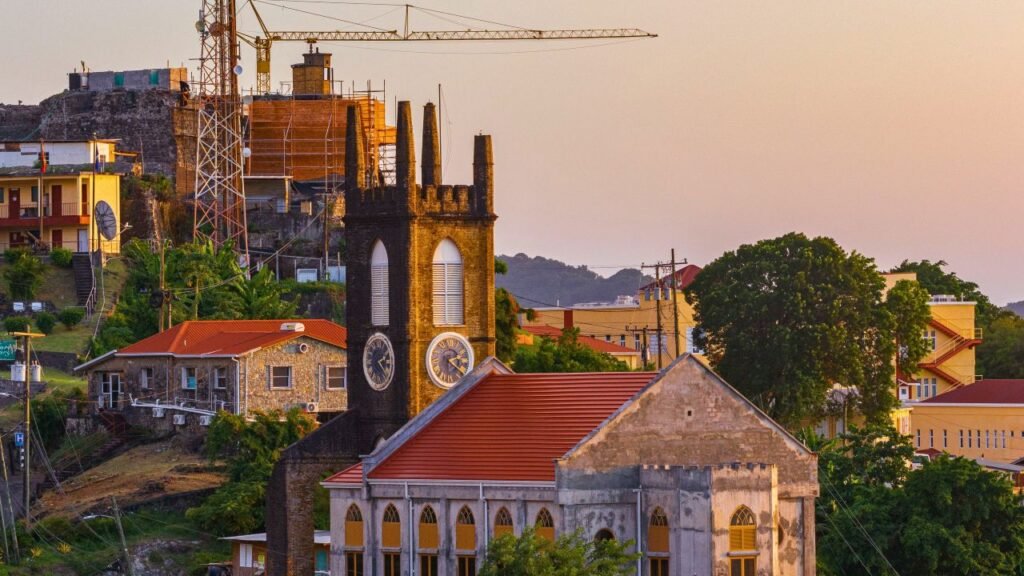
The geography of Grenada is a stunning display of dramatic volcanic terrain. The main island is highly mountainous, dominated by a rugged interior ridge of ancient volcanic craters, including Mount St. Catherine, which rises over $840\text{ meters}$ ($2,750\text{ feet}$) above sea level.
[ The Physical Layout of the Tri-Island State ]
┌─────────────────────────┬─────────────────────────┬─────────────────────────┐
│ Grenada │ Carriacou │ Petite Martinique │
│ The volcanic mainland │ The largest sister isle,│ A steep, circular volcanic│
│ featuring rainforests, │ famous for boatbuilding │ peak dominated by a │
│ waterfalls & crater lakes.│ and ancestral rituals. │ traditional fishing community.│
└─────────────────────────┴─────────────────────────┴─────────────────────────┘
The interior is blanketed in dense, pristine tropical rainforests fed by crashing waterfalls (like Annandale and Concord Falls) and features Grand Etang Lake, a natural lake filling an extinct volcanic crater. The coastline is an intricate mix of white-sand beaches, notably Grand Anse Beach, and deep, sheltered natural harbors like the Carenage in the capital city of St. George’s.
Economy
Grenada’s economy has evolved from a historic plantation model into a modern, service-oriented framework.
- The Agriculture of Spice: The nation remains an agrarian powerhouse for boutique luxury crops. It is one of the world’s primary exporters of nutmeg and mace (the lacy red outer membrane of the nutmeg seed), alongside premium organic cocoa, cinnamon, cloves, and wild ginger.
- Tourism and Education: Today, the largest driver of national GDP is upscale eco-tourism, centered around marine diving, yachting, and cruise arrivals. Furthermore, the island hosts St. George’s University, a world-class international medical school that injects significant global diversity and revenue into the domestic services economy.
Politics
Grenada is a sovereign, independent state operating as a parliamentary constitutional monarchy. King Charles III remains the nominal head of state, represented locally by a Governor-General. Executive power is held fully by the Prime Minister, who leads the cabinet and belongs to the majority party in the elected House of Representatives.
The nation maintains a robust, highly active two-party democratic system with an unbroken record of peaceful, transparent transitions of power. Grenada is an active member of the Caribbean Community (CARICOM) and the Organization of Eastern Caribbean States (OECS), advocating strongly on the global stage for climate resilience and renewable energy development for small island developing states.
Ethnic Groups
Centuries of transatlantic shipping and estate agriculture have shaped a harmonious, multi-ethnic population across the tri-island state:
| Ethnic Group | Estimated Share | Historical Foundations & Cultural Legacy |
| African Descent | ~82.4% | The demographic core, maintaining the foundational drum lines, spiritual systems, and festival structures. |
| Mixed Heritage | ~13.3% | Reflecting generations of rich cross-cultural marriages across the island’s commercial hubs. |
| East Indian | ~2.2% | Descended from 19th-century indentured laborers, heavily influencing local agricultural methods and spices. |
| European / Other | ~2.1% | Comprising expatriate academic communities, historical European lineages, and indigenous remnants. |
Beliefs & Values
Grenada is a deeply spiritual, faith-driven society. The vast majority of the population identifies as Christian, with Roman Catholicism (approx. 45%) and Anglicanism/Protestantism (approx. 40%) forming the main institutional pillars. Christian ethics deeply guide the civic laws, educational systems, and public holiday structures of the country.
Ancestral Reverence: The Big Drum Dance of Carriacou
On the sister island of Carriacou, a unique spiritual and cultural practice known as the Big Drum Dance remains beautifully intact. Unlike the mainland, where colonial authorities successfully suppressed many direct African rituals, Carriacou preserved specific tribal melodies.
During major community events (such as boat launches, marriages, or house-raisings), elder drummers strike three open wooden drums to call upon the ancestors. The singers perform traditional chants categorizing their lineages straight back to specific West African nations, such as the Cromanti, Temne, Chamba, Mandinka, and Moko. It is a stunning display of living, unbroken historical genealogy.
Food & Cuisine
Grenadian cuisine is a direct reflection of its agricultural bounty, characterized by the heavy, creative use of fresh coconut milk, local root crops, and an abundance of fresh spices.
The National Culinary Masterpiece: Oil Down
The absolute centerpiece of Grenadian identity is Oil Down. This comforting, one-pot dish is packed with history and cultural meaning, cooked traditionally over an open wood fire in a massive iron pot (kauldron):
- The Layers: The bottom of the pot is packed with salted meats (pork tail, pig ears, or salted fish), followed by thick chunks of fresh breadfruit, yams, and sweet potatoes. Next come dumplings (boys) and fresh vegetables, all topped with a thick blanket of callaloo (young taro leaves) to trap the steam.
- The Extraction: The entire pot is drenched in fresh, hand-squeezed coconut milk heavily infused with crushed garlic, hot peppers, and saffron (local turmeric), which gives the dish its iconic golden hue.
- The Meaning: It is called “Oil Down” because as it simmers over the open flame, the coconut milk completely evaporates, leaving a rich, savory layer of coconut oil at the absolute bottom of the pot. Preparing an Oil Down is an inherently communal social ritual; friends gather for a “cook-up,” singing, liming, and telling stories around the fire while the pot simmers.
Clothing & Symbols
Traditional Vestments
For daily attire, Grenadians wear modern, lightweight clothing suited for the tropical heat. However, during national heritage celebrations, traditional folk dress steps into the spotlight.
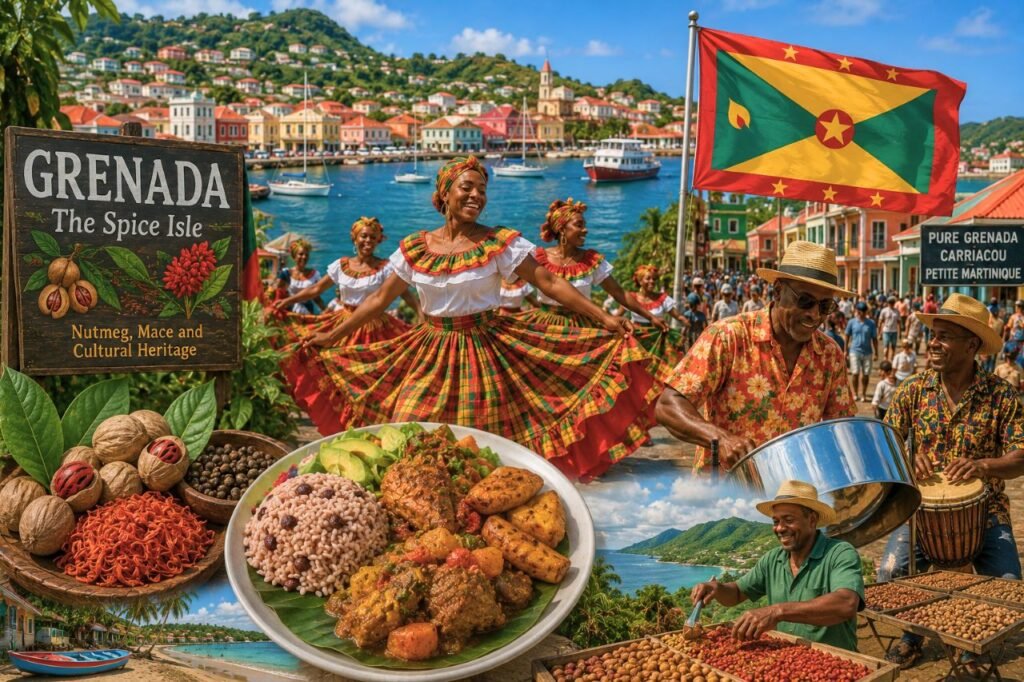
Women wear a bright white cotton peasant blouse paired with a vibrant, layered gingham or madras pattern skirt featuring red, gold, and green accents. Men wear matching lightweight white cotton shirts and trousers, accessorized with a madras sash wrapped cleanly around the waist and a straw hat.
[ The Iconography of the Grenadian Flag ]
┌───────────────────────────────────────────────────────────────────────────┐
│ RED BORDER (Containing 6 Gold Stars representing the parishes) │
├────────────────────────────────────┬──────────────────────────────────────┤
│ GOLD TRIANGLE │ GREEN TRIANGLE │
├────────────────────────────────────┼──────────────────────────────────────┤
│ NUTMEG SYMBOL (On the hoist) │ RED CENTRIC CIRCLE (With 1 Star) │
├────────────────────────────────────┼──────────────────────────────────────┤
│ GREEN TRIANGLE │ GOLD TRIANGLE │
├────────────────────────────────────┴──────────────────────────────────────┤
│ RED BORDER (Containing 6 Gold Stars representing the parishes) │
└───────────────────────────────────────────────────────────────────────────┘
Powerful National Icons
The Grenada national flag is widely considered one of the most visually striking and structurally symbolic flags in the world:
- The Colors: The vibrant green triangles represent the lush, fertile agricultural fields; the gold triangles symbolize the sun-drenched coastal beaches and the warmth of the citizens; the surrounding red border stands for the burning courage and vitality of the people.
- The Stars: The six gold stars resting on the border represent the six administrative parishes, while the larger central star inside a red circle symbolizes the sister islands of Carriacou and Petite Martinique.
- The Nutmeg: Displayed prominently on the green hoist triangle is a beautifully stylized clove of nutmeg, representing the country’s historic economic foundation and agricultural identity.
Music, Dance & Art
The Pulsing Sounds of Jab Soka and Calypso
Music is the absolute heartbeat of the island, driving daily life across all generations. Grenada is the proud pioneer of a distinct sub-genre of Caribbean soca known as Jab Soca. Characterized by its intense, fast-paced rhythms, minimal electronic melodies, and heavy, hypnotic bass lines driven by conga drums and metallic cowbells, Jab Soca mimics the primal energy of the J’ouvert morning trail.
Traditional Calypso also holds an esteemed place, acting as an auditory newspaper where local lyricists utilize sharp wit, political satire, and double entendres to comment on contemporary governance and social issues.
Visual Art and the Undersea World
In the visual arts, Grenada achieved historic global acclaim as the site of the world’s first Underwater Sculpture Park, designed by eco-artist Jason deCaires Taylor in Molinere Bay.
Submerged in the marine conservation zone, these life-sized concrete sculptures—including The Vicissitudes, a ring of children holding hands—act as artificial coral reefs. They represent the profound intersection of human culture and environmental preservation, mirroring the Grenadian worldview that humanity must actively support and protect the natural world.
Summary
The culture of Grenada stands as a magnificent testament to the beauty that emerges when a society honors its historical roots while actively nurturing its natural gifts. By preserving the ancestral rhythms of the Carriacou Big Drum, protecting the liberating spirit of the J’ouvert Jab Jab, and gathered around the shared community comfort of a steaming pot of Oil Down, this tri-island state has carved out an unforgettable, independent identity in North America. Grenada continues to move forward with pride—celebrating its cultural diversity and sharing its fragrant, musical soul with the global community.
At Best Culture Insight, we see culture as the heartbeat of every society – the way people live, connect, and express their identity.