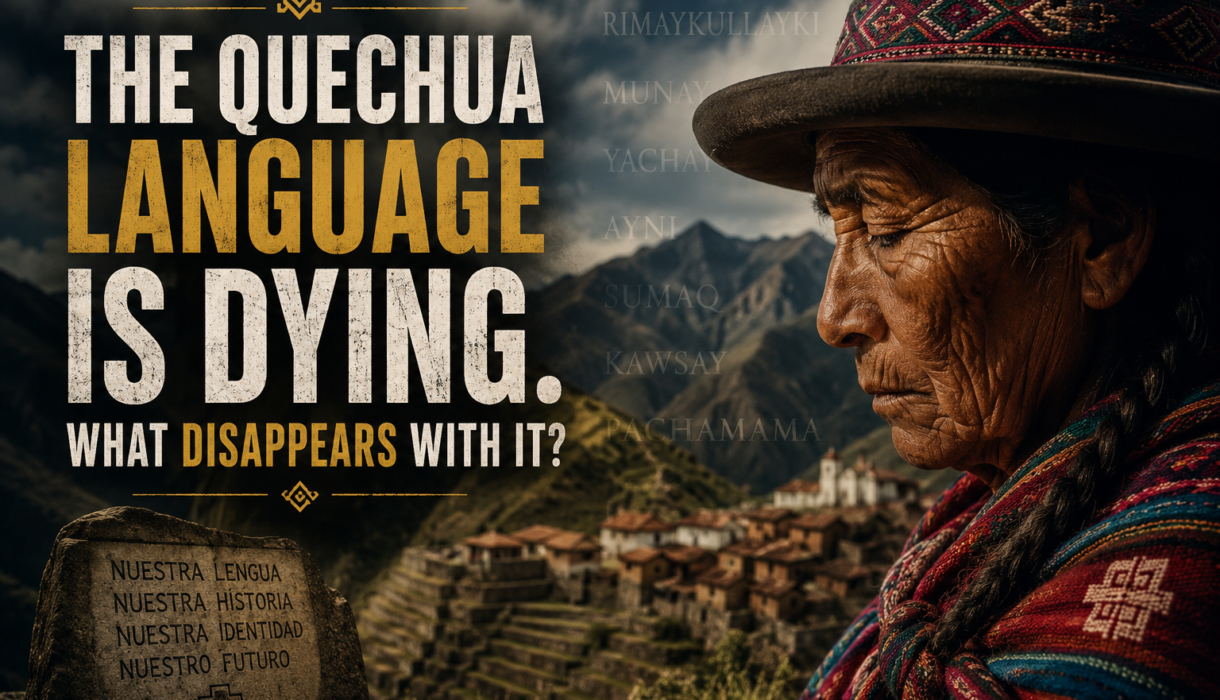

Language is far more than a mechanism for communication; it is a living archive of human thought, philosophy, and environmental adaptation. Quechua, the ancient tongue spoken by the Inca Empire and millions of Indigenous people across the South American Andes today, is facing a quiet crisis. As social pressure, rapid urbanization, and educational systems favor Spanish, youth in mountain communities are increasingly adopting dominant national tongues. When a language like Quechua fades, it does not die in isolation. Its decline threatens to erase thousands of years of specialized ecological wisdom, unique philosophical frameworks, and irreplaceable cultural identity.
Centuries of Ecological and Agricultural Knowledge
Over millennia, Quechua speakers mastered one of the most rugged and complex topographies on Earth: the high-altitude Andean mountains. Encoded directly into the Quechua vocabulary is a precise scientific catalog of agricultural techniques, microclimate management, and native botany. Words exist to describe micro-varieties of potatoes, soil textures, and atmospheric changes that have no direct equivalents in European languages. As younger generations lose fluency, modern science loses access to centuries of sustainable farming practices and climate resilience strategies that could prove vital for global food security.
A Worldview Built on Reciprocity and Connection
The Quechua language expresses a fundamentally different way of understanding existence. Central to Andean culture is the concept of Ayni, often translated as mutual reciprocity—the belief that humans, nature, and the spiritual world exist in a constant, equal exchange. Quechua grammar itself reinforces community over individualism, featuring linguistic markers that distinguish whether information was personally experienced or learned through tradition. Losing the language means losing a worldview that prioritizes environmental stewardship and communal harmony over consumerism and isolation.
The Erosion of Oral History and Artistic Expression
Quechua has historically been a predominantly oral language, rich in storytelling, poetry, and song. Epic tales of historical events, ancestral myths, and traditional medicine have been passed down from elders to children through spoken narrative for generations. As fewer children learn Quechua as a mother tongue, the living chain of oral transmission breaks. Folk songs (hayllis) lose their nuanced emotional resonance, medicinal practices become misunderstood, and a vast body of literature existing solely in memory risks vanishing without a trace.
The Movement to Reclaim and Preserve the Ancestral Voice
Despite these alarming trends, the story of Quechua is not yet a eulogy. Activists, educators, and young digital creators across Peru, Bolivia, and Ecuador are fighting to revitalize their ancestral tongue. From Quechua hip-hop and bilingual school programs to mobile translation apps and social media campaigns, modern tools are being mobilized to make the language accessible and proud once again. Preserving Quechua is not merely an act of linguistic conservation; it is a vital human rights initiative that honors the dignity of Indigenous heritage and ensures that a profound voice of human history remains vibrant for generations to come.