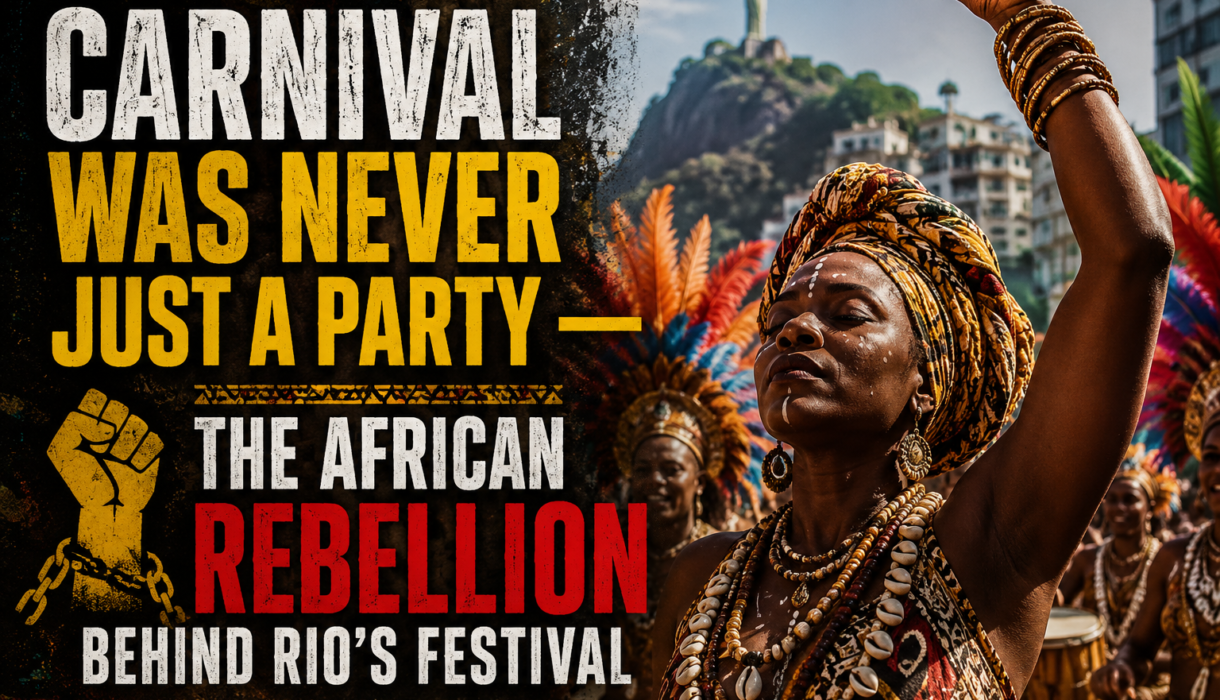

To the modern global observer, Rio de Janeiro’s Carnival appears to be the ultimate spectacle of glitter, grand floats, and nonstop celebration. Every year, millions of tourists flock to Brazil to witness this sea of color and sound. However, stripping away the commercial polish reveals a history born not out of mere entertainment, but out of defiance, ancestral survival, and radical resistance. Beneath the dazzling lights of the Sambadrome lies the powerful story of how enslaved Africans took a European Catholic festival and transformed it into a vehicle for political rebellion, cultural preservation, and spiritual reclamation.
European Feasts Meets African Resistance
The roots of Carnival originally arrived in Brazil through Portuguese colonizers, who celebrated Entrudo—a chaotic European pre-Lenten festival marked by street fights, food throwing, and public revelry. However, as millions of enslaved Africans were brought to Brazil to work the sugar plantations and urban centers, they seized upon these public gatherings as rare moments of freedom. Barred from participating in elite white ballrooms, African communities formed their own street processions. They blended traditional West African royal ceremonies, spiritual masquerades, and rhythmic drumming with the European festivities, turning a colonial holiday into a public display of solidarity, identity, and defiance against oppression.
Samba: The Secret Rhythms of “Little Africa”
At the heart of Rio’s Carnival is samba, a musical genre that was initially criminalized by Brazilian authorities following the abolition of slavery in 1888. Former slaves migrating from Bahia settled in Rio’s central neighborhood, famously known as Pequena África (Little Africa). Here, matriarchs known as Tias Baianas (Bahian Aunts) hosted clandestine gatherings in their homes under the guise of religious communal meals. In these sacred spaces, Afro-Brazilians preserved West African polyrhythms—specifically the Angolan semba—and evolved them into modern samba. Practicing this music on the streets was treated as a crime, making every beat of the drum a direct act of political rebellion against state suppression.
The Birth of Samba Schools as Community Fortresses
By the late 1920s, working-class Afro-Brazilians organized into Escolas de Samba (Samba Schools) within Rio’s hillside favelas. Far from being simple dance academies, these organizations served as vital social hubs, political networks, and cultural safe havens for marginalized communities. When the state realized it could no longer suppress samba, it sought to co-opt and legalize Carnival during the mid-20th century. Yet, the samba schools adapted masterfully, using their parade themes (samba-enredo) to subtly critique government oppression, honor forgotten Black historical heroes, and tell the true history of African resistance that official school textbooks erased.
Reclaiming the Streets in the Modern Era
Today, even as Rio’s Carnival generates billions in tourism revenue, its rebellious pulse remains unextinguished. Modern samba schools consistently push back against whitewashing by using the world’s largest stage to confront police brutality, racial inequality, and political corruption in Brazil. The traditional street parties, known as blocos, continue to offer free, democratic access to public spaces for working-class citizens, echoing the original spirit of Pequena África. Ultimately, Rio’s Carnival is not merely a party—it is an enduring, living monument to African resistance, proving that joy and celebration can be the most potent forms of freedom.