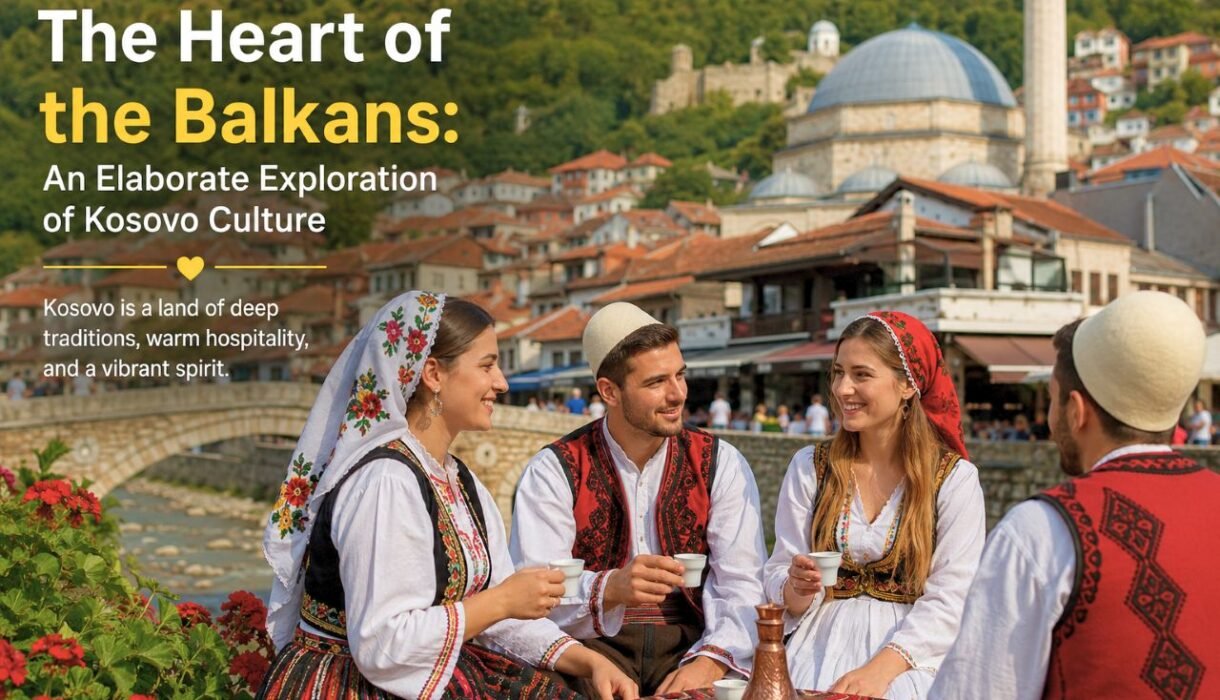

Kosovo, nestled in the center of the Balkan Peninsula in Southeast Europe, is home to a culture defined by incredible resilience, profound warmth, and a fascinating blend of ancient traditions and youthful energy. As Europe’s youngest country by both independence and demographic profile—with over half its population under the age of 30—Kosovo is vibrant, dynamic, and rapidly evolving.
The people of Kosovo, primarily Kosovar Albanians alongside various minority communities, are renowned for their hospitality (mikpritja). To step into Kosovo is to enter a land where family is the ultimate anchor, coffee is a daily social ritual, and guests are treated with sacred reverence. This write-up explores the depth of Kosovo’s diverse heritage, celebrating its preservation through decades of historical transformation.
History & Origins
Kosovo’s cultural lineage is an intricate tapestry woven by ancient civilizations, powerful medieval empires, and distinct East-meets-West influences.

- Ancient Illyrian Foundations: The roots of the majority population tie back to the Illyrians, an ancient group of tribes that inhabited the Western Balkans. During antiquity, Kosovo was the heart of Dardania, a powerful Illyrian kingdom that later became a crucial Roman province, leaving behind rich archaeological sites like Ulpiana.
- The Slavic Migrations & The Medieval Era: In the 6th and 7th centuries, Slavic tribes migrated into the region. By the medieval period, Kosovo became a core political and spiritual center of the Serbian Empire. Magnificent Serbian Orthodox monasteries, such as those in Deçan and Gračanica, were built during this era, blending Byzantine and Western architectural styles.
- Ottoman Rule (1389–1912): Following the legendary Battle of Kosovo in 1389, the region gradually integrated into the Ottoman Empire for over five centuries. This era profoundly transformed Kosovo’s cultural landscape, introducing Islam, Ottoman legal structures, oriental architecture, and culinary traditions that remain prominent today.
- The 20th Century & Independence: Following the collapse of the Ottoman Empire, Kosovo became part of Yugoslavia. The late 20th century was marked by political turmoil, culminating in the Kosovo War (1998–1999). Backed by international intervention, Kosovo transitioned to a UN-administered territory and proudly declared its independence on February 17, 2008. Today, its history is viewed as a testament to the endurance and survival of its people.
Culture, Traditions & Customs
Traditional Weddings (Dasma)
Weddings in Kosovo are legendary, multi-day celebrations that blend ancient tribal rituals with modern festivities. Traditionally lasting up to a week, a Kosovar wedding features distinct days for the bride’s family and the groom’s family. A key ritual is the Kanata (or Nata e Kënnës), the henna night, where the bride bids a bittersweet farewell to her maternal home, surrounded by female relatives singing traditional, emotional polyphonic songs. The groom’s procession to fetch the bride is historically accompanied by tupana (large drums) and the waving of the traditional flag.
Rites of Passage and Naming Ceremonies
Family events are heavily community-oriented. Naming ceremonies often take place within the immediate family circle, where names emphasizing strength, nature, or freedom (such as Arbër, Liridon, or Blerta) are chosen. The birth of a child is celebrated across the entire neighborhood with the distribution of flija or sweet pastries, signaling a new addition to the community safety net.
Cultural Festivals
- DokuFest: Hosted in the historic, cobblestoned city of Prizren, this internationally acclaimed international documentary and short film festival transforms the country into a cosmopolitan art hub every August.
- Sunny Hill Festival: Founded by international pop star Dua Lipa and her father Dukagjin Lipa (both of Kosovar-Albanian descent), this massive music festival in Prishtina highlights Kosovo’s contemporary connection to global youth culture.
Languages & Communication
Linguistic diversity is a defining feature of Kosovo, protected under its constitutional framework.
The Spoken Dialects
- Albanian: Spoken by the vast majority. In daily life, Kosovars speak Gheg Albanian, a northern dialect characterized by its distinct vocal rhythms, idioms, and nasal vowels, differing slightly from the standard Albanian used in official media and education.
- Serbian: An official language of the state, spoken primarily by the Kosovo Serb community, utilizing both Cyrillic and Latin scripts.
- Minority Tongues: Turkish, Bosnian, and Romani are widely spoken and recognized as official languages in various municipalities (e.g., Turkish in Prizren).
Greetings & Expressions
Communication in Kosovo is warm, polite, and heavily centered on checking in on the well-being of the speaker’s family.
- “Tungjatjeta” / “Tung”
Meaning: “May you live long” / “Bye”—the standard, affectionate Albanian greeting.
- “Si je? A je lodh?”
Meaning: “How are you? Are you tired?”—a quintessential Kosovar phrase showing empathy for the other person’s hard work.
- “Bukë, kripë e zemër”
Proverb: “Bread, salt, and a warm heart.” This ancient saying forms the core worldview of Balkan hospitality—even if a host has little to offer materially, they will share it with love and honor.
Geography
Kosovo is a landlocked paradise characterized by two vast plain basins—the Kosovo Plain in the east and the Dukagjin Plain in the west—completely encircled by majestic mountain ranges.
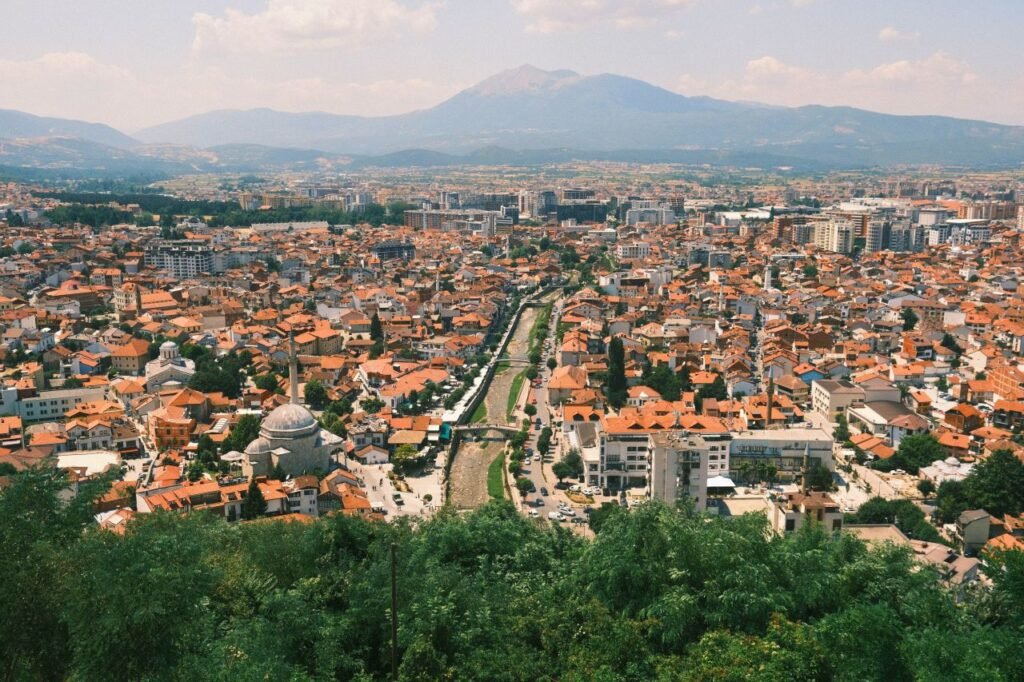
In the south, the Šar Mountains (Sharr) offer pristine alpine ecosystems and popular ski destinations like Brezovica. In the west, the Accursed Mountains (Prokletije / Bjeshkët e Nemuna) boast jagged peaks and dramatic geological formations, including the breathtaking Rugova Canyon near Peja. The country is blessed with dense oak and beech forests, rushing rivers like the White Drin, and a continental climate featuring warm summers and snowy winters.
Economy
Kosovo transitions within a developing, free-market economy. Historically reliant on heavy mining, it is rapidly modernizing into a service-oriented hub.
- The Digital & Tech Boom: Thanks to its exceptionally multilingual, young, and tech-savvy workforce, Kosovo has become a premier regional destination for IT outsourcing, software development, and customer support services for Western Europe.
- Mineral Wealth: The country sits on immense natural reserves of lignite (brown coal), ranking among the highest deposits globally. It also possesses rich historical reserves of lead, zinc, and silver, centered around the massive Trepça mine complex.
- The Power of the Diaspora: The vast Kosovar diaspora living in Germany, Switzerland, and the UK plays an indispensable role in the economy, injecting substantial capital through annual remittances and seasonal tourism.
Politics
Kosovo operates as a multi-party, representative democratic parliamentary republic. Executive power is exercised by the government, led by the Prime Minister, while the President serves as the formal head of state, embodying the unity of the republic.
The unicameral Assembly of Kosovo consists of 120 seats. In an explicit effort to preserve cultural diversity and minority rights, the constitution guarantees 20 seats specifically reserved for minority communities (10 for Kosovo Serbs and 10 for Bosnians, Turks, Roma, Ashkali, and Egyptians). Kosovo continues to focus its foreign policy on full integration into the European Union, NATO, and the United Nations.
Ethnic Groups
Kosovo’s demographic landscape is predominantly Albanian, yet it features an intentionally preserved tapestry of distinct ethnic enclaves.
| Ethnic Group | Estimated Population Share | Primary Concentration Zones |
| K-Albanians | ~92-93% | Nationwide |
| K-Serbs | ~4-5% | Northern Kosovo, Gračanica, Štrpce |
| Bosniaks | ~1.5% | Prizren region, Peja |
| Turks | ~1.0% | Prizren, Mamusha |
| Roma, Ashkali, Egyptian (RAE) | ~1.0% | Scattered urban and rural hubs |
Beliefs & Values
Religious Harmony
The majority of Kosovar Albanians, along with the Turkish and Bosniak populations, practice Islam (primarily Sunni and Sufi orders), introduced during the Ottoman era. The Kosovo Serb population practices Serbian Orthodox Christianity, while a distinct minority of Albanians are Roman Catholic (historically tied to figures like Mother Teresa, whose family roots are Kosovar). Kosovo is deeply secular, and religious tolerance is highly valued; it is common to see mosques and churches standing peacefully on the same street blocks.
The Kanun and The Sacred Guest
For centuries, social life in rural areas was guided by the Kanun of Lekë Dukagjini, an ancient code of customary Albanian law. While modern civil law governs the nation today, the ethical principles of the Kanun still shape traditional moral values. The most famous concept is Besa—a sacred word of honor or pledge. Under Besa, keeping a promise is an absolute moral duty.
The Sanctity of the Guest: According to traditional custom, “The house of the Albanian belongs to God and the guest.” Anyone who knocks on a door seeking shelter is granted absolute safety, protection, and the finest food the family can provide.
Food & Cuisine
Kosovan cuisine is a hearty, comforting blend of Mediterranean freshness and Ottoman culinary techniques. Pies, dairy products, and grilled meats dominate the traditional table.
- Flija: The undisputed king of Kosovan traditional food. It consists of multiple layers of crepe-like batter brushed with cream, yogurt, and oil. It is cooked slowly outdoors over several hours using a saç—a large, spherical metal lid covered in glowing hot coals. It is a dish that signifies community, family gatherings, and slow-food mastery.
- Pite: Flaky, savory phyllo pastry pies stuffed with minced meat, spinach, or salted cheese, typically served with cold ajran (a salty yogurt drink).
- Grilled Meats (Qebapa): Hand-shaped skinless minced meat sausages, grilled over charcoal and served inside soft, hollow flatbreads (samun), accompanied by Ajvar—a rich, roasted red pepper and eggplant relish.
Clothing & Symbols
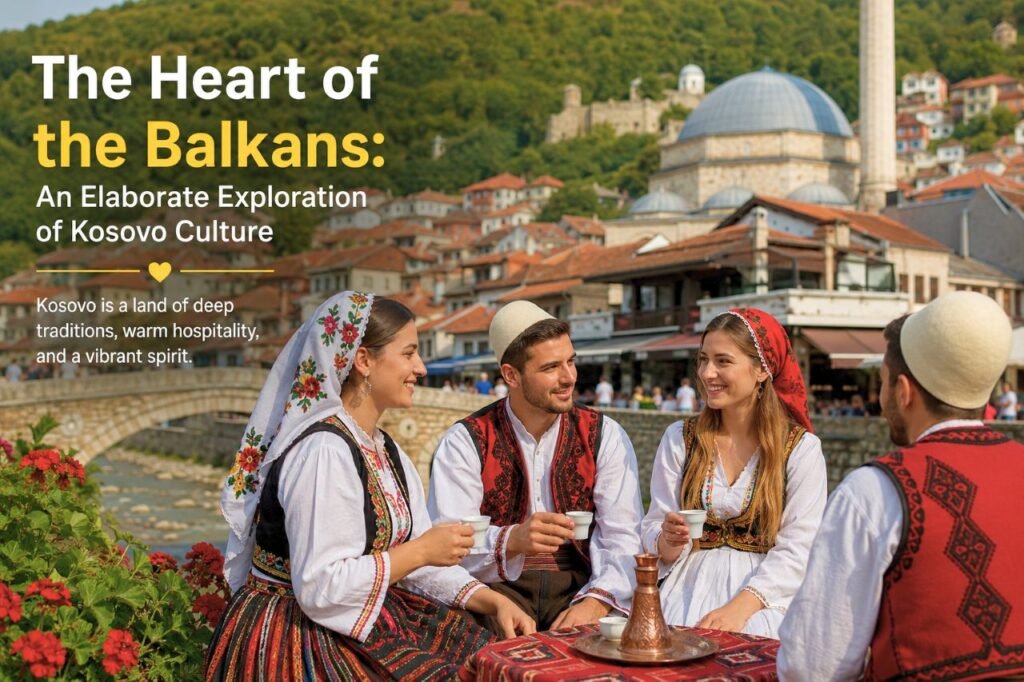
Traditional Costumes
Kosovo’s traditional attire varies dramatically across its historical micro-regions (such as Rugova or Has), characterized by intricate wool embroidery and geometric patterns.
- The Plis: A round, brimless white felt cap worn proudly by Albanian men, serving as an ancient symbol of national identity dating back to Illyrian times.
- The Xhubleta: Though more common in the high mountain regions, this bell-shaped, heavy wool skirt features ancient wave patterns and represents one of the oldest traditional costume styles in Europe.
National Symbols
- The State Flag: Unique and intentionally non-nationalistic, it features a blue background adorned with a golden silhouette map of the country, topped by six white stars. These stars explicitly symbolize the peaceful coexistence of Kosovo’s six main ethnic groups: Albanians, Serbs, Turks, Bosniaks, Gorani, and the RAE communities.
Music, Dance & Art
Traditional Soundscapes
Kosovo’s folklore comes alive through its distinct musical instruments. The Çiftelia is a traditional two-stringed wooden lute with a long neck, played by folk rhapsodists to narrate ancient epic poems and tales of bravery. The rhythmic backbone of festive events is provided by the Tupan (a massive double-headed drum) and the Def (traditional tambourine).
Folk Dances (Valle)
Traditional dancing is communal, energetic, and performed at every major milestone. The Valla e Rugovës (Dance of Rugova) is a highly dramatic martial folk dance originating from the western mountains, characterized by synchronized steps, mock sword fights, and intense physical agility, symbolizing the proud warrior spirit of the highlands.
Summary
The culture of Kosovo is a brilliant, unfolding narrative of endurance, heritage, and modern evolution. By honoring its ancient Illyrian roots, preserving its diverse architectural and religious monuments, and practicing unconditional hospitality, Kosovo keeps its rich history alive. Concurrently, its thriving coffee house culture, international film festivals, and tech-driven youth make it an exciting gateway to the future of the Balkans. Kosovo remains an inspiring, multifaceted destination where old traditions and new horizons exist side by side.
At Best Culture Insight, we see culture as the heartbeat of every society – the way people live, connect, and express their identity.