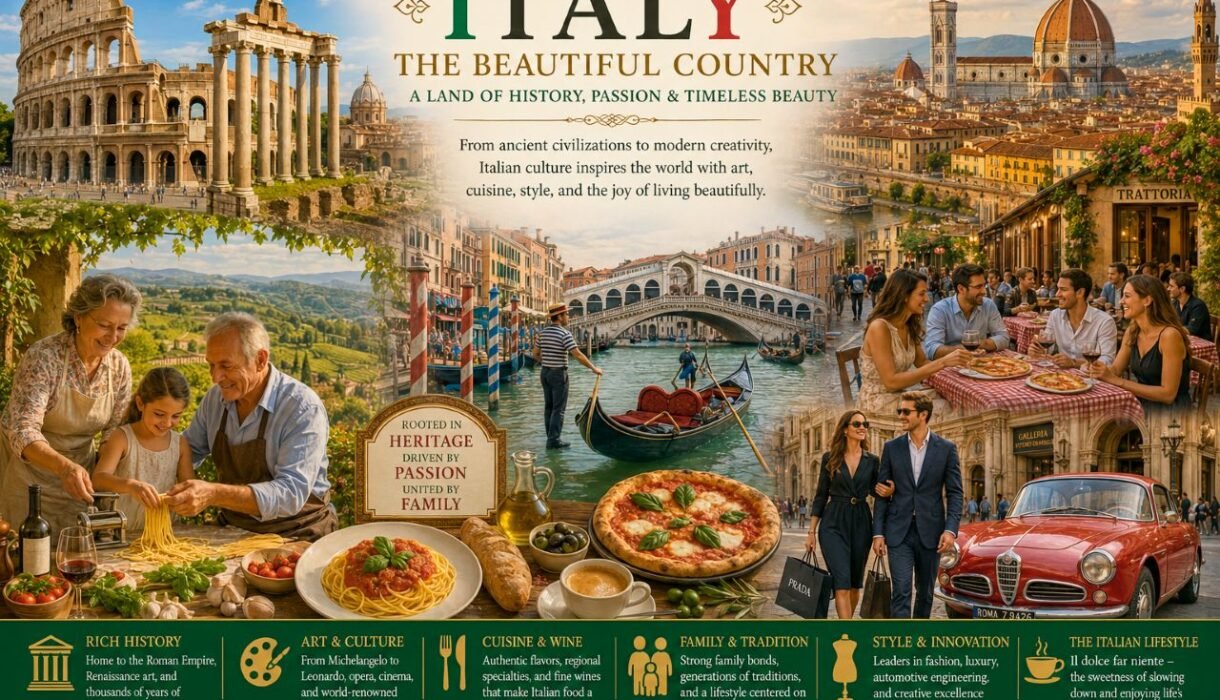

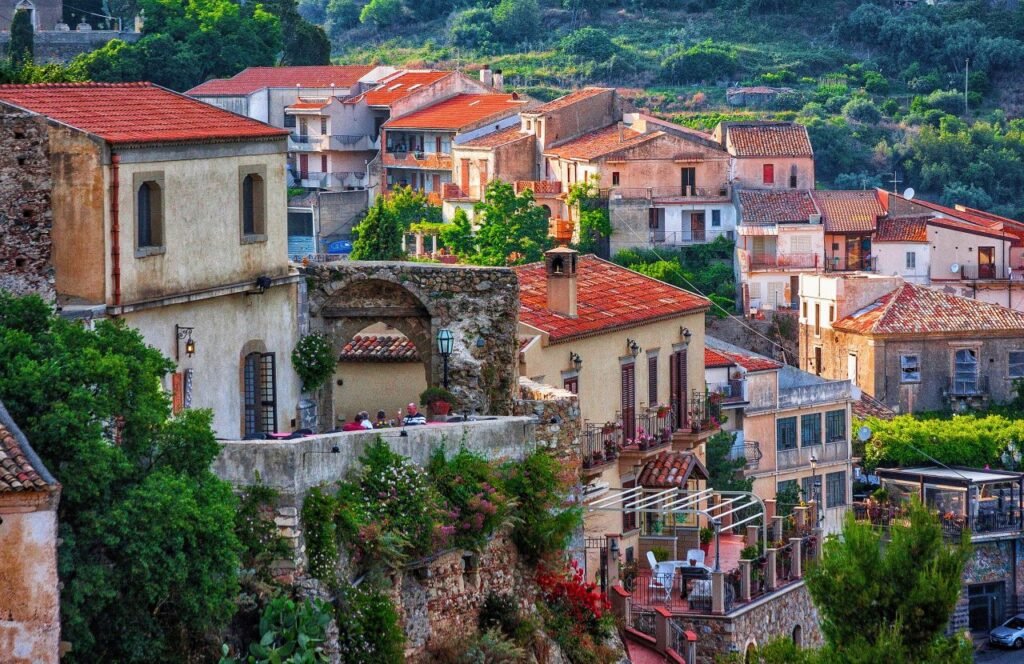
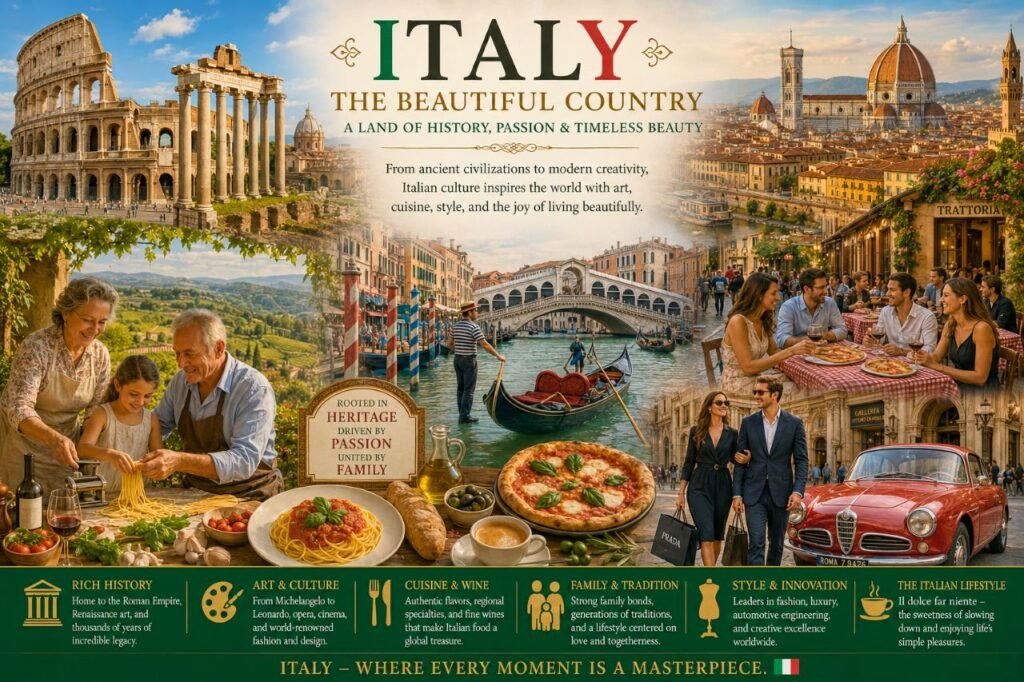
Italy (Italia), situated at the heart of the Mediterranean Sea, possesses a culture that has acted as a primary blueprint for Western civilization. Known affectionately as the Bel Paese (the Beautiful Country), Italy is a living museum where ancient Roman ruins sit amidst bustling modern fashion capitals. The people of Italy—the Italians—are defined by an expressive, passionate approach to life rooted in family, regional pride (campanilisimo), and an innate appreciation for beauty in all its forms.
Italian culture strikes a harmonious balance between intense historical preservation and pioneering global trends. It is a heritage celebrated worldwide through its legendary culinary arts, iconic Renaissance masterpieces, and high-octane automotive engineering. At its core, the Italian lifestyle is anchored by the philosophy of il dolce far niente—the sweetness of doing nothing—and a commitment to slow down, savoring life’s simple pleasures with community and loved ones.
History & Origins
Italy’s history is a profound timeline of imperial dominance, fragmented city-states, and a spectacular cultural rebirth that reshaped global art and science.
[Etruscan & Greek Beginnings (c. 800 BC)]➔[The Roman Empire (27 BC – 476 AD)]➔[The Renaissance (14th – 17th Century)]➔[The Risorgimento / Unification (1861)]➔[Modern Democratic Republic (1946)]
- The Ancient Roots: Before Rome dominated the peninsula, advanced civilizations flourished, notably the Etruscans in central Italy and Greek colonists in the south (Magna Graecia). By 753 BC, Rome was founded, evolving from a modest kingdom into a massive Republic and eventually the Roman Empire. At its peak, Rome unified the Mediterranean world, leaving a legacy of law, architecture, roads, and the Latin language.
- The Fragmented Middle Ages: Following the fall of the Western Roman Empire in 476 AD, Italy fractured into a patchwork of independent maritime republics and competitive city-states, including Venice, Florence, Genoa, and the Papal States. Despite political instability, these entities became major trade hubs.
- The Renaissance (Il Rinascimento): Centered in 14th-century Florence, Italy birthed the Renaissance—a monumental cultural revival of classical learning, humanism, and the arts. Visionaries like Leonardo da Vinci, Michelangelo, and Galileo Galilei fundamentally altered humanity’s understanding of science, anatomy, and creative expression.
- The Risorgimento (Unification): For centuries, Italy remained a geopolitical playground for foreign empires. In the 19th century, a nationalist political and social movement known as the Risorgimento emerged. Led by figures like Giuseppe Garibaldi and Count Cavour, the movement successfully unified the fragmented states, establishing the Kingdom of Italy in 1861.
- The Modern Era: After enduring the hardships of World War I and the subsequent rise and fall of Benito Mussolini’s fascist regime during World War II, a popular referendum in 1946 abolished the monarchy. Italy officially emerged as a democratic republic, quickly growing into a foundational member of the European Union.
Culture, Traditions & Customs
Marriage and Family Celebrations
In Italy, weddings are grandiose, multi-generational community affairs emphasizing hospitality and abundance. Traditional customs vary by region, but a widely practiced ritual involves gifting Bomboniere to wedding guests. These are elegant keepsake pouches containing candy-coated almonds (confetti). Crucially, the almonds must always be distributed in an odd number—typically five—signifying five wishes for the new couple: health, wealth, happiness, fertility, and longevity.
Traditional Naming Conventions
Historically, Italian families followed a highly structured system to honor grandparents and pass names down systematically:
- The firstborn son was named after the paternal grandfather.
- The second son after the maternal grandfather.
- The firstborn daughter after the paternal grandmother.
- The second daughter after the maternal grandmother.
While modern parents exercise more creative freedom, naming children after family ancestors or revered saints remains deeply entrenched.
Major Festivals and Carnivals
- Carnevale di Venezia (Venice Carnival): Held annually in the weeks leading up to Lent, this historic festival is famous for its elaborate, hand-crafted porcelain and leather masks. The tradition dates back to the Middle Ages, allowing citizens of different social classes to mix freely without judgment.
- Il Palio di Siena: A historic, bareback horse race held twice every summer in Siena’s central square, Piazza del Campo. The city’s 17 distinct neighborhoods (contrade) compete with fierce, centuries-old rivalry, accompanied by vibrant medieval pageantry.
Languages & Communication
While Italy shares a single official tongue, its linguistic reality is an expressive mosaic of distinct regional languages and highly nuanced non-verbal cues.
The Italian Language and Regional Dialects
Modern Italian derives directly from the Tuscan dialect, popularized by the legendary poet Dante Alighieri in his 14th-century work, the Divine Comedy. Before unification, the peninsula spoke a vast array of distinct regional languages (such as Sicilian, Neapolitan, and Venetian). Many of these are not simple variations of standard Italian but distinct languages that evolved directly from Vulgar Latin, and they continue to be spoken alongside standard Italian today.
Non-Verbal Communication and Idioms
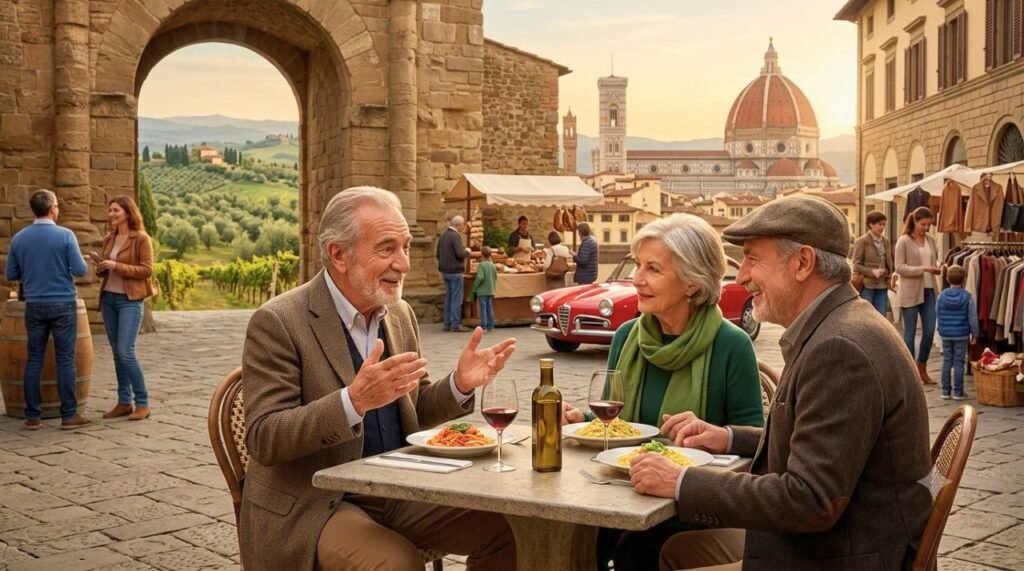
Italians are globally famous for their highly expressive communication style. Hand gestures are an essential, complex dialect of their own, used to add emphasis, emotion, and subtle context to every spoken sentence.
- “Ciao!”
Translation: The universally recognized, casual Italian greeting used for both “Hello” and “Goodbye.”
- “La dolce vita”
Meaning: “The sweet life”—a core cultural philosophy reflecting the pursuit of a life filled with beauty, pleasure, good food, and relaxed companionship.
- “In bocca al lupo”
Proverb Translation: “Into the mouth of the wolf.” This is the standard Italian way to wish someone good luck, particularly before an exam or performance. The mandatory, traditional response is “Crepi!” (“May the wolf die!”).
Geography
Italy is a distinctive, boot-shaped peninsula jutting out into the Mediterranean Sea, featuring an incredibly varied and dramatic topography.
The country’s geography can be categorized into three primary environments:
- The Mountainous North: The top of the peninsula is crowned by the majestic Alps, forming a natural alpine border with Europe. Just south of the Alps lie the Apennines, a rugged mountain chain that acts as a spine running down the entire length of the country.
- The Fertile Plains and Lakes: Nestled between the mountains is the Po River Valley, the agricultural and industrial heartland of the nation. The north also features stunning, deep-glacial lakes such as Lake Como and Lake Garda.
- The Volcanic and Coastal South: The southern regions and islands (including Sicily and Sardinia) feature a warm, sun-drenched Mediterranean climate. This region is home to active volcanoes like Mount Vesuvius and Mount Etna, which have enriched the surrounding volcanic soils for millennia.
Economy
Italy possesses a highly developed, advanced industrial economy, operating as one of the largest members of the Eurozone. Its economic structure is sharply divided between a highly industrialized, wealthy northern sector and a more structurally developing, agricultural southern sector (Il Mezzogiorno).
- The Precision Manufacturing Powerhouse: Italy is a global leader in high-end manufacturing, machine production, and metallic design. It is globally synonymous with premium luxury sports cars and motorcycles, including Ferrari, Lamborghini, and Ducati.
- The Global Fashion Capital: Milan serves as a premier epicenter of global fashion, anchoring an expansive textile and luxury goods industry that exports premium apparel, footwear, and leather accessories across the globe.
- Agribusiness and Wine: Italy is consistently the world’s largest producer of wine by volume. Its agricultural economy relies on protected geographic status designations (DOP), ensuring premium global pricing for authentic items like Parmigiano-Reggiano, Prosciutto di Parma, and extra-virgin olive oil.
Politics
Italy is a democratic parliamentary republic. The President of the Republic serves as the formal head of state, performing an important balancing role and representing national unity. Executive political power resides with the government, headed by the President of the Council of Ministers (the Prime Minister).
The national parliament is strictly bicameral, comprising the Chamber of Deputies and the Senate of the Republic. Italy’s post-war political landscape is historically dynamic, characterized by frequent coalition government changes. Despite these shifts, its core democratic institutions and allegiance to the European Union and NATO remain robust.
Ethnic Groups
For much of its modern history, Italy was a country of emigration, sending millions of citizens across the Atlantic. However, over the past few decades, it has transformed into a major destination for international migration.
Today, approximately 91% of the population identifies as ethnic Italian. The remaining population consists of growing foreign-born communities that enrich Italy’s modern demographic profile, with the largest immigrant groups originating from Romania, Albania, Morocco, China, and Ukraine. Additionally, historical, localized linguistic minorities exist peacefully within its borders, such as German-speakers in the northern province of South Tyrol and French-speakers in the Aosta Valley.
Beliefs & Values
Faith, Heritage, and Secularization
Roman Catholicism has historically been the dominant spiritual, cultural, and political force in Italy. Vatican City, an independent city-state located entirely within the geographic borders of Rome, serves as the spiritual headquarters of the global Catholic Church. While modern Italy has become highly secularized and everyday church attendance has shifted, Catholic values continue to heavily influence social structures, legal calendars, national holidays, and familial obligations.
The Sacred Nature of Family
In Italy, the family (la famiglia) is the absolute cornerstone of social structure.
Italian social organization relies heavily on strong generational bonds. It is incredibly common for multiple generations to live within close proximity or under the same roof. Adult children frequently maintain close ties with their parents, and Sunday family lunches remain an unshakeable cultural ritual. This family-first framework provides a reliable, informal emotional and economic safety net across generations.
Food & Cuisine
To Italians, food is not merely sustenance; it is a profound form of art, a cultural language, and an act of love. Italian cuisine is deeply regional, relying on a strict philosophy of simplicity—where dishes often feature only three to four exceptional ingredients prepared with impeccable technique.
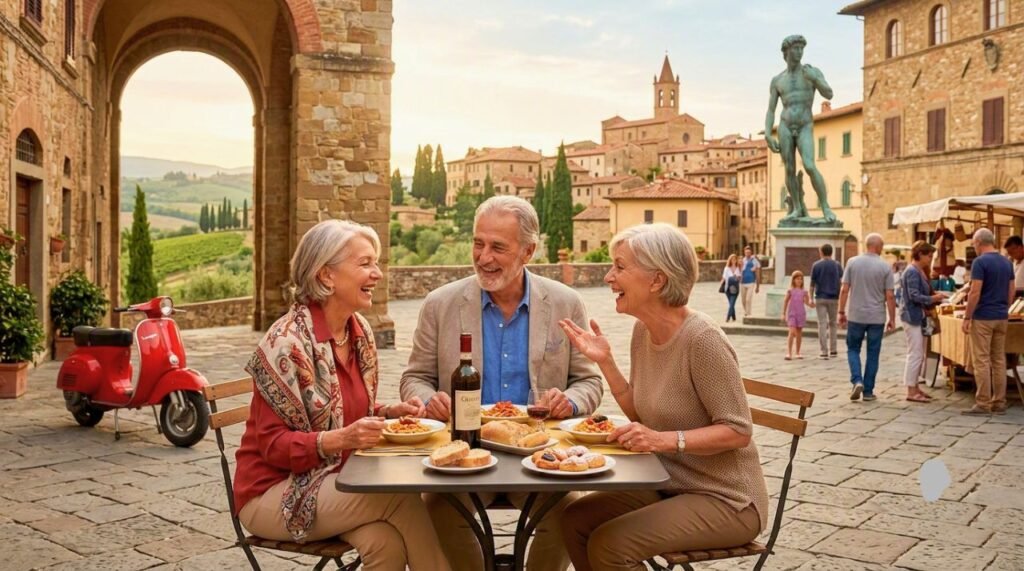
- The Regional Mosaic: What foreigners call “Italian food” is actually a collection of distinct regional cuisines. The north favors rich ingredients like butter, creamy polenta, and risotto, while the south is the birthplace of dried durum-wheat pasta, bright tomato sauces, and fresh seafood.
- The Pizza and Pasta Legacy: Naples is the historic birthplace of Pizza Margherita, intentionally designed in 1889 to showcase the colors of the Italian flag: red tomatoes, white mozzarella, and green basil. Pasta shapes are meticulously paired with specific sauces based on physics—heavy, textured ragù pairs with wide tagliatelle, while smooth olive-oil sauces coat thin spaghetti perfectly.
- The Espresso Ritual: Coffee is an intricate cultural system. Espresso is consumed quickly while standing at a local bar. A cardinal rule of Italian culinary etiquette dictates that milk-heavy coffees, like cappuccinos, are strictly breakfast drinks, never to be ordered after 11:00 AM, as milk is viewed as an impediment to proper digestion after a heavy meal.
Clothing & Symbols
The Legacy of Sprezzatura
Italy is a premier global vanguard of fashion, design, and textile excellence. Italian style is anchored by the historical concept of Sprezzatura—a term coined during the Renaissance meaning a certain effortless elegance, where clothing looks stylish and impeccable without appearing rehearsed or forced. High-quality natural materials like fine merino wool, supple leather, and breathable linen are foundational elements of the daily wardrobe.
National Symbols
- Il Tricolore (The National Flag): Featuring three equal vertical bands of green, white, and red. Popularly, the green represents Italy’s plains and hills, white represents the snow-capped Alps, and red symbolizes the blood spilled during the wars of unification.
- The Stella d’Italia (Star of Italy): The oldest symbolic representation of the peninsula, dating back to antiquity, depicting a radiant five-pointed white star.
- The Olive and Oak Branches: Featured on the official emblem of the Republic, the olive branch symbolizes the nation’s desire for internal and international peace, while the oak branch represents the strength and dignity of the Italian people.
Music, Dance & Art
Classical Mastery and Opera
Italy is the literal birthplace of opera, a theatrical art form developed in Florence at the end of the 16th century. Master composers like Giuseppe Verdi, Giacomo Puccini, and Antonio Vivaldi created musical scores that continue to anchor the global classical repertoire. The country also invented many foundational musical instruments, including the piano and the violin (perfected by Antonio Stradivari in Cremona).
Art and Architectural Heritage
Italy contains more UNESCO World Heritage sites than almost any other country on Earth. Its artistic history is a continuous parade of revolutionary movements:
- Ancient Roman Engineering: Perfected the architectural arch and concrete, enabling monumental structures like the Pantheon and the Colosseum.
- The High Renaissance: Birthed immortal masterpieces such as Leonardo da Vinci’s The Last Supper and Michelangelo’s awe-inspiring frescoes on the ceiling of the Sistine Chapel.
- The Baroque Movement: Spearheaded by Caravaggio and Bernini, introducing intense drama, theatrical lighting, and emotional realism to global art.
Summary
The culture of Italy is a triumphant testament to the enduring power of human creativity, passion, and community. By masterfully preserving its unmatched historical ruins, classical operatic traditions, and regional culinary arts while simultaneously acting as a sleek vanguard of global fashion, design, and technological engineering, Italy has secured an immortal legacy. From the quiet majesty of a Renaissance fresco to the lively chatter of a neighborhood espresso bar, Italy’s heritage remains a warm, radiant inspiration to the world.
At Best Culture Insight, we see culture as the heartbeat of every society – the way people live, connect, and express their identity.