The Heart of South America: A Deep Exploration of Paraguay Culture
Posted in :

Often called El Corazón de Sudamérica (The Heart of South America), Paraguay is a landlocked nation of striking contrasts, raw natural beauty, and a deeply resilient spirit. While bordered by giants like Brazil, Argentina, and Bolivia, Paraguay stands completely distinct in its cultural identity.
Unlike many neighboring South American countries where indigenous populations were heavily marginalized or separated from colonial society, Paraguay evolved into a deeply integrated, homogeneous mix. Here, the indigenous Guaraní heritage didn’t just survive colonial rule—it mixed directly with Spanish traditions to form a unified national culture. To truly understand Paraguay is to experience a proud society where ancient indigenous customs, a unique language, and vibrant contemporary traditions shape every aspect of daily life.
History & Origins
Before the arrival of Europeans, the vast forests and river networks east of the Paraguay River were home to the semi-nomadic Guaraní people. They practiced sustainable agriculture, developed advanced botanical medicine, and maintained a deeply spiritual connection to the land.
The historical landscape changed significantly in 1537 when Spanish explorer Juan de Salazar y Espinosa founded Asunción, which quickly became a strategic base for colonial expansion across South America. The encounter between the Spanish conquistadors and the Guaraní took a very unique path:
- Alliance and Intermarriage: Rather than engaging in continuous warfare, early Spanish settlers and Guaraní chiefs formed strategic alliances. Spanish men married Guaraní women, giving rise to a large, unified Mestizo (mixed) population that embraced both ancestral heritages.
- The Jesuit Reductions: In the 17th and 18th centuries, Jesuit missionaries established autonomous, organized communities known as reducciones (reductions). Within these missions, the Guaraní were protected from slave traders, introduced to European musical instruments, and taught advanced masonry—all while retaining their native language.
Paraguay achieved independence from Spain on May 14, 1811, but its national identity was forged in fire through devastating conflicts. The Triple Alliance War (1864–1870) against Brazil, Argentina, and Uruguay wiped out over 60 percent of the country’s population, including up to 90 percent of its adult male demographic. This profound tragedy fundamentally reshaped Paraguayan society, placing women at the center of cultural preservation, community rebuilding, and ancestral storytelling.
Culture, Traditions & Customs
The Ritual of Tereré
No custom defines Paraguayan identity more completely than Tereré—the national drink and a practice recognized by UNESCO as Intangible Cultural Heritage. Tereré consists of yerba mate infused with ice-cold water and fresh medicinal herbs known as pohã ñana (like mint, lemon verbena, or ginger), crushed using a traditional mortar and pestle.
More than just a refreshing drink for hot afternoons, tereré is a deeply communal ritual. It is shared within a circle of family or friends using a single cup (guampa) and a metal straw (bombilla). The cebador (the server) prepares and passes the drink clockwise. Accepting a cup and saying “Gracias” signals that you are fully satisfied and stepping out of the circle, making it a powerful symbol of trust and community bonding.
Rites of Passage and Festivals
- Fiestas Patronales (Patron Saint Feasts): Every town and city across Paraguay honors its specific patron saint with vibrant community festivals. These celebrations feature traditional games like Yvyra syî (climbing a greased pole), Toro candil (a playful game involving a mock bull with flaming horns), and Karrera vosa (sack races).
- San Juan Ára (St. John’s Day): Celebrated on June 24, this highly popular festival blends Christian tradition with ancient fire rituals. Communities gather around large bonfires to watch daring participants perform the Tata ári jehasa (walking barefoot over glowing hot coals) and enjoy an array of heavy traditional street foods.
- Quinceañera: The traditional transition into womanhood for young girls turning fifteen remains a core family milestone, celebrated with elegant formal galas, coordinated family dances, and large multi-generational gatherings.
Languages & Communication
Paraguay is remarkably unique in its linguistic landscape, standing as the only country in the Americas where an indigenous language—Guaraní—is spoken by the vast majority of the population, regardless of ethnic background or social standing. Under the national constitution, both Spanish and Guaraní are official languages.
Rather than keeping them separate, daily life relies heavily on Jopara (which translates to “mixture”), a casual hybrid spoken dialect that blends Spanish vocabulary with Guaraní grammar and expressions.
Popular Guaraní Phrases and Expressions:
- “Mba’éichapa?” – The standard, warm greeting meaning “How are you?”
- “Iporãnte” – The typical, positive response meaning “I am doing well.”
- “¡Anana!” – An exclamation used to express deep surprise, shock, or amazement.
- “Aháta aju” – A beautiful phrase that literally translates to “I am leaving, but I am coming right back.”
Communication in Paraguay is warm, polite, and deeply relational. When entering a shop, office, or neighborhood bus, it is a customary social rule to offer a general greeting (“Buenas días” or “Buenas tardes”) to everyone present.
Geography
Paraguay is split into two sharply contrasting geographic regions by the prominent Paraguay River:
- The Chaco Region (Occidental): Making up roughly 60 percent of the country’s landmass but home to less than 3 percent of its population, the Chaco is a vast, semi-arid, and rugged lowland. It features thorny forests, marshy wetlands, and expansive cattle ranches, serving as a haven for diverse wildlife like jaguars, pumas, and exotic bird species.
- The Paraneña Region (Oriental): Home to over 95 percent of the country’s population, this region features rolling green hills, fertile agricultural soil, and lush subtropical forests fed by the Paraná and Paraguay rivers.
The country houses major geographic and engineering wonders, including the Monday Falls (a series of spectacular hidden forest waterfalls) and the massive Itaipu Dam, shared with Brazil, which ranks as one of the world’s largest operational hydroelectric facilities.
Economy
Historically grounded in agriculture and livestock, Paraguay’s economy is a major global producer and exporter of soybeans, corn, and high-quality beef. The vast pastures of the Chaco region support a thriving cattle industry, while the country’s massive rivers supply clean hydroelectric energy, making Paraguay a top net exporter of renewable electricity in South America. In recent years, urban centers like Asunción and Ciudad del Este have seen rapid industrial development, driven by manufacturing, construction, and a young, dynamic workforce.
Politics
Paraguay is a unitary presidential representative republic. The President serves as both head of state and head of government, exercising executive power alongside a bicameral National Congress composed of the Senate and the Chamber of Deputies. Following decades of authoritarian rule under the military dictatorship of Alfredo Stroessner (1854–1989), the nation successfully transitioned to a constitutional democracy in 1992. Political life remains highly active, with elections heavily contested between traditional political parties.
Ethnic Groups
Paraguay’s population stands out for its high degree of ethnic homogeneity, with over 95 percent identifying as Mestizo (mixed Spanish and Guaraní descent). This shared ancestry has helped create a unified national identity.
| Ethnic/Cultural Group | Regional Focus | Key Cultural Characteristics |
| Mestizo Majority | Nationwide (Urban/Rural) | The core carriers of Jopara speech, traditional folklore, and national customs. |
| Indigenous Peoples | Chaco and Eastern Forests | Composed of 19 distinct ethnic groups (including the Ayoreo, Enxet, and Mbyá) who preserve ancient ancestral tongues and traditional crafts. |
| Mennonite Immigrants | Central Chaco Region | German-descended agricultural communities that established highly productive dairy cooperatives in the isolation of the Chaco. |
| Recent Immigrants | Border regions and cities | Notable communities of Brazilian, German, Lebanese, and East Asian descendants who enrich urban commerce and trade. |
Beliefs & Values
Roman Catholicism is the dominant religion, shaping Paraguay’s social structure and holiday calendar. However, religious practice here is deeply uniquely intertwined with Guaraní spirituality.
A prime example is the national devotion to the Virgin of Caacupé, the country’s patron saint. Every December 8, hundreds of thousands of pilgrims travel from all corners of the country—often walking for miles or carrying heavy loads—to the basilica city of Caacupé to fulfill vows and pray for family blessings.
Paraguayan culture places immense value on solidarity, humility, and hospitality. This is beautifully expressed through the social concept of ñandereko—a Guaraní term representing the traditional lifestyle that emphasizes community harmony, respect for elders, and a relaxed, unhurried approach to life’s daily pressures.
Food & Cuisine
Paraguayan cuisine is hearty, comforting, and deeply satisfying. It centers on three key staple ingredients: cassava (mandioca), corn, and beef. Mandioca is boiled fresh daily and sits on nearly every dinner table as a substitute for bread.
[ Staples of the Paraguayan Kitchen ] ┌─────────────────────────┬─────────────────────────┬─────────────────────────┐ │ Mandioca │ Corn │ Beef │ │ Served boiled alongside │ Ground into flour for │ Grilled over open fire │ │ nearly every savory │ savory breads, soups, │ for traditional weekend │ │ meal of the day. │ and layered cakes. │ family asados. │ └─────────────────────────┴─────────────────────────┴─────────────────────────┘Iconic Traditional Dishes
- Chipa: The quintessential snack of Paraguay. These are dense, ring-shaped breads made from cassava starch, corn flour, lard, anise seeds, and fresh local cheese. Traditionally baked in a outdoor dome-shaped clay oven called a tatakuá, chipa is sold everywhere by street vendors known as chiperas.
- Sopa Paraguaya: Despite its literal name translating to “Paraguayan Soup,” this is actually the world’s only solid soup. It is a rich, spongy corn cake made with cornmeal, cheese, onions, milk, and lard, created accidentally during the 19th century when a president’s chef added too much corn flour to a traditional broth.
- Vori Vori: A rich, warming chicken soup featuring small, hand-rolled balls of cornmeal and cheese. This classic comfort food was proudly named one of the best soups in the world by international culinary guides.
- Asado: The traditional weekend barbecue. Families gather around open-air wood grills to cook thick cuts of beef, sausage, and ribs, always served alongside boiled mandioca and cold sopa paraguaya.
Clothing & Symbols
Traditional Lace and Fabrics
Traditional Paraguayan attire is defined by its world-renowned textiles. The most famous is Ñandutí (meaning “spiderweb” in Guaraní), an exquisite, intricately hand-woven needle lace. Artisans, centered primarily in the town of Itauguá, hand-weave vibrant circular patterns on wooden frames, mimicking native flowers, animals, and religious themes.
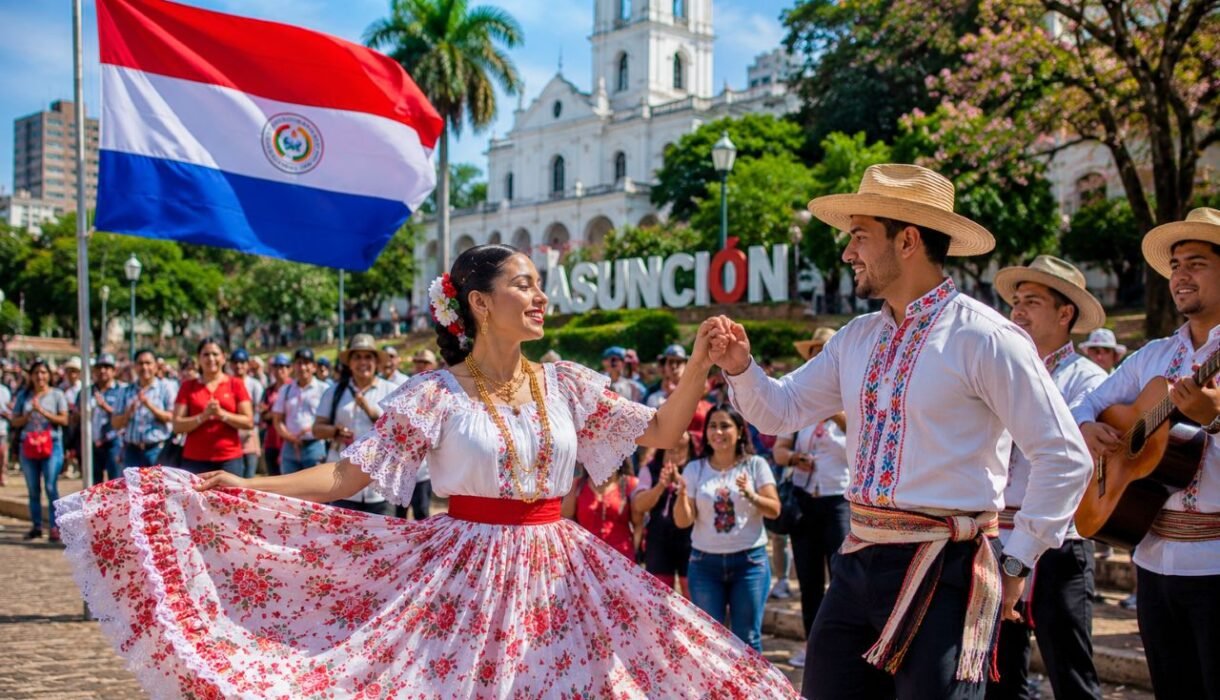
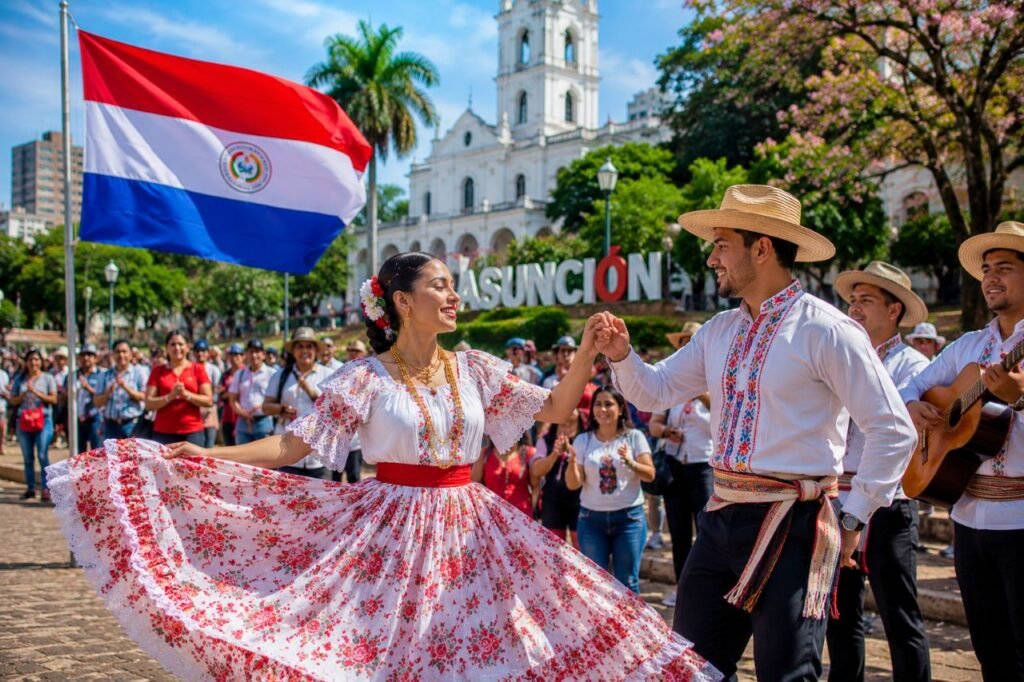
Men traditionally wear a lightweight, white cotton shirt known as an Ao Po’i, featuring intricate geometric embroidery along the collar and chest, perfect for the hot tropical climate. For formal celebrations, women wear long, flowing tiered skirts adorned with colorful strips of Ñandutí lace and matching embroidered blouses.
National Symbols
The flag of Paraguay holds a unique historical distinction: it is the only national flag in the world with different designs on its front and back. The front (obverse) features the national coat of arms with a golden star enclosed by a palm and olive branch. The back (reverse) features the Seal of the Treasury, showing a lion guarding a staff topped with a liberty cap, representing peace and liberty under the national motto: “Paz y Justicia” (Peace and Justice).
Music, Dance & Art
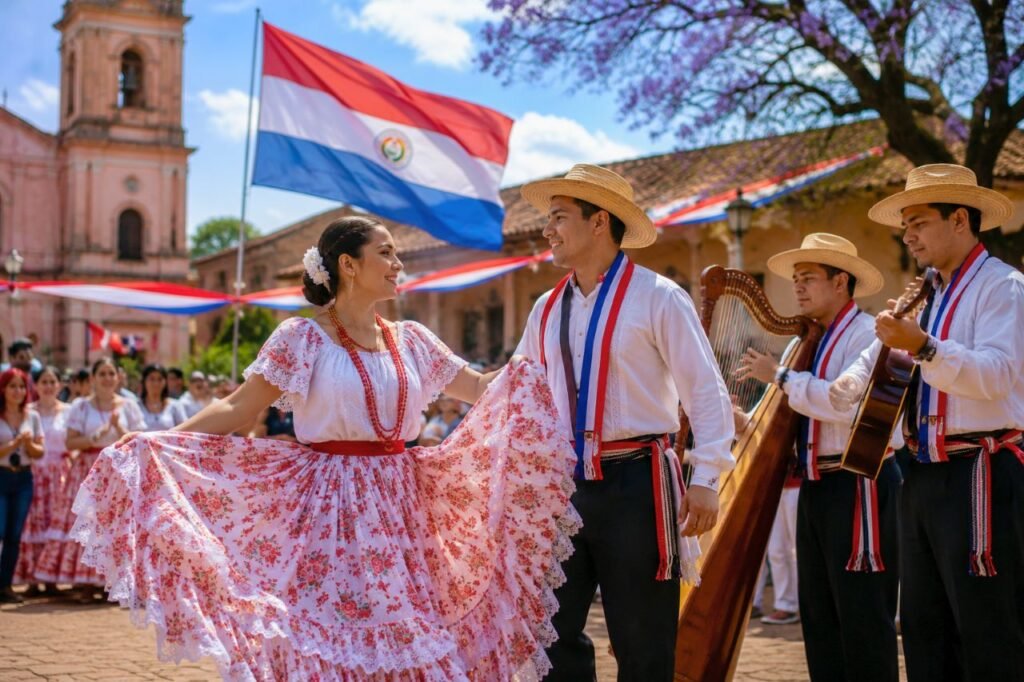
Festival dance in the sunlit plaza, Paraguay culture
The Paraguayan Harp
While music across South America is often dominated by guitars and heavy percussion, the soul of Paraguay is captured by the Paraguayan Harp (arpa paraguaya). Brought by Jesuit missionaries, the instrument was adapted by local craftsmen who crafted it from native tropical woods, creating a lighter harp played entirely by ear without foot pedals.
The music of the harp is fast, melodic, and highly expressive, famously mimicking the sounds of nature, galloping horses, or tropical birds in classic folk pieces like “Pájaro Campana” (The Bellbird).
The Spectacular Bottle Dance
Paraguayan folk dance is an energetic display of rhythm and balance. The most famous performance is the Danza de la Botella (Bottle Dance), where female dancers dressed in traditional Ao Po’i attire balance multiple glass bottles stacked vertically on top of their heads while performing intricate spins and steps. Skilled dancers can balance up to ten bottles at once, showcasing incredible poise and core strength.
Summary
The culture of Paraguay is a beautiful testament to the power of cultural integration and resilience. By embracing its indigenous Guaraní language alongside its Spanish colonial history, this landlocked nation has carved out one of the most distinctive and authentic identities in the Americas. From the shared circle of an ice-cold tereré to the delicate, vibrant threads of a hand-woven Ñandutí lace, Paraguay stands proud—inviting the world to discover a rich, warm, and profoundly united cultural heritage.
At Best Culture Insight, we see culture as the heartbeat of every society—the way people live, connect, and express their identity.