The Land of Six Peoples: A Deep Journey Into Guyana Culture
Posted in :

Nestled on the northeastern shoulder of South America, facing the Atlantic Ocean, lies Guyana—the only English-speaking nation on the continent. Known officially as the Co-operative Republic of Guyana, its name stems from an indigenous word meaning “Land of Many Waters.”
While geographically tied to the South American mainland, Guyana is culturally, historically, and politically a Caribbean nation. Its identity is not defined by a single heritage, but by a beautiful blend known as the “Land of Six Peoples.” To immerse yourself in Guyanese culture is to encounter a society that celebrates shared space, national resilience, and a rich blend of traditions.
History & Origins
Before European contact, Guyana was inhabited by various Amerindian tribes, primarily the Arawaks and Caribs, who developed deep agricultural and fishing systems along the country’s vast river networks.
The historical landscape shifted dramatically in the late 16th and early 17th centuries when European powers, starting with the Dutch, established trading posts and sugar plantations. Control shifted between the Dutch, French, and British, before the British formally established the colony of British Guiana in 1831.
The plantation economy relied heavily on forced labor, drawing distinct groups across generations:

- Enslaved Africans were brought under brutal colonial systems to clear the coastal swamps and construct the seawalls.
- Following the abolition of slavery in 1834, colonial authorities brought Portuguese, East Indian, and Chinese indentured laborers to fill the labor gaps on the sugar estates.
This complex colonial history created a multi-ethnic society. Guyana achieved full independence from Great Britain on May 26, 1966, and officially became a cooperative republic in 1970, kickstarting an era dedicated to unifying its diverse people under the national motto: “One People, One Nation, One Destiny.”
Culture, Traditions & Customs
Marriage and Family Life
Family life in Guyana varies across ethnic lines but retains a deeply communal core. In Indo-Guyanese communities, traditional Hindu weddings (Vivah) are grand, multi-day celebrations that feature the Maticoor (a pre-wedding ritual led by women) and elaborate turmeric cleansing ceremonies. Afro-Guyanese communities often observe the Kwe-Kwe (or Que-Que), an energetic pre-wedding ancestral celebration filled with rhythmic drumming, folk singing, and dance designed to formally introduce the two families and offer marital advice to the couple.
Festivals and Public Holidays
Guyana’s national calendar highlights the peaceful coexistence of its religious traditions, with major Christian, Hindu, and Islamic celebrations observed as national public holidays.
- Mashramani: Celebrated on February 23 to mark Guyana’s Republic Day, this secular festival takes its name from an Amerindian word meaning “a celebration after cooperative work.” The streets of Georgetown fill with colorful costume float parades, vibrant masquerade bands, and competitive Calypso, Chutney, and Soca music festivals.
- Phagwah (Holi): The Hindu spring festival is celebrated by Guyanese of all backgrounds. People wear white clothing and playfully douse friends and neighbors with colorful powders (abeer) and water, symbolizing the triumph of good over evil.
- Diwali: The Festival of Lights is marked by the lighting of thousands of clay lamps called diyas along walkways and verandas, followed by spectacular illuminated vehicle motorcades.
- Easter Monday: A massive, cross-cultural event where thousands of families head to parks, seawalls, and open savannahs to fly handmade, colorful kites, symbolically commemorating the resurrection.
Languages & Communication
While English is the official language used in schools, government offices, and corporate commerce, the true voice of daily life is Guyanese Creole (Creolese). Creolese is an English-based creole with linguistic roots, syntax, and vocabulary heavily influenced by African, East Indian, Dutch, and Amerindian dialects.
Popular Guyanese Proverbs and Expressions:
- “Don’t lackey it” – Don’t waste time or mess around.
- “Every fish got its day in de frying pan” – Everyone will eventually face their day of reckoning.
- “Moon run til day catch it” – You can hide your misdeeds for a while, but you will eventually be exposed.
- “Ayo” – A plural form of “you” used when addressing a group.
Greetings are generally warm, expressive, and informal among acquaintances, shifting to polite British-influenced formalities (“Good morning,” “Good afternoon”) in professional environments.
Geography
Guyana is divided into four main geographic regions that shape its unique environmental identity:
- The Coastal Plain: A narrow, low-lying fertile strip along the Atlantic coast, protected by a vast system of Dutch-designed canals and seawalls. Over 90% of the population lives in this region.
- The White Sand Belt: An inland region rich in hardwood forests and mineral deposits, particularly bauxite.
- The Interior Highlands / Rainforest: A vast, untouched expanse of pristine tropical rainforest that blankets over 80% of the country’s landmass.
- The Rupununi Savannah: A vast, rolling grassland region in the south near the Brazilian border, home to indigenous ranching communities and diverse wildlife.
The country boasts massive river networks—including the Essequibo, Demerara, and Berbice rivers—and houses the majestic Kaieteur Falls, one of the world’s most powerful single-drop waterfalls.
Economy
Historically driven by agricultural commodities and raw resources—such as sugarcane, rice, timber, gold, and bauxite mining—Guyana’s economic profile has transformed dramatically due to massive offshore oil discoveries in the Stabroek Block.
This transformation has made Guyana one of the world’s fastest-growing economies. Despite this industrial shift, traditional agriculture, eco-tourism focused on rainforest preservation, and traditional artisanal crafts made by indigenous communities remain vital sources of livelihood for rural populations.
Politics
Guyana is a democratic, semi-presidential representative republic. The President serves as both head of state and head of government, exercising executive authority alongside a unicameral legislature called the National Assembly. Political participation is high, though historically influenced by ethnic voting patterns between the two largest groups. In international relations, Guyana serves as a proud founding member and host to the headquarters of the Caribbean Community (CARICOM) in Georgetown.
Ethnic Groups
The unique social fabric of Guyana is built on its diverse ethnic groups, officially recognized through historical migration records:
| Ethnic Origin | Approximate Population Share | Key Historic Contributions |
| Indo-Guyanese | ~40% | Introduced rice cultivation, traditional curries, roti, and Hindu/Islamic architecture. |
| Afro-Guyanese | ~30% | Developed the coastal village drainage networks, local civil services, and traditional folklore. |
| Mixed Race | ~20% | Bridges various cultural domains across urban centers. |
| Amerindian | ~10.5% | The first inhabitants; custodians of the interior rainforests and local sustainable farming techniques. |
| Chinese & Portuguese | ~1.5% | Introduced commercial shopkeeping, garlic pork traditions, and distinct cuisine elements. |
Beliefs & Values
Guyana’s religious landscape is remarkably diverse and legally protected. According to national census data, roughly 64% of the population identifies as Christian (across Protestant and Catholic denominations), 25% identifies as Hindu, and 7% identifies as Muslim (primarily Sunni).
A small percentage also practices indigenous faiths like Areruya, Rastafarianism, or traditional African-derived practices like Obeah and Cumfa drumming. Despite these distinct doctrines, Guyanese society places an immense moral value on interfaith solidarity, community hospitality, and the collective celebration of neighboring households’ religious milestones.
Food & Cuisine
Guyanese cuisine is a flavorful multi-ethnic experience, emphasizing fresh, locally sourced ingredients cooked using traditional, low-and-slow wood-fire methods (traditionally utilizing an outdoor clay stove known as a chulha).
Iconic Guyanese Dishes
- Pepperpot: The official national dish of Guyana. Inherited from Amerindian ancestors, this rich meat stew (made with beef, pork, or mutton) is flavored with cinnamon, hot peppers, and cassareep—a thick, dark, preservative syrup made from boiled cassava root. It is traditionally slow-cooked and served with dense, homemade braided bread on Christmas morning.
- Cook-up Rice: A beloved, comforting one-pot meal made by simmering rice, black-eyed peas (or split peas), and an assortment of meats in fresh coconut milk and local herbs. It is a Saturday evening staple across the nation.
- Roti and Curry: Reflecting East Indian roots, Guyanese curry features chicken, goat, duck, or chickpeas flavored with local spices and wrapped inside buss-up-shut or paratha roti—a soft, flaky, layered flatbread.
- Metemgee: A thick, rich soup made from ground provisions (cassava, yuca, sweet potatoes, plantains) boiled down in seasoned coconut milk and topped with fried fish or meat dumplings.
Clothing & Symbols
Traditional and Formal Attire
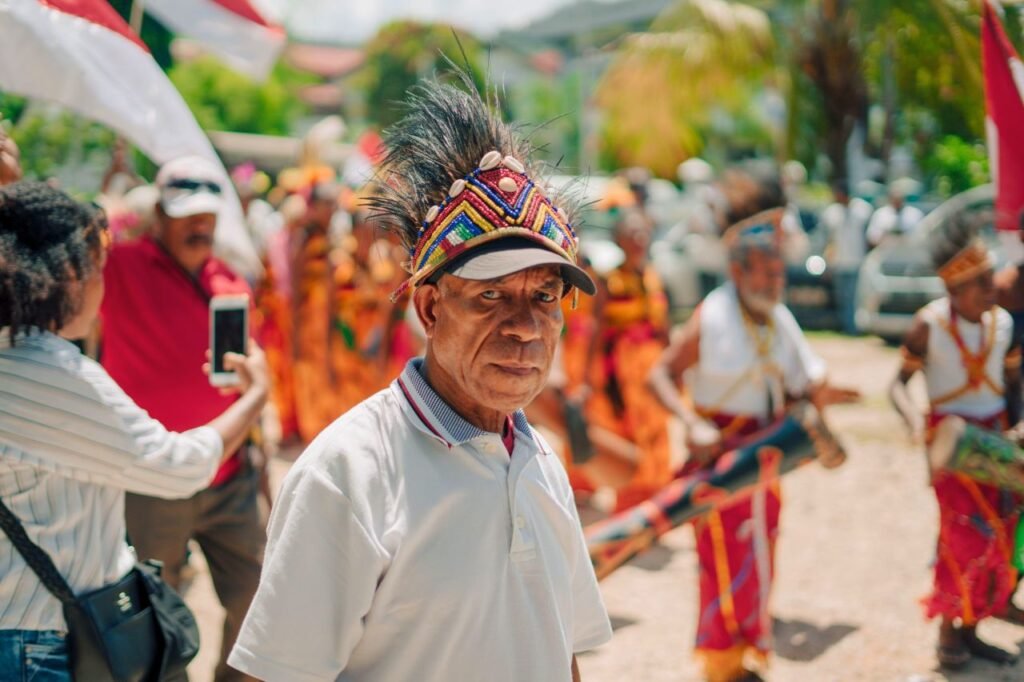
Modern Guyanese wear western-style apparel for day-to-day life, but traditional ethnic garments reappear during cultural festivals. During Diwali and Phagwah, Indo-Guyanese don elegant saris, shalwars, and kurtas. For Emancipation celebrations, Afro-Guyanese wear vibrant, intricately patterned African dashikis and headwraps.
A staple of casual formalwear for men across all ethnicities is the structured Shirt-Jac, a short-sleeved, button-down tunic suited for tropical climates.
Historic Architecture and Visual Symbols
Guyana’s built heritage is defined by magnificent, nineteenth-century British and Dutch wooden structures featuring Demerara windows—slatted wooden windows designed with ice-box mirrors to cool interior spaces. The national flag, known as the Golden Arrowhead, features a green field for agricultural and forest wealth, a white border for waters, a golden arrow representing a bright future, a black border for endurance, and a red triangle representing the dynamic nation-building spirit of its people.
Music, Dance & Art
Guyana’s expressive arts reflect its lively Caribbean and continental hybrid identity:
- Rhythms: The airwaves are dominated by Calypso, Soca, and Chutney music—a high-energy fusion of traditional Indian folk melodies mixed with upbeat Caribbean soca beats, driven by dholak drums and brass sections.
- Masquerade Dance: An energetic street-dance tradition featuring costumed performers on stilts, accompanied by boom drums and flutes, showcasing a fusion of West African performance art and local Guyanese folk storytelling.
- Visual Art: Guyana has produced world-renowned literary and visual masters. Authors like Edgar Mittelholzer and Wilson Harris captured the country’s landscape in literature, while painters and sculptors utilize rich local woods and canvas styles to reflect the pristine beauty of the Amazonian interior.
Summary
The culture of Guyana is a brilliant mosaic of history and heritage. By preserving its indigenous roots, honoring the legacies of its diverse ancestral populations, and embracing a shared Caribbean lifestyle, this South American gem demonstrates how unity can thrive within diversity. From the savory smell of Christmas morning Pepperpot to the colorful explosions of street parades, Guyana stands proud as a model of cultural preservation and harmony at the edge of the continent.
At Best Culture Insight, we see culture as the heartbeat of every society—the way people live, connect, and express their identity.