Stretching from the sun-drenched Pacific coast across the snow-capped peaks of the Andes and deep into the dense wilderness of the Amazon, Peru is a country of breathtaking physical and cultural landscapes. Known officially as the Republic of Peru, this South American nation stands as one of the world’s few cradles of pristine, ancient civilization.
To experience Peruvian culture is to witness a profound, living synthesis where thousands of years of pre-Columbian tradition blend seamlessly with Spanish colonial heritage and subsequent waves of global migration. It is a culture rooted in deep spiritual reverence for the earth, highly sophisticated ancestral artistry, and a world-renowned culinary identity that proudly celebrates diversity in every facet of life. Let’s dive into Peru culture.
History & Origins
Peru’s cultural history dates back over 5,000 years to the Caral-Supe civilization, recognized as the oldest known civilization in the Americas. Across millennia, a succession of highly advanced pre-Inca cultures—including the Chavín, Moche, Nazca, and Wari—flourished along the coastal deserts and high valleys, perfecting complex irrigation systems, monumental stone masonry, and stunning metallurgy.
In the 15th century, the Inca Empire (Tahuantinsuyo) unified these diverse regional cultures into the largest empire in pre-Columbian America. Centered in Cusco, the Incas constructed an extensive highway network across the Andes, developed advanced terraced agriculture, and built architectural masterpieces like Machu Picchu.

The historical path changed permanently in 1532 when Spanish conquistadors led by Francisco Pizarro arrived, capitalizing on an internal Inca civil war to capture the empire. The resulting colonial era established the Viceroyalty of Peru, making Lima a major seat of Spanish imperial power. This period introduced European architecture, language, and Roman Catholicism, which combined with indigenous traditions. Peru fought for its freedom and declared independence on July 28, 1821, led by the liberator José de San Martín, entering a modern era dedicated to building a unified republic from its diverse roots.
Culture, Traditions & Customs
Community Alliances and Rites of Passage
In the rural Andean highlands, social organization relies heavily on the Ayllu—a traditional system of extended family communities dating back to Inca times. Within the Ayllu, community labor is governed by the principle of Ayni, a Quechua concept meaning “today for you, tomorrow for me.” This deep-seated system of mutual reciprocity means neighbors collectively pool labor to construct houses, harvest crops, or organize community events.
Traditional milestones blend Catholic sacraments with ancient Andean customs:
- Rutuchi: A pre-Inca first haircutting ceremony for toddlers around the age of two. Godparents and family members take turns cutting a lock of the child’s hair, offering a financial gift or token of livestock to help build the child’s future savings.
- Sirvinakuy: An ancient form of trial marriage still practiced in some traditional Andean communities, where a couple lives together cohabitationally to establish a household before formalizing their bond through church or state ceremonies.
Major Festivals
Peru’s cultural calendar features over 3,000 annual festivals, most representing a unique blend of Catholic feast days and indigenous cosmic celebrations.
- Inti Raymi (Festival of the Sun): Celebrated every June 24 at the fortress of Sacsayhuamán in Cusco, this spectacular, highly choreographed indigenous ceremony honors the winter solstice and the sun god Inti, drawing thousands of international visitors.
- Fiesta de la Candelaria: Held in Puno on the shores of Lake Titicaca, this massive festival is a vibrant explosion of traditional music and dance, featuring thousands of musicians and dancers performing the Diablada (Dance of the Demons) in elaborate, colorful masks.
- Señor de los Milagros (Lord of the Miracles): Every October, the streets of Lima fill with hundreds of thousands of devotees dressed in deep purple robes to carry a historic, seventeenth-century mural painting of Jesus Christ through the city center in one of the largest Catholic processions in the Americas.
Languages & Communication
Peru is a multilingual nation. Under the national constitution, Spanish is the primary official language, spoken by roughly 84% of the population. However, deep institutional protections are granted to indigenous tongues, most notably Quechua (spoken by over 13% of the population, primarily across the highlands) and Aymara (prevalent in the southern Altiplano region), alongside dozens of distinct Amazonian tribal dialects.
[ The Linguistic Landscape of Peru ] ┌─────────────────────────┬─────────────────────────┬─────────────────────────┐ │ Spanish │ Quechua │ Aymara │ │ The primary language of │ The ancient tongue of │ Spoken widely around │ │ government, education, │ the Incas, preserved │ Lake Titicaca and the │ │ and urban commerce. │ across the highlands. │ southern Altiplano. │ └─────────────────────────┴─────────────────────────┴─────────────────────────┘Peruvian Spanish is known for its relatively clear, polite, and expressive pronunciation, frequently incorporating affectionate suffixes (-ito or -ita) and distinct localized idioms:
- “Chela” – A casual, widely used term for a beer.
- “Choche” / “Pata” – Popular slang words used to address a close friend.
- “Asu mare!” – A common exclamation expressing deep shock, surprise, or amazement.
Geography
Peru is divided into three sharply distinct geographic regions that heavily influence the lifestyle, economy, and traditions of their respective populations:
- La Costa (The Coast): A narrow, hyper-arid desert strip running along the Pacific ocean, broken up by fertile river valleys. It houses major urban centers like Lima and Trujillo, and is characterized by a reliance on marine fishing and commercial commerce.
- La Sierra (The Highlands): The towering peaks and high valleys of the Andes mountain range. This region features severe mountain terrain, extreme temperature shifts, and high-altitude cities like Cusco, Arequipa, and Puno.
- La Selva (The Jungle): A massive expanse of dense Amazonian tropical rainforest covering over 60% of the country’s territory. It is home to incredible biodiversity and vibrant river network trading hubs like Iquitos and Puerto Maldonado.
Economy
Peru possesses a dynamic market economy historically driven by its rich geological and natural resources. The country ranks as a top global producer of copper, silver, zinc, and gold. Beyond mineral extraction, traditional agriculture remains a vital foundation for rural communities, with Peru serving as a leading global exporter of coffee, asparagus, avocados, and thousands of varieties of native potatoes. Furthermore, international tourism centered around world heritage sites like Machu Picchu and a thriving textile export industry form major pillars of national economic growth.
Politics
Peru is a democratic presidential representative republic. The President acts as both head of state and head of government, holding executive power alongside a unicameral legislature known as the Congress of the Republic. Political participation is high, with voting legally mandatory for all citizens between the ages of 18 and 70. The country’s modern political history has focused heavily on strengthening democratic institutions, decentralizing authority to regional governments, and driving balanced economic integration across its distinct geographic zones.
Ethnic Groups
Peru’s contemporary population is a beautiful testament to centuries of cross-cultural integration, resulting in a rich multi-ethnic tapestry:
| Ethnic Origin | Approximate Population Share | Cultural and Historic Footprint |
| Mestizo | ~60% | Blends Spanish and indigenous roots; forms the demographic majority in most large urban centers. |
| Amerindian | ~26% | Composed primarily of highland Quechua and Aymara peoples, alongside over 50 distinct Amazonian ethnic groups. |
| White / European | ~6% | Descendants of Spanish colonial settlers, alongside later waves of Italian, German, and British immigrants. |
| Afro-Peruvian | ~3.6% | Historically centered along the southern coast; introduced world-famous percussion music, dance, and culinary styles. |
| Asian-Peruvian | ~1% | Primarily Chinese and Japanese descendants; profoundly transformed Peru’s national cuisine and commercial trade. |
Beliefs & Values
While roughly 74% of Peruvians identify as Roman Catholic and over 14% belong to evangelical Protestant denominations, actual spiritual practice across the country is defined by religious syncretism.
In the Andean worldview, Christian saints are frequently paired with pre-Columbian deities. Most notably, the Virgin Mary is deeply integrated with Pachamama (Mother Earth), who remains a central figure of spiritual devotion. Before building a house, traveling a dangerous mountain highway, or harvesting crops, Peruvians of all backgrounds perform a Pago a la Tierra (Payment to the Earth)—a traditional ritual offering of coca leaves, chicha (corn beer), and sweets to ensure protection, spiritual balance, and agricultural abundance.
Food & Cuisine
Peruvian cuisine is universally recognized as one of the world’s finest, celebrated for its astonishing diversity of ingredients drawn from the country’s 84 distinct microclimates.
Iconic Dishes and Culinary Meaning
- Ceviche: The undisputed national dish of Peru. It consists of fresh, raw ocean fish cured in sharp, freshly squeezed key lime juice, tossed with sliced red onions and fiery rocoto chilies. It is served cold alongside sweet potato (camote) and large-kernel Andean corn (choclo).
- Pachamanca: An ancient, profoundly symbolic Andean cooking method dating back to the Inca Empire. An assortment of meats (lamb, pork, chicken), potatoes, corn, and lima beans are seasoned with local herbs like huacatay (black mint) and slow-cooked underground over red-hot volcanic stones, covered with plantain leaves and earth.
- Lomo Saltado: A perfect example of Chinese-Peruvian (Chifa) fusion cuisine. It features tender strips of beef flash-fried in a roaring wok with red onions, tomatoes, soy sauce, and vinegar, served together with both crispy french fries and white rice.
- Causa Rellena: A cold potato terrine made from yellow potatoes mashed with spicy yellow chili pepper (ají amarillo) and lime juice, layered with a filling of shredded chicken or tuna salad.
Clothing & Symbols
Textile Arts and Identity
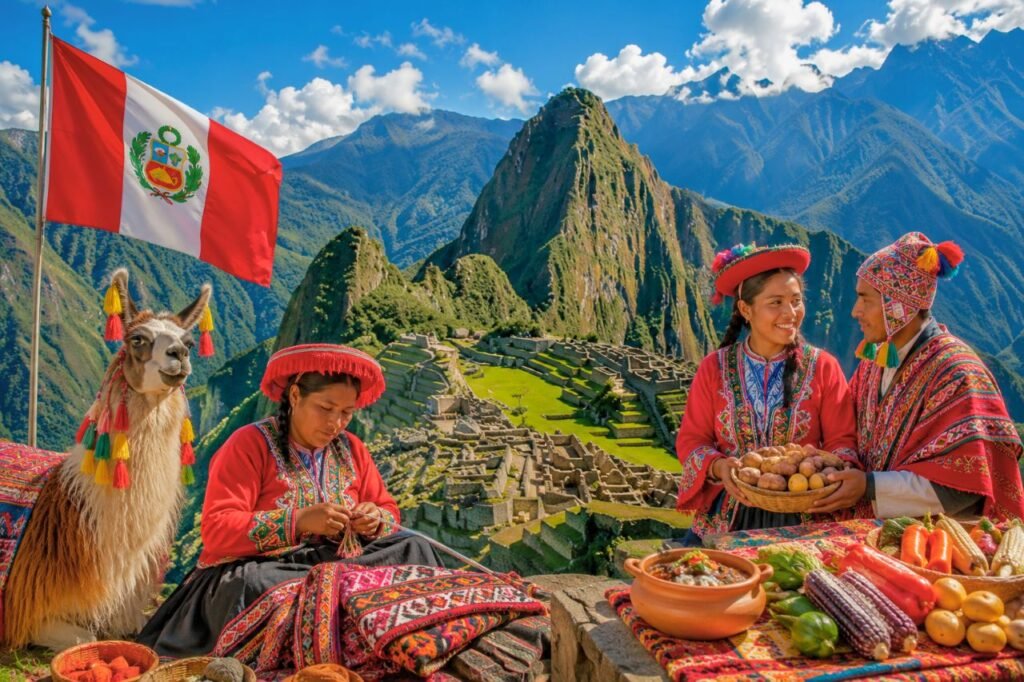
Peruvian traditional textiles are among the finest hand-woven fabrics in the world, serving as a vital visual language across the Andean highlands. Utilizing backstrap looms and hand-spun yarn dyed naturally with plants and insects (like cochineal), weavers create intricate geometric patterns that communicate an individual’s village, social status, and relationship to local mountain gods (Apus).
Classic garments include the Chullo—a warm alpaca wool cap with ear flaps, traditionally knitted by men—and the Poncho, worn extensively by highland men for insulation against mountain winds. Highland women wear the Pollera, a heavy, layered wool skirt paired with a distinctive felt brim hat, with style variations identifying specific regional valleys.
National Symbols
The national flag of Peru features three vertical bands of red, white, and red. The red symbolizes the blood spilled by patriots during the fight for freedom, while the white represents peace and purity. The central coat of arms prominently features a Vicuña (representing fauna wealth), a Cinchona Tree (representing flora wealth and the source of quinine), and a Cornucopia spilling gold coins, showcasing the country’s abundant mineral resources.
Music, Dance & Art
Musical Rhythms and Instruments
Peru’s musical heritage spans several distinct regional traditions:
- Andean Melodies: Driven by the haunting, ethereal sounds of the Quena and Zampoña (traditional panflutes) paired with the Charango—a small, ten-stringed guitar traditionally crafted from an armadillo shell.
- Afro-Peruvian Grooves: Built around the Cajón, a hollow wooden box drum that players sit on and strike with their hands, creating complex polyrhythms that form the backbone of coastal folk music.
National Dance
The national dance of Peru is the Marinera, an elegant, high-energy courtship dance performed along the coast. Dancers dress in beautiful, flowing white outfits, with the man wearing a traditional wide-brimmed straw hat and poncho, while the woman dances completely barefoot. Using white silk handkerchiefs to trace complex patterns in the air, the pair performs a dramatic game of flirtation, rhythm, and impeccable poise.
Summary
The culture of Peru is a brilliant celebration of historical endurance, artistic genius, and profound geographical diversity. By maintaining an unbroken link to its ancient Inca ancestors while welcoming global cultural influences, this South American nation has created a deeply authentic and globally celebrated identity. From the spiritual payment made to Pachamama to the complex flavors of a fresh plate of ceviche, Peru stands as a proud guardian of cultural wealth, warmly inviting the world to experience its timeless heritage.
At Best Culture Insight, we see culture as the heartbeat of every society—the way people live, connect, and express their identity.