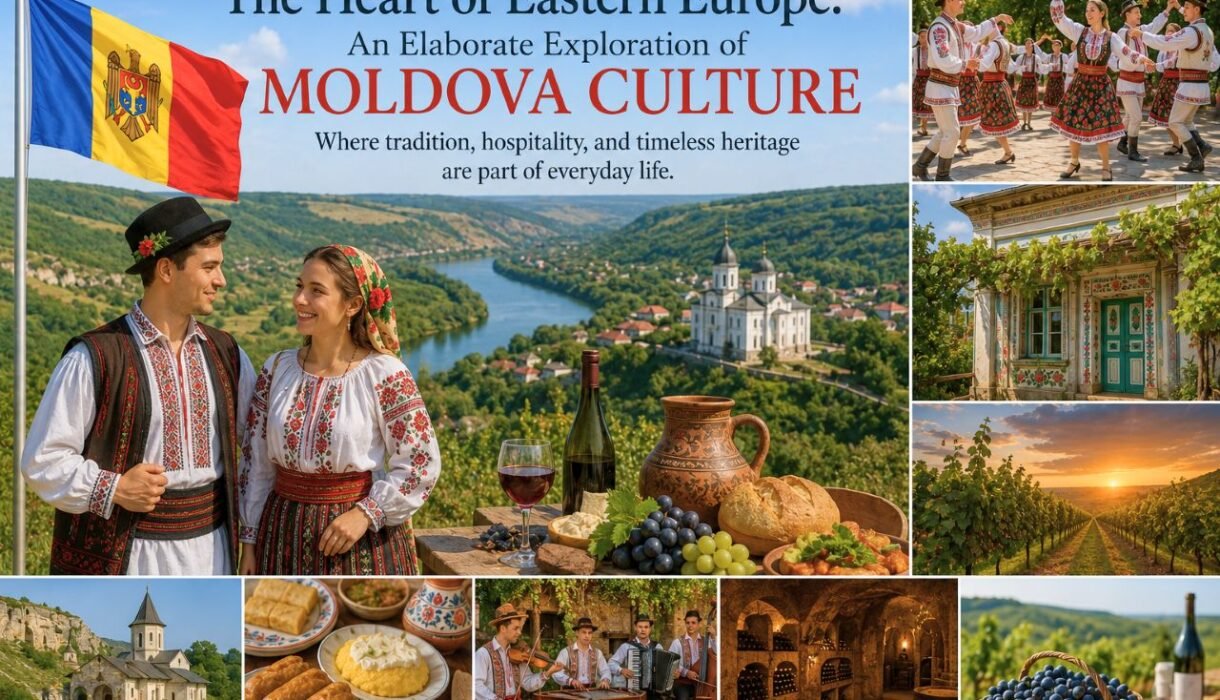

Tucked away between Romania and Ukraine in Eastern Europe, Moldova is a land of rolling green hills, ancient forests, and a rich, deeply poetic cultural heritage. Often described as one of Europe’s hidden gems, this peaceful, landlocked nation boasts an incredibly warm-hearted population (Moldoveni) whose traditions reflect a unique historical bridge between Latin Europe and the Slavic world.
Known globally for its world-class winemaking, intricate folklore, and legendary hospitality, Moldova offers a fascinating glimpse into an authentic, slow-paced lifestyle where heritage is not just remembered—it is lived daily. This research-driven, comprehensive guide celebrates and preserves the cultural wealth of Moldova, highlighting the enduring customs that define its people.
History & Origins
Moldova’s cultural identity is forged from centuries of surviving at the crossroads of powerful empires.
- Ancient Roots and the Geto-Dacians: The earliest ancestors of the Moldovan people were the Geto-Dacians, an ancient Indo-European tribe. They integrated into the Roman Empire in the first centuries AD, adopting the Latin language and culture that form the basis of modern Moldovan identity.
- The Medieval Principality: The foundation of Moldovan statehood dates back to 1359, when the Principality of Moldavia was established. Under its most celebrated ruler, Stephen the Great (Ștefan cel Mare), who reigned from 1457 to 1504, Moldavia successfully defended its territory against the Ottoman Empire, constructing numerous fortresses and monasteries that remain cultural symbols today.
- From Empires to Independence: By the 16th century, Moldavia fell under Ottoman suzerainty. In 1812, the eastern half of the region (known as Bessarabia) was annexed by the Russian Empire. Following a brief unification with Romania after World War I, the territory was annexed by the Soviet Union, becoming the Moldavian SSR. Moldova peacefully reclaimed its sovereignty, declaring full independence on August 27, 1991.
Culture, Traditions & Customs
The Martisor Festival
The arrival of spring is marked by one of Moldova’s most beloved and poetic traditions: Mărțișor.
On March 1st, people exchange small, handmade talismans made of intertwined red and white threads, often adorned with tassels, flowers, or coins. The white thread symbolizes purity, peace, and the melting snow, while the red thread represents vitality, love, and the warmth of the sun. Moldovans wear these pins on their chests close to their hearts throughout the month of March. At the end of the month, they tie the threads to the branch of a blossoming fruit tree to bring health, prosperity, and good luck for the rest of the year.
Marriage and Family Traditions
In Moldova, weddings (Nunți) are grand, theatrical affairs that can last for days. They are packed with ancient rituals meant to secure a prosperous future for the newlyweds:
- The Godparents (Nășii Mari): Unlike Western traditions where godparents are chosen only for children, a Moldovan couple must select an older, respected married couple to act as their “spiritual wedding parents.” The Nășii Mari guide the young couple throughout their married life and hold a position of honor second only to the biological parents.
- The Bread of the Bride (Colacul Miresei): An elaborately braided circular bread is held over the bride’s head by her godmother, torn into pieces, and shared among the guests to symbolize fertility and communal sharing.
Life Passages and Naming Ceremonies
Following a birth, a naming ceremony and baptism (Cumătria) is held. The child is assigned several spiritual guardians called cumătri. This celebration is a joyful, festive banquet that cements lifelong networks of mutual support.
Another essential rite of passage is the Claca—a historic tradition of communal mutual aid. When a young family needs to build a house or harvest their crops, the entire village gathers to do the work together, finishing the day with a communal feast of food, music, and wine.
Languages & Communication
Romanian / Moldovan: A Romance Tongue
The official state language of Moldova is Romanian (historically and constitutionally also referred to as Moldovan). It is a Romance language closely related to Italian, French, Spanish, and Portuguese, direct evidence of the region’s Latin ancestry.
Due to its decades spent within the Russian Empire and the Soviet Union, a significant portion of the population is bilingual, speaking Russian fluently. It is also common to hear Russian vocabulary blended into informal, everyday Moldovan speech.
Greetings and Everyday Etiquette
Moldovans communicate with earnest politeness and respect.
- “Bună ziua!”
Meaning: “Good day!” — the standard, respectful greeting for anyone you meet.
- “Mulțumesc!”
Meaning: “Thank you!”
- “Oaspeții sunt trimiși de Dumnezeu.”
Meaning: A beautiful Moldovan proverb translating to “Guests are sent by God.” This encapsulates the local worldview: if you step into a Moldovan home, you will instantly be treated as royalty, seated at the finest table, and served the best homemade food and wine.
Geography
Moldova’s landscape is remarkably picturesque, dominated by gently undulating hills, fertile black soil (cernoziom), and quiet river valleys.
The country is cradled between two main rivers: the Prut to the west, which forms the border with Romania, and the Dniester (Nistru) to the east. Central Moldova is home to the legendary Codri—an ancient, dense forest ecosystem filled with oak, beech, and linden trees. This region serves as a prominent sanctuary for native wildlife and is deeply woven into national folklore as a symbol of refuge and natural strength.
Economy
Moldova has historically relied on its exceptionally fertile agricultural lands, making it a prominent producer of fruits, vegetables, grains, and sunflower seeds.
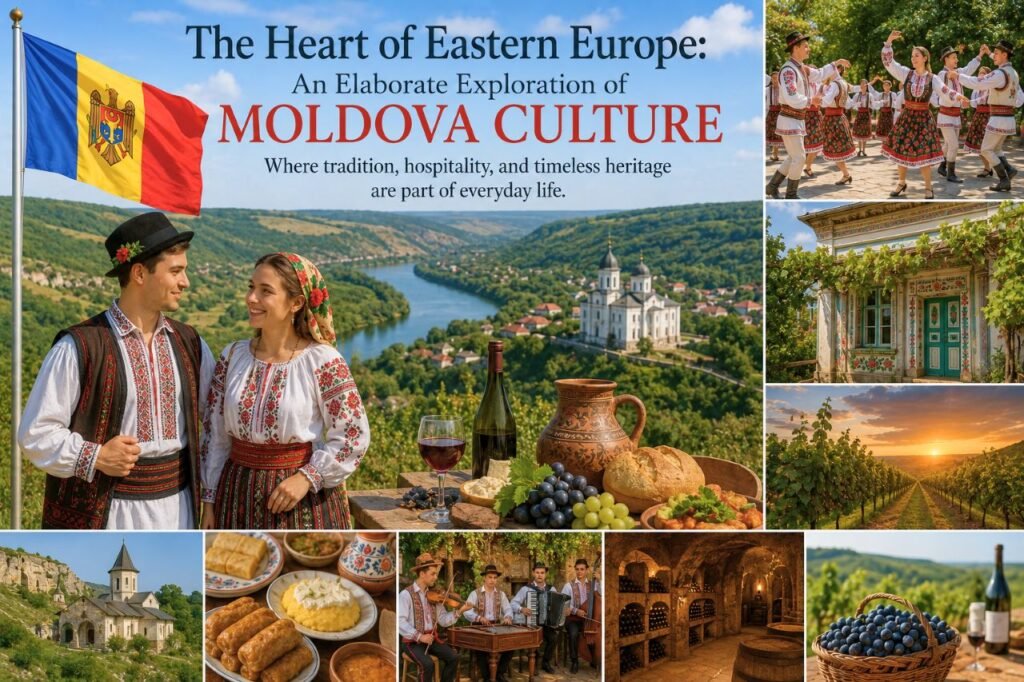
- A Wine Superpower: Wine is the crown jewel of the Moldovan economy. The country has one of the highest densities of vineyards in the world relative to its size. It is home to Mileștii Mici, which holds the Guinness World Record for the largest wine cellar by number of bottles (over 1.5 million), and Cricova, a massive underground network of limestone tunnels spanning over 120 kilometers used entirely for wine storage and tasting.
- Transitioning Sectors: In recent years, Moldova has successfully diversified, growing its Information Technology (IT) export sector, light manufacturing, and automotive components, backed by free economic zones.
Politics
Moldova is a unitary parliamentary representative democratic republic.
The President serves as the head of state, while the Prime Minister acts as the head of government, exercising executive power alongside the Cabinet. Legislative power is vested in a 101-seat unicameral Parliament. In recent years, Moldova has embarked on a decisive pro-European path, obtaining EU candidate status in 2022 and actively pursuing reforms to align its judicial, political, and economic structures with Western democratic standards.
Ethnic Groups
While ethnically Moldovan/Romanian citizens form the vast majority of the population, the country is home to a peaceful and culturally diverse tapestry of minority communities.
| Ethnic Group | Approximate Share | Primary Region / Cultural Influence |
| Moldovans / Romanians | ~82.1% | Distributed nationwide; primary bearers of the Latin linguistic and cultural heritage |
| Ukrainians | ~6.6% | Concentrated mostly in northern Moldova and the Transnistria region |
| Gagauz | ~4.6% | An Orthodox Christian Turkic group residing in the autonomous region of Gagauzia in the south |
| Russians | ~4.1% | Primarily urban populations and concentrated in the eastern Transnistria region |
| Bulgarians | ~1.9% | Located mostly in southern districts such as Taraclia, preserving Bulgarian language and customs |
Beliefs & Values
Eastern Orthodox Christianity
The spiritual life of Moldova is anchored in Eastern Orthodox Christianity, practiced by over 90% of the population.
Churches and monasteries are architectural marvels and spiritual sanctuaries. Historic rock-hewn monastery complexes, such as Orheiul Vechi, are carved directly into limestone cliffs overlooking the Răut River. These sites have served as centers of prayer, literacy, and resistance during times of foreign invasion for centuries.
Food & Cuisine
Moldovan cuisine is simple, rustic, and incredibly comforting, designed to fuel agricultural life using fresh, seasonal ingredients.
- Mămăligă: The absolute staple of any Moldovan table. It is a thick, golden yellow porridge made from boiled cornmeal, similar to Italian polenta but much firmer. It is sliced using a clean cotton string and traditionally served with tocană (pork stew), fresh sheep’s milk cheese (brânză), and a dollop of sour cream (smântână).
- Sarmale: Delicate cabbage or grape leaves stuffed with a seasoned mixture of minced pork, beef, rice, onions, and carrots, then slow-cooked in clay pots for hours.
- Plăcinte: Traditional, flaky round pastries stuffed with various fillings. The most popular options are fresh dill and curd cheese (brânză de vaci), grated pumpkin, sweet apples, or sour cherries.
Clothing & Symbols
The Traditional Costume and the “Ia” Blouse
The traditional Moldovan costume is an artistic masterpiece. The most prominent piece is the Ia (pronounced “ee-ah”), a traditional white linen or cotton blouse meticulously embroidered by hand with geometric and floral patterns.
- Symbolic Embroidery: The colors and symbols embroidered onto the Ia are deeply meaningful. Red represents life, passion, and vitality; black symbolizes the fertile earth and the memory of ancestors; while green reflects youth and the natural world. Common motifs include the “Tree of Life” (representing cosmic connection) and the “Path of the Sun” (representing progress and eternity).
- The Cușmă: In winter, Moldovan men traditionally wear the cușmă, a tall, conical hat made of black or grey lambskin, which has become a beloved symbol of rural pride.
Music, Dance & Art
The Hora: The Dance of Unity
Traditional dance is the ultimate expression of communal joy in Moldova. The Hora is a traditional circle dance where participants hold hands, moving in a rhythmic, circular pattern that symbolizes unity, equality, and cosmic alignment. During weddings and national holidays, a Hora can swell to include hundreds of people swirling together in perfect harmony.
Traditional Musical Instruments
- Nai: The traditional Romanian/Moldovan pan flute, capable of producing hauntingly beautiful, ethereal melodies that mimic wind, rustling leaves, and bird calls.
- Cobza: A traditional multi-stringed lute used to provide rhythmic accompaniment to violins and accordions during folk celebrations.
- Doina: A melancholic, deeply emotional musical style. Often improvised, it expresses themes of longing (dor), love, and the natural world, recognized by UNESCO as part of humanity’s Intangible Cultural Heritage.
Summary
Moldova’s culture is a living testament to the beauty of simplicity, community, and respect for one’s roots. From the shared threads of the Mărțișor to the majestic, historic wine cellars of Mileștii Mici, the Moldovan people have carefully preserved an ancient identity. Through a unique blend of Latin warmth and Eastern European resilience, Moldova invites the world to slow down, share a glass of wine, and celebrate the deep-seated cultural diversity that enriches our world.
At Best Culture Insight, we see culture as the heartbeat of every society – the way people live, connect, and express their identity.