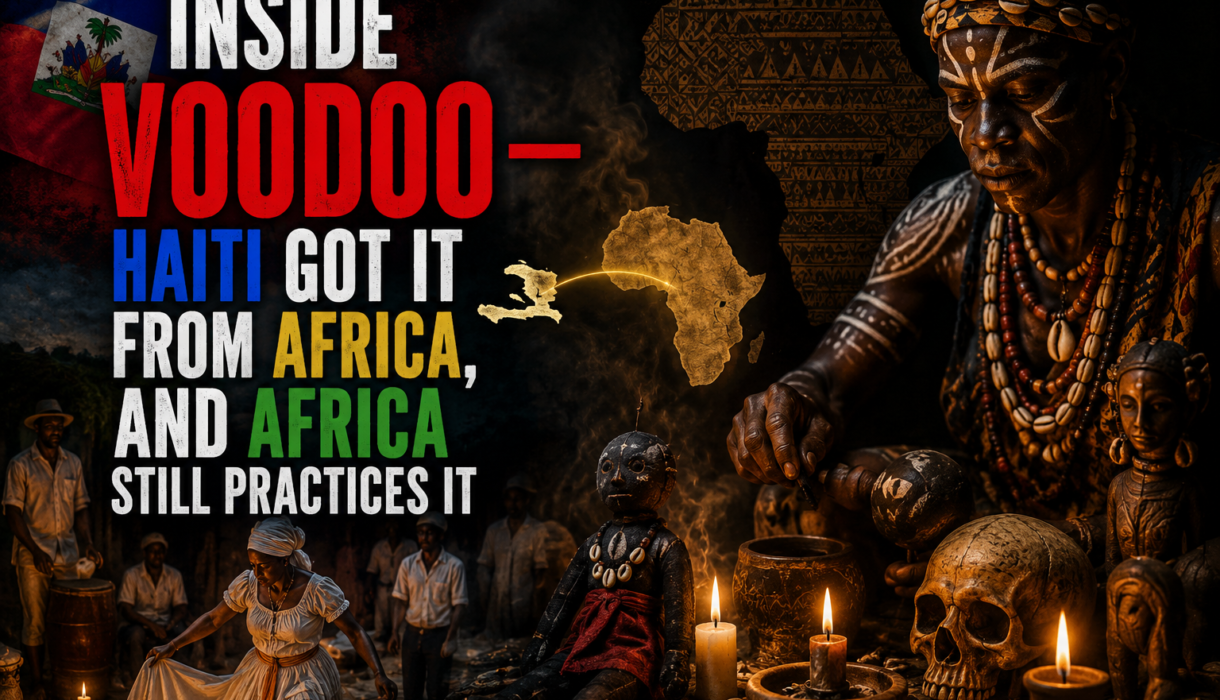
Inside Voodoo — Haiti Got It From Africa, and Africa Still Practices It
Posted in :

The mention of “Voodoo” often conjures Hollywood-inspired imagery of dark magic, mysterious curses, and pin-cushion dolls. However, the reality of this ancient spiritual system is grounded in profound community, reverence for nature, and cultural survival. To understand Voodoo, one must look beyond the cinematic myths to its true birthplace: West Africa. Transformed by the fires of the transatlantic slave trade, this ancestral faith traveled across the ocean to become the bedrock of Haitian identity, creating an unbreakable spiritual bridge between the African continent and the Caribbean.
The West African Cradle: The True Meaning of Vodun
Long before it reached the shores of the Americas, Voodoo existed—and still exists—as Vodun (meaning “spirit” or “deity” in the Fon and Ewe languages). Originating primarily along the Gulf of Guinea, in modern-day Benin, Togo, and parts of Nigeria and Ghana, Vodun is an indigenous, monotheistic religion. Practitioners believe in a supreme creator God, Mahou or Mawu, who is too vast to approach directly. Instead, believers connect with the divine through lesser spirits called Voduns, who govern the natural elements like earth, water, and fire, acting as intermediaries between the physical and spiritual realms.
The Middle Passage and the Birth of Haitian Vodou
During the transatlantic slave trade, millions of West Africans from the Dahomey, Yoruba, and Kongo kingdoms were captured and enslaved in colonial Saint-Domingue (now Haiti). Forced to abandon their traditions and convert to Roman Catholicism, the enslaved population engaged in a brilliant act of spiritual preservation. They mapped their African deities onto Catholic saints, hiding their true worship in plain sight. This fusion birthed Haitian Vodou, a resilient faith that ultimately served as the psychological and revolutionary catalyst for the Haitian Revolution, enabling the world’s first successful slave revolt and the birth of the first independent Black republic.
Living Tradition: How West Africa Practices Today
While Haitian Vodou evolved into its own distinct and beautiful branch, the original African Vodun never faded. Today, West Africa remains the vibrant heartland of the faith, where it is practiced openly and with immense national pride. In Benin, Vodun is recognized as an official national religion, celebrated annually with a major national holiday on January 10th that draws thousands of international pilgrims. From the bustling fetish markets of Lomé, Togo, to sacred family shrines across the region, millions of Africans continue to look to Vodun for guidance, traditional medicine, and holistic justice, proving that the religion is a living, breathing component of modern African life.
Dismantling the Myth for a Global Audience
The sensationalized, negative portrayal of Voodoo is largely a legacy of colonial propaganda designed to demonize African and Haitian independence. In reality, both the African and Haitian expressions of the faith prioritize harmony with nature, deep respect for ancestors, and community healing. Rituals involve drumming, complex dances, and spiritual possession, where deities are invited to heal the sick or offer wisdom to the living. By recognizing the profound connection between West African Vodun and Haitian Vodou, global observers can appreciate a sophisticated world religion that has survived centuries of suppression to remain a source of strength, identity, and peace.