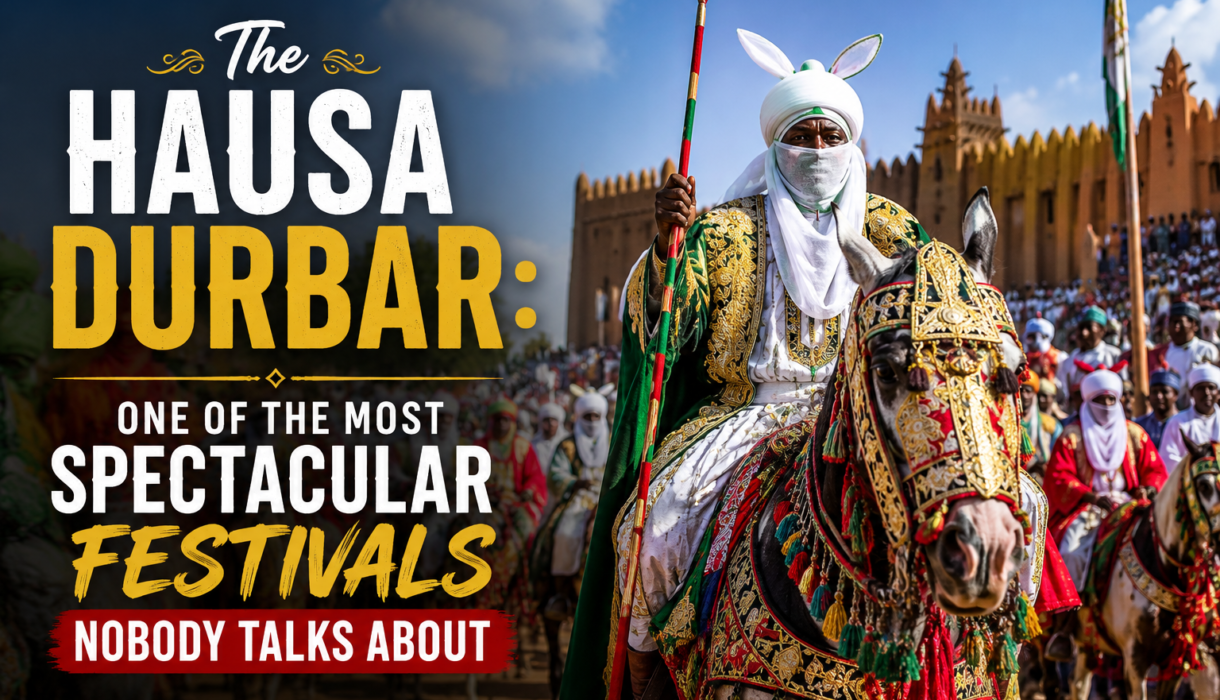
The Hausa Durbar: One of the Most Spectacular Festivals Nobody Talks About
Posted in :

When people think of the world’s most spectacular cultural carnivals, events like the Rio Carnival or India’s Holi often dominate the conversation. Yet, tucked away in Northern Nigeria lies the Hausa Durbar (Hawan Sallah or Hawan Daushe), a breathtakingly colorful, centuries-old equestrian festival that easily rivals any global spectacle. Celebrated twice a year at the end of the Islamic holy months of Eid al-Fitr and Eid al-Adha, the Durbar is a glorious explosion of royal pageantry, military-like discipline, and vibrant African heritage. Despite its jaw-dropping scale, this mesmerizing display of culture remains one of the travel world’s best-kept secrets, quietly preserved by the ancient emirates of the Sahel.
The Ancient Origins of Military Might
The origins of the Durbar stretch back over 500 years to the late 15th century, during the reign of Sarki Muhammadu Rumfa, the legendary Emir of Kano. Initially, the festival was not merely ceremonial; it served as a vital military parade. The royal cavalry would gather in front of the Emir’s palace to demonstrate their combat readiness, showcase their equestrian prowess, and pledge their unwavering loyalty to the crown before marching off to defend the kingdom. Over the generations, through colonial encounters and modern transformations, this display of medieval military strength evolved into a highly coordinated, peaceful celebration of Northern Nigerian identity and Islamic unity.
A Sensory Explosion of Color and Sound
Today, attending a Durbar in historic cities like Kano, Katsina, or Zazzau (Zaria) is like stepping directly into a living history book. The entire city square transforms as thousands of horsemen draped in multi-colored, hand-woven regalia and massive, beautifully wound turbans (Rawani) take to the streets. The horses themselves are dressed just as lavishly, adorned with silver-embossed leather saddles, brass stirrups, and vibrant velvet blankets. Accompanying this sea of color is a rhythmic wall of sound—the deep booming of traditional drums, the chanting of praise singers, and the piercing, hypnotic notes of the Kakaki, a remarkably long metal trumpet reserved exclusively for royalty.
The Thrilling Climax: The Jahi Salute
The undisputed highlight of the multi-day festival is a heart-stopping event known as the Jahi race. During this ritual, regiments of noble horsemen line up at one end of the square, draw their swords, and charge at a terrifying, full-speed gallop directly toward the seated Emir. Just as they seem on the verge of crashing into the royal pavilion, the riders display flawless coordination, pulling back their reins to halt their steeds abruptly only a few feet away. They raise their golden swords in the air, shouting praises to salute their leader’s authority. It is an incredible display of raw trust, control, and bravery that leaves onlookers completely spellbound.
A UNESCO-Recognized Treasure Worth Discovering
The Hausa Durbar is more than just an entertaining parade; it is an invaluable cultural ecosystem that supports local leatherworkers, weavers, and blacksmiths who pass down their ancient crafts through the generations. Recognizing its profound importance to global heritage, the Kano Durbar Festival was officially inscribed on UNESCO’s Representative List of the Intangible Cultural Heritage of Humanity. As travelers continuously search for genuine, untamed, and historically intact adventures, this magnificent equestrian festival stands ready for the global spotlight. For anyone wishing to witness the true, majestic heart of West African history, the Hausa Durbar is a bucket-list experience that deserves to be talked about.