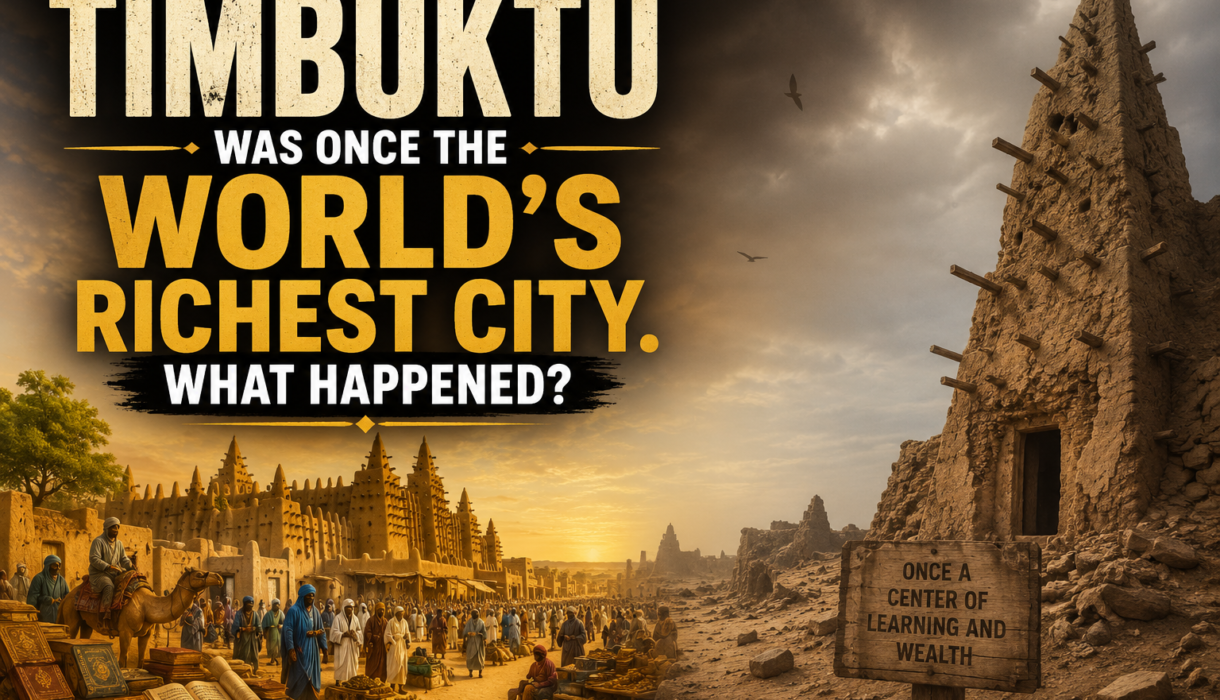

For centuries, the mere mention of “Timbuktu” evoked images of a golden, unreachable paradise at the edge of the known world. Situated near the Niger River in modern-day Mali, this legendary city was once the beating heart of global commerce and arguably the wealthiest metropolis on Earth. During the Middle Ages, it served as the prime meeting point where the vast riches of West Africa converged with Arab, Berber, and European merchants. However, the legendary metropolis that once rivaled the greatest capitals of Europe eventually faded into a quiet, remote desert town, leaving historians and travelers to wonder how such an empire of wealth vanished.
The Golden Age of Gold and Salt
Timbuktu’s astronomical wealth was built entirely on its strategic geography and the trans-Saharan trade network. Positioned where the Sahara Desert meets the fertile Niger River basin, the city became the ultimate middleman for two of the medieval world’s most valuable commodities: gold and salt. Pure gold from the southern forests of West Africa was traded pound-for-pound with rock salt mined from the Saharan north. Under the prosperous Mali Empire—championed by Mansa Musa, historically regarded as the richest individual in human history—and later the Songhai Empire, Timbuktu controlled this lucrative trade, generating revenues that funded grand palaces and legendary infrastructure.
A Hub of Intellectual Wealth
Timbuktu’s riches were not merely material; the city transformed its financial prosperity into intellectual dominance. Flush with cash, West African rulers established the prestigious University of Sankore, alongside hundreds of Islamic schools and libraries. Book production became the city’s most profitable and prestigious industry, attracting the finest scientists, astronomers, and theologians from across the Islamic world. The city became home to hundreds of thousands of invaluable manuscripts covering topics from mathematics to human rights, proving that medieval Africa was a sophisticated global epicenter of higher learning.
The Turning Point: Invasion and Plunder
The decline of this great empire began with a devastating geopolitical shock in the late 16th century. Seeking to gain direct control of West Africa’s gold mines, a Moroccan army equipped with early firearms invaded the Songhai Empire in 1591, culminating in the sacking of Timbuktu. The invaders plundered the city’s accumulated treasures, burned its celebrated libraries, and exiled or executed its leading scholars. The resulting political instability fractured the regional security that had protected merchants for centuries, leaving Timbuktu vulnerable to repeated raids by neighboring factions and halting its economic momentum.
The Shift in Global Trade Routes
While the Moroccan invasion dealt a severe blow, the permanent end of Timbuktu’s golden era was sealed by a shift in global logistics. During the Age of Discovery, European maritime powers successfully established direct sea routes along the West African coast, effectively bypassing the arduous trans-Saharan caravan routes. As global commerce transitioned from camels in the desert to ships on the ocean, Timbuktu lost its monopolistic status as the gateway to African wealth. Today, while the legendary city remains a UNESCO World Heritage site and a symbol of profound African heritage, its transition from a bustling global powerhouse to a tranquil desert sanctuary stands as a powerful reminder of how shifting trade and politics can rewrite the fortunes of even the wealthiest cities on Earth.