The Cultural Mosaic of South America: A Deep Journey Into Suriname Culture
Posted in :

Tucked away on the northeastern Atlantic coast of South America lies Suriname, a hidden gem that breaks almost every generalization about the continent. As the smallest independent nation in South America, the Republic of Suriname holds a fascinating distinction: it is the only territory outside of Europe where Dutch is the official spoken and written language. – Suriname Culture
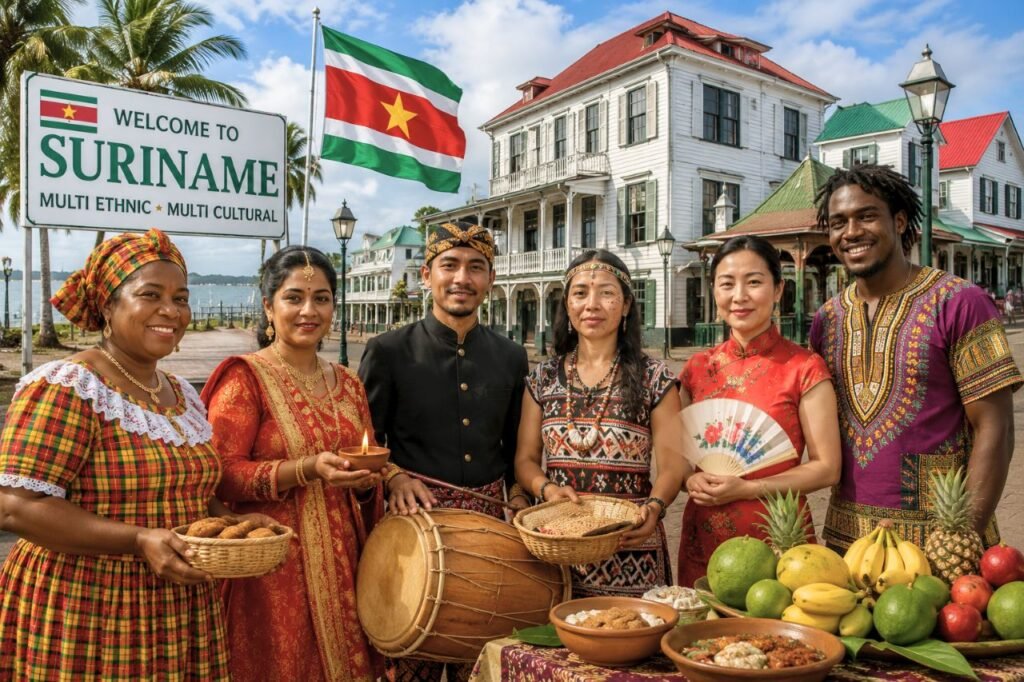
Though physically located on the South American mainland, Suriname is deeply Caribbean in spirit, history, and cultural alignment. Its true magic, however, lies in its demographic makeup. Suriname is a stunning, harmonious cultural mosaic where African, East Indian, Javanese, Indigenous, Chinese, and European lineages do not merely coexist—they intertwine to form one of the most multi-ethnic societies on Earth.
History & Origins
Long before European sails appeared on the horizon, Suriname’s dense rainforests and coastal rivers were home to diverse Indigenous tribes, including the Lokono (Arawak) and Kalina (Carib) peoples.
The geopolitical destiny of the region shifted in the 17th century when British settlers established plantations, which were subsequently traded to the Dutch in 1667 under the Treaty of Breda—in exchange for a small North American island known as New Amsterdam, today’s Manhattan. Under Dutch colonial administration, the colony of Dutch Guiana developed a highly profitable, brutal sugar plantation economy that relied entirely on forced labor:
- Enslaved Africans were imported in massive numbers. Many successfully escaped the coastal plantations into the deep, untamed interior rainforests. These escapees, known as Maroons, formed autonomous kingdoms, fought successful guerrilla wars against colonial forces, and preserved West African language, spiritual, and social structures.
- Following the final abolition of slavery in 1863, the Dutch colonial government faced severe labor shortages. They turned to contract indentured labor, bringing successive waves of immigrants: Chinese laborers, followed by large numbers of East Indians (Hindustanis) from British India, and Javanese workers from the Dutch East Indies (modern-day Indonesia).
This layering of global migrations created Suriname’s unique modern demographic structure. The nation peacefully achieved full independence from the Netherlands on November 25, 1975, embarking on a continuous mission to build a unified national identity.
Culture, Traditions & Customs
Multi-Ethnic Rites of Passage
Because of its distinct ancestral streams, life-cycle milestones in Suriname are celebrated through a variety of cultural lenses. In the Hindustani community, weddings are multi-day Vedic affairs full of vibrant yellow turmeric applications (Haldi) and traditional singing.
Among Javanese Surinamese, a baby’s transition into early childhood is honored through the Tedhak Siten ceremony, where a child is placed on the ground for the first time to touch the earth, symbolizing a balanced path through life. For Afro-Surinamese families, milestone birthdays—especially turning fifty—are celebrated as Abraham (for men) or Sarah (for women) feasts, marked by massive family gatherings, storytelling, and musical tributes.
National Festivals
Suriname’s national holiday calendar is a beautiful reflection of its cultural diversity, recognizing the sacred days of multiple world religions.
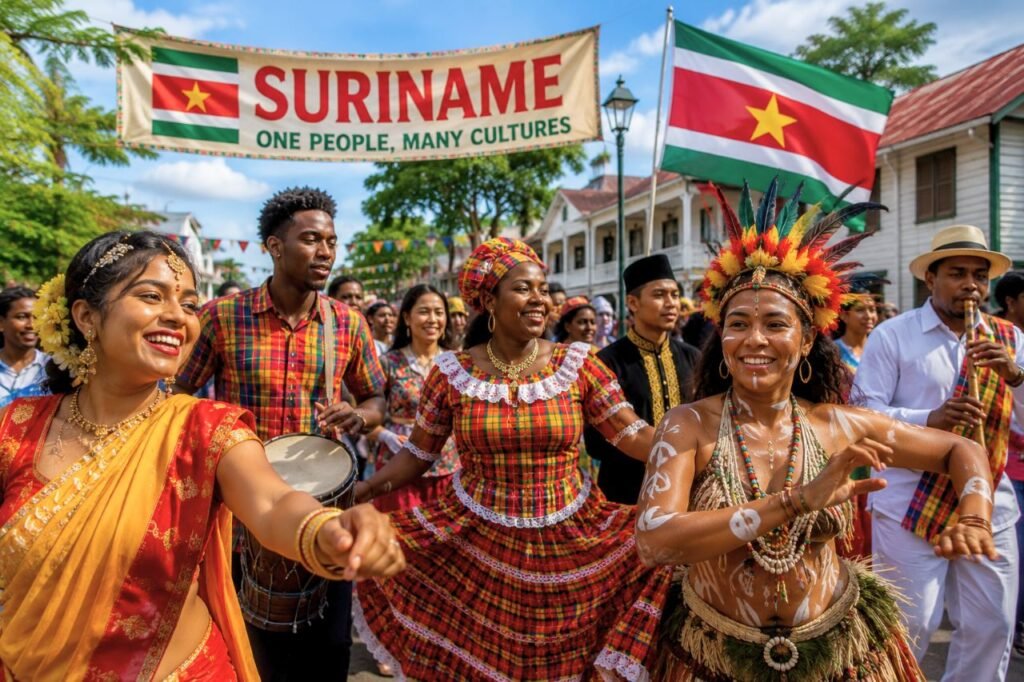
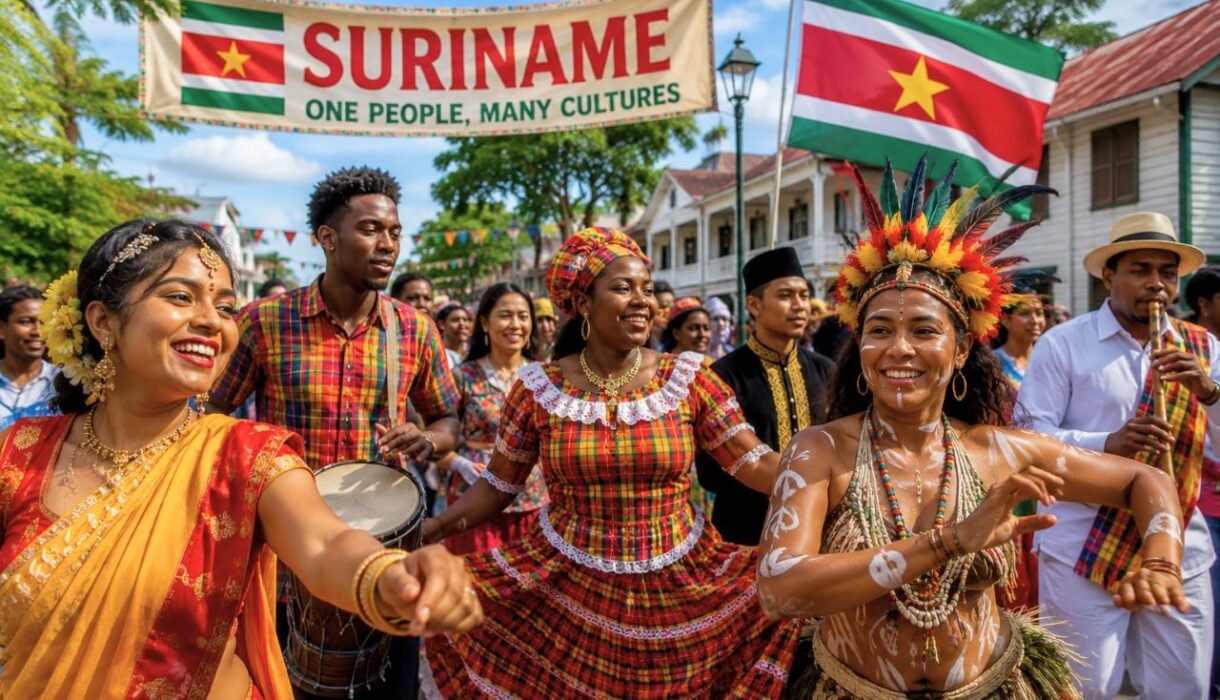
- Keti Koti (July 1): Translating to “The Chain is Broken” in Sranan Tongo, this highly emotional national holiday commemorates the abolition of slavery. The streets of the capital, Paramaribo, come alive with colorful street parades, traditional dress, and historical dramatic reenactments.
- National Day of Maroons (October 10): A day dedicated to honoring the treaties signed between the Dutch colonial authorities and Maroon tribes, celebrating indigenous and African resistance, autonomy, and cultural survival.
- Phagwah and Diwali: The Hindu spring festival of colors and autumn festival of lights are celebrated nationally across all cultural boundaries, with neighbors sharing sweet treats and colored powders.
- Eid al-Fitr: Marking the end of Ramadan, this is a major public holiday celebrated with deep reverence by both the Javanese and Hindustani Muslim communities.
Languages & Communication
Suriname is a linguistic wonder. While Dutch is the official language taught in schools, used in corporate boardrooms, and utilized by government bodies, the true unifying voice of the street is Sranan Tongo (Surinamese Creole). Originally developed as a pidgin language for communication between enslaved peoples and colonial masters, Sranan Tongo is an English-based creole deeply infused with Dutch, Portuguese, English, and West African vocabulary.
In addition to these, regional communities speak Sarnami Hindustani (a dialect of Bhojpuri), Surinamese Javanese, various Maroon languages (such as Saramaccan and Ndjuka), and several Indigenous tribal dialects.
Popular Sranan Tongo Proverbs and Expressions:
- “Fa i tan?” – A warm, standard daily greeting meaning “How are you doing?”
- “No mofo” – An expression meaning “Without a doubt” or “Guaranteed.”
- “Te yu e nyan nanga didibri, yu mu abi wan langa torku” – If you eat with the devil, you must use a long fork (Exercise extreme caution when dealing with untrustworthy people).
Geography
Suriname is geographically divided into two primary zones that dictate its population patterns:
- The Coastal Lowlands: A narrow, fertile northern plain facing the Atlantic Ocean. Over 90 percent of the nation’s population resides here, clustered around the historic capital city of Paramaribo and agricultural settlements.
- The Tropical Interior Forest: A massive, undulating green expanse of pristine Amazonian rainforest that blankets more than 80 percent of the country’s land territory. This region is broken up by massive river systems like the Suriname, Marowijne, and Coppename rivers, and contains the vast Central Suriname Nature Reserve, a UNESCO World Heritage site famed for its untouched biodiversity.
Economy
Suriname’s economic foundation has historically relied on raw natural resources, primarily gold mining, oil extraction, and bauxite processing. The agricultural sector remains a crucial employer along the coastal plains, producing rice, bananas, and lumber for export.
Furthermore, the pristine condition of the interior rainforests has driven a growing eco-tourism market, while the discovery of massive offshore oil reserves mirrors recent developments in neighboring Guyana, setting up the country for a significant economic shift.
Politics
Suriname is a constitutional presidential republic. The executive authority is held by the President, who is elected by a two-thirds majority in the unicameral national legislature, known as the National Assembly (De Nationale Assemblée).
Since establishing a stable democratic constitutional framework in 1987 following a period of military governance, Suriname has maintained a competitive multi-party political system. Political parties are frequently organized as coalitions that cut across ethnic lines, ensuring that policy decisions reflect the nation’s diverse interests.
Ethnic Groups
The harmonious coexistence of Suriname’s distinct ethnic groups is a source of immense national pride, with census data illustrating its diverse social makeup:
| Ethnic Group | Population Share | Historic and Social Contributions |
| Hindustani (East Indian) | ~27% | Introduced rice farming, traditional curry variations, and distinct musical styles. |
| Maroon (Afro-Descendant) | ~21% | Preserved West African spiritual practices, woodcarving arts, and botanical medicine. |
| Creole (Mixed Afro-Descendant) | ~15% | Historically drove urban commerce, developed Sranan Tongo, and shaped local administration. |
| Javanese (Indonesian) | ~14% | Contributed unique culinary traditions, traditional court dances, and intensive wetland agriculture. |
| Mixed Race | ~13% | Serves as a demographic bridge across cosmopolitan urban areas. |
| Indigenous & Other | ~10% | Includes the original Amerindian groups, alongside influential Chinese, Lebanese, and European merchant communities. |
Beliefs & Values
Suriname stands out as a global model for interfaith solidarity and peace. Its religious landscape is remarkably varied: roughly 48% of the population identifies as Christian (divided between Catholic and Moravian Protestant faiths), 22% identifies as Hindu, and 14% identifies as Muslim.
Alongside these major world religions, many Surinamese practice ancestral spiritual systems, such as Winti, an Afro-Surinamese religion focused on honoring ancestral spirits and natural deities.
The absolute symbol of this interfaith harmony is found on Keizerstraat in the center of Paramaribo, where the Neveh Shalom Synagogue and the Jami Mosque sit directly next to each other. For generations, members of both congregations have shared parking spaces, maintained properties together, and celebrated each other’s religious holidays—a powerful symbol of mutual respect.
Food & Cuisine
Surinamese cuisine is an aromatic, flavorful fusion of culinary worlds, offering an incredible dining experience where completely different cooking traditions meet on a single plate.
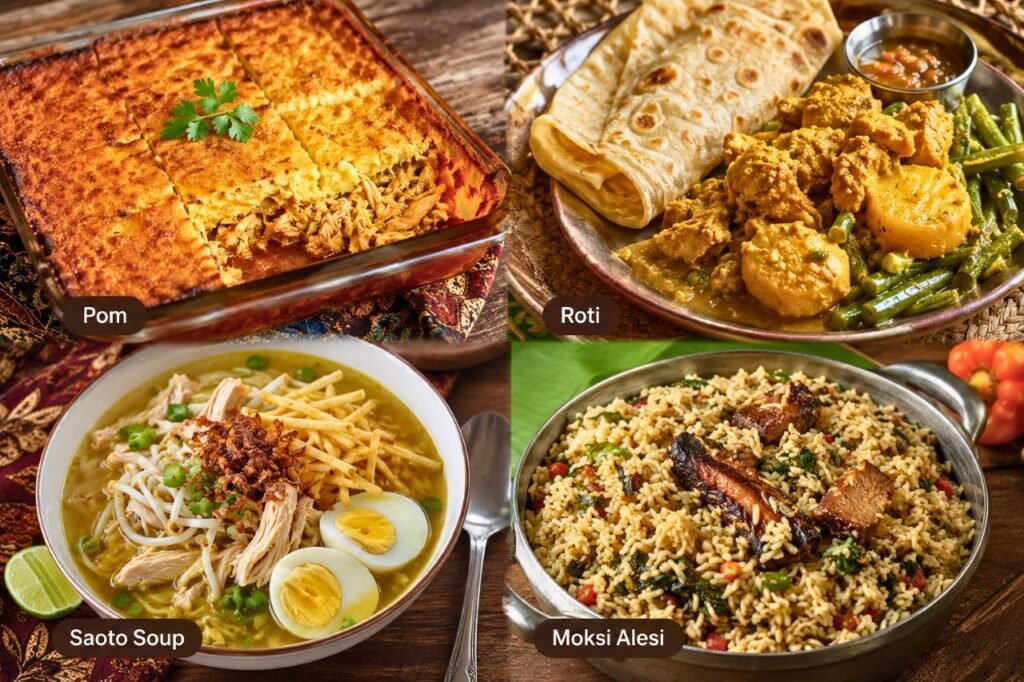
Surinamese Caribbean cuisine sampler
Iconic National Dishes
- Pom: The undisputed king of Surinamese festive cuisine. This savory oven-baked casserole is made from grated tayer (a local root vegetable), layered with heavily seasoned chicken, citrus juices, and a rich, sweet-and-savory sauce. It is a mandatory addition to any family celebration across all ethnic groups.
- Roti: Adapted from East Indian traditions, Surinamese roti features a flaky flatbread stuffed with ground split peas or potatoes, served alongside rich curry chicken, potatoes, and kouseband (yardlong beans).
- Saoto Soup: A beloved dish from the Javanese community. This comforting, fragrant chicken broth is seasoned with lemongrass, galangal, and allspice, then filled with shredded chicken, bean sprouts, hard-boiled eggs, and topped with crispy fried onions and potato sticks.
- Moksi Alesi: A savory one-pot rice dish inspired by Maroon and Creole traditions, where rice is cooked with coconut milk, salted fish, smoked meat, and local leafy greens.
Clothing & Symbols
The Kotomisi Artistry
The ultimate visual symbol of Afro-Surinamese womanhood is the Koto dress, worn paired with an intricately folded headwrap known as an Angisa. This traditional outfit developed during the colonial era as a creative response to dress codes imposed on enslaved women.
The Angisa headwrap is starched stiff and folded into very specific, geometric patterns. Historically, these folds served as a secret visual language among women. A specific fold could signal a woman’s romantic status, broadcast neighborhood news, or express a silent protest against colonial masters without a single word being spoken.
National Emblems
The national flag of Suriname consists of five horizontal bands of green, white, red, white, and green. The green stripes represent the fertility of the forests and agricultural lands; the white symbolizes peace, justice, and freedom; and the central red band signifies love, progress, and national sacrifice. In the center sits a prominent five-pointed golden star, which represents the unity and bright future of Suriname’s five major ethnic populations working together.
Music, Dance & Art
The Rhythms of Kaseko
Suriname’s musical style is anchored by Kaseko, a high-energy dance music that developed in the mid-20th century. Kaseko blends traditional Afro-Surinamese narrative songs with western brass instruments, electric guitars, and complex, syncopated percussion rhythms driven by the Skratji (a large bass drum topped with cymbals).
Alongside Kaseko, the airwaves feature Aleke, a popular percussion style created by Maroon youth, as well as contemporary Indian Chutney-Soca.
Maroon Visual Artistry
The interior Maroon communities are internationally celebrated for their exceptional woodcarving arts. Maroon men hand-carve intricate geometric designs into everyday items like canoe paddles, stools, and house facades. These complex, intertwined patterns are not merely decorative—they carry deep symbolic meanings relating to family protection, spiritual stories, and respect for ancestors.
Summary
The culture of Suriname is a stunning example of the beauty that emerges when global heritages unite to build a single nation. By holding onto their individual ancestral roots while proudly sharing a common national identity, the people of this South American country have built a truly unique society. From the shared parking lot between the mosque and the synagogue to the rich flavor of a home-baked holiday Pom, Suriname proves that true cultural diversity is not a barrier to unity, but the very foundation of national strength.
At Best Culture Insight, we see culture as the heartbeat of every society—the way people live, connect, and express their identity.