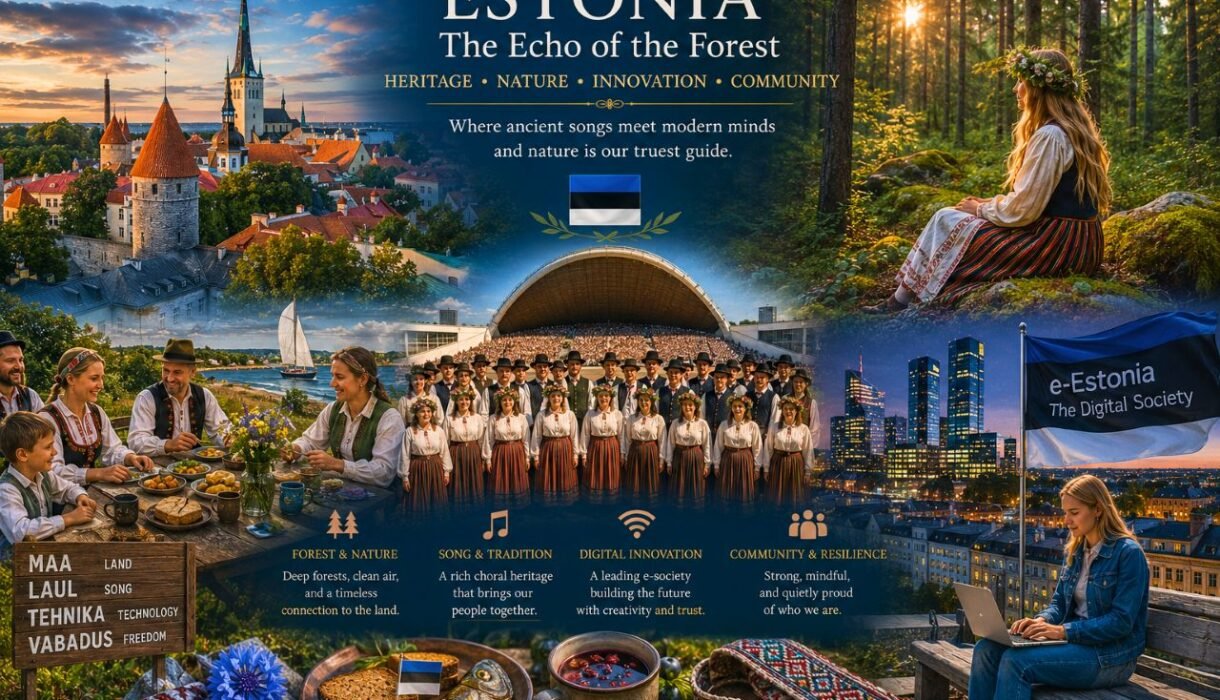

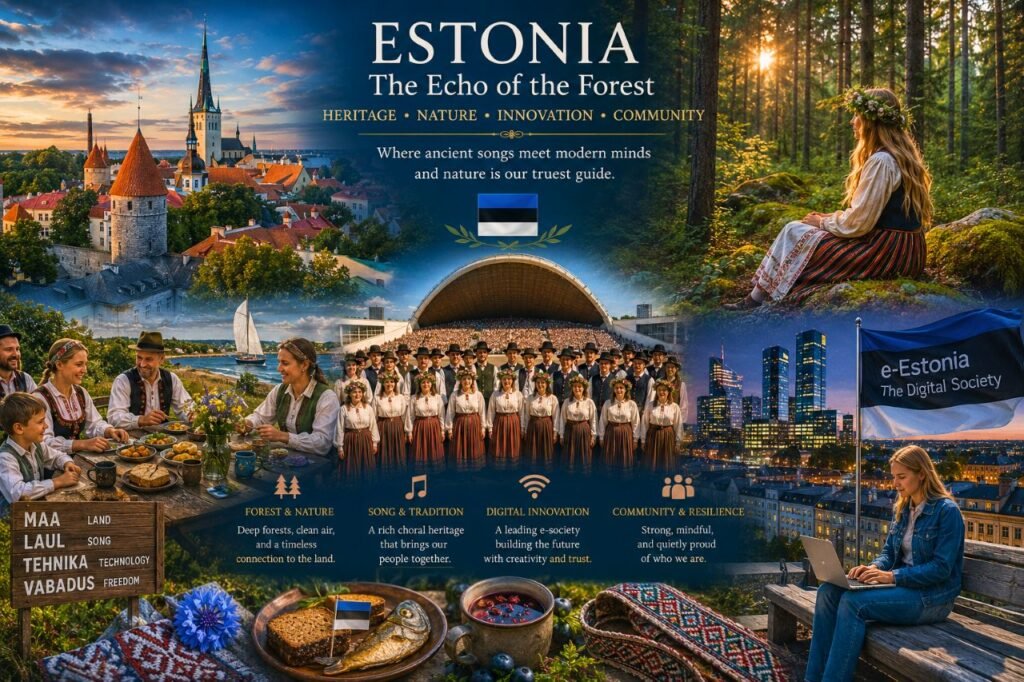
Bordered by the Baltic Sea and vast, ancient northern woodlands, Estonia (Eesti) presents one of Europe’s most fascinating cultural paradoxes. It is a land where ancient Finno-Ugric forest folklore seamlessly blends with a hyper-modern digital society. The Estonian people (Eestlased) are quiet, reflective, and deeply connected to nature, possessing a resilience forged through centuries of foreign rule. – Culture
Often grouped politically with its Baltic neighbors, Latvia and Lithuania, Estonia is culturally and linguistically distinct, sharing deep roots with Finland and Scandinavia. From the pristine medieval cobblestones of Tallinn to the digital infrastructure that powers daily life, Estonian culture is built on deep ecological respect, technological innovation, and a profound love for choral music.
History & Origins
The historical journey of Estonia is defined by a deep-seated survival instinct against successive waves of imperial expansion.
[Finno-Ugric Tribes Arrive]➔[Northern Crusades & German Rule]➔[Swedish Golden Age]➔[Russian Tsarist Empire]➔[Interwar Independence & Soviet Occupation]➔[The Singing Revolution & Rebirth]
- Ancient Roots: Ancestors of the Estonians settled the eastern shores of the Baltic Sea around 9000 BC, making them some of the longest-continuous inhabitants of any European territory. Unlike their Indo-European neighbors, these Finno-Ugric tribes lived in close animistic harmony with the forests.
- Centuries of Conquest: In the 13th century, the Northern Crusades forcibly introduced Christianity, ushering in centuries of rule by Baltic German nobility, Denmark, and the Kingdom of Poland. The 17th century under Swedish rule is remembered fondly as the “Old Good Swedish Time” due to the establishment of early education and the founding of the University of Tartu in 1632. This was followed by two centuries within the imperial Russian Tsarist Empire.
- Independence, Loss, and Song: Estonia declared independence in 1918, only to be forcibly annexed by the Soviet Union during World War II. After nearly fifty years of iron rule, Estonians achieved a peaceful democratic rebirth through the Singing Revolution (1987–1991). Hundreds of thousands of citizens gathered spontaneously to sing forbidden national hymns, using music to bring down the Soviet apparatus without a single drop of blood.
Culture, Traditions & Customs
Marriage & Family Milestones
Estonians generally prefer quiet, intimate family structures, placing high value on personal space, self-reliance, and gender equality. Modern weddings (Pulmad) often preserve playful, historical rural customs.
During the reception, the groom is frequently subjected to “hijacking” tests where he must prove his practical skills—such as chopping a log, identifying fishing tools, or changing a tire—before he can win his bride back from his wedding guests.
Midsummer Eve and the Magic of Nature
- Jaanipäev (St. John’s Day): Celebrated on the night of June 23, Midsummer Eve is the most important date on the Estonian calendar. Families leave the cities for rural summer cottages to build massive bonfires, feast on seasonal foods, and stay awake through the “White Night” (when the sun barely sets). Traditional folklore states that lovers who head deep into the forest to find the mythical blooming fern flower will receive lifetime luck.
Languages & Communication
The official language is Estonian (Eesti keel), a member of the Finno-Ugric language family.
Linguistic Structure and Character
Estonian is not an Indo-European language, meaning it is completely unrelated to neighboring Russian, Latvian, or English, but shares structural similarities with Finnish and Hungarian. It is famous for its melodic qualities, driven by 14 noun cases, a lack of grammatical gender, and the complete absence of a future tense (Estonians joke that they are practically futureless, choosing to live entirely in the present). It features a unique vowel, Õ, which requires a specific positioning of the tongue toward the back of the mouth.
Communication Style & Vernacular Proverbs
Estonians are notoriously reserved, comfortable with long pauses in conversation, and generally dislike superficial small talk. They view quiet listening as a form of respect.
- “Rääkimine hõbe, vaikimine kuld.”
Translation: “Speaking is silver, silence is gold.” This timeless proverb perfectly encapsulates the introverted, thoughtful communication style preferred across Estonian society.
Geography
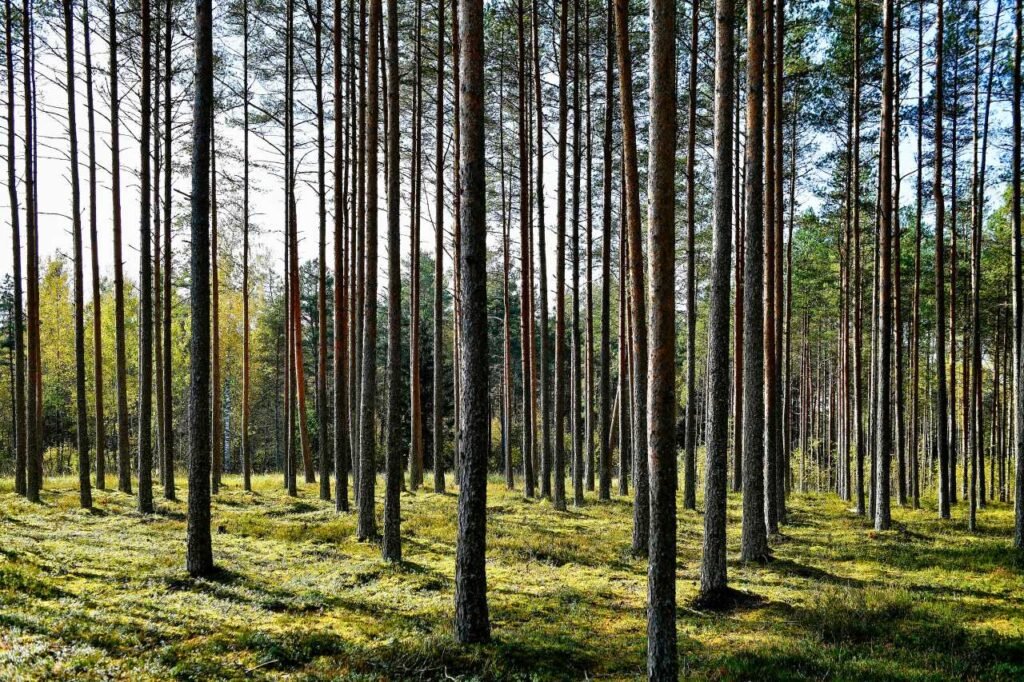
Estonia is a flat maritime country located on the northeastern edge of the European Union. Over 50% of its mainland is covered by lush forests, while another 22% is made up of ancient peat bogs and wetlands.
The country boasts a dramatic coastline along the Baltic Sea, featuring more than 2,222 islands and islets—the largest being Saaremaa and Hiiumaa, which preserve distinct island dialects and traditional windmill architectures. The country is also dotted with more than 1,400 natural lakes, including the massive Lake Peipus, which forms a natural liquid border with Russia.
Economy
Estonia has established itself as an economic pioneer, operating a highly advanced, free-market economy known globally as the e-Estonia phenomenon. Key pillars of economic strength include:
- Information Technology and Startups: Estonia has birthed more tech “unicorns” per capita than any other nation in Europe (including Skype, Wise, and Bolt). It introduced the world’s first E-Residency program, allowing global entrepreneurs to start EU-based businesses entirely online.
- Timber and Wood Processing: Utilizing sustainable forestry models to manufacture high-value modular houses and paper products.
- Electronics and Telecommunications: Leading manufacturing sectors in partnership with Scandinavian enterprises.
Politics
Estonia is a stable, unicameral parliamentary republic. Legislative authority rests in the Riigikogu (101 seats). The Prime Minister serves as the official head of government, wielding executive administrative control, while the President holds a largely ceremonial role as head of state.
Estonia is the global pioneer of i-Voting, allowing citizens to securely cast their parliamentary ballots from any computer worldwide using digital national ID cards. The country joined NATO and the European Union in 2004, serving as a passionate advocate for digital defense and continental cybersecurity.
Ethnic Groups
The population displays a clear cultural layout, with roughly 69% identifying as ethnically Estonian.
Due to industrial migrations during the Soviet era, there is a significant Russian minority comprising about 24% of the population, mostly concentrated in the capital city of Tallinn and the industrial northeastern border city of Narva. Smaller historical and recent immigrant minority groups include Ukrainians, Belarusians, Finns, and Germans.
Beliefs & Values
Secularism and Modern Animism
Statistically, Estonia regularly ranks as one of the least religious countries in the world, with less than 15% of the population expressing active belief in a specific church or traditional deity. However, this lack of church attendance does not mean a lack of spirituality.
Maausk and the Sacred Forest
Many Estonians practice a modern, informal version of Maausk (Earth Faith). This worldview views nature as a living, conscious entity.
The Sacred Hiis: Forests are treated with deep respect, and it is common for Estonians to visit ancient sacred groves (hiis) to tie ribbons to “soul trees” or sit in quiet contemplation to recharge their mental energy.
Food & Cuisine
Traditional Estonian cuisine (Eesti köök) is rustic, seasonal, and deeply influenced by rural peasant survival through dark winters, heavily borrowing elements from German and Scandinavian cooking.
[Dense Rye Sourdough] + [Forest-Foraged Chanterelles & Berries] + [Salted Baltic Fish] = Authentic Estonian Gastronomy- Leib (Black Rye Bread): The absolute center of Estonian culinary life. It is a dense, dark sourdough rye bread that is eaten with every meal. Estonians respect bread so deeply that if a piece accidentally drops on the floor, it is custom to pick it up, kiss it to apologize, and never throw it in the trash. Instead of saying “bon appétit,” Estonians say Jätku leiba (“May your bread last”).
- Kiluvõileib: A classic open-faced sandwich consisting of a slice of dark black bread topped with butter, a spiced Baltic sprat fillet, and a sliced hard-boiled egg.
- Verivorst (Blood Sausage): The definitive Estonian Christmas dish. These are barley-and-blood-filled sausages seasoned with marjoram, roasted until the skin splits, and served alongside sour cream and tart lingonberry jam.
- Kama: A unique traditional food mix consisting of finely milled roasted flour made from rye, oats, barley, and peas. It is mixed into fresh kefir, yogurt, or sour milk and sweetened with sugar or local forest honey for breakfast.
Clothing & Symbols
Folk Costumes and National Geometry
Traditional Estonian folk clothing (Rahvarõivad) is a source of immense national pride. Each of Estonia’s historical parishes boasts its own unique color scheme and geometric striped pattern woven into woolen skirts. Women wear heavily pleated skirts, white linen blouses with intricate openwork embroidery, and elaborate metal brooches (sõlg) designed to protect the wearer from malicious spirits.
National Symbols
The national flag features a striking, clean tricolor design: Blue (representing the sky, sea, and national loyalty), Black (representing the fertile soil, dark history, and the traditional black coats of the peasantry), and White (representing snow, hard work, and Estonia’s pursuit of freedom). Visually, this color palette perfectly mirrors a snow-covered Estonian pine forest under a winter sky.
Music, Dance & Art

Estonian culture song, craft, harmony
The Song Celebration (Laulupidu)
Choral singing is the absolute pinnacle of Estonian cultural expression. Held once every five years, the Estonian Song Celebration (Laulupidu) is a massive event that brings together joint choirs of up to 30,000 singers performing on a giant outdoor stage to an audience of over 100,000 spectators. This UNESCO-listed tradition serves as the living soul of the nation, celebrating national survival through shared vocal harmony.
Runo-Song Artistry and Visual Crafts
- Regilaul (Runo-Song): An ancient, pre-Christian style of continuous singing based on an eight-syllable line, utilizing a call-and-response format between a lead singer and a choir. It was used to pass down tribal histories and mythologies for generations.
- Woodworking and Handcrafts: Estonians excel at producing traditional wooden utensils, woven textiles, and sheepskin leatherwork, often incorporating ancient protection symbols into functional, modern household items.
Summary
The culture of Estonia is a beautiful study in civilizational balance. By anchoring themselves to their ancient Finno-Ugric woodland values while fearlessly engineering a borderless digital future, the Estonian people have created a highly functional, stable, and deeply respectful society. From the thunderous harmonies of the Laulupidu festival to the quiet reverence for black rye bread and the global reach of its digital innovations, Estonia continues to inspire the world as a vibrant beacon of cultural longevity, ecological wisdom, and technological advancement.
At Best Culture Insight, we see culture as the heartbeat of every society – the way people live, connect, and express their identity.