
Positioned as the elegant gateway connecting continental Europe to the Scandinavian north, Denmark (Danmark) possesses a culture celebrated worldwide for its balance of high social equality, minimalist design, and an unparalleled standard of personal well-being. The Danes (Danskere) are the proud creators of a highly progressive society that consistently ranks among the happiest nations on Earth.
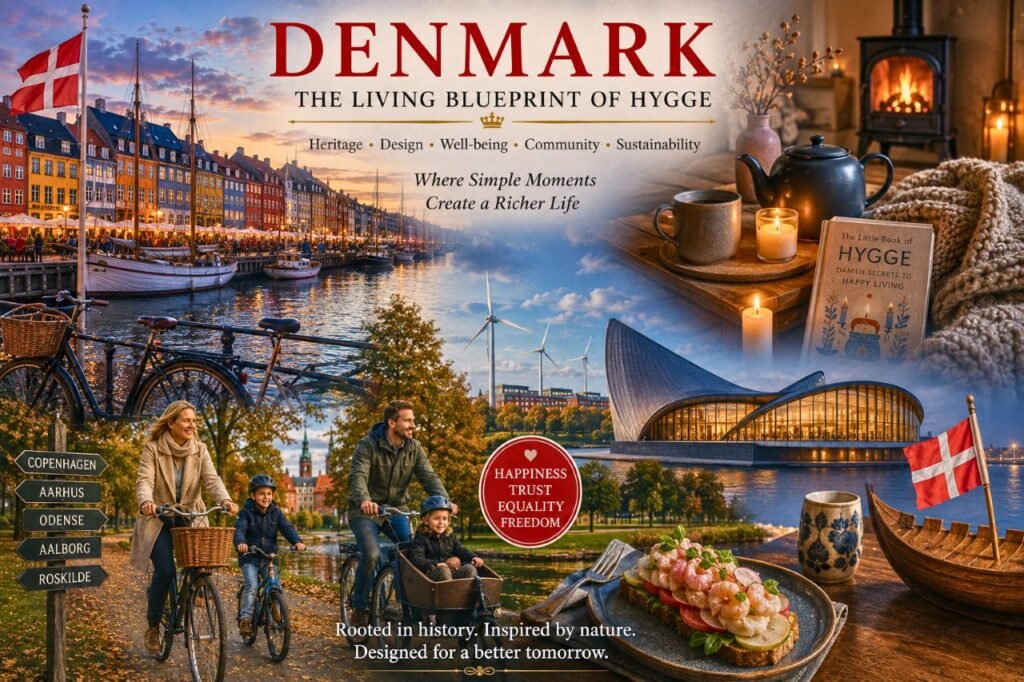
Far from being a product of mere economic wealth, Danish culture is rooted in a collective commitment to community trust, mutual respect, and a deliberate focus on the simple joys of life. From the historic, brightly colored waterfronts of Copenhagen to the wild, wind-swept dunes of Jutland, Denmark offers a masterclass in living well—blending a deep Viking heritage with cutting-edge green innovation and a sophisticated social model.
History & Origins
The historical tapestry of Denmark is an extraordinary journey from fierce maritime expansion to enlightened social engineering.
[Viking Age Expansion 8th-11th C.]➔[The Powerful Kalmar Union]➔[Reformation & Imperial Losses]➔[Rise of Constitutional Monarchy]➔[The Nordic Welfare Model]
- The Viking Age and Consolidation: In the 8th century, Danish Vikings burst onto the global stage as peerless navigators, traders, and raiders. By the late 10th century, King Harald Bluetooth successfully unified the regional tribal factions, converted the kingdom to Christianity, and established the oldest continuous monarchy in Europe.
- The Golden Age of the Kalmar Union: By 1397, Queen Margaret I consolidated Danish power by forging the Kalmar Union, a massive political alliance that placed Denmark, Norway, and Sweden under a single crown ruled from Copenhagen. This regional hegemony lasted for over a century until Sweden broke away in 1523.
- Loss and Rebirth: Subsequent centuries brought devastating territorial losses during conflicts with Sweden and the German states. However, these losses triggered a profound inward transformation. In 1849, Denmark peacefully transitioned into a constitutional monarchy. Guided by the visionary educational philosopher N.F.S. Grundtvig, the nation invested deeply in public education, cooperative farming, and egalitarian social reforms, laying the foundations for the modern Nordic welfare state.
Culture, Traditions & Customs
Marriage & Family Milestones
Danish families lean heavily toward egalitarian nuclear structures where work and home life are perfectly balanced. Traditional Danish weddings (Bryllup) are joyful, casual, yet highly organized affairs with unique reception traditions.
If the guests rhythmically stamp their feet on the floor, the newlyweds must crawl under the table to kiss. If the guests clink their silverware against their glasses, the couple must stand on top of their chairs to kiss. Additionally, during the reception party, the groom is hoisted into the air by his friends, who ceremonially cut off the tips of his socks to prevent him from straying into the arms of other women!
Rites of Passage and Seasonal Festivals
- Studenterkørsel (The Graduation Run): Every summer, high school graduates who have earned their iconic white and red/blue student caps (Studenterhue) ride through towns on the back of decorated open-air flatbed trucks. They play loud music, wave to locals, and stop at every graduate’s family home for snacks and drinks.
- Sankt Hans Aften (Midsummer Eve): Celebrated on June 23, Danes gather along beaches, lakesides, and neighborhood parks to build massive bonfires. They sing traditional songs, notably Holger Drachmann’s Midsommervisen, to welcome the peak of summer and symbolically burn away winter hardships.
Languages & Communication
The official language is Danish (Dansk), a North Germanic language that functions as an essential vehicle for the nation’s cultural identity.
Linguistic Identity and Pronunciation
Danish uses the standard Latin alphabet with three unique vowels added at the end: Æ, Ø, and Å. The language is famous for its distinct phonetic character, notably the stød (a glottal catch or brief constriction of the vocal cords).
To foreign ears, spoken Danish is often characterized by its soft consonants, where letters like d and g are frequently dropped or softened into fluid vowel sounds. This contrasts sharply with the precise phonetic system of standard German or Swedish.
Communication Style & Vernacular Expressions
Danes are highly direct, honest, and informal communicators. They generally despise corporate titles and artificial politeness, preferring clear, transparent dialogue.
- “Der er ikke noget, der hedder dårligt vejr, kun dårlig påklædning.”
Translation: “There is no such thing as bad weather, only bad clothing.” This classic proverb captures the practical, resilient Danish approach to nature and everyday challenges.
Geography
Denmark is a low-lying maritime country made up of the Jutland Peninsula (which shares a southern land border with Germany) and an archipelago of 443 named islands, the largest being Zealand (Sjælland) and Funen (Fyn).

The topography is completely flat, shaped by ancient glacial flows into rolling agricultural plains, heather-covered moors, and gentle coastal fjords. Denmark possesses over 7,300 kilometers of sandy coastline, ensuring that no point in the entire country is more than 52 kilometers away from the sea.
Economy
Denmark operates a highly advanced, industrialized mixed economy featuring an exceptionally strong social safety net—a system known globally as the Nordic Model. Key pillars of economic strength include:
- Green Technology and Renewable Energy: Led by wind turbine manufacturing giant Vestas, Denmark produces a significant percentage of its electricity from offshore wind farms.
- Maritime Logistics and Shipping: Home to A.P. Moller-Maersk, the world’s largest container shipping operator.
- Pharmaceuticals and Life Sciences: Featuring global medical powerhouses like Novo Nordisk.
- Design and Innovation: Exporting world-famous consumer brands, including LEGO and Bang & Olufsen electronics.
Politics
Denmark is a constitutional parliamentary monarchy. The monarch holds a purely ceremonial role as the formal head of state. Executive authority is concentrated in the Prime Minister, who leads the cabinet and must maintain confidence within the unicameral Parliament, known as the Folketing (179 seats, including two reserved for Greenland and two for the Faroe Islands).
The political environment relies heavily on a tradition of consensus politics, where minority governments routinely build coalitions with multiple parties to pass legislation. Denmark is a founding member of NATO and officially joined the European Union in 1973.
Ethnic Groups
The population displays a strong historic core, with approximately 86% identifying as ethnically Danish.
The remaining percentage of the population includes immigrants and their descendants from a broad array of nations, notably Turkey, Poland, Syria, Germany, and Iraq. Additionally, the Danish state includes the autonomous territories of the Faroe Islands and Greenland, each inhabited by indigenous populations with distinct languages, political assemblies, and maritime traditions.
Beliefs & Values
Secularism and the State Church
While roughly 70% of the population maintains nominal membership in the Evangelical Lutheran Church of Denmark (Folkekirken), the nation is highly secularized. For the vast majority of modern Danes, church attendance is reserved strictly for cultural milestones like baptisms, weddings, and Christmas Eve.
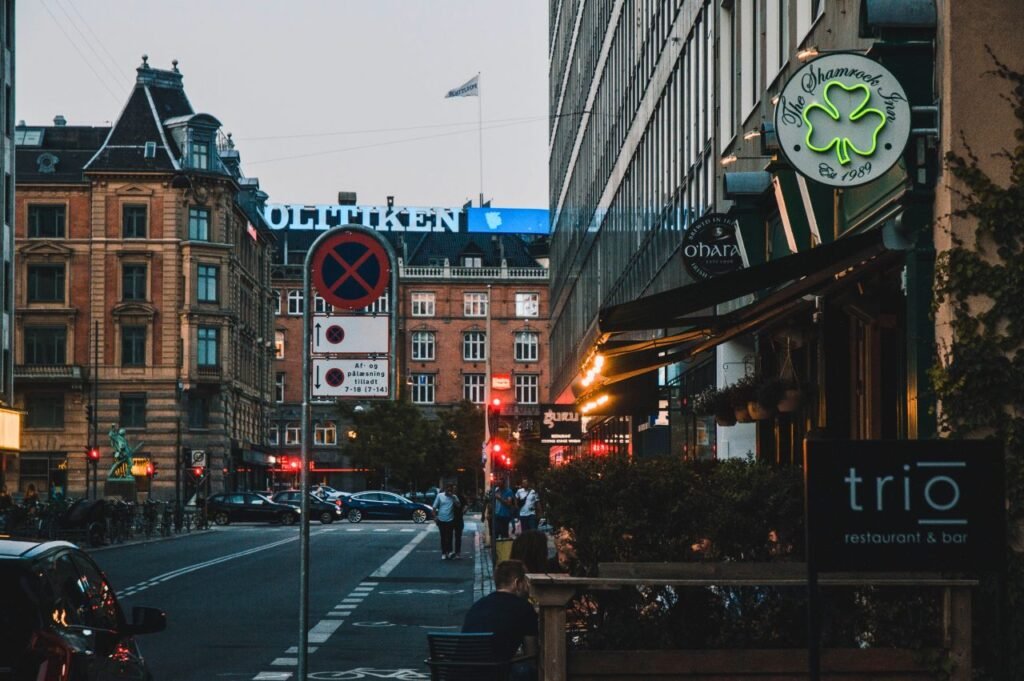
Janteloven and Hygge
Two defining philosophical concepts shape the Danish worldview:
| Concept | Cultural Core | Social Impact |
| Janteloven (Law of Jante) | Institutional humility; the cultural norm that no individual is superior to the collective community. | Discourages extreme displays of personal wealth, arrogance, or individual boasting. |
| Hygge | Creating a warm, cozy atmosphere; enjoying the good things in life with loved ones. | Promotes candlelit dinners, casual clothing, simple home-cooked food, and authentic, relaxed conversations. |
Food & Cuisine
Traditional Danish cuisine (Det danske køkken) was historically built around heavy, comforting ingredients needed to sustain farmers through cold winters: pork, potatoes, rye bread, and fish. However, in recent decades, the country revolutionized global gastronomy through the creation of the New Nordic Cuisine movement, which champions hyper-local, seasonal, and organic ingredients.
- Smørrebrød: The definitive Danish lunch culinary art form. It consists of a dense, buttered slice of dark rye bread (rugbrød) topped with complex layers of ingredients. Classic combinations include pickled herring with dill, roast beef with horseradish, or crispy pan-fried plaice fillet with remoulade.
- Stegt Flæsk med Persillesovs: Officially voted Denmark’s national dish. It consists of thick, crispy slices of fried pork belly served with boiled potatoes and a generous pouring of rich cream-based parsley sauce.
- Frikadeller: Traditional Danish pan-fried meatballs crafted from a blend of minced pork and veal, onion, egg, and flour, typically served alongside pickled red cabbage.
- Wienerbrød (Danish Pastry): Known globally as “a Danish,” this delicate pastry technique was actually brought to Denmark by Austrian bakers in the 19th century but perfected by native pastry chefs into multi-layered, flaky masterworks filled with custard, marzipan, or fruit jam.
Clothing & Symbols
Minimalist Style and Functional Attire
Modern Danish fashion is defined by effortless chic, architectural minimalism, and absolute practicality. Because Danes cycle everywhere in all weather conditions, clothing is designed to be highly functional yet sophisticated—featuring relaxed silhouettes, neutral tones, high-quality fabrics, and layers that transition easily from a bike commute to a business meeting.
National Symbols
The national flag, the Dannebrog (Danish Cloth), features a white Scandinavian cross on a bright red field.
The Flag Legend: According to national folklore, the Dannebrog fell directly from the heavens into the hands of Danish forces during the Battle of Lyndanisse in 1219, providing divine inspiration that turned the tide of battle. It is officially recorded as the oldest continuously used national flag in the world.
Music, Dance & Art
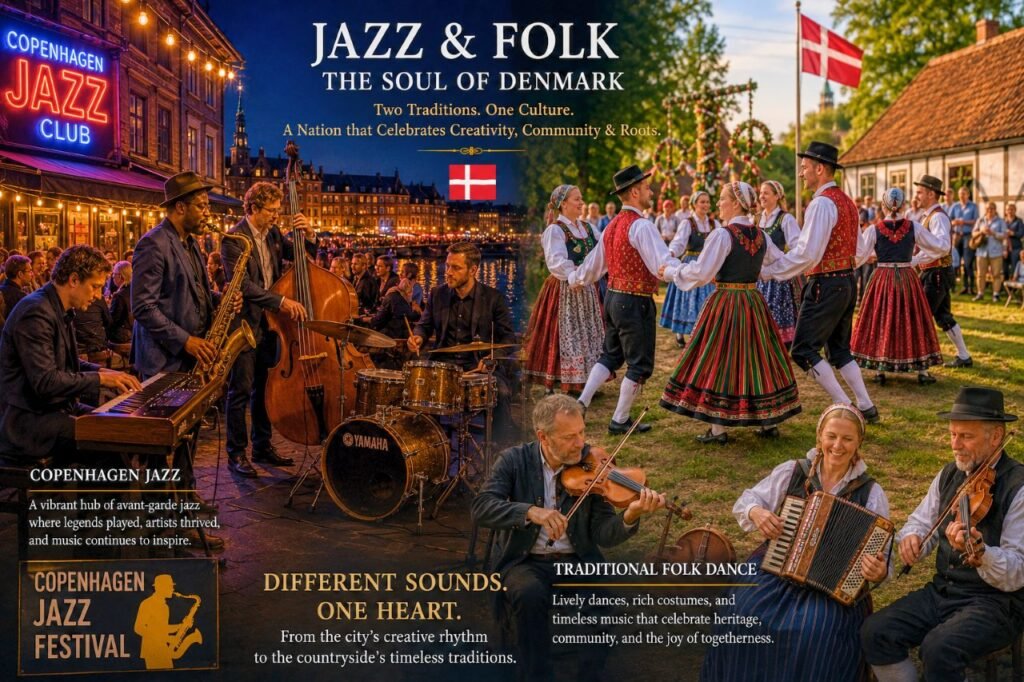
Jazz and folk: the heart of Denmark
Functional Architecture and Mid-Century Modernism
Denmark has exerted a monumental influence on global visual culture through Danish Design and functional architecture. Pioneers like Arne Jacobsen (creator of the iconic Egg and Swan chairs) and Jørn Utzon (the visionary architect behind the Sydney Opera House) established a global aesthetic standard that seamlessly combined human scale, minimalist beauty, and practical utility.
Jazz and Folk Performance
- Copenhagen Jazz: Denmark has long served as a prominent European capital for avant-garde jazz. In the 1960s, American legends like Dexter Gordon moved to Copenhagen, fostering a vibrant local jazz scene that culminates annually in the massive Copenhagen Jazz Festival.
- Traditional Folk Dance: Rural communities preserve a rich heritage of lively fiddle and accordion-driven circle dances, which are showcased during summer harvest festivals by performers wearing regional hand-woven woolen costumes.
Summary
The culture of Denmark stands as a shining proof of what can be accomplished when a society values collective well-being, trust, and structural simplicity over individual excess. By transforming their historic maritime legacy into a modern model of environmental sustainability and social equality, the Danish people have crafted a lifestyle that is both highly advanced and fundamentally comforting. From the artful construction of a lunch smørrebrød to the cozy light of a candlelit hygge evening, Denmark continues to inspire the world as a blueprint for a balanced, joyful, and harmonious existence.
At Best Culture Insight, we see culture as the heartbeat of every society – the way people live, connect, and express their identity.