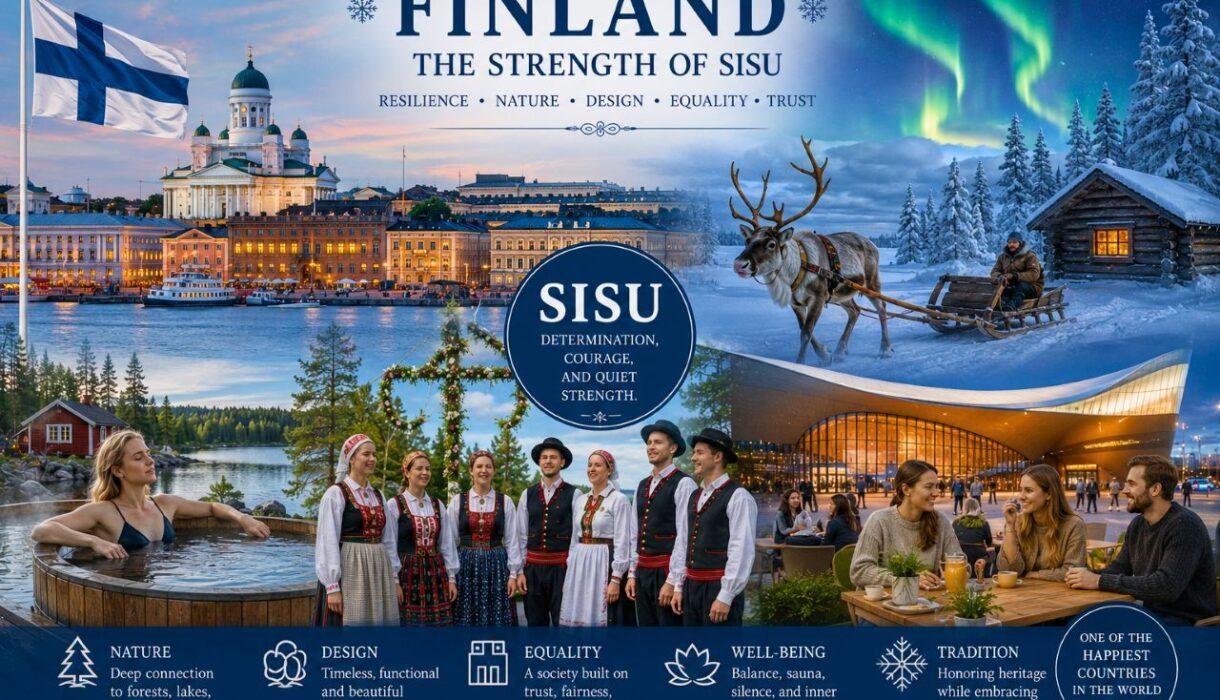

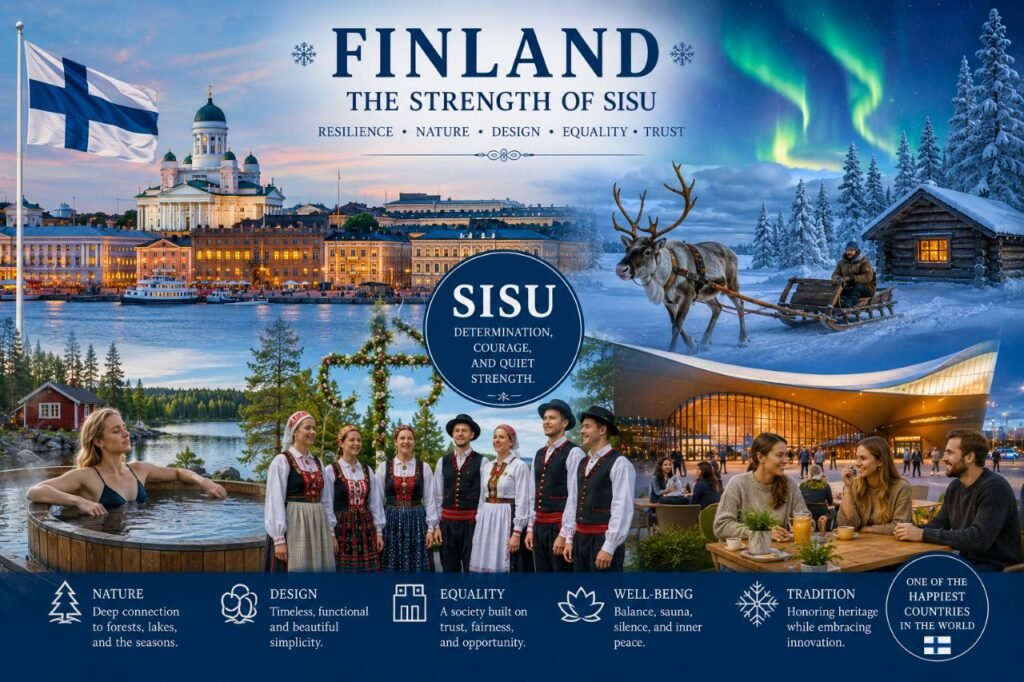
Bordering the Baltic Sea and stretching far past the Arctic Circle, Finland (Suomi) represents an extraordinary cultural study in resilience, quiet introspection, and radical egalitarianism. The Finnish people (Suomalaiset) have built a hyper-advanced, prosperous, and highly integrated modern society that consistently captures global headlines by ranking as the happiest country in the world.
This national happiness is not defined by loud celebration, but by deep contentment, social trust, and structural simplicity. The Finns are characterized by a profound intimacy with their natural surroundings, an unwavering respect for personal space, and an uncompromising inner fortitude. From the bustling, design-forward streets of Helsinki to the snowy, aurora-lit expanses of Lapland, Finnish culture beautifully illustrates how a society can honor ancient, primal traditions while engineering world-class socio-economic systems.
History & Origins
The historical trajectory of Finland is defined by centuries of precarious survival between major competing imperial powers.

[Finno-Ugric Tribes Arrive] ➔ [700 Years of Swedish Imperial Rule] ➔ [Autonomous Russian Grand Duchy] ➔ [1917 Independence & Civil War] ➔ [The Winter War Defense] ➔ [The Modern Welfare State]
- Ancient Finno-Ugric Migrations: The ancestors of modern Finns migrated into the pristine Scandinavian boreal forests thousands of years ago. Like their Estonian cousins, they spoke a Finno-Ugric tongue completely separate from the Indo-European languages of neighboring Germanic and Slavic tribes, building an animistic worldview deeply tied to forest ecology.
- The Swedish and Russian Imperial Eras: From the 12th century until 1809, Finland was an integral part of the Kingdom of Sweden, which heavily established its legal systems, Christian architecture, and social structures. Following the Napoleonic Wars, Sweden ceded the territory to the Russian Empire, where it became the autonomous Grand Duchy of Finland. This period paradoxically allowed Finnish nationalism to flourish, sparking a cultural awakening led by intellectuals who sought to formalize the native language and identity.
- Independence and the Crucible of War: Seizing the chaos of the Russian Revolution, Finland boldly declared absolute independence in 1917. The young republic’s defining modern trial arrived during World War II with the Winter War (1939–1940). Facing a massive Soviet invasion, vastly outnumbered Finnish soldiers utilized innovative guerrilla tactics in sub-zero forests to defend their sovereignty, cementing an unbreakable national solidarity.
Culture, Traditions & Customs
The Sacred Institution of the Sauna
To understand Finland, one must understand the Sauna. It is not a luxury spa amenity; it is a sacred cultural monument and an essential locus of daily life. With over 3.3 million saunas in a country of 5.5 million people, there is structurally enough room for the entire population to bathe simultaneously.
Historically, the sauna was the cleanest room in a rural homestead—serving as the place where women gave birth, bodies were prepared for burial, and meat was cured. It remains a space of absolute equality and psychological cleansing where individuals converse quietly without societal hierarchy or pretense.
Family Milestones and Rites of Passage
- The Maternity Package (Äitiyspakkaus): For nearly a century, the Finnish state has gifted every expectant mother a massive cardboard box packed with essential baby clothes, sheets, and care products. The box itself features a small mattress at the bottom, traditionally serving as the infant’s very first bed. This beloved institution serves as a powerful symbol of the nation’s foundational commitment to childhood equality.
- Juhannus (Midsummer Festival): Celebrated in late June when the sun does not set, cities completely empty out as the entire population migrates to rural summer cottages (mökki). Finns light massive lakeside bonfires (kokko), fish, drink, and hang birch branches around doorways to invite health and prosperity.
Languages & Communication
Finland has two primary official languages: Finnish (Suomi), spoken by roughly 87% of the population, and Swedish (Svenska), spoken by a historic 5% coastal minority.
Linguistic Profile
Finnish is a member of the Uralic language family, making it completely distinct from English, Swedish, or Russian. It is highly phonetic and structural, utilizing 15 distinct noun cases, no grammatical gender, and no articles (like a or the). Crucially, the language lacks a future tense, and there is no direct word for “please”—politeness is instead woven into the vocal tone, choice of verbs, and actions.
Communication Style
Finns are universally recognized for their direct, deeply authentic, and understated communication style. They possess an extraordinary tolerance for silence, viewing verbal pauses not as awkward gaps, but as moments of respect and careful deliberation. Small talk is largely avoided; words are chosen with extreme precision and treated as binding commitments.
“Puhuminen on hopeaa, vaikeneminen kultaa.”
Translation: “Speaking is silver, silence is gold.” This classic proverb perfectly illustrates the national preference for quiet reflection over performative conversation.
Geography
Finland is known famously as the “Land of a Thousand Lakes”—though this is a massive understatement, as the country actually contains over 188,000 interior lakes. Over 75% of the land area is covered by dense taiga forest, making it the most heavily wooded nation in Europe.
The country is geologically flat but features rolling granite hills and unique eskers left behind by retreating Ice Age glaciers. The northernmost third forms the Arctic wilderness of Lapland, characterized by vast tundra, wild reindeer populations, and intense seasonal phenomena: the Midnight Sun in summer and the Polar Night (kaamos) in winter.
Economy
Finland operates a highly advanced, knowledge-based social market economy characterized by exceptional transparency and world-class industrial innovation. Key pillars include:
- High-Technology and Electronics: Forging global paths in mobile telecommunications engineering and a massive digital gaming industry (creators of Angry Birds and Clash of Clans).
- Forestry and Biomaterials: Transforming traditional logging into high-value, sustainable paper, packaging, and biochemical exports.
- Industrial Engineering and CleanTech: Designing world-class Arctic icebreakers, maritime cruise ships, and advanced energy-efficiency systems.
- The Renowned Education System: Consistently topping global charts, the tuition-free public school system emphasizes play, critical thinking, and teacher autonomy, serving as a template for international educational development.
Politics
Finland is a parliamentary representative democracy headed by a Prime Minister who wields executive legislative authority over the domestic cabinet. The President serves as the official head of state, directing foreign policy and serving as commander-in-chief of the military forces.
The unicameral Parliament, the Eduskunta, consists of 200 members elected through proportional representation. The political landscape relies heavily on multi-party consensus and coalition-building. Finland officially joined the European Union in 1995 and became a full member of NATO in 2023, marking a historic shift in its geopolitical security strategy.
Ethnic Groups
The vast majority of the population is ethnically Finnish.
The country’s most historic indigenous minority is the Sámi people, who inhabit the northern reaches of Lapland. They possess their own distinct languages, political parliament, and protected reindeer-herding cultures. Other established historical minorities include Swedish-speaking Finns, Romani, and Tatars. In recent decades, urban centers have grown increasingly diverse through immigration, welcoming expanding communities from Iraq, Russia, Estonia, Somalia, and Ukraine.
Beliefs & Values
Sisu: The National Soul
The undisputed core of the Finnish worldview is summarized by a single, untranslatable word: Sisu.
[Unexpected Hardship / Crisis] ➔ [Deployment of Sisu] ➔ [Quiet, Unyielding Perseverance] ➔ [Sovereignty & Survival]
Sisu is an ancient psychological concept combining unyielding courage, stoic resilience, and a stubborn refusal to surrender in the face of absolute adversity. It is the quality that allowed Finnish soldiers to hold off armies in 1939 and continues to inspire modern Finns to face harsh winter mornings with quiet determination.
Secularism and Everyman’s Right
While roughly 65% of citizens maintain formal alignment with the Evangelical Lutheran Church of Finland, active religious practice is very low. Modern Finnish morality is heavily anchored in humanism, gender equality (Finland was the first European country to grant full political rights to women in 1906), and Jokamiehenoikeus (Everyman’s Right). This unique legal framework guarantees that anyone is free to roam through any forest, forage for wild berries and mushrooms, and camp responsibly, regardless of private land ownership.
Food & Cuisine
Traditional Finnish cuisine (Suomalainen ruoka) is simple, unpretentious, and deeply reliant on fresh, unpolluted ingredients harvested directly from local lakes and woodlands.
- Karjalanpiirakka (Karelian Pasties): A beloved national pastry featuring a thin, crimped rye dough crust packed tightly with dense rice porridge or mashed potatoes, traditionally topped with warm munavoi (egg butter).
- Ruisleipä (Rye Bread): The absolute cornerstone of the Finnish diet. Made from 100% whole grain rye sourdough, this dense, dark, and slightly sour bread is eaten daily and revered as a symbol of national nourishment.
- Forest Bounties: Finns consume immense quantities of wild chanterelle mushrooms and forest berries—notably bilberries (wild Arctic blueberries) and rare, amber cloudberries picked from northern peat bogs.
- Leipäjuusto (Squeaky Cheese): A mild, fresh cow’s milk cheese that is baked until a charred pattern forms on top. It possesses a distinct squeaky texture when bitten and is traditionally served warm alongside sweet cloudberry jam.
- Kahvi (Coffee Culture): Finns are statistically the highest consumers of coffee per capita on Earth, drinking an average of 12 kilograms per person annually. Coffee breaks (kahvitauko) are legally mandated within Finnish workplace agreements.
Clothing & Symbols
Traditional Dress and Modern Finnish Design
Traditional Finnish folk costumes (Kansallispuvut) are vibrant, highly structured historical garments reflecting regional patterns from Karelia and the coastal areas. They feature wool skirts, linen blouses, embroidered vests, and distinctive buckled shoes, worn today during folk music festivals and formal state events.
In modern fashion, Finland is an international icon of bold, functional design. Brands like Marimekko (famous for its iconic Unikko poppy print) and Iittala glassware established a global aesthetic that prioritizes functional clean lines, organic geometry, and timeless industrial quality.
National Symbols
The national flag, the Siniristilippu (Blue-Cross Flag), features a sea-blue Scandinavian cross set against a field of pure white, visually capturing the blue of Finland’s lakes and the white of its winter snows. The national coat of arms displays a crowned gold lion trampling a curved sabre on a red field, symbolizing historical independence between East and West.
Music, Dance & Art
The Kalevala and Epics of Sound
The foundational bedrock of Finnish artistic culture is the Kalevala, a monumental 19th-century compilation of ancient epic folklore oral poems assembled by scholar Elias Lönnrot. This mythological masterpiece detailing the creations of wizard-heroes heavily inspired the musical works of Jean Sibelius, whose magnificent symphonic tone poem Finlandia became the auditory catalyst for the nation’s independence movement.
Heavy Metal and Contemporary Visual Arts
- The Metal Phenomenon: Finland possesses more heavy metal bands per capita than any other country on Earth. Bands like Nightwish, Children of Bodom, and Apocalyptica transformed metal into a mainstream cultural export, where heavy guitar riffs are proudly integrated alongside classical orchestration.
- The Kantele: The traditional acoustic instrument of Finland is the Kantele, a plucked string instrument belonging to the Baltic psaltery family, producing a bell-like sound featured heavily in modern folk revivals.
- Alvar Aalto and Modern Architecture: Master architect Alvar Aalto revolutionized global modernist architecture by designing buildings and furniture that seamlessly adapted human scales, local timber materials, and flowing organic curves into functional spaces.
Summary
The culture of Finland stands as a magnificent testament to the triumph of quiet determination, structural equity, and ecological harmony. By anchoring their modern identity to the ancient, transformative power of the sauna, the stoic psychological reserve of sisu, and a deep respect for their pristine wilderness, the Finnish people have masterfully engineered one of the world’s most stable, innovative, and content societies. From the striking geometric prints of Marimekko to the majestic orchestral scores of Sibelius and the daily warmth of a hot cup of coffee, Finland continues to offer the world an inspiring blueprint for a balanced, purposeful, and thoroughly harmonious life.
At Best Culture Insight, we see culture as the heartbeat of every society – the way people live, connect, and express their identity.