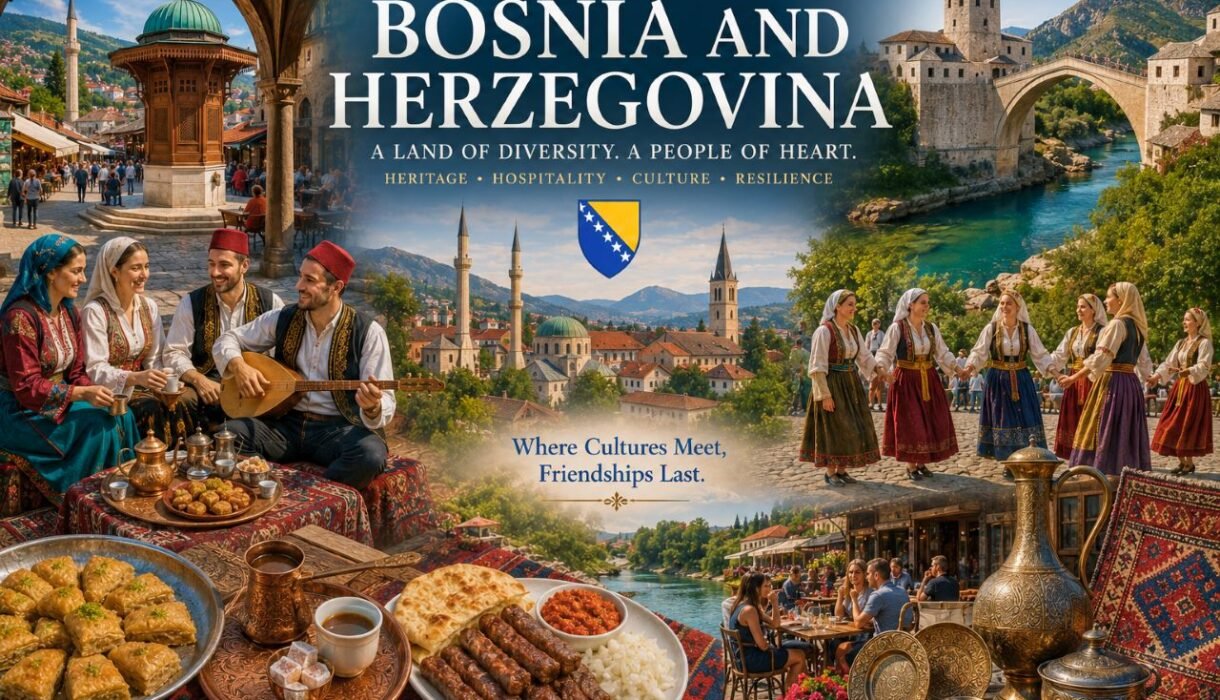
The Confluence of East and West: An Elaborate Exploration of Bosnia and Herzegovina Culture
Posted in :

Nestled in the heart of the Balkan Peninsula, Bosnia and Herzegovina possesses one of Europe’s most fascinating, multi-layered cultural identities. Often called the “Jerusalem of Europe,” this beautiful nation represents a profound historical meeting point where the Islamic Ottoman East and the Christian Austro-Hungarian West fused into a singular society.
The people of Bosnia and Herzegovina are renowned for their extraordinary warmth, legendary hospitality, and a distinct, resilient sense of humor. Despite navigating a turbulent modern history, they have preserved a lifestyle centered on deep neighborly relations (komšiluk), artistic expression, and an unhurried, heartfelt appreciation for life’s simple pleasures.
History & Origins
The historical evolution of Bosnia and Herzegovina is a saga of powerful empires, indigenous medieval kingdoms, and complex spiritual transformations.

[Illyrian & Slavic Migrations]➔[Independent Medieval Bosnian Kingdom]➔[Ottoman Empire Rule]➔[Austro-Hungarian Administration]➔[Yugoslav Era]➔[Sovereign State]
- The Medieval Kingdom and the Bogomils: Settled by Slavic tribes in the 7th century, Bosnia emerged as a powerful independent medieval kingdom by the 12th century under rulers like Ban Kulin and King Tvrtko I. During this era, the region was home to the independent Bosnian Church, whose followers (often linked to the Bogomils) carved thousands of mysterious, monumental stone tombstones called stećci across the landscape.
- The Ottoman Golden Age: In 1463, Bosnia was integrated into the Ottoman Empire. Over the next four centuries, a large portion of the local population embraced Islam, transforming the social, architectural, and culinary fabric of the region. Cities like Sarajevo and Mostar grew into grand, wealthy centers of trade, learning, and Islamic architecture.
- The Western Shift and Modernity: In 1878, the Austro-Hungarian Empire assumed administration of the territory, introducing Central European industrialization, legal frameworks, and Art Nouveau architecture. Following the assassination of Archduke Franz Ferdinand in Sarajevo in 1914—which triggered World War I—the country eventually became part of the Kingdom of Yugoslavia, and later, the Socialist Federal Republic of Yugoslavia. Bosnia and Herzegovina declared its independence in 1992, weathering a devastating three-year war before emerging as the modern sovereign state it is today.
Culture, Traditions & Customs
Marriage & Family Milestones
Family forms the absolute cornerstone of Bosnian social structure. Traditional weddings (svadba) are grand, multi-day celebrations filled with music, dancing, and elaborate feasts. An old custom involves the groom and his wedding party traveling to the bride’s house to symbolically “buy” her from her family through playful financial negotiations with her brothers. In naming ceremonies, it is common to pick names that honor ancestors while reflecting the family’s religious heritage.
Festivals & Seasonal Traditions
- Sarajevo Film Festival: Founded in 1995 during the siege of the city as an act of cultural resistance, it has grown into the premier film festival in Southeastern Europe, drawing Hollywood elite and international artists annually.
- The Bridge Divers of Mostar: A historic rite of passage dating back to the 16th century. Every summer, brave local young men jump from the apex of the Stari Most bridge into the freezing, turbulent waters of the Neretva River below to prove their maturity and courage to the community.
Languages & Communication
The linguistic landscape of Bosnia and Herzegovina is uniquely shaped by its history. The state recognizes three official languages: Bosnian, Croatian, and Serbian.
Linguistic Unity
Linguistically, all three are mutually intelligible standard varieties of the South Slavic language group. They share near-identical grammar and core vocabulary but utilize different alphabets and localized idioms. Bosnian and Croatian primarily use the Latin alphabet, while Serbian uses both Cyrillic and Latin. The languages are heavily enriched with Turkisms—loanwords borrowed from Turkish, Arabic, and Persian during the Ottoman era.
Greetings & Local Proverbs
- Greetings: The universal, non-religious greeting is Dobar dan (Good day), though the Arabic-derived Selam is common among Muslims, and Ćao or Zdravo (Hello/Cheers) is popular among youth.
- “Sve se može pokrpiti osim slomljena srca.”
Translation: “Everything can be patched up except a broken heart.” This proverb underscores the deep value placed on emotional sincerity and relationship harmony.
Geography
Bosnia and Herzegovina is a land of dramatic, rugged natural beauty. The country’s topography is overwhelmingly mountainous, carved by the spine of the Dinaric Alps.
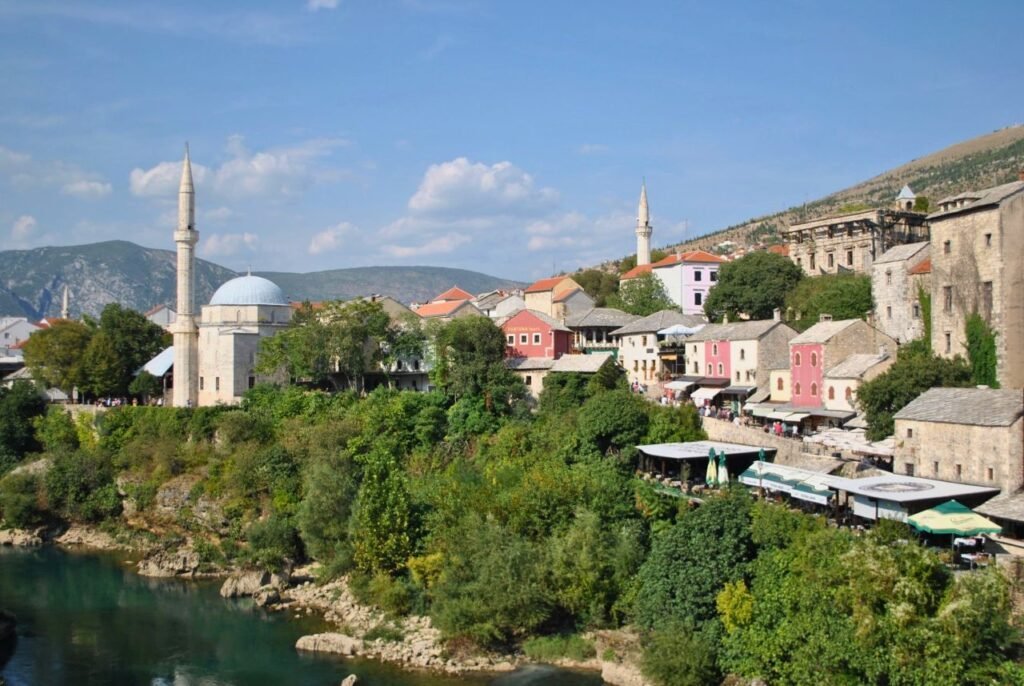
Crystal-clear, emerald-green rivers like the Una, Neretva, Drina, and Vrbas cut deep canyons through limestone gorges, feeding spectacular waterfalls like the Kravica drops. While Bosnia covers the mountainous northern and central interior, the smaller southern region of Herzegovina features a warm, Mediterranean climate, rolling vineyards, and limestone karst landscapes. The country also possesses a tiny, 20-kilometer strip of coastline along the Adriatic Sea at the town of Neum.
Economy
The economic framework of Bosnia and Herzegovina is transition-based, relying heavily on its rich natural resources. Core industries include:
- Metallurgy and Mining: Major production lines for aluminum, steel, and iron ore.
- Hydroelectric Power: Abundant mountain rivers make the country a net exporter of green electricity to neighboring Balkan states.
- Timber and Furniture Manufacturing: Utilizing massive, pristine beech and pine forests.
- Eco-Tourism: Rapidly expanding due to world-class white-water rafting, pristine hiking paths, and affordable, high-altitude ski resorts like Jahorina and Bjelašnica.
Politics
The political structure of Bosnia and Herzegovina is exceptionally complex, established by the 1995 Dayton Peace Agreement to ensure equal representation among its distinct communities.
The country is divided into two highly autonomous first-tier political entities: the Federation of Bosnia and Herzegovina (primarily inhabited by Bosniaks and Croats) and the Republika Srpska (primarily inhabited by Serbs), along with the self-governing Brčko District. The national executive branch is led by a unique Three-Member Presidency, consisting of one Bosniak, one Croat, and one Serb leader who rotate chairmanship every eight months.
Ethnic Groups
The demographic makeup of the country is defined by its three constitutionally recognized “constituent peoples”:
- Bosniaks: The largest ethnic group, traditionally of Slavic Muslim heritage.
- Serbs: Predominantly orthodox Christians, living largely in the northern and eastern regions.
- Croats: Predominantly Roman Catholic Christians, concentrated largely in western Herzegovina and central pockets.
Significant small historic minority groups include the Roma, Ukrainians, and a proud Sephardic Jewish community that famously preserved the historic Sarajevo Haggadah through multiple wars.
Beliefs & Values
Religious Coexistence
For centuries, Islam, Eastern Orthodox Christianity, Roman Catholicism, and Judaism coexisted side-by-side. Walking through downtown Sarajevo, one can hear the Muslim call to prayer (Adhan) while simultaneously hearing the bells of a Catholic cathedral and an Orthodox church, a unique layout that forms the bedrock of the country’s multi-confessional identity.
The Philosophy of Ćejf and Ćaskanje
A fundamental cultural pillar is Ćejf—an Ottoman-derived concept describing a state of profound, meditative relaxation, purely savoring a moment for its own sake. It is closely linked to Ćaskanje (leisurely chatting) and the preservation of komšiluk (the sacred bond of neighborhood unity), where neighbors regularly visit one another without prior notice to share life updates over coffee.
Food & Cuisine
Bosnian cuisine (Bosanska kuhinja) is a culinary triumph that strikes a perfect balance between Western and Eastern traditions. It relies on fresh, local meats, organic vegetables, and slow-simmered methods, using minimal heavy spices to let natural flavors shine.
- Ćevapi: The undisputed national culinary icon. These are small, grilled logs of minced meat (traditionally a blend of beef and lamb) seasoned simply with garlic and salt. They are served stuffed inside a pillowy, steamed flatbread called somun, accompanied by a mountain of raw diced onions and rich clotted cream (kajmak).
- Burek & Pita: A spectacular savory pie made of tissue-thin layers of hand-stretched phyllo dough.
The Golden Rule: In Bosnia, it is a strict culinary law that only the meat-filled version can be called Burek. If it is stuffed with cheese it is Sirnica, spinach is Zeljanica, and potato is Krompiruša.
- Bosanski Lonac: A comforting, slow-cooked meat and vegetable stew layered inside an authentic clay pot and simmered for hours.
- The Ritual of Bosnian Coffee: Never confuse Bosnian coffee with Turkish coffee. It is prepared by boiling water in a copper pot called a džezva, adding finely ground coffee, and boiling it a second time to create a rich crema. It is served on a copper tray with a small ceramic cup (fildžan), sugar cubes, and a piece of sweet walnut Baklava or Rahat Lokum (Turkish delight).
Clothing & Symbols
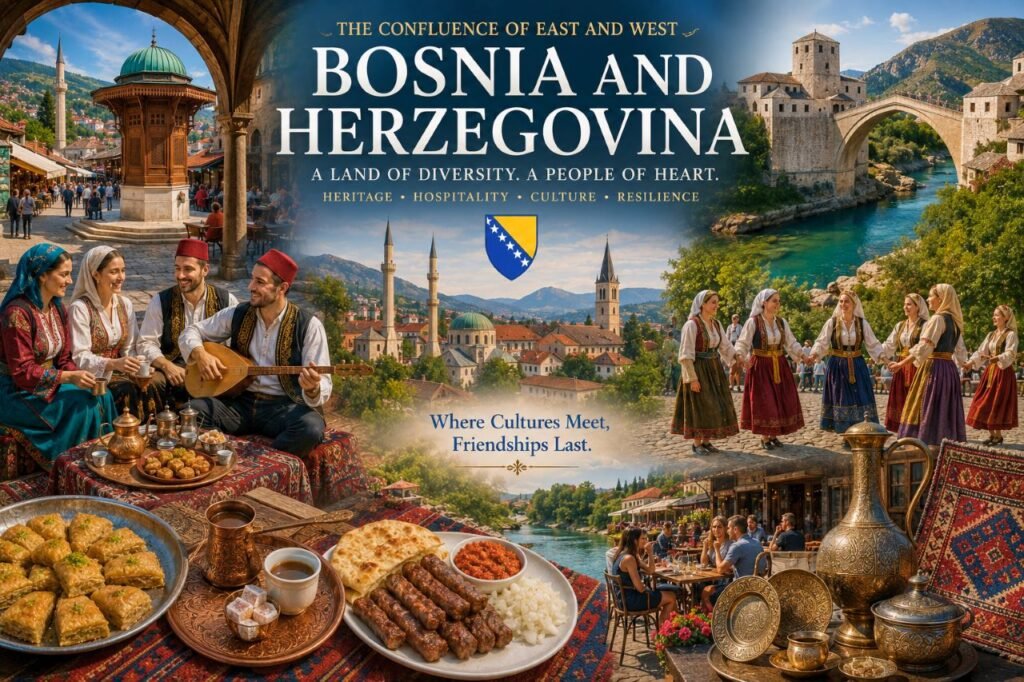
Bosnia and Herzegovina, where cultures meet
Traditional Attire and Craftsmanship
Historic Bosnian clothing varies by region and religious community, but shares common elements. Women traditionally wore long white linen chemises decorated with intricate geometric embroidery, velvet vests (jelek) woven with gold threads, and silk aprons. Men wore dark, durable woolen trousers, embroidered waistcoats, and distinctive hats like the woolen Fez or the traditional knitted Šajkača. Today, these styles are kept alive by folk ensembles during major festivals.
National Symbols
The national flag features a bold dark blue field with a yellow right triangle, flanked by a line of white seven-pointed stars. The three points of the yellow triangle represent the three primary constituent peoples (Bosniaks, Croats, and Serbs) while also mirroring the geometric shape of the country’s borders. The stars represent Europe, symbolizing the nation’s timeless path toward European integration and unity.
Music, Dance & Art
Sevdalinka: The Soul of the Balkans
The musical crown jewel of the nation is Sevdalinka, an archaic, deeply emotional genre of folk music often described as the “Bosnian Blues.” Originating during the Ottoman era, these melancholic, poetic love songs express themes of longing, heartbreak, and spiritual yearning (sevdah). Historically performed solo with a stringed Saz, modern Sevdalinka is often accompanied by the accordion and has undergone a magnificent neo-traditional revival through modern jazz fusions.
Traditional Dances & Art
The traditional communal circle dance, the Kolo, remains a fixture of weddings and cultural celebrations, featuring rapid, rhythmic footwork performed in synchronization. In the visual arts, Bosnia is famous for its intricate copper-smithing (Kazandžijska radnja), an ancient craft passed down through generations along the historic Kujundžiluk streets of Mostar and Sarajevo, where master craftsmen hand-chisel complex geometric and floral motifs onto coffee sets and decorative plates.
Summary
The culture of Bosnia and Herzegovina is an enduring testament to the beauty of pluralism. By successfully weaving together Slavic roots, Islamic mysticism, and Christian European structures, the Bosnian people have created a society that celebrates diversity through every cup of coffee, every strain of Sevdalinka music, and every shared neighborhood meal. It is a land that teaches the world that true cultural wealth lies not in absolute uniformity, but in the harmonious, resilient coexistence of diverse traditions.
At Best Culture Insight, we see culture as the heartbeat of every society – the way people live, connect, and express their identity.