
Situated at the literal and figurative heart of Western Europe, Belgium possesses a culture that is beautifully complex, deeply historic, and quietly brilliant. The Belgian people (Belgen or Belges) are masters of a rare cultural art form: balancing two distinctly different linguistic and regional identities within a single, highly prosperous country.
Belgian culture is defined by its understated, relaxed approach to life, famously encapsulated by their characteristic modesty and dry sense of humor. Far from being a uniform society, Belgium is a vibrant mosaic where medieval historic towns meet hyper-modern global diplomacy. It is a nation that treats fine dining, artistic surrealism, and local neighborhood life not as occasional luxuries, but as daily essentials.
History & Origins
The historical journey of Belgium is a saga of European power struggles, crossroads diplomacy, and eventual self-determination.
[Belgae Celtic Tribes] ➔ [Roman Gallia Belgica] ➔ [Burgundian & Spanish Netherlands] ➔ [Austrian & French Rule] ➔ [1830 Belgian Revolution]
- Ancient Battlefield of Europe: Julius Caesar famously remarked in his Commentaries on the Gallic War that of all the tribes of Gaul, the Belgae were the bravest. Because of its flat, open plains and vital river routes, the region spent centuries functioning as the military chessboard of Europe.
- The Wealth of Flanders and Wallonia: During the Middle Ages, Flemish trading cities like Bruges, Ghent, and Ypres grew into incredibly wealthy global hubs of textile production and commerce. The territory passed smoothly through the hands of the Dukes of Burgundy, the Spanish Empire, the Austrian Habsburgs, and Napoleon’s French Empire.
- The 1830 Revolution: Belgium emerged as an independent nation in 1830 following an unexpected opera-house rebellion against Dutch rule. The country established a constitutional monarchy and rapidly transformed into an early leader of the Industrial Revolution, powered by the coal and iron mines of Wallonia.
Culture, Traditions & Customs
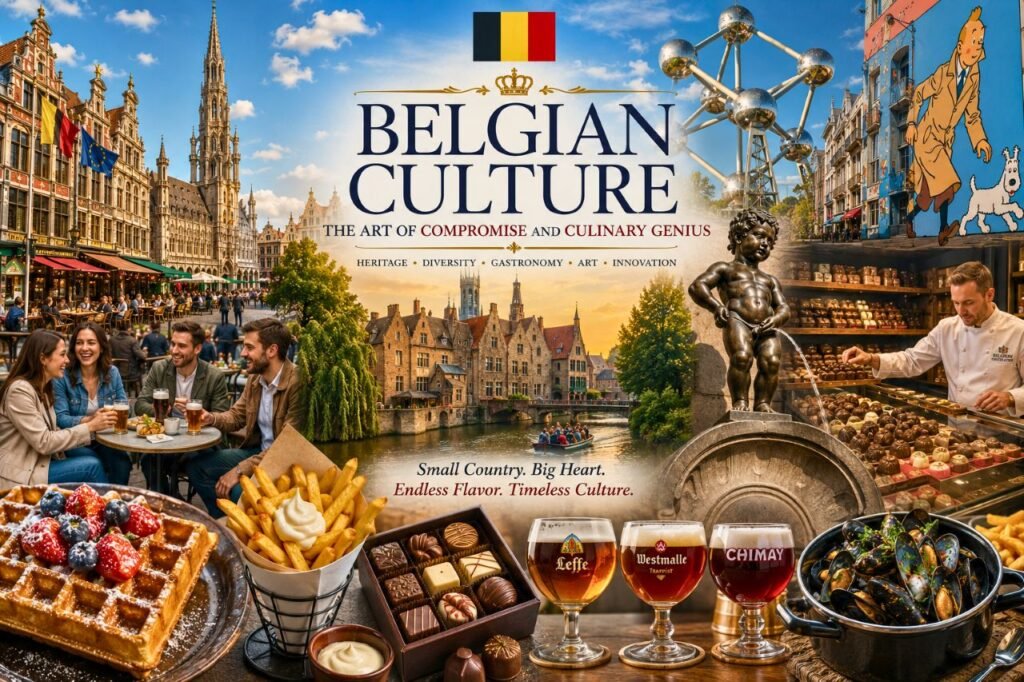
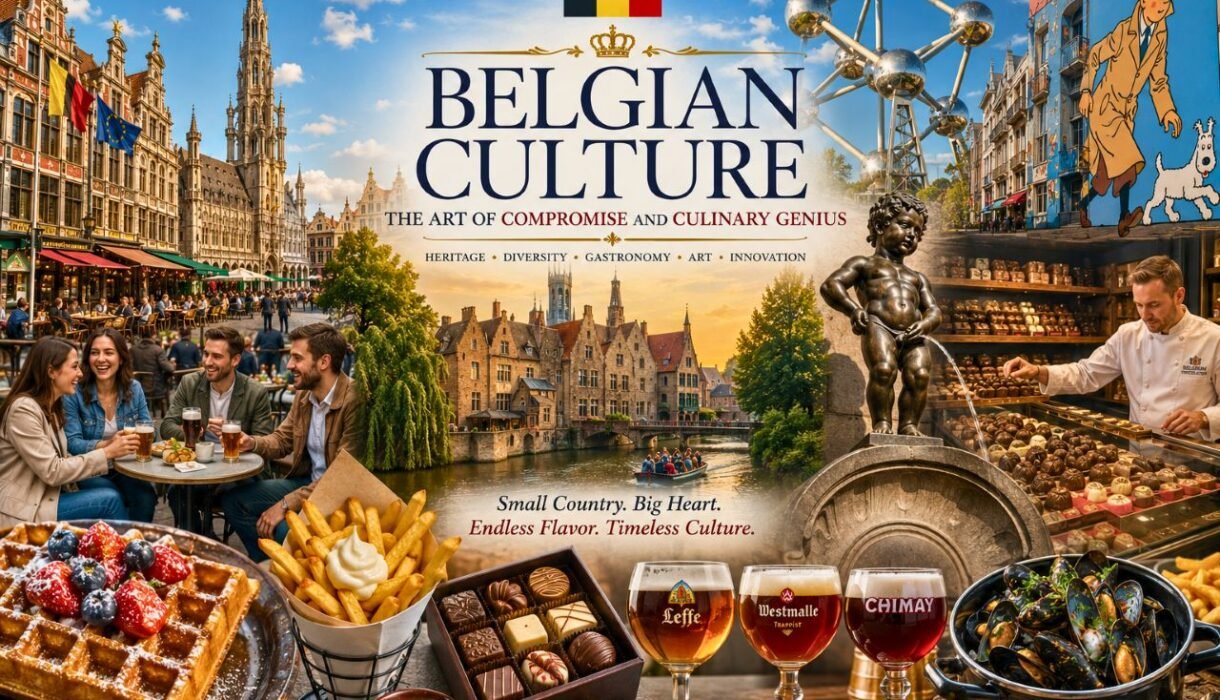
Belgium, A Celebration of Culture and Flavor
Marriage & Family Milestones
Modern Belgian family life values a healthy work-life balance and close local networks. Traditional Belgian weddings are elegant, family-centered events. An old, beautiful custom involves the bride carrying a specially embroidered lace handkerchief featuring her family name. After the wedding, this handkerchief is framed and hung on the wall, to be passed down through the generations to the next bride.
Festivals & Seasonal Folklore
- The Carnival of Binche: Celebrated in Wallonia in the days leading up to Ash Wednesday, this ancient, spectacular festival is recognized by UNESCO. It features hundreds of local men dressing up as mystical figures called Gilles, wearing vibrant wax masks, clogs, and massive ostrich-feather hats, who parade through the streets throwing oranges to onlookers for good luck.
- The Procession of the Holy Blood: Held every Ascension Day in Bruges, this solemn, medieval pageant draws thousands of spectators to watch residents dress in historical costume to reenact biblical scenes and transport a sacred relic through the city streets.
Languages & Communication
Belgium is a fascinating, complex linguistic puzzle divided strictly into three officially recognized federal communities.
| Region | Language | Approx. Population Share |
| Flanders (North) | Dutch (Flemish) | ~60% |
| Wallonia (South) | French | ~38% |
| East Cantons (East) | German | ~1% |
The Brussels Enclave
The capital city, Brussels, sits geographically within Flanders but operates as a completely bilingual enclave where both French and Dutch hold equal official status, though French is the primary spoken language of daily city life.
Greetings & Social Nuances
Belgians value politeness and a modest personal boundary. The standard greeting is a brief, firm handshake. Among close acquaintances, a light kiss on a single cheek is common.
Unlike neighbors in some directions, Belgians are exceptionally humble; boasting or talking loudly about personal wealth is viewed as highly impolite. They have mastered the art of Belgitude—a self-deprecating pride that laughs gently at their own complex bureaucracy.
Geography
Belgium is a small, compact country divided into three main physical geographic zones:
- The Coastal Plain: Low-lying, sandy plains along the North Sea, featuring extensive polders (land reclaimed from the sea).
- The Central Plateau: A gently rolling, highly fertile agricultural area that covers the heart of the country.
- The Ardennes: A rugged, hilly region in the southeast covered in dense, pristine forests, winding river caves, and small historic castles.
Economy
Belgium’s economy is highly developed, globalized, and deeply integrated into the European framework. Lacking massive raw mineral wealth in the modern era, the country relies heavily on its advanced transport infrastructure (including the Port of Antwerp, one of the largest shipping ports in the world) to import raw materials, add high-tech value, and export finished goods.
Core industries include chemical manufacturing, automotive assembly, pharmaceutical development, and diamond cutting (centered globally in Antwerp).
Politics
Belgium is a federal parliamentary constitutional monarchy. The current head of state is King Philippe, whose role is largely unified and symbolic. The head of government is the Prime Minister.
The political system is highly decentralized, split into three geographical regions (Flanders, Wallonia, and the Brussels-Capital Region) and three linguistic communities. Because power is so evenly distributed, forming a federal government requires massive coalitions. This process is highly complex—Belgium holds the world record for the longest time spent without an elected official government (541 days). Despite this, daily life runs smoothly due to an elite national skill in the art of compromise.
Ethnic Groups
The historic framework of the population consists of two main native groups: the Germanic Flemish of the north and the Celtic-Latin Walloons of the south.
Because Brussels functions as the de facto capital of the European Union and NATO, Belgium has become a major hub of international immigration. It is home to large, well-integrated communities originating from Italy, France, the Netherlands, Morocco, Turkey, and the Democratic Republic of Congo, creating a rich, multicultural urban tapestry.
Beliefs & Values
Religious Heritage
Historically, Roman Catholicism served as the primary moral and cultural pillar of Belgian life. While regular church attendance has declined significantly in recent decades, Catholic cultural structures, holidays, and breathtaking Gothic cathedrals remain central parts of local identity. Islam, Protestantism, and Judaism represent active minority communities.
The Worldview of Tolerance
Modern Belgian society values personal freedom, social solidarity, and absolute tolerance. This progressive worldview is reflected in its laws; Belgium was the second nation in the world to legalize same-sex marriage. The overarching philosophy focuses on a pragmatic, live-and-let-live mentality, prioritizing neighborhood peace and community well-being above ideological rigidity.
Food & Cuisine
Belgian cuisine is famously described as being cooked with the quality and portion size of Germany, but served with the refinement and passion of France.
- Moules-Frites: The unofficial national dish. Plump, fresh North Sea mussels steamed in a savory broth of white wine, celery, leeks, and butter, served alongside a mountain of crisp fries.
- The Secret of Real Frites: True Belgian fries are never called “French fries” locally. They are cut from specific bintje potatoes and double-fried—first at a lower temperature to cook the inside, then at a higher temperature to create a perfectly golden, crunchy exterior. They are served traditionally in a paper cone with a massive dollop of mayonnaise.
- Carbonnade Flamande: A rich, slow-simmered beef stew prepared with sweet caramelized onions, thyme, bay leaves, and dark Belgian abbey beer, creating an incredibly deep flavor profile.
- Chocolate and Beer Mastery: Belgium is home to artisan praline chocolates (invented by Neuhaus in Brussels) and a world-renowned beer heritage. From sour Lambics fermented with wild airborne yeasts to rich, complex Trappist beers brewed by monks inside monastery walls, beer culture here is so unique it is protected by UNESCO.
Clothing & Symbols
Historic Textiles and Style
While daily clothing in Belgium matches modern Western styles, the country holds an elite history in textile arts. During the Renaissance, Flemish weavers created the most prized tapestry art in the world.
Similarly, Brussels and Bruges lace became luxury items coveted by royal courts across Europe due to their microscopic, ethereal web designs. Today, this heritage is celebrated by avant-garde fashion houses, notably the “Antwerp Six,” who turned Belgium into a global center of modern, conceptual clothing design.
National Symbols
The national flag features three vertical stripes of black, yellow, and red, representing the historic coat of arms of the Duchy of Brabant. A beloved, quirky cultural symbol is Manneken Pis—a tiny bronze fountain statue of a young boy peeing, located near the Grand Place in Brussels. Reflecting the nation’s playful, irreverent humor, the city regularly dresses the statue in hundreds of customized miniature costumes throughout the year to mark various historical events.
Music, Dance & Art
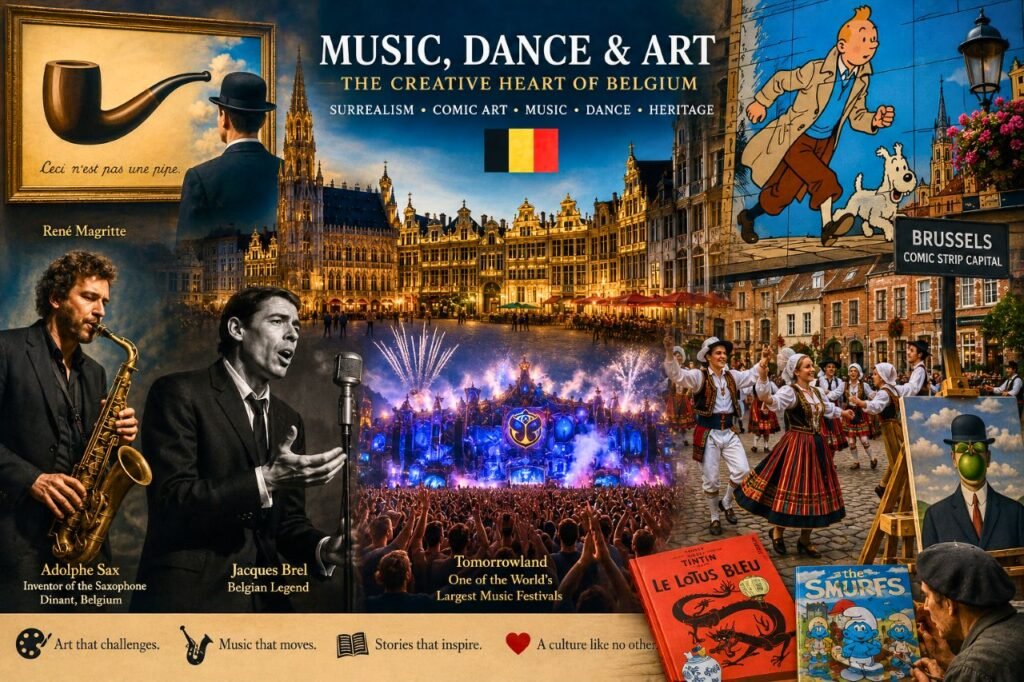
The vibrant heart of Belgium
Surrealism and Sequential Art
Belgian art is deeply visual and delightfully eccentric. In the 20th century, the country became a world center for Surrealism, led by the brilliant painter René Magritte, who challenged reality with his famous painting of a pipe captioned “Ceci n’est pas une pipe” (“This is not a pipe”).
Belgium is also the historic home of the Comic Strip (Bande Dessinée). It has the highest concentration of comic book artists per square mile in the world, giving birth to legendary global characters like Tintin (by Hergé) and The Smurfs (by Peyo).
Music and Performance
From the medieval polyphonic vocal music of the Franco-Flemish school to the melancholic genius of 20th-century singer-songwriter Jacques Brel, Belgium has a rich acoustic history. The country also invented the saxophone, created by musical instrument maker Adolphe Sax in Dinant in the 1840s. Today, Belgium is an epicenter of electronic dance music, hosting Tomorrowland, one of the largest music festivals on Earth.
Summary
The culture of Belgium is a quiet triumph of coexistence and creative expression. By turning diversity into a foundation for governance and everyday lifestyle, the Belgian people have built a society that is peaceful, prosperous, and exceptionally delicious. Whether exploring a surrealist art gallery, enjoying a slow-simmered beef stew, or sipping a legendary Trappist beer along an old canal, visitors find a country that reminds the world that life is best enjoyed with absolute humility, creative freedom, and an unhurried appreciation for the finer things.
At Best Culture Insight, we see culture as the heartbeat of every society – the way people live, connect, and express their identity.