Situated in the southeastern heart of the Balkan Peninsula, Bulgaria boasts one of Europe’s oldest, most resilient, and deeply soulful cultural identities. The Bulgarian people (Balgari) are heirs to a land that has served as a critical civilizational crossroads for millennia, bridging Continental Europe, the Mediterranean, and Asia Minor. – Culture
Bulgarian culture is a vibrant, multi-layered tapestry where ancient Thracian mysticism, Slavic heritage, and Proto-Bulgarian warrior traditions melt into a proud Eastern Orthodox Christian foundation. Known for their deep relationship with the soil, an unmatched vocal heritage, and a remarkably welcoming spirit, Bulgarians have preserved an ancient way of life that values community, respect for ancestors, and the magnificent, untamed beauty of their natural world.
History & Origins
Bulgaria is historically unique as one of the few European nations that has retained its original ethnic name and core identity for over thirteen centuries.
[Thracian Kingdoms & Roman Rule]➔[First Bulgarian Empire & Cyrillic Birth]➔[Second Bulgarian Empire]➔[Ottoman Dominion]➔[National Revival & Modern Sovereignty]
- The Golden Antiquity: Long before the arrival of the Slavs, the land was home to the ancient Thracians, renowned for their advanced goldsmithing, warrior kings, and mythical figures like Orpheus. The world’s oldest processed gold, dating back over 6,000 years, was discovered in the Varna Necropolis on Bulgaria’s Black Sea coast.
- The Birth of empires and the Cyrillic Script: The First Bulgarian Empire was founded in 681 AD by Khan Asparuh, uniting the Proto-Bulgarians and Slavic tribes. Under Tsar Boris I, Bulgaria officially adopted Christianity in 864 AD. Crucially, the empire became the cradle of Slavic literacy when the Cyrillic alphabet was developed in the Preslav and Ohrid Literary Schools during the late 9th century, later spreading across the entire Slavic world.
- The Ottoman Era and National Revival: Following the fall of the Second Bulgarian Empire in 1496, Bulgaria spent nearly five centuries under Ottoman rule. Throughout this period, local culture and the Christian faith were carefully protected inside secluded mountain monasteries, such as the famous Rila Monastery. The 18th and 19th centuries sparked the Bulgarian National Revival, an era of cultural awakening, stunning architectural creation, and revolutionary struggle that culminated in independence following the Russo-Turkish War of 1877–1878.
Culture, Traditions & Customs
Marriage & Family Milestones
Family relationships form the bedrock of Bulgarian society. Traditional weddings (Svadba) are highly festive events rich with symbolic protective actions. A beautiful custom involves the groom’s family marching to the bride’s house, where the groom must complete playful tests and offer a symbolic “ransom” to her family. Before entering the wedding venue, the mother-in-law feeds the newlyweds bread dipped in honey (wishing them a sweet life) and salt (reminding them of life’s struggles), while a bucket of water is spilled before them to clear a smooth path for their future.
Festivals & Seasonal Traditions
- Marta (Baba Marta): On March 1, Bulgarians celebrate Baba Marta (Grandmother March), an ancient pre-Christian custom welcoming spring. People exchange Martenitsi—intertwined red and white woolen threads symbolizing health, strength, and fertility. These are worn on wrists or pinned to jackets until the first stork or budding tree is spotted, at which point they are tied to a blooming branch.
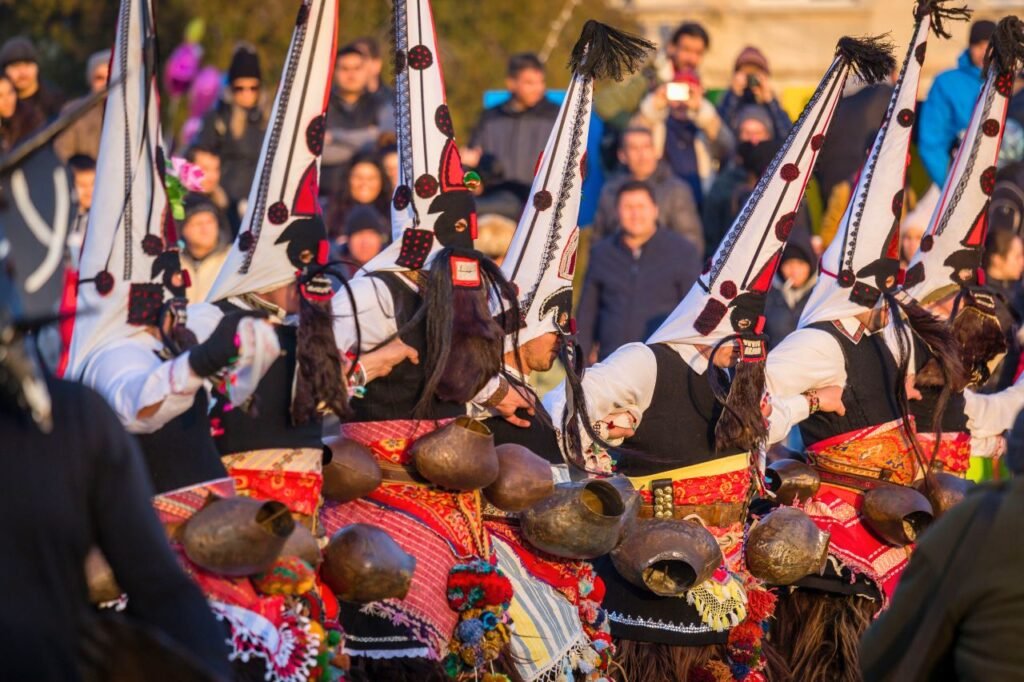
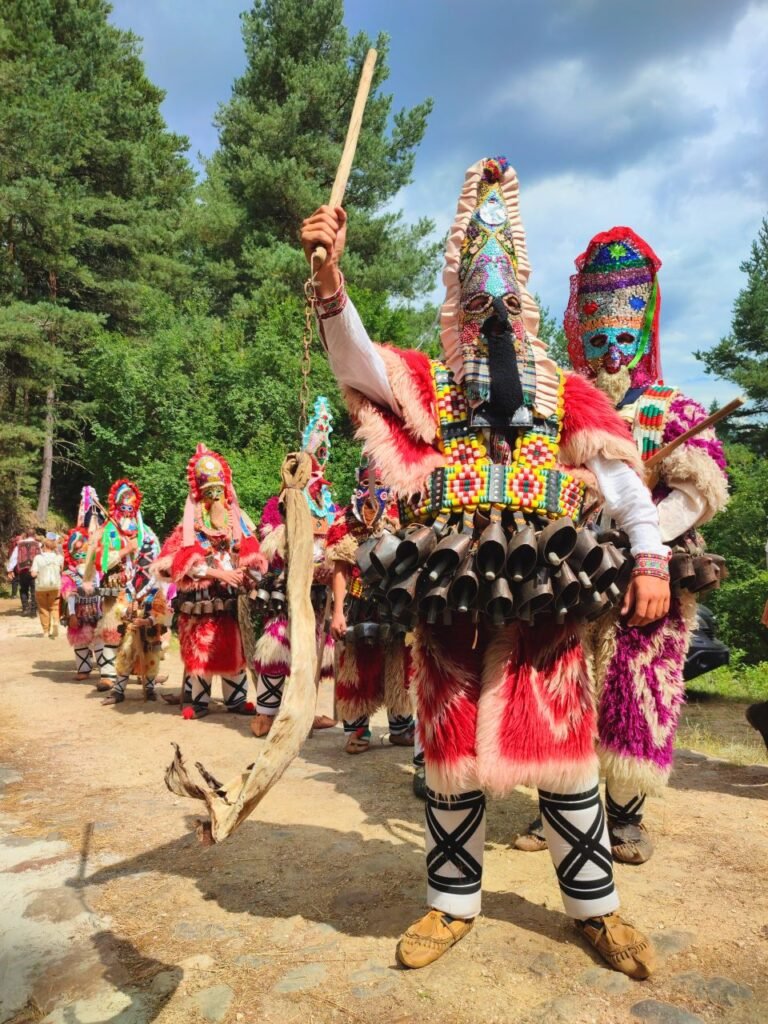
- Kukeri Festival: Held during the winter solstice or just before Lent, this spectacular ritual involves local men and boys dressing up in massive, terrifying costumes made of long-haired goat fur, wood, and leather. Wearing large, heavy copper and bronze bells around their waists, they dance rhythmically through villages to scare away evil winter spirits and bless the soil for a fertile harvest.
Languages & Communication
The state language is Bulgarian (Balgarski yazyk), which holds a historic place as the first written Slavic tongue.
Linguistic Traits
Bulgarian is unique among Slavic languages because it has completely dropped noun cases, using articles attached to the end of nouns instead. It is written exclusively in the Cyrillic script, a source of immense national pride celebrated every year on May 24.
The Nod Paradox: Visitors must be careful with physical communication in Bulgaria: nodding up and down traditionally means “No,” while shaking the head horizontally means “Yes”—a unique trait that trips up almost every traveler.
Local Proverbs & Expressions
- “Капка по капка – вир става.”
Translation: “Drop by drop, a lake forms.” This proverb emphasizes the core values of patience, small savings, and continuous effort.
- “Добрата дума железни врати отваря.”
Translation: “A kind word opens even iron gates,” highlighting the deep cultural preference for politeness and hospitality.
Geography
Bulgaria features a stunningly diverse landscape packed into a compact territory. The country is split horizontally by the rugged Balkan Mountains (Stara Planina), which give the entire peninsula its name.

This vibrant, collage-style poster celebrates Bulgaria’s rich cultural heritage and breathtaking landscapes.
The northern region is defined by the fertile Danubian Plain, while the south boasts spectacular, high-altitude alpine ranges: the Rila Mountains (home to Musala, the highest peak in the Balkans) and the jagged Pirin range. Eastward, the country slopes down to meet the Black Sea coast, famous for its wide, sandy beaches and historic maritime ports. In the central valleys lies the fertile Rose Valley, which produces the vast majority of the world’s precious rose oil.
Economy
Bulgaria operates as a free-market economy and has been a member of the European Union since 2007. Historically focused on agriculture, the nation has evolved into an industrial and technological center.
Core economic drivers include mining (extracting copper, zinc, and lignite), machinery manufacturing, and a rapidly expanding Information Technology and software outsourcing sector centered in Sofia. Bulgaria is also a global leader in agriculture as the world’s primary exporter of lavender and high-grade rose oil, which forms the aromatic base for international luxury perfumes.
Politics
Bulgaria is a parliamentary republic characterized by a clear separation of powers. The head of state is the President, who represents national unity and serves as the commander-in-chief of the military forces.
Executive political authority is held by the Prime Minister, who leads the Council of Ministers and must maintain a majority within the unicameral parliament—the National Assembly (Narodno Sabranie), composed of 240 elected deputies. The country is an active member of both NATO and the European Union, aligning its geopolitical policies with democratic European frameworks.
Ethnic Groups
The population displays a high degree of cultural continuity, with roughly 85% identifying as ethnically Bulgarian.
The largest historical minority group is the Turkish community (around 8.8%), predominantly settled in the southern Rhodope region and parts of the northeast. The Roma people constitute the second-largest minority at roughly 4.9%. Smaller, historically significant communities include Armenians, Greeks, Jews, and Russians, all of whom contribute to the country’s diverse cultural landscape.
Beliefs & Values
Religious Bedrock
The spiritual identity of the nation is anchored by the Bulgarian Orthodox Church, which encompasses roughly 75% of the population. Christianity in Bulgaria is deeply tied to historical survival; the church was the sole institution that preserved the Bulgarian language, literature, and historical memory through centuries of foreign rule. Islam is the second largest religion, practiced by roughly 10% of the population (primarily the Turkish minority and Pomaks).
Worldview of Endurance and Peace
The core values of Bulgarian life are industriousness, family loyalty, and a deep respect for traditions. Generations of surviving difficult historical eras have fostered a collective mindset focused on patience, caution, and resilience. Above all, Bulgarians display an intense reverence for nature, treating mountains, forests, and fresh water sources as sacred elements capable of healing the spirit.
Food & Cuisine
Bulgarian cuisine (Balgarska kuchnia) is a delicious, slow-cooked culinary tradition heavily influenced by Balkan geography and Mediterranean flavors. It is rich in fresh vegetables, grilled meats, and legendary dairy products.
- Shopska Salad: The undisputed culinary ambassador of the country, reflecting the colors of the national flag. It features a crisp mix of diced tomatoes, cucumbers, roasted red peppers, and onions, topped with a mountain of finely grated Sirene (a salty white brined sheep or cow cheese) and a drizzle of sunflower oil.
- Banitsa: A beloved, comforting pastry made by layering whisked eggs and crumbled sirene cheese between sheets of thin filo pastry, then baking it into a golden, flaky spiral. It is a staple breakfast food, traditionally enjoyed alongside a cold glass of Ayran (a savory yogurt drink) or Boza.
- The Magic of Kiselo Mlyako: Bulgarian yogurt (Kiselo mlyako) is globally famous for its unmatched thick texture and health benefits. This unique quality is caused by a native, airborne microscopic bacterium found only in the local air—Lactobacillus bulgaricus.
- Meshana Skara: A heavy platter of mixed grilled meats, including kyufte (spiced meatballs) and kebapche (elongated minced meat rolls), seasoned with native herbs like savory (chubrica).
Clothing & Symbols
Traditional Attire and the Shevitsa
Traditional Bulgarian clothing (Nosiya) varies by region but is universally defined by the Shevitsa—complex, bright geometric embroidery that decorates linen shirts, tunics, and aprons.
These red, green, white, and black embroidered patterns are not merely decorative; they serve as a symbolic visual language. Historically, a single look at a woman’s shevitsa could reveal her exact village, marital status, and social position. The specific geometric patterns were believed to act as a protective shield against illness and the “evil eye.”
National Symbols
The national flag consists of three horizontal bands: white (representing peace and freedom), green (representing the fertility of the forests and fields), and red (representing the courage of the soldiers who died for the country). The historic coat of arms features a golden, crowned lion rampant displayed on a dark red shield, symbolizing royal sovereignty and ancient warrior strength.
Music, Dance & Art
Cosmic Voices and Asymmetrical Rhythms
The folk music of Bulgaria is an absolute global wonder, celebrated for its complex asymmetrical rhythms (such as $5/8$, $7/8$, or $11/8$ time signatures) that do not exist in Western classical music. The vocal technique involves a unique, open-throated style that produces an incredibly piercing, haunting sound.
Voices in Space: The Bulgarian folk song “Izlel e Delyu Haydutin,” performed by the legendary Valya Balkanska, was chosen by NASA to be included on the golden Voyager Golden Record, launched into deep space in 1977 as a message to extraterrestrial civilizations.
- Traditional Instruments: The acoustic background of Bulgarian life is powered by the Gaida (a bagpipe made of goat hide), the Kaval (a wooden flute), and the Gadulka (a pear-shaped bowed string instrument).
- The Horo Dance: The ultimate physical expression of unity. During any celebration, residents lock hands or belts to form a massive, swirling circle dance called the Horo, stepping in intricate, rapid synchronization to the asymmetrical beat of the drums and bagpipes.
Summary
Bulgarian culture is an enduring testament to the preserving power of tradition and natural harmony. By safeguarding their unique Cyrillic alphabet, their intricate shevitsa embroidery, and the magical, cosmic sounds of their folk choirs, the Bulgarian people have maintained a pristine identity through the ages. From the fragrant rose fields to the snowy peaks of Rila and the festive fires of the Kukeri, Bulgaria continues to offer the world a cultural landscape defined by ancient mystery, profound resilience, and an unhurried, warm-hearted lifestyle.
At Best Culture Insight, we see culture as the heartbeat of every society – the way people live, connect, and express their identity.