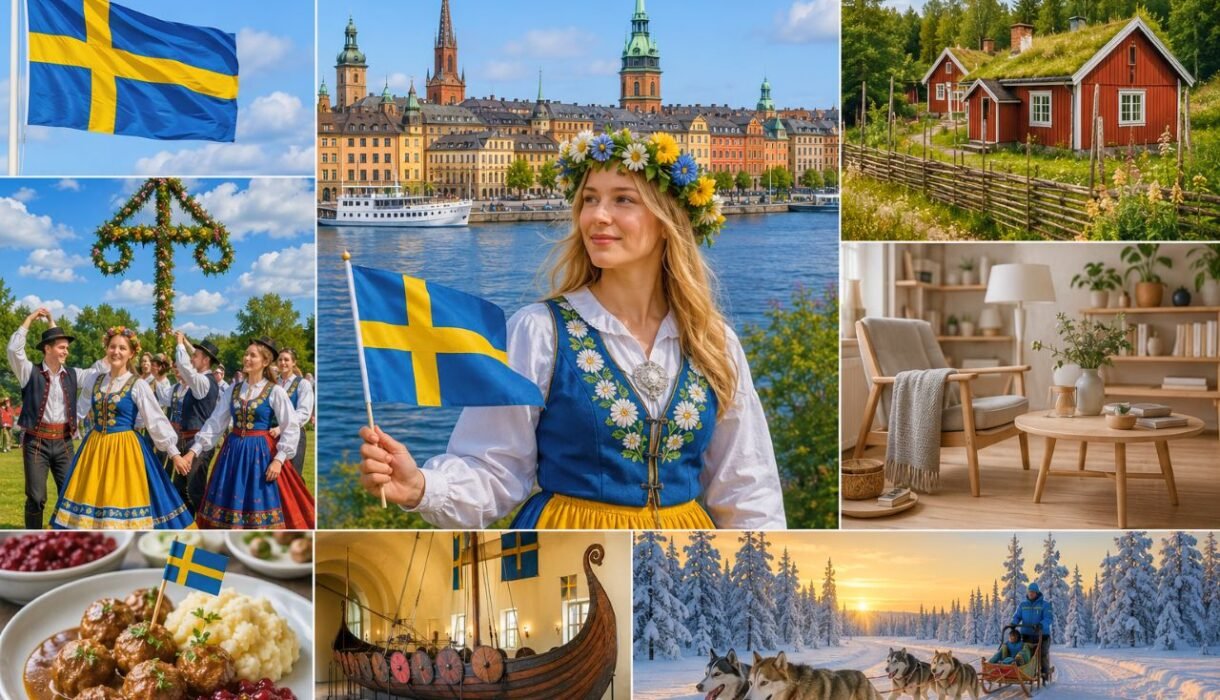

Stretching across the eastern expanse of the Scandinavian Peninsula, Sweden is a nation celebrated for its vast boreal forests, thousands of coastal islands, and a deeply progressive social framework. The vibrant Culture of Sweden—known natively as svensk kultur—is an inspiring harmony of ancient Norse traditions, egalitarian social values, and a profound reverence for the natural world. The Swedish people are recognized worldwide for their modest demeanor, passion for innovation, commitment to environmental sustainability, and a unique social philosophy that balances personal autonomy with communal well-being. From the historical, stone-paved alleyways of Stockholm’s Gamla Stan to the snowy wilderness of Lapland, Sweden offers a rich, beautifully balanced cultural tapestry.
History & Origins
Sweden’s historical narrative evolved from seafaring medieval raiders into a formidable European power, and ultimately into a modern global beacon of peace and social welfare.
- The Viking Age (8th–11th Centuries): Early North Germanic tribes, including the Svear and Götar, expanded eastwards along Baltic river routes during the Viking Era, establishing trade networks as far as Constantinople and Kyiv.
- Christianization & The Kalmar Union: By the 11th century, Christianity replaced Old Norse paganism. In 1397, Sweden joined Denmark and Norway in the Kalmar Union.
- The Vasa Dynasty & Great Power Era: In 1523, Gustav Vasa led a successful rebellion, breaking away from the union, establishing the modern Swedish state, and introducing Lutheran Protestantism. During the 17th century (Stormaktstiden), King Gustavus Adolphus transformed Sweden into a dominant military empire surrounding the Baltic Sea.
- Neutrality & The Welfare State: Following territorial losses in the 18th and early 19th centuries, Sweden adopted an official policy of non-alignment and non-participation in wars starting in 1814. During the 20th century, the social democratic vision of Folkhemmet (“The People’s Home”) constructed Sweden’s world-renowned modern welfare state.
Culture, Traditions & Customs
Lagom & Fika: The Core Philosophy of Life
Two concepts define everyday Swedish social existence:
- Lagom: Translating roughly to “not too little, not too much—just enough,” lagom is the national ethos of moderation, balance, fairness, and avoiding excess or boasting.
- Fika: Far more than a simple coffee break, fika is a cherished daily social ritual where friends, family, or colleagues pause their work to gather over coffee, tea, and sweet pastries like cinnamon buns (kanelbullar).
Midsummer & Seasonal Celebrations
- Midsummer (Midsommar): Held in late June during the summer solstice, Midsummer is arguably Sweden’s most cherished holiday. Communities gather outdoors to raise a leafy maypole (midsommarstång), dance in flower crowns, sing folk songs, and feast on pickled herring and fresh strawberries under the midnight sun.
- Saint Lucia’s Day (December 13): To brighten the dark Nordic winter, young people dress in white gowns, led by a girl wearing a crown of glowing candles representing Saint Lucia, singing traditional carols and serving saffron buns (lussekatter).
Life Milestones & Marriage
Swedish weddings (bröllop) are personal and intimate affairs. A unique wedding custom includes guests freely kissing the bride or groom whenever their new spouse leaves the dining room during the reception dinner.
Languages & Communication
Language Spoken
The official language is Swedish (svenska), a North Germanic language spoken by roughly 10 million people. It is closely related to Norwegian and Danish, allowing for a high degree of mutual comprehension across Scandinavia.
Sweden consistently ranks among the top non-native English-speaking nations in the world, with English taught extensively from early childhood.
Communication Style & Etiquette
Swedish communication is direct, calm, and consensus-driven. Interrupting others is considered impolite, and modest silence is valued over small talk.
- Greetings: A light, friendly handshake paired with eye contact is standard. Casual greetings among peers include Hej! or Tjena!.
- Key Expressions:
- Tack! (Thank you!)
- Var så god (You’re welcome / Here you go)
- Skål! (Cheers!—accompanied by looking each person in the eye)
Proverbs & Wisdom
- “Det finns inget dåligt väder, bara dåliga kläder.”
Meaning: “There is no bad weather, only bad clothes”—a classic phrase reflecting the Swedish commitment to enjoying the outdoors in every season.
- “Lagom är bäst.”
Meaning: “The right amount is best”—reaffirming the value of balance and moderation.
Geography
Covering approximately 450,295 square kilometers, Sweden is the largest nation in Northern Europe, characterized by diverse, untouched landscapes divided into three main regions:
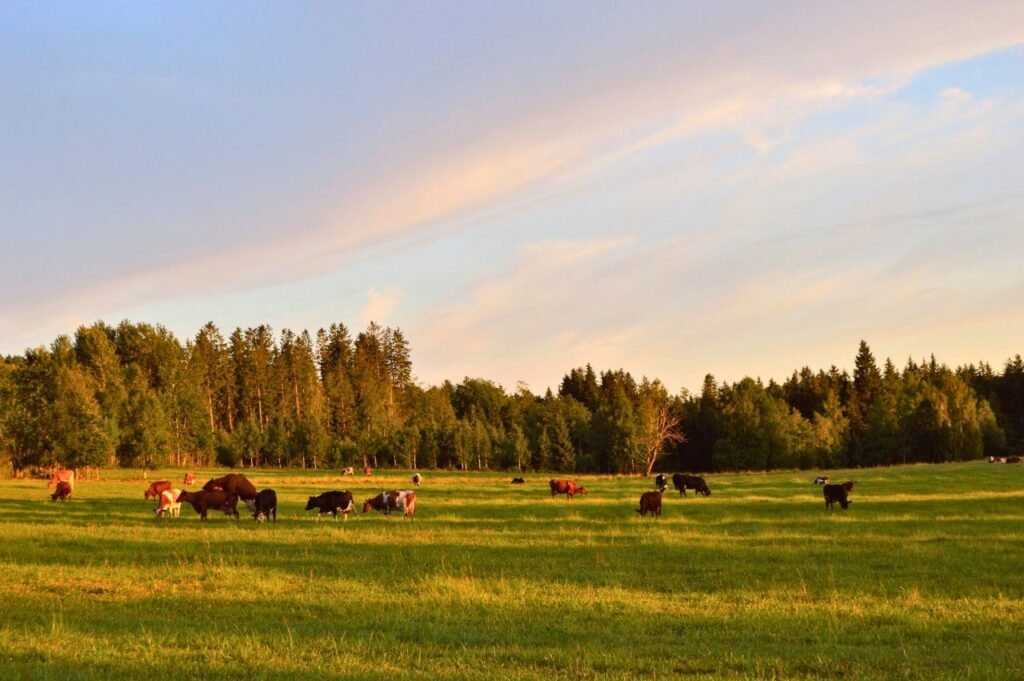
- Götaland (South): Rolling agricultural fields, dense hardwood forests, and coastal archipelagos.
- Svealand (Central): Lakes, valleys, and forests surrounding major urban centers like Stockholm.
- Norrland (North): A vast wilderness covering over half the country, featuring snow-capped Scandinavian Mountains (Skanderna), roaring rivers, tundra, and Lapland—the ancestral home of the indigenous Sámi people.
- Allemansrätten: The constitutional “Right of Public Access” grants every person the legal freedom to roam, camp, pick wild berries, and hike anywhere in nature, provided they do not disturb or destroy.
Economy
Sweden possesses a highly competitive, knowledge-based market economy that balances private enterprise with an extensive social safety net.
Sweden is an international hub for technological innovation, green energy, and global corporate giants—having given birth to brands like IKEA, Volvo, Spotify, Electrolux, and Ericsson. Major export pillars include precision machinery, timber, high-grade iron ore, telecommunications, and automotive manufacturing.
Politics
Sweden is a constitutional monarchy with a parliamentary democracy.
- Monarch: The King (currently King Carl XVI Gustaf) serves as the ceremonial Head of State without political authority.
- Prime Minister: The Head of Government, holding executive authority over state administration.
- Riksdag: The unicameral national parliament consisting of 349 members elected through proportional representation every four years.
Ethnic Groups
Sweden’s demographic landscape combines a Scandinavian majority, indigenous peoples, and a diverse modern population:
| Ethnic / Regional Group | Historic Context & Presence | Cultural Legacy |
| Swedes | ~75–80% majority nationwide | Germanic roots; Lutheran heritage; creators of modern Scandinavian design. |
| Sámi People | ~20,000–40,000 in Northern Sweden | Indigenous Arctic culture; traditional reindeer herding; Joik musical throat-singing. |
| Tornedalians & Finns | Eastern & Northern border regions | Historic minority with distinct Finno-Ugric linguistic traditions. |
| New Swedes (Immigrants) | Major urban centers | Diverse international communities enriching Sweden’s culinary and artistic landscape. |
Beliefs & Values
Secular Humanism & Spirituality
While the Church of Sweden (Evangelical Lutheran) was the state church until 2000, modern Sweden is one of the world’s most secular societies. Spiritual connection for many Swedes is experienced directly through nature and the outdoors (friluftsliv).
Moral Values
- Jantelagen (The Law of Jante): An unwritten social code discouraging individual vanity, boastfulness, or placing oneself above the community.
- Gender Equality & Sustainability: Sweden leads global standards in parental leave policies, environmental conservation, and social inclusivity.
Food & Cuisine
Swedish gastronomy focuses on fresh, seasonal ingredients, wild berries, seafood, rye breads, and preserved meats.
- Köttbullar (Swedish Meatballs): Tender spiced meat spheres served with rich cream sauce (gräddsås), smooth potato puree, pickled cucumbers, and tart lingonberry jam.
- Smörgåsbord & Pickled Herring (Sill): A traditional buffet featuring pickled herring in various marinades (mustard, dill, onion), smoked salmon, cheeses, and crispbread (knäckebröd).
- Janssons Frestelse: A rich, baked casserole of layered potatoes, onions, breadcrumbs, and pickled sprat fillets (ansjovis).
- Surströmming: A notoriously pungent fermented Baltic sea herring from Northern Sweden, eaten outdoors during late summer on flatbread.
Clothing & Symbols
Sweden: culture, nature, and traditions
Traditional Attire (Svenska Folkdräkter)
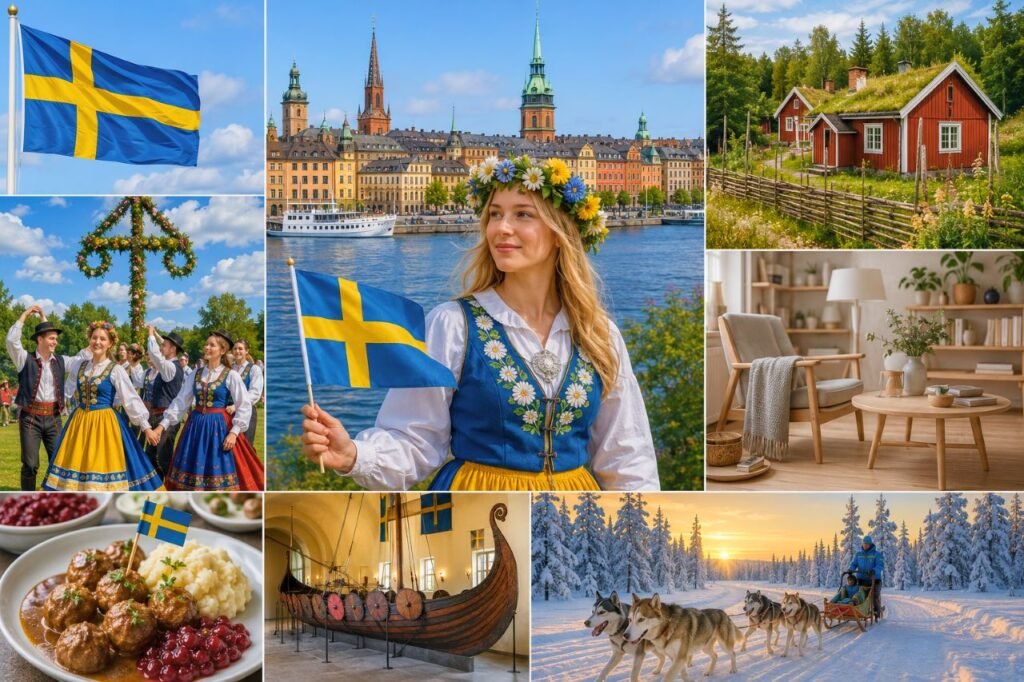
Traditional Swedish folk dresses vary across regions, featuring bright embroidered waistcoats, wool skirts, aprons, and white shirts. The official National Costume (Sverigedräkten), created in 1903, features vibrant yellow and blue colors matching the national flag.
Iconic Symbols
- The Dala Horse (Dalahäst): A hand-carved, brightly painted wooden toy horse originating from the Dalarna region, recognized worldwide as a symbol of Swedish folk craft.
- The Yellow Cross on Blue: The national flag, dating back to the 16th century, derived from the Nordic Cross design.
Music, Dance & Art
Musical Export Powerhouse
Sweden is the third-largest net exporter of music in the world (after the US and UK). Its legendary pop heritage includes ABBA, Roxette, Max Martin, Avicii, and vibrant heavy metal and indie music scenes.
Traditional Music & Dance
Folk music relies on the fiddle and the unique Nyckelharpa (a keyed fiddle instrument dating to the Middle Ages). Popular folk dances like the Polska feature lively couple turns performed at seasonal festivals.
Literature & Design
Sweden has given the world enduring literary classics, from Astrid Lindgren’s Pippi Longstocking to modern Nordic Noir crime novels. In design, the principle of Scandinavian Modernism emphasizes functionalism, clean lines, and natural materials accessible to all.
Summary
In summary, Sweden Culture represents a harmonious synthesis of deep historical roots, profound love for nature, and a forward-thinking commitment to social equality. Through cherished traditions like Fika and Midsummer, a balanced philosophy of Lagom, and world-renowned contributions to music, design, and innovation, Sweden offers an extraordinary blueprint for living in harmony with both society and nature.
At Best Culture Insight, we see culture as the heartbeat of every society – the way people live, connect, and express their identity.