Rhythm, Sea, and Spirit: A Deep Exploration of Bahamas Culture
Posted in :

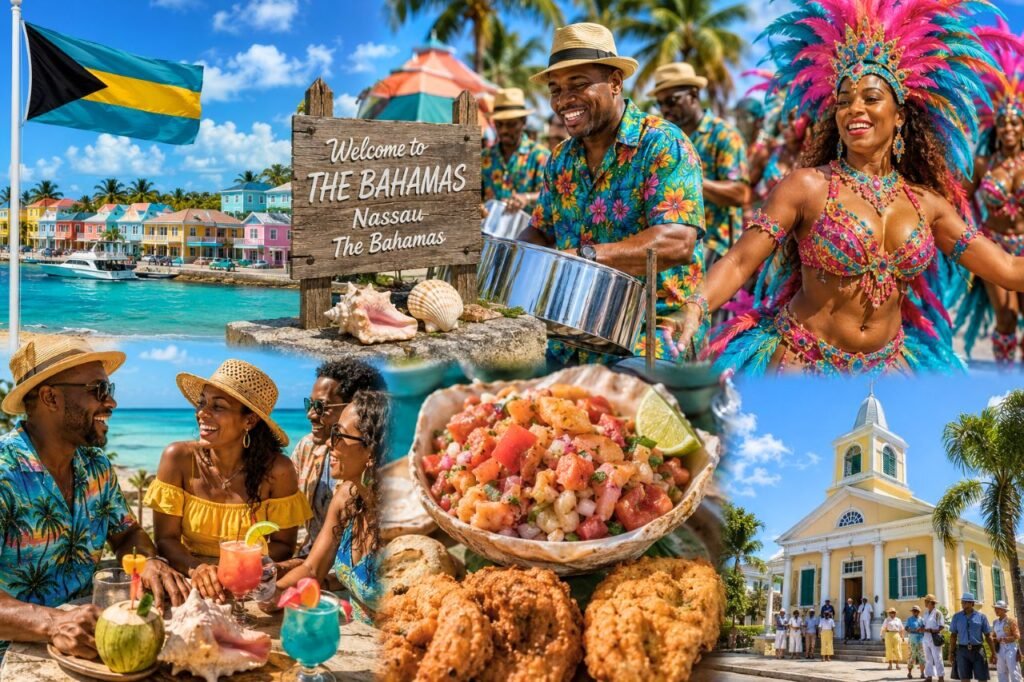
Scattered like a handful of matching turquoise gems across the western Atlantic Ocean, the Commonwealth of The Bahamas is far more than a stunning vacation destination. Positioned in the northern reaches of the Caribbean region of North America, this archipelago nation of over 700 islands and cays features a deep, sophisticated, and resilient culture. – Bahamas culture
The people, known proudly as Bahamians, have built a distinct lifestyle deeply tied to the rhythms of the sea and the historical spirit of liberation. Their identity is a rich synthesis of West African traditions, British colonial systems, and neighboring American influences. It is a society where deep religious devotion peacefully coexists with the explosive, wild energy of street festivals, and where the values of hospitality, storytelling, and family form the core of daily life.
History & Origins
The historical tapestry of the Bahamas began with the Lucayans, a branch of the seafaring Taíno people who settled the islands around 500 to 800 AD, living harmoniously through fishing and small-scale agriculture.
The course of global history altered permanently on October 12, 1492, when Christopher Columbus made his very first landfall in the New World on the Bahamian island of San Salvador. Within a generation, Spanish explorers completely depopulated the islands, forcing the gentle Lucayans into enslavement in the mines of Hispaniola.
- The Eleutheran Adventurers: After more than a century of isolation, a group of English Puritans known as the Eleutheran Adventurers arrived in 1648 seeking religious freedom, giving the island of Eleuthera its name (from the Greek word for “freedom”).
- The Pirate Republic & British Control: During the late 17th century, the archipelago’s intricate maze of shallow channels and hidden cays became a notorious haven for pirates like Blackbeard. The British Crown established formal control in 1718 under Governor Woodes Rogers, successfully driving out the outlaws.
- The Influx of African Heritage: The primary demographic shift occurred following the American Revolutionary War. Thousands of British Loyalists fled the newly formed United States for the Bahamas, bringing along enslaved West Africans. This massive influx brought rich language structures, musical traditions, and agricultural skills that became the foundation of modern Bahamian identity.
The Bahamas peacefully achieved full political independence from Great Britain on July 10, 1973, emerging as a proud, self-determined sovereign nation.
Culture, Traditions & Customs
Community Milestones and Rites of Passage
Family is the emotional anchor of Bahamian society, characterized by extensive, tight-knit matriarchal structures where grandmothers and aunts play key roles in raising children. Traditional milestones, such as infant christenings and multi-generational church weddings, are celebrated with massive communal feasts.
Funerals in the Bahamas hold profound cultural weight. Deeply rooted in African and Victorian-era traditions, they are viewed as a celebratory “homegoing” for the soul. They feature spirited choral singing, brass bands processing through street neighborhoods, and large repasts where communities gather to share memories and comfort each other.
The Heartbeat of the Nation: Junkanoo
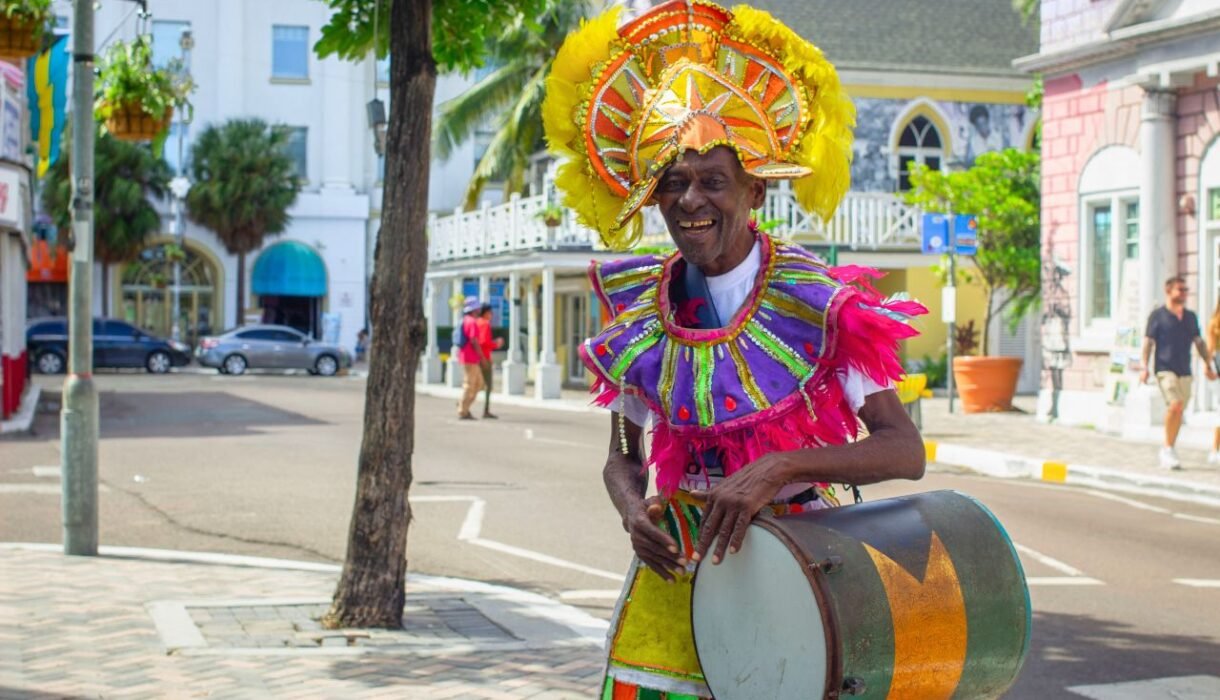
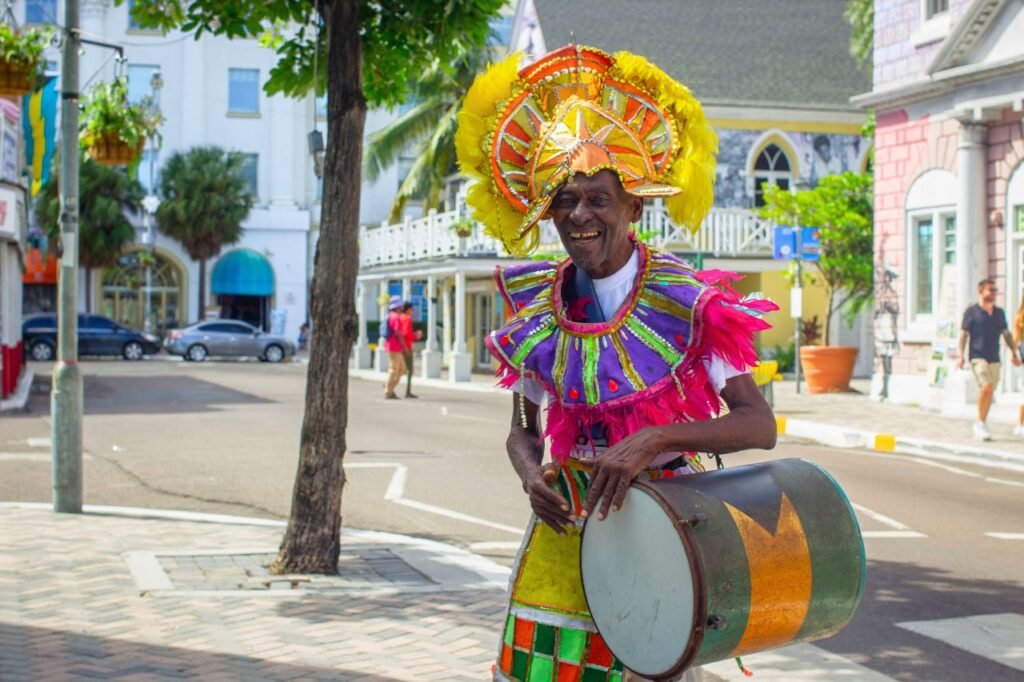
The absolute pinnacle of Bahamian cultural preservation is Junkanoo, a spectacular street festival with origins dating back to the era of slavery. Traditionally, enslaved workers were granted three days off during the Christmas season, which they celebrated by masking their faces, playing homemade instruments, and traveling from house to house on stilts.
Today, Junkanoo has evolved into a massive cultural competition taking place in the pre-dawn hours of Boxing Day (December 26) and New Year’s Day.
Major cultural groups spend months in secret shacks meticulously crafting towering, multi-layered costumes using nothing but cardboard and colorful, fringed crepe paper. The parade, known as “rushing,” fills Downtown Nassau with the deafening, polyrhythmic sounds of goatskin drums, brass sections, and scraping cowbells.
Languages & Communication
While English is the official language utilized across standard education, civil government, and news media, the everyday voice of the streets is Bahamian Dialect (Bahamian English Creole). This expressive dialect blends standard English vocabulary with West African grammatical patterns, nautical terms, and localized slang words. It features a fast-paced cadence, often dropping initial consonants or softening vowels to create a fluid, poetic speech rhythm.
Popular Bahamian Expressions and Proverbs:
- “Switcha” – The classic national term for fresh, homemade limeade.
- “Bey” / “Chil” – Ubiquitous terms used for “boy,” “girl,” or a close companion.
- “Sippin’ on the line” – A casual idiomatic phrase meaning to share hot town gossip.
- “Don’t throw away dirty water until you have clean water” – Exercise caution before abandoning your current security or income for an unverified promise.
Geography
The Bahamas forms a sprawling archipelago stretching over 500 miles across the Atlantic Ocean, situated just east of Florida and north of Cuba. The terrain is remarkably flat and low-lying, built primarily on a foundation of fossilized coral limestone reefs.
[ The Spatial Layout of The Bahamas ]
┌─────────────────────────┬─────────────────────────┬─────────────────────────┐
│ New Providence │ Grand Bahama │ The Out Islands │
│ The political & economic│ A major commercial hub │ Over 600 pristine cays │
│ hub; home to the capital│ featuring eco-tourism │ preserving traditional │
│ city of Nassau. │ and industrial ports. │ fishing and slow life. │
└─────────────────────────┴─────────────────────────┴─────────────────────────┘
The country is divided between the bustling metropolis of New Providence (home to Nassau, where over 70% of the population lives) and the pristine Family Islands (or Out Islands) like Andros, Abaco, Exuma, and Eleuthera. The nation is surrounded by the Great and Little Bahama Banks, featuring shallow, light-blue waters so clear they can be seen from space.
Economy
The Bahamas boasts one of the highest per-capita income rates in the Americas, driven by a highly stable, service-oriented economy. Tourism is the primary economic engine, accounting for roughly 50% of the national GDP and employing over half of the domestic workforce.
The second pillar of the economy is international financial services, supported by strict privacy laws and a tax-neutral status. Along the Out Islands, traditional economic activities like small-scale farming, salt harvesting on Inagua, and commercial fishing remain vital cornerstones of community survival.
Politics
The Bahamas is an independent constitutional parliamentary democracy and a member of the Commonwealth of Nations. King Charles III remains the ceremonial head of state, represented locally by a Bahamian Governor-General.
Executive authority is held by the Prime Minister, who leads the cabinet and is chosen from the elected representatives in the House of Assembly. The nation maintains an exceptionally stable two-party political framework, characterized by peaceful transitions of power and a deep institutional respect for constitutional law and human liberties.
Ethnic Groups
Centuries of maritime migrations, colonial plantation trade, and regional labor movements have shaped a warm, cohesive demographic landscape across the islands:
| Ethnic Group | National Presence | Historical Foundations & Footprint |
| African Descent | ~90.6% | Descendants of West African peoples brought via the transatlantic trade and freed from slave ships by the British Royal Navy. |
| White / Caucasian | ~4.7% | Primarily tracing ancestry to early English Puritans, American Loyalist settlers, and European trading families. |
| Mixed / Multiracial | ~2.1% | Representing generations of cultural and racial integration across the Atlantic basin. |
| Other / Haitian | ~2.6% | Includes influential modern immigrant worker communities, alongside small Greek, Chinese, and Lebanese merchant groups. |
Beliefs & Values
The Bahamas is a profoundly religious society, with its national constitution explicitly declaring a commitment to “Christian Values.” The country has one of the highest densities of churches per capita in the world. The vast majority of the population identifies as Protestant, with Baptist, Anglican, and Methodist denominations holding massive spiritual and social influence.
Christian principles heavily guide national education, public morals, and legal frameworks, and Sundays are traditionally reserved for formal worship and family gatherings.
Alongside mainstream Christianity, elements of Obeah—an ancestral Afro-Caribbean spiritual practice involving folk medicine, herbalism, and spiritual protection—persist quietly in some rural communities, serving as an underground link to West African folk traditions.
Food & Cuisine
Bahamian cuisine is a bold, intensely seasoned culinary tradition centered around fresh seafood, tropical citrus fruits, corn, and spicy peppers.
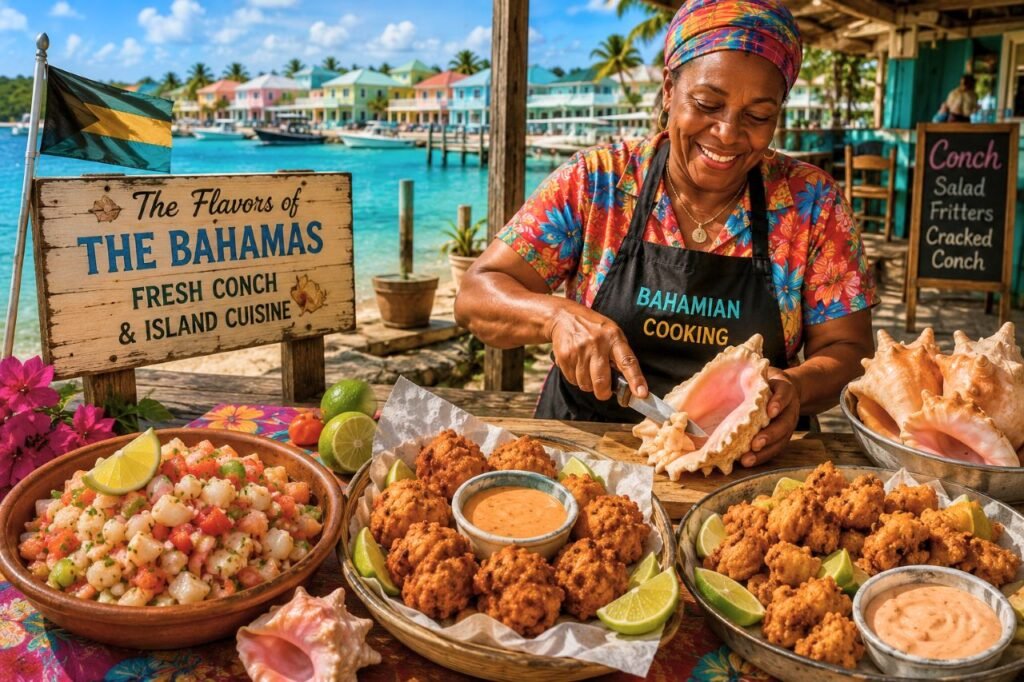
Fresh conch and coastal flavors – Bahamas Culture
The Royalty of the Sea: Conch
The undisputed king of the Bahamian menu is Conch (pronounced “konk”), a large marine mollusk with a sweet, firm white meat. It is prepared in numerous creative ways:
- Conch Salad: A refreshing dish where raw conch meat is diced finely and tossed with fresh tomatoes, green bell peppers, onions, and cured instantly in a pool of fresh, sour orange and lime juices, spiced with hot bird pepper.
- Cracked Conch: Tenderized conch meat dipped in a seasoned batter and deep-fried until golden brown, served with a tangy dipping sauce.
- Conch Fritters: Deep-fried balls of seasoned cornmeal batter packed with bits of minced conch, sweet peppers, onions, and tomato paste.
Other National Staples
- Bahamian Rock Lobster: Enjoyed minced and simmered with onions, sweet peppers, and tomato paste, served alongside hot grits.
- Peas n’ Rice: The essential side dish for any Bahamian meal. It features pigeon peas cooked with long-grain white rice, seasoned with salted pork, onions, tomato paste, and fresh thyme.
- Guava Duff: The ultimate traditional dessert. This labor-intensive sweet treat consists of a soft dough spread with fresh guava pulp, rolled into a log, wrapped tightly in cloth, and boiled for hours. It is served warm, sliced into rounds and drenched in a decadent butter-rum sauce.
Clothing & Symbols
Androsia Fabric and National Dress
While modern Western clothing is standard for daily life, the national textile of the Bahamas is Androsia. This vibrant, hand-dyed batik fabric is made exclusively on the wild island of Andros. Artisans use hand-carved stamps fashioned from local sponge or wood to apply hot wax patterns onto 100% cotton cloth, which is then dyed in brilliant shades of turquoise, pink, and green that mimic the tropical environment.
On formal national occasions, women wear elegant tiered dresses tailored from Androsia cloth, while men wear smart batik shirts, proudly showcasing localized craftsmanship.
[ The Crafting Stages of Androsia Batik ]
┌─────────────────────────┬─────────────────────────┬─────────────────────────┐
│ Waxing the Pattern │ Immersion Dyeing │ Boiling the Wax │
│ Hot wax stamps are │ The cloth is soaked in │ The fabric is boiled to │
│ hand-pressed onto text- │ vibrant dyes; the waxed │ melt the wax, revealing │
│ ile canvas sheets. │ zones resist colors. │ the white design icons. │
└─────────────────────────┴─────────────────────────┴─────────────────────────┘
National Symbols
The national flag of The Bahamas features a black equilateral triangle on the left, pointing toward three horizontal bands of aquamarine, gold, and aquamarine. The black triangle represents the enterprise, vigor, and determination of the Bahamian people; the aquamarine stripes symbolize the pristine waters surrounding the islands; and the central gold band represents the sun-drenched land.
The national coat of arms prominently displays a flamingo and a marlin supporting a central shield topped by Christopher Columbus’s flagship, the Santa María, under the inspiring national motto: “Forward, Upward, Onward, Together.”
Music, Dance & Art
Goombay and Rake ‘n’ Scrape
The indigenous musical soundscape of the Bahamas is anchored by Goombay and Rake ‘n’ Scrape. Goombay music is a traditional storytelling style driven by the steady beat of a goatskin drum, historically played around campfires to pass down community histories.
Rake ‘n’ Scrape is an incredibly inventive musical genre born in the Out Islands (specifically Cat Island). Master musicians construct a polyrhythmic melody using basic, everyday items:
- The Goatskin Drum: A wooden barrel topped with cured goat hide, heated over an open flame before performances to tighten the skin.
- The Carpenter’s Handsaw: Placed against the knee and bent, the metal blade is scraped with a knife or screwdriver to create a metallic, syncopated rhythm.
- The Accordion: Provides the nostalgic folk melody that weaves the percussive elements together.
The Visual Arts Revolution
In the fine arts, the Bahamas has fostered a vibrant creative community. Legendary self-taught master artists like Amos Ferguson pioneered a distinct style of Bahamian intuitive art, using glossy house paints on cardboard to capture scenes of folklore, Junkanoo, and daily island life. Today, contemporary spaces like the National Art Gallery of The Bahamas (NAGB) showcase world-class modern installations, proving the country is a major center for Caribbean visual arts.
Summary
The culture of The Bahamas is a stunning testament to the beauty that emerges when a community honors its history while building a forward-looking nation. By proudly maintaining the rhythmic energy of Rake ‘n’ Scrape, the spectacular artistry of Junkanoo, and an economic model grounded in sustainable hospitality, this island nation has carved out one of the most vibrant identities in North America. From the shared joy of a roadside conch salad to the unifying beat of a goatskin drum, the Bahamas stands tall—proudly celebrating its cultural diversity and sharing its enduring spirit with the world.
At Best Culture Insight, we see culture as the heartbeat of every society—the way people live, connect, and express their identity.