Discovering Chile Culture: A Journey Through the Soul of South America
Posted in :

Stretching like a long, narrow ribbon between the towering peaks of the Andes Mountains and the vast expanse of the Pacific Ocean, Chile is a land of dramatic contrasts. This unique geography has fostered one of the most resilient, distinctive, and vibrant cultures in South America. Known natively as el fin del mundo (the end of the world), Chile is home to more than 19 million people whose collective identity is a profound blend of indigenous heritage and European influence.
To understand the Chilean people—affectionately known as Chilenos—one must understand their warmth, their deep sense of community, and their legendary resilience. Living in a geographic corridor prone to earthquakes and volcanic activity, Chileans have developed a societal bond anchored in solidarity, humor, and an unshakeable poetic spirit. This article explores the depth of Chilean culture, celebrating its diversity and preserving the stories that make this nation a cultural treasure of the global community.
History & Origins
The tapestry of Chilean culture began thousands of years ago with its original inhabitants. Long before the arrival of European explorers, diverse indigenous groups inhabited the region. In the arid northern deserts, the Atacameño and Diaguita cultures developed advanced agriculture. In the fertile central valleys and forested south, the fierce and resilient Mapuche people established a deeply spiritual, decentralized society deeply connected to the land.
The historical trajectory changed permanently in 1536 when Spanish conquistadors, led by Diego de Almagro and later Pedro de Valdivia, arrived in search of gold. Unlike other regions of South America, the Spanish faced fierce resistance from the Mapuche in a conflict known as the Arauco War, which lasted for nearly three centuries. This intense point of contact resulted in a profound mixing of bloodlines and traditions, creating a dominant Mestizo (mixed Spanish and Indigenous) population.
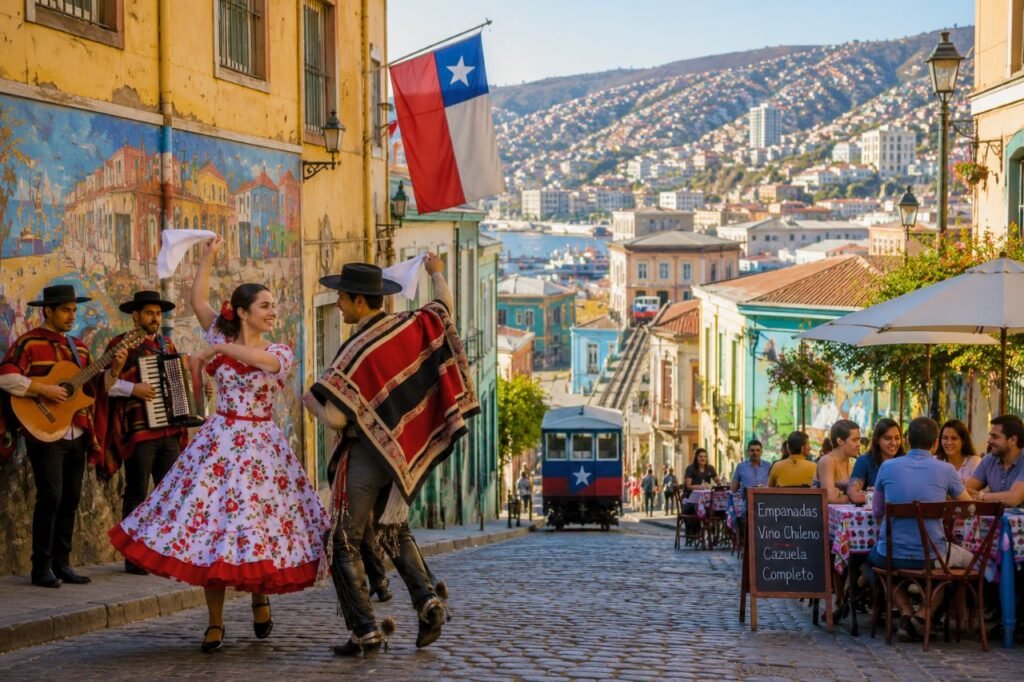
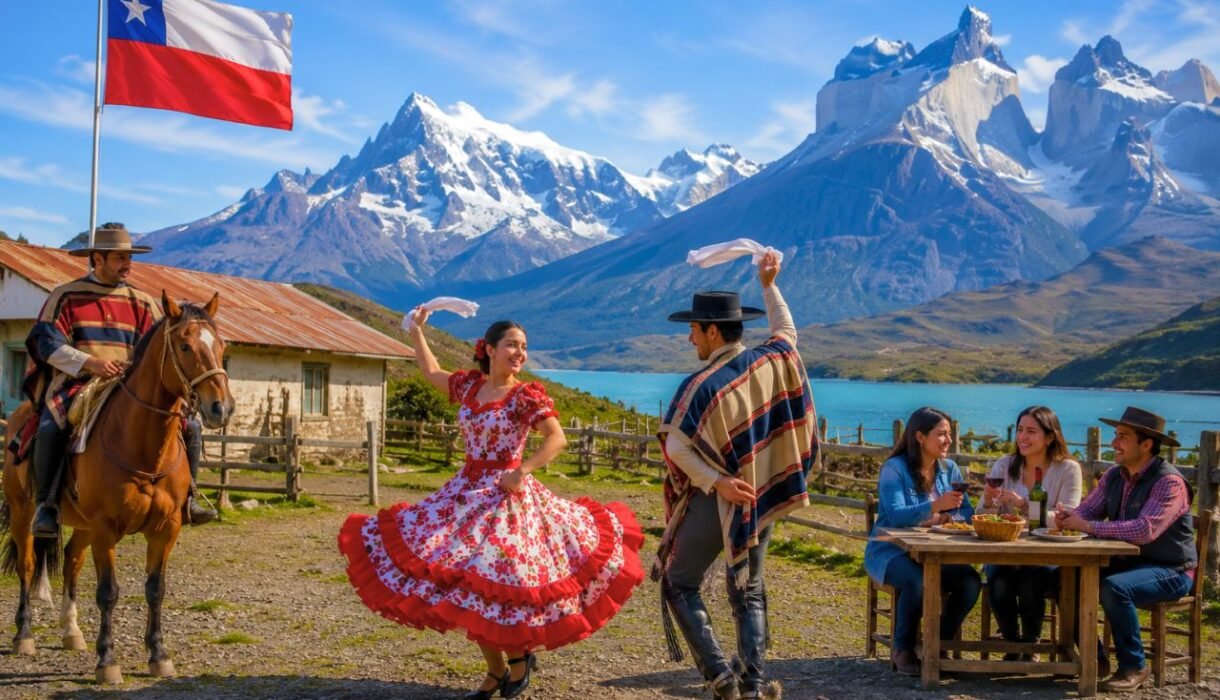
Vibrant Chilean street festival scene – Chile Culture
Chile declared its independence from Spain on February 12, 1818, under the leadership of Bernardo O’Higgins and José de San Martín. Throughout the 19th and 20th centuries, waves of European immigrants—particularly from Germany, Italy, Britain, Croatia, and Palestine—settled in various regions of Chile. German immigrants heavily influenced the architecture, beer-brewing traditions, and agriculture of the southern Lake District, while British merchants left their mark on the port city of Valparaíso. This diverse migration pattern layered seamlessly on top of the foundational Mestizo and Indigenous roots to form modern Chilean society.
Culture, Traditions & Customs
Marriage and Family
In Chile, family (la familia) is the absolute cornerstone of social life. Traditional marriage customs heavily reflect Roman Catholic traditions, though civil ceremonies are the legally binding prerequisite before any religious wedding. Chilean weddings are grand, lively affairs that often last until the early hours of the morning, featuring the brindis (a series of heartfelt or poetic toasts) and substantial feasting. An interesting cultural nuance is that women traditionally keep their maiden surnames after marriage, reflecting a long-standing legal structure and a deep respect for maternal lineages.
Naming Ceremonies and Birth
While traditional Catholic baptisms remain incredibly common, naming practices carry deep generational weight. Children are traditionally given two first names and two surnames—the first being the father’s primary surname, followed by the mother’s primary surname. This practice visually map out an individual’s lineage, ensuring both sides of the family are structurally honored in daily life.
Major Festivals and Holidays
- Fiestas Patrias (September 18th – 19th): Locally referred to as El Dieciocho, this is Chile’s most important national festival. Celebrating the first steps toward independence, the entire country erupts into celebration. Families gather in fondas—temporary open-air pavilions thatched with branches—to eat traditional foods, drink chicha, and dance.
- Festival Internacional de la Canción de Viña del Mar: Held annually in February, this is the most important musical festival in Latin America, where a notoriously vocal audience (known as El Monstruo, or The Monster) decides the fate of international performers.
- Carnaval Andino Con la Fuerza del Sol: Celebrated in the northern city of Arica, this festival showcases a massive display of indigenous Andean music, costumes, and dances, blending Chilean, Peruvian, and Bolivian traditions.
Rites of Passage
The Quinceañera marks a young girl’s transition into womanhood at age 15, celebrated with formal dresses and choreographed waltzes. For young men and women alike, completing higher education is celebrated with a unique, messy ritual: upon passing their final university exams, friends and family ambush the graduate, tearing their clothes and drenching them in flour, eggs, and condiments in a joyous public display of accomplishment.
Languages & Communication
While Spanish is the official language spoken by the vast majority of the population, Chilean Spanish (castellano de Chile) is distinct, colorful, and famously fast. It is characterized by its unique intonation, dropped syllable endings (such as pronouncing gracias as “gracia”), and an extensive vocabulary of local slang known as Chilenismos.
Key Chilean Expressions:
- ¡Cachai!: Meaning “Do you understand?” or “You get it?”
- Po: A structural suffix added to almost any word for emphasis (Sí, po / No, po). Derived from pues.
- Fome: Boring or dull.
- Pololo / Polola: Boyfriend or girlfriend. The verb pololear means to date casually.
Traditional Greetings
Greetings are warm and involve physical contact. Men shake hands firmly, while women greet both men and women with a single gentle kiss on the right cheek. Close male friends often transition from a handshake into a hearty hug accompanied by a couple of pats on the back.
Chilean Proverbs and Expressions
- “No tener ni uno” — To be completely broke (literally, “not even having one peso”).
- “Pasarlo chancho” — To have an absolutely fantastic time (literally, “to pass it like a pig”).
- “Echar la talla” — To joke around or banter playfully with friends.
Geography
Chile is a geographic anomaly, stretching over 4,270 kilometers (2,653 miles) from north to south, while averaging just 177 kilometers (110 miles) from east to west. This extreme verticality creates a spectacular range of distinct ecological zones:
- The North (Atacama Desert): The absolute driest non-polar desert on Earth. It is a hyper-arid landscape rich in minerals, featuring dramatic salt flats, geysers, and some of the clearest skies on earth, making it the global capital for astronomical observation.
- The Central Valley: Featuring a Mediterranean climate, this fertile heartland is home to the capital city, Santiago, as well as the nation’s primary agricultural hubs and world-renowned vineyards.
- The South (Lake District): A lush expanse of emerald forests, snow-capped volcanoes, and glacial lakes deeply influenced by German architectural settlement.
- Patagonia and the Fjords: The extreme southern frontier, defined by massive ice fields, deep fjords, and dramatic granite peaks like those in Torres del Paine National Park.
- Insular Territories: Chile also includes Easter Island (Rapa Nui), located thousands of miles out in the Pacific Ocean, famous for its monumental, enigmatic Moai stone statues.
Economy
Chile possesses one of the most stable, open, and competitive economies in Latin America. Historically built on mining, Chile is the world’s leading producer of copper, which accounts for a massive portion of its export revenue. In recent years, lithium extraction has also surged in importance due to global technological demands.
Beyond mining, Chile is a powerhouse export economy driven by agriculture and natural resources. It is a premier global exporter of fresh fruits (such as grapes, blueberries, and cherries), farmed salmon, wood products, and exceptional wines like Carménère and Cabernet Sauvignon. The country’s commitment to open trade is highlighted by its vast network of free trade agreements spanning the globe.
Politics
Chile operates as a democratic presidential republic, where the President serves as both the head of state and the head of government. The country’s modern political identity is deeply shaped by its transition back to democracy in 1990, following the 17-year military dictatorship of Augusto Pinochet (1973–1990).
Since returning to democratic governance, Chile has maintained a stable multi-party system characterized by peaceful transitions of power between center-left and center-right coalitions. In recent years, vibrant civic movements have driven structural evolution, including efforts to reform social safety nets, healthcare, and education, showcasing the deeply engaged and participatory nature of modern Chilean citizens.
Ethnic Groups
The vast majority of Chileans identify as white or mestizo, representing a blend of Spanish European ancestry and indigenous heritage. However, recognition and celebration of pure indigenous cultures have grown substantially over the last few decades.
| Ethnic Group / Identity | Percentage of Population (Approx.) | Primary Geographic Concentration |
| White & Mestizo | ~87% | Concentrated heavily in Central Valley and urban centers |
| Mapuche | ~10% | Araucanía region and southern-central Chile |
| Other Indigenous (Aymara, Diaguita, Atacameño) | ~2% | Northern desert oases and Andean highlands |
| Rapa Nui | ~0.1% | Easter Island (Valparaíso Region insular territory) |
Recent decades have also brought a new wave of intra-regional immigration to Chile. Vibrant communities from Haiti, Venezuela, Colombia, and Peru have settled in urban centers, introducing new culinary, musical, and linguistic diversity to the urban landscape.
Beliefs & Values
While Chile is historically and structurally a Roman Catholic nation, secularization has grown rapidly in recent decades. Today, freedom of religion is structurally protected, with a notable rise in Evangelical Protestantism and those identifying with no religious affiliation.
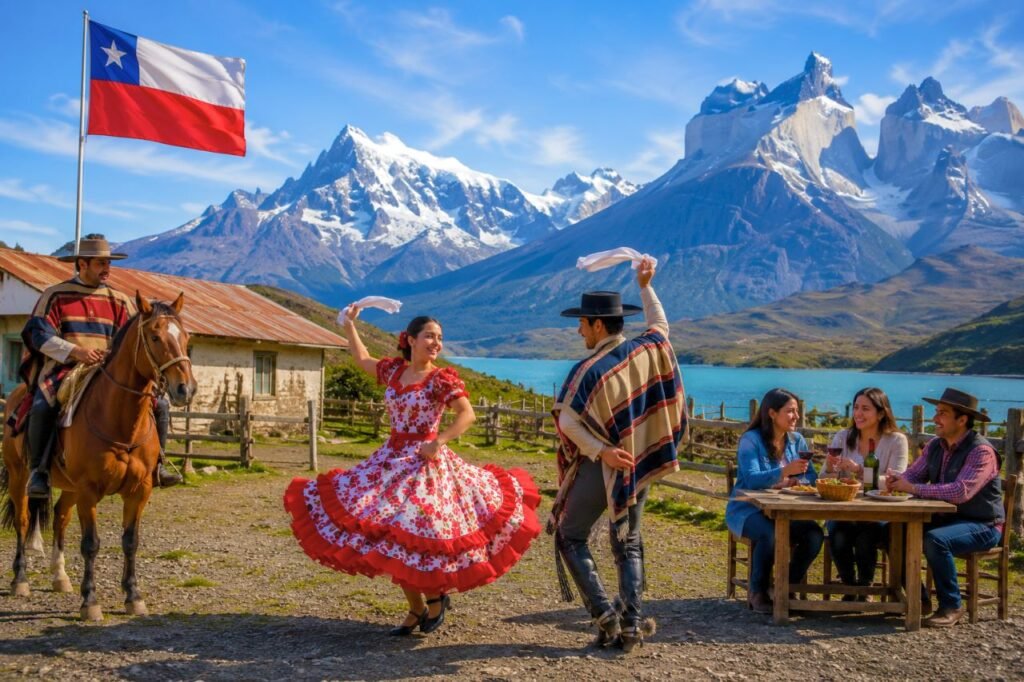
Festive celebration in the Chilean countryside – Chile Culture, South America
Despite shifting religious demographics, Christian moral values continue to influence traditional social frameworks. However, the core Chilean worldview is primarily defined by solidaridad (solidarity). Because Chile experiences frequent and catastrophic natural disasters like earthquakes, community mutual aid is deeply embedded in the culture. This is perfectly exemplified by La Teletón, a massive annual 24-hour televised charity event that unites the entire nation to raise funds for children with disabilities.
Chileans also value modesty, intellectual skepticism, and a profound respect for literary arts, viewing their world through a uniquely poetic lens.
Food & Cuisine
Chilean cuisine (comida típica) is a comforting, hearty celebration of fresh ingredients from the land and sea. It relies on simple, robust seasonings—such as merquén, a traditional Mapuche spice blend made from smoked chili peppers and coriander seed.
Traditional Dishes
- Pastel de Choclo: A savory corn pie made with a layer of sweetened sweetcorn paste topping a filling of pino (ground beef cooked with onions, raisins, black olives, and hard-boiled eggs) and chicken. It is traditionally baked in a rustic black clay dish called a paila de greda.
- Empanada de Pino: Large, baked pastry pockets stuffed with the traditional pino meat filling, enjoyed by families across the country every single weekend.
- Cazuela: A warming, clear broth soup featuring a large piece of beef or chicken, a whole potato, a chunk of pumpkin, and a piece of corn on the cob.
- Completo Chileno: An upgraded version of the hot dog, loaded with chopped tomatoes, sauerkraut, mashed avocado (palta), and a generous layer of homemade mayonnaise.
Coastal Seafood
With thousands of miles of coastline, seafood is central to the diet. Standout dishes include Caldillo de Congrio (conger eel soup, famously immortalized in a poem by Pablo Neruda) and Machas a la Parmesana (razor clams baked in their shells with white wine and melted parmesan cheese).
Clothing & Symbols
In daily life, contemporary Chileans dress in modern, Western-style clothing. However, during national holidays and traditional festivals, historical attire takes center stage.
The most iconic traditional clothing belongs to the Huaso (the skilled Chilean cowboy or rural countryman). A complete Huaso outfit features a structured, flat-brimmed hat (chupalla), a beautifully woven short poncho called a chamanto, tall leather riding boots adorned with large metallic spurs, and a decorative sash around the waist. Women dancing alongside the Huaso wear the vestido de china, a traditional 19th-century styled dress featuring vibrant floral patterns, a cinched waist, and a wide, ruffled skirt designed to spin during traditional dances.
[ National Symbols of Chile ] ┌───────────────────────┬───────────────────────┬───────────────────────┐ │ The Flag │ The National Flower │ The National Shield │ │ "La Estrella Solitaria"│ The Copihue │ The Huemul Deer & │ │ Blue, White, and Red │ Red Bell-Shaped Vine │ The Andean Condor │ └───────────────────────┴───────────────────────┴───────────────────────┘The flag of Chile, known as La Estrella Solitaria (The Lone Star), consists of two horizontal bands of white and red, with a blue square and a white five-pointed star in the upper left. The blue represents the sky and the Pacific Ocean, white symbolizes the snow of the Andes, red honors the blood spilled fighting for independence, and the single star guides the path of progress.
Music, Dance & Art
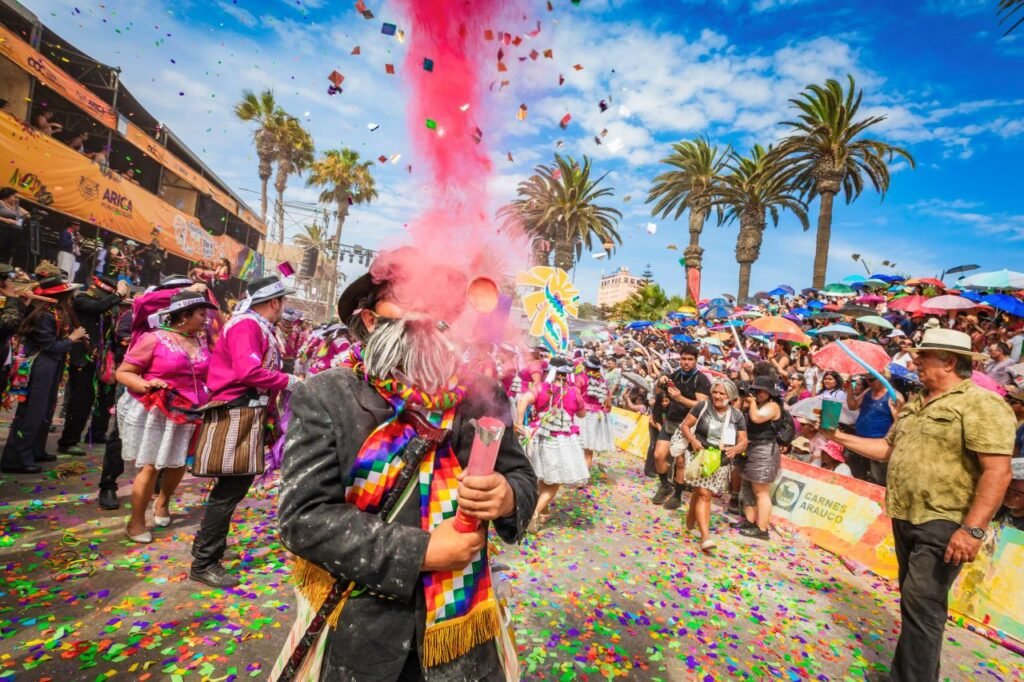
Colorful carnival in Arica, Chile with festive dancers, music, and cheerful crowds
The National Dance: La Cueca
The Cueca is the official national dance of Chile. Inspired by the courtship ritual of a rooster and a hen, dancers wave white handkerchiefs (pañuelos) above their heads without ever touching each other, performing precise, rhythmic footwork called zapateo.
Music Movements
Chile has a profound musical legacy. In the 1960s and 70s, the Nueva Canción Chilena (New Chilean Song) movement revolutionized Latin American music by blending traditional indigenous folklore with powerful political poetry. Legendary figures like Víctor Jara and Violeta Parra utilized traditional instruments such as the charango (a small Andean stringed instrument) and the quena (an Andean flute) to give a powerful voice to working-class society.
Literature and Art
Chile is proudly known as the “Land of Poets” (País de Poetas), a title earned by its immense literary contributions to the world. It is the proud home of two Nobel Laureates in Literature: Gabriela Mistral (1945), who was the first Latin American author to receive the honor, and Pablo Neruda (1971), whose passionate love poems and historical epics remain globally celebrated. In contemporary literature, Isabel Allende stands as one of the most widely read Spanish-language novelists on Earth.
In visual arts, the street murals of Valparaíso function as a massive open-air gallery, while traditional crafts—such as the black clay pottery of Pomaire and the intricate horsehair weaving (crin) of Rari—preserve generations of creative history.
Summary
Chilean culture is a beautiful testament to human connection, artistic genius, and geographical adaptation. From its origins as a fierce frontier between Spanish conquistadors and the Mapuche people to its status as a modern literary and economic hub, Chile has retained a distinct and soulful identity. Whether through the rhythm of a spinning Cueca dance, the comfort of a warm Pastel de Choclo, or the profound verses of its Nobel poets, Chile invites the world to celebrate its enduring legacy. It is a culture forged by the earth, written in poetry, and lived with unmatched warmth.
At Best Culture Insight, we see culture as the heartbeat of every society—the way people live, connect, and express their identity.