
Spanning eleven time zones across Eastern Europe and Northern Asia, Russia is a vast nation defined by its striking contrasts, intense winters, and deep intellectual legacy. The complex Culture of Russia functions as an expansive bridge between Eastern and Western philosophical thought, forged by millennia of tribal migrations, imperial expansions, and radical political movements. The Russian people are globally recognized for their deep-ingrained resilience, profound appreciation for high art, and a passionate, hospitable communal spirit hidden beneath a stoic public exterior. From the gilded domes of Moscow to the endless, quiet taiga forests of Siberia, Russia offers an immersive, multifaceted cultural journey.
History & Origins
The historical development of Russia is a multi-layered narrative of survival, spiritual transformation, and sudden imperial re-inventions.
- Kievan Rus’ and Christianization: The cultural foundation of Russia traces back to the East Slavic tribes who established Kievan Rus’ in the 9th century. In 988 CE, Prince Vladimir the Great officially adopted Orthodox Christianity from the Byzantine Empire, permanently aligning Russian literature, iconography, and values with the Eastern Christian world.
- The Mongol Conquest and Muscovy: In the 13th century, the devastating Mongol invasions fractured the region. Out of the ashes, the Grand Duchy of Moscow rose to prominence, eventually overthrowing the Golden Horde. Ivan IV (“The Terrible”) centralized power and declared himself the first Tsar of all Russia in 1547.
- The Romanov Empire and Westernization: Peter the Great founded St. Petersburg in 1703, systematically introducing European dress, education, and naval science to modernize the empire. For three centuries, the Romanov dynasty cultivated a massive Eurasian superpower marked by absolute monarchy and a golden age of literature.
- The Soviet Era and Post-Soviet Reality: The Russian Revolution of 1917 brought an abrupt end to the tsarist system, birthing the Soviet Union (USSR)—the world’s first socialist state. This era dramatically reshaped global geopolitics, industrializing the country while strictly enforcing secular, state-directed cultural norms. Following the collapse of the USSR in 1991, modern Russia emerged, navigating a complex path to reclaim its historic pre-revolutionary traditions.
Culture, Traditions & Customs
Marriage & Wedding Rituals
Traditional Russian weddings are lengthy, dramatic events full of lighthearted community play. One of the most famous customs is the Vykup Nevesty (Buying of the Bride). Before the church or civil ceremony, the groom arrives at the bride’s home, where her family and bridesmaids block his path. He must solve riddles, sing songs, or pay symbolic cash bounties to bypass each obstacle and prove his dedication. At the reception, guests frequently shout “Gorko!” (Bitter!), a traditional cue forcing the newlyweds to kiss to “sweeten” the banquet wine.
Naming Ceremonies and Patronymics
Russian names possess a distinct tripartite structure rooted in family lineage: a given first name, a patronymic name, and a family surname. The patronymic is derived directly from the father’s first name (for instance, the son of Ivan becomes Ivanovich, while the daughter becomes Ivanovna). In formal communication or to show respect to elders, individuals are universally addressed using both their first name and patronymic.
Major Festivals & Traditions
- Maslenitsa (Pancake Week): An ancient Slavic festival celebrating the departure of winter and the rebirth of spring. For an entire week before Great Lent, families bake heaps of round, golden blini (pancakes) symbolizing the sun, culminating in the festive burning of a straw effigy representing winter.
- Victory Day (May 9th): A deeply solemn and unifying national holiday commemorating the massive sacrifices made during World War II. Millions of citizens participate in the “Immortal Regiment” marches, holding aloft portraits of family members who fought in the conflict.
- The Banya Culture: The traditional Russian steam bathhouse is a vital health and social ritual. Locals relax in intense heat, using veniks (leafy bundles of birch or oak twigs) to massage the skin and stimulate blood circulation, followed by a shocking plunge into cold water or snow.
Languages & Communication
Language Spoken
Russian is the sole official language at the state level, though Russia’s constituent republics recognize over thirty co-official regional tongues. Written in the Cyrillic alphabet, Russian is a phonetically rich East Slavic language characterized by complex grammar systems, melodic intonations, and highly flexible sentence structures.
Etiquette & Communication Styles
Russians are famously direct and authentic in their conversations. Smiling at strangers in public is traditionally seen as insincere; instead, smiles are reserved as genuine expressions for friends and family.
- Greetings: A firm, direct handshake is standard among men, though it is a strict superstition never to shake hands across a threshold or doorway, as it is believed to bring bad luck.
- Phrases: Zdravstvuyte (Hello – formal), Privet (Hi – casual), and Spasibo (Thank you).
Proverbs & Wisdom
- “Встречают по одёжке, а провожают по уму.”
Meaning: “They greet you by your clothes, but say goodbye according to your intelligence”—the Russian take on first impressions versus long-term character.
- “Тише едешь, дальше будешь.”
Meaning: “Drive slower, and you’ll get further”—emphasizing the cultural value of patience, caution, and thorough preparation over reckless speed.
Geography
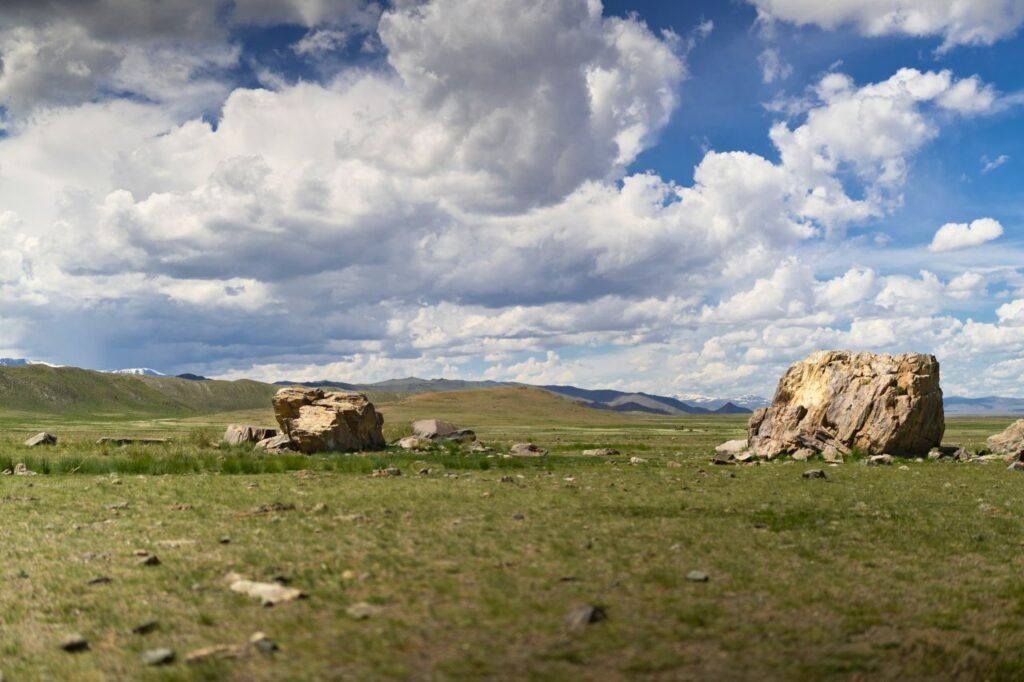
Russia is the largest country in the world by landmass, spanning across Eastern Europe and Northern Asia. Its immense territory encompasses a series of distinct environmental zones: the frozen northern tundra, the vast subarctic taiga forests, the rolling grassy steppes, and semi-arid southern expanses.
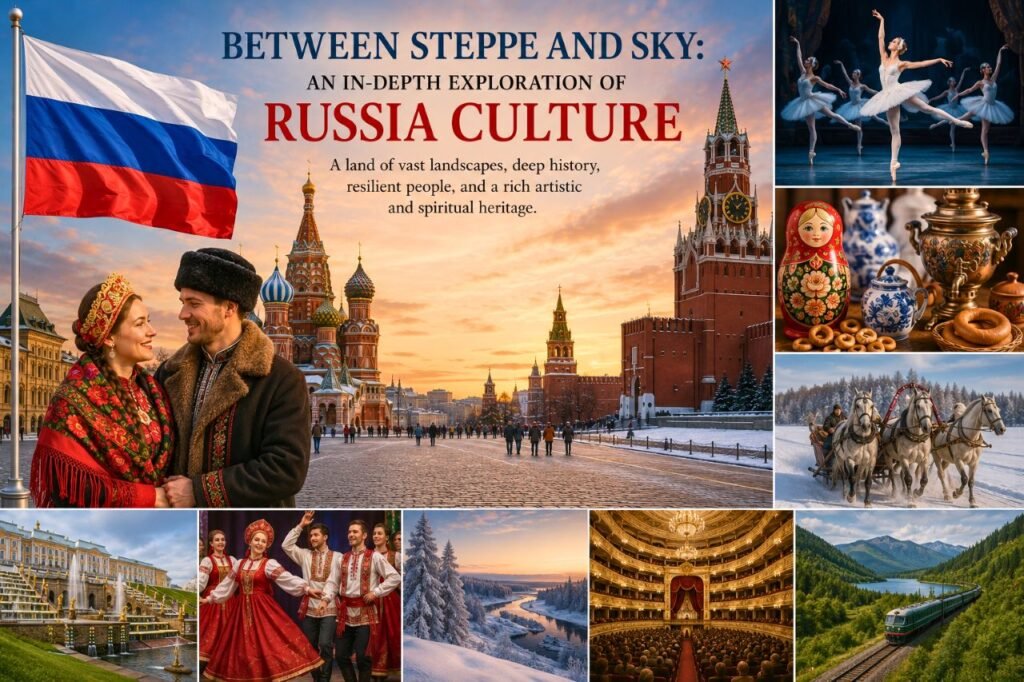
Between steppe and sky Russia’s culture
The country is split geographically by the ancient Ural Mountains, which serve as the traditional boundary between the European and Asian continents. Russia holds magnificent geographic records, including the Volga River (Europe’s longest river) and Lake Baikal in Siberia—the oldest, deepest, and most voluminous freshwater lake on earth, containing roughly 20% of the planet’s unfrozen surface fresh water.
Economy
Russia possesses a vast, commodity-driven mixed economy that plays a critical role in global industrial and energy supply chains.
The primary engine of the economic landscape is the export of natural resources, with the country holding some of the world’s largest proven reserves of natural gas, petroleum, coal, and precious metals. Other prominent sectors include heavy metallurgical manufacturing, aerospace engineering, military defense technology, and a massive agricultural sector that ranks among the world’s leading exporters of wheat and grains.
Politics
Russia is a presidential republic with a highly centralized governance structure.
The President serves as the Head of State, directing foreign policy, internal security, and exercising immense executive authority. The Prime Minister is appointed by the President with parliamentary approval to serve as the Head of Government, overseeing economic policies and state bureaucracy.
Legislative power is held by the Federal Assembly, a bicameral parliament consisting of the State Duma (the lower house, with 450 elected deputies) and the Federation Council (the upper house representing regional administrators).
Ethnic Groups
While ethnic Russians comprise roughly 78% of the total population, the country is officially a multi-ethnic federation home to more than 190 distinct indigenous ethnic groups, each preserving their own unique heritages.
| Ethnic Group | Cultural & Regional Context | Heritage & Traditions |
| Russians | Nationwide majority population | Slavic language base; predominantly Orthodox Christian traditions. |
| Tatars | Centered primarily in the Volga region (Tatarstan) | Turkic language base; rich Sunni Islamic heritage and distinct crafts. |
| Bashkirs, Chuvash | Concentrated around the Ural Mountains | Turkic origins; unique musical and epic folklore traditions. |
| Indigenous Siberians | Scattered across northern and eastern Siberia | Includes the Evenks, Chukchi, and Buryats; historic practices of Shamanism and reindeer herding. |
Beliefs & Values
Religion & Spirituality
The spiritual framework of Russia is highly diverse but dominated historically by Russian Orthodox Christianity, which serves as a powerful symbol of national identity and historical continuity.
The state officially recognizes four “traditional religions” deeply rooted in the nation’s historical development: Orthodox Christianity, Islam (prominent in the Volga region and the North Caucasus), Buddhism (practiced traditionally in Buryatia and Kalmykia), and Judaism. Despite decades of forced state atheism during the Soviet era, spiritual revival remains strong, with traditional moral values placing a heavy premium on patriotism, community obligation, and respect for family structures.
Food & Cuisine
Traditional Russian cuisine is comforting, highly resourceful, and masterfully designed to provide sustained energy through the demanding subarctic climate. It relies heavily on root vegetables, grains, cabbage, poultry, and fish.
- Borsch: A vibrant, deep red soup made from simmered beetroots, cabbage, potatoes, and meat. It is universally served hot with a generous dollop of fresh sour cream (smetana) and dill.
- Pelmeni: Delicate unleavened dough dumplings stuffed with a seasoned mixture of minced meats (pork, beef, or lamb), boiled and served coated in melted butter or vinegar.
- Shchi: A historic cabbage soup that has served as the cornerstone of the local diet for over a thousand years, often slow-cooked in traditional clay ovens.
- Beef Stroganoff: World-famous tender strips of beef sautéed with onions and mushrooms in a rich, tangy sour cream sauce.
Clothing & Symbols
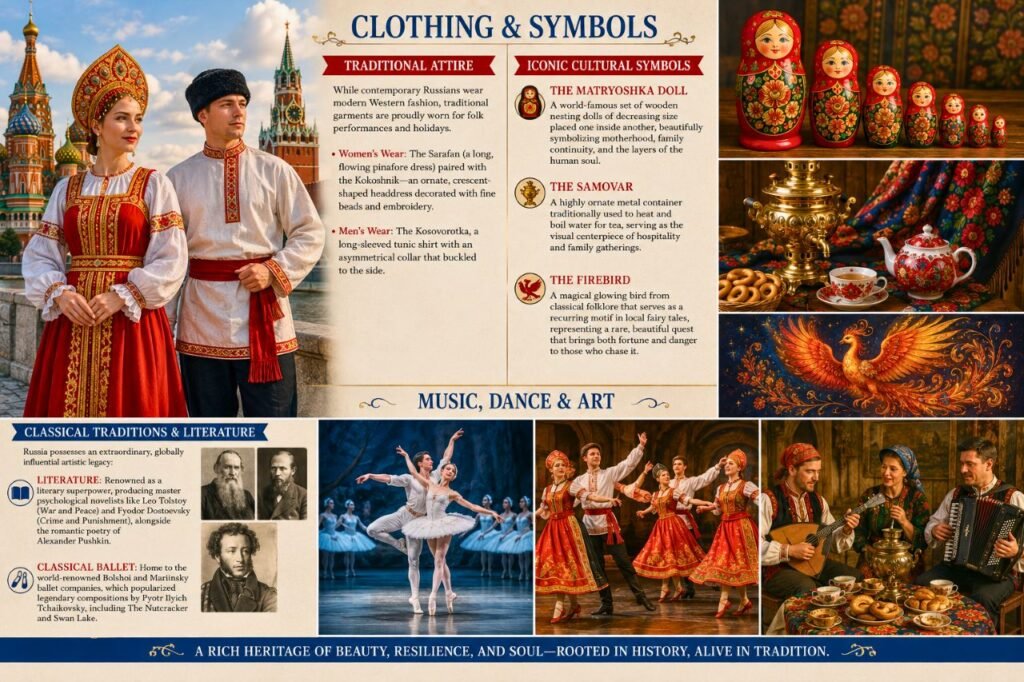
Russian cultural heritage in full display
Traditional Attire
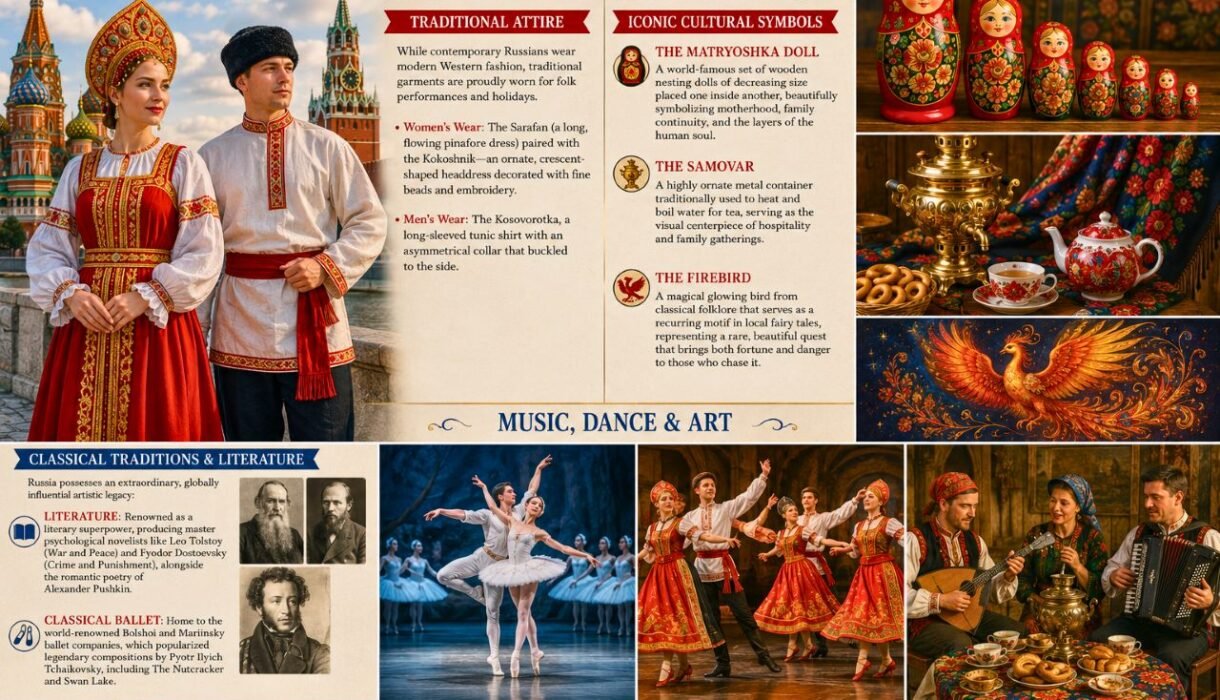
While contemporary Russians wear modern Western fashion, traditional garments are proudly worn for folk performances and holidays. Women’s traditional wear is highlighted by the Sarafan (a long, flowing pinafore dress) paired with the Kokoshnik—an ornate, crescent-shaped headdress decorated with fine beads and embroidery. Men traditionally wore the Kosovorotka, a long-sleeved tunic shirt with an asymmetrical collar that buckled to the side.
Iconic Cultural Symbols
- The Matryoshka Doll: A world-famous set of wooden nesting dolls of decreasing size placed one inside another, beautifully symbolizing motherhood, family continuity, and the layers of the human soul.
- The Samovar: A highly ornate metal container traditionally used to heat and boil water for tea, serving as the visual centerpiece of hospitality and family gatherings.
- The Firebird: A magical glowing bird from classical folklore that serves as a recurring motif in local fairy tales, representing a rare, beautiful quest that brings both fortune and danger to those who chase it.
Music, Dance & Art
Classical Traditions & Literature
Russia possesses an extraordinary, globally influential artistic legacy:
- Literature: Renowned as a literary superpower, producing master psychological novelists like Leo Tolstoy (War and Peace) and Fyodor Dostoevsky (Crime and Punishment), alongside the romantic poetry of Alexander Pushkin.
- Classical Ballet: Home to the world-renowned Bolshoi and Mariinsky ballet companies, which popularized legendary compositions by Pyotr Ilyich Tchaikovsky, including The Nutcracker and Swan Lake.
Folk Performance & Crafts
- The Balalaika: A distinctive triangular, three-stringed musical instrument that produces a bright, plucky tone central to folk ensembles.
- Troika Dancing: Energetic folk dances featuring fast footwork, sweeping spins, and dramatic leaps that mimic the driving energy of a traditional three-horse carriage team.
- Khokhloma Painting: A cherished folk craft involving the intricate painting of wooden tableware and furniture with vivid red and gold floral patterns against a deep black background.
Summary
The culture of Russia stands as a majestic, deeply resonant testament to the power of human endurance and creative brilliance. By successfully balancing its ancient Slavic foundations and rich Eastern Orthodox spirituality with Western artistic forms and a multi-ethnic geographic reality, the nation has shaped a truly unique Eurasian identity. Whether experienced through the complex prose of its literary masters, the warmth of a shared pot of tea around a Samovar, or the driving rhythm of a winter folk dance, Russia’s cultural heritage remains an indispensable, profoundly evocative pillar of global diversity.
At Best Culture Insight, we see culture as the heartbeat of every society – the way people live, connect, and express their identity.