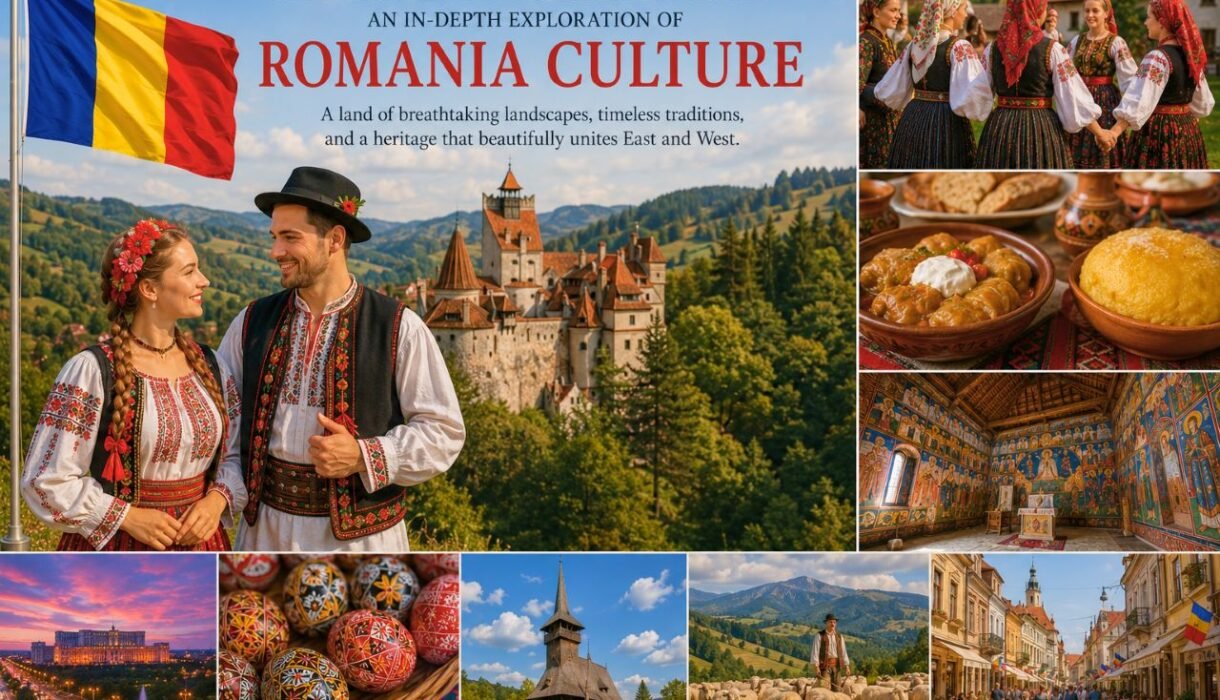

Situated in Eastern Europe, bordering the Black Sea and the Balkan Peninsula, Romania is a nation defined by its mesmerizing landscapes, medieval fortifications, and deep-rooted spiritual heritage. The enigmatic Culture of Romania functions as a distinct cultural island, blending a Romance linguistic foundation with rich Slavic, Ottoman, and Austro-Hungarian historical influences. The Romanian people are recognized for their profound warmth, poetic worldview, and an enduring devotion to preservation. From the misty Carpathian peaks to the dynamic urban landscape of Bucharest, Romania offers an authentic window into a world where ancient folklore remains an active part of daily life.
History & Origins
The historical identity of Romania is an enduring story of survival, cultural convergence, and a distinct Latin heritage surrounded by Slavic nations.
- Dacians and the Roman Empire: The earliest known ancestors of the region were the Dacians. In 106 CE, the Roman Emperor Trajan conquered Dacia, leading to an intense period of Romanization. This synthesis of Roman settlers and Dacian tribes laid the linguistic and cultural bedrock for the modern Romanian identity.
- The Medieval Principalities: For centuries, the Romanian people were divided into three main historical principalities: Wallachia, Moldavia, and Transylvania. These regions stood as a heavily defended frontier against the expansion of the Ottoman Empire, led by legendary figures like Vlad III Dracula (Vlad the Impaler) and Stephen the Great.
- The Great Unification: Wallachia and Moldavia united in 1859 to form the basis of the modern state. Following the devastation of World War I, Transylvania was unified with the kingdom in 1918, completing the cultural map of “Greater Romania.”
- The Communist Era and Rebirth: After World War II, the nation endured decades of strict Soviet-aligned communist rule, culminating in the totalitarian regime of Nicolae Ceaușescu. The historic Romanian Revolution of 1989 restored democracy, paving the way for the nation to join the European Union in 2007.
Culture, Traditions & Customs
Marriage & Family Customs
In Romanian society, weddings (nunta) are massive, theatrical community events that stretch over days. Traditional customs are full of humor and symbolism. One of the most widespread is the “Kidnapping of the Bride” (furatul miresei), where friends fake-kidnap the bride during the reception. The groom must publicly bargain for her return, typically paying a ransom of fine wine, a declaration of love, or humorous tasks.
Naming Ceremonies and Rites of Passage
Baptism remains an essential spiritual milestone, welcoming infants into the Christian Orthodox faith. Aside from religious milestones, the “Cutting of the Moț” (tăierea moțului) is celebrated when a child turns one. A small lock of the baby’s hair is cut, and the child is presented with a tray containing diverse objects (such as a pen, money, or a stethoscope). The first three items the child grabs are playfully believed to predict their future career path.
Festivals & Winter Traditions
The period between Christmas and New Year features extraordinary folk spectacles. Communities participate in Ursul (The Bear Dance) and Călușarii, where performers wear heavy, authentic bear skins or elaborate traditional costumes, dancing to drums and pipes through villages to scare away evil spirits and welcome a prosperous new year.
Languages & Communication
Language Spoken
The official national language is Romanian. It is a Romance language closely related to Italian, French, Spanish, and Portuguese. It holds the unique distinction of being the only Latin-derived language in Eastern Europe, though its vocabulary features a fascinating 10–15% layer of Slavic, Turkish, and Balkan loanwords. Hungarian and Romani are also spoken by significant minority communities.
Greetings & Communication Style
Communication in Romania is warm, polite, and expressive. Personal space is respected, but once a connection is made, people are exceptionally friendly.
- Bună ziua (Good day) is the standard formal greeting.
- Mulțumesc translates to “Thank you.”
- “La rândul tău” or “Să fie într-un ceas bun” are commonly used to wish someone good luck or auspicious timing.
Proverbs & Sayings
- “Cine se scoală de dimineață, departe ajunge.”
Meaning: “The one who wakes up early goes far”—the Romanian equivalent of “the early bird catches the worm.”
- “Mămăliga explodează târziu.”
Meaning: “The polenta explodes late.” A historical saying referencing the long-suffering patience of the Romanian people, which can turn into a fierce revolution when pushed too far.
Geography
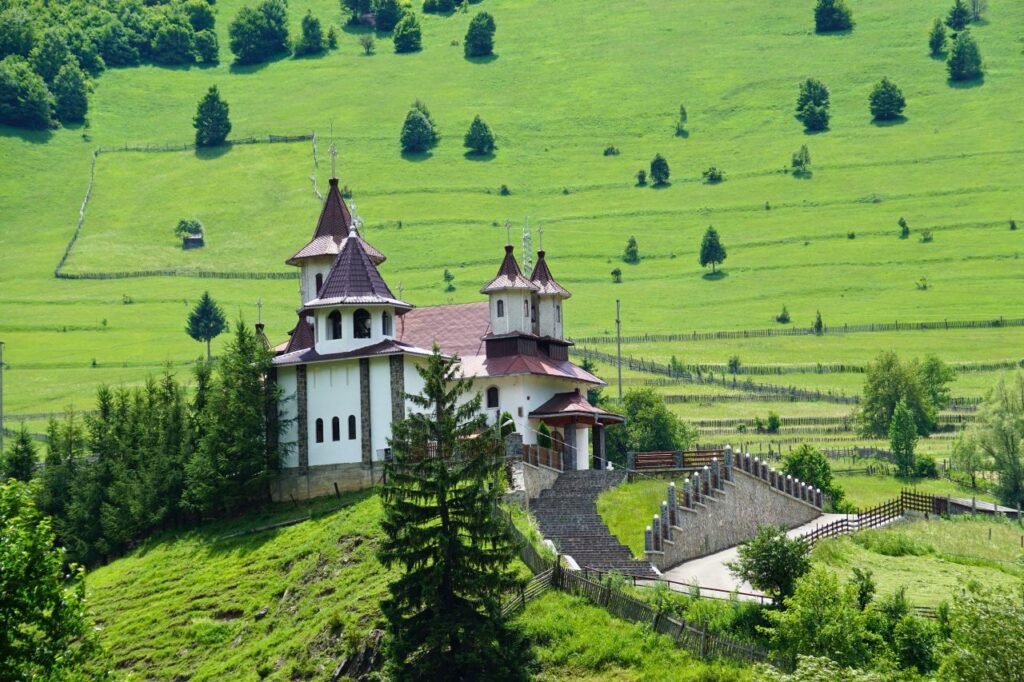
Romania is characterized by a perfectly balanced distribution of plains, hills, and mountains. The majestic Carpathian Mountains cut an arc through the center of the country, dividing the historical regions.
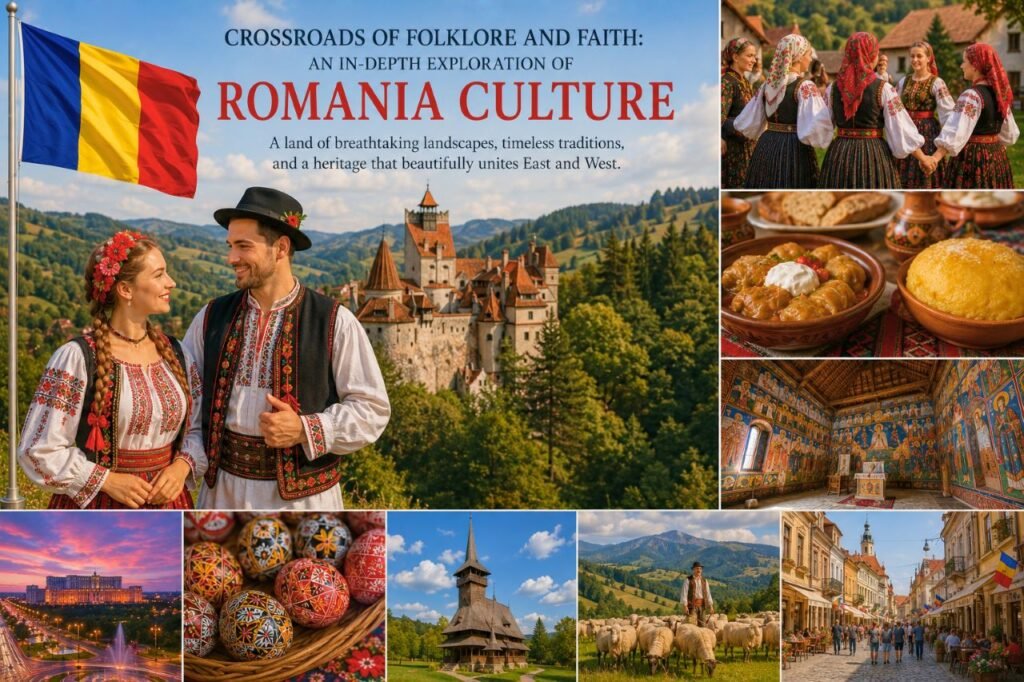
Romania Culture and heritage in focus
To the south lies the fertile Danubian Plain, while the eastern edge meets the pristine Danube Delta—the second largest and best-preserved delta in Europe, hosting a massive UNESCO-protected bird and wetland sanctuary before draining into the Black Sea.
Economy
Historically an agrarian society, modern Romania has built a diversified, fast-growing economy within the European Union.
- Information Technology: Romania is an influential European hub for software development, tech startups, and cybersecurity, boasting some of the fastest internet speeds on the continent.
- Manufacturing: Home to robust automotive manufacturing, notably the global brand Dacia (Renault Group).
- Agriculture: Thanks to its expansive fertile lowlands, the nation remains a major European exporter of grains, sunflower seeds, and wine.
Politics
Romania is a semi-presidential representative democratic republic.
The President serves as the head of state, managing foreign policy and national defense, while the Prime Minister serves as the head of government, exercising executive administrative control.
The bicameral parliament consists of the Senate (Senat) and the Chamber of Deputies (Camera Deputaților). Romania is a committed member of NATO and the European Union, contributing heavily to regional stability.
Ethnic Groups
While the vast majority of the population identifies as ethnically Romanian, the nation is home to a rich mosaic of regional minorities.
| Ethnic Group | Approximate Share | Primary Region & Heritage |
| Romanians | ~89% | Distributed nationwide; Romance language and Orthodox heritage. |
| Hungarians | ~6% | Heavily concentrated in Transylvania; rich architectural and artisanal impact. |
| Roma | ~3% | Rich musical, metalworking, and nomadic cultural history. |
| Ukrainians, Germans, Turks | ~2% | Distinct historic enclaves, including the Transylvanian Saxons and Dobrojean Tatars. |
Beliefs & Values
Religious Life
The spiritual worldview of Romania is overwhelmingly anchored in the Romanian Orthodox Church, to which over 85% of the population adheres. Monasteries and village churches are not merely historical relics; they are deeply respected epicenters of community life. Moral values place a massive premium on omenie—a unique cultural concept translating to human kindness, honor, hospitality, and respect for one’s community.
Food & Cuisine
Romanian food is hearty, comforting, and deeply tied to rural agricultural rhythms, heavily influenced by Balkan, Austrian, and Turkish traditions.
- Sarmale (Cabbage Rolls): The undisputed national dish. These are meticulously rolled cabbage or vine leaves stuffed with a seasoned mixture of minced pork, beef, rice, and local herbs, slow-simmered in clay pots with smoked bacon and tomato sauce.
- Mămăligă: A dense, golden yellow cornmeal porridge akin to Italian polenta, traditionally served piping hot alongside fresh sour cream (smântână) and salty sheep’s milk cheese (brânză).
- Mici (Mititei): Skinless grilled sausages made from a seasoned blend of minced pork, beef, and lamb, infused with garlic and baking soda to give them a unique, juicy bounce.
- Cozonac: A rich, sweet braided bread marbled with walnut paste, cocoa, or Turkish delight, baked universally for Easter and Christmas.
Clothing & Symbols
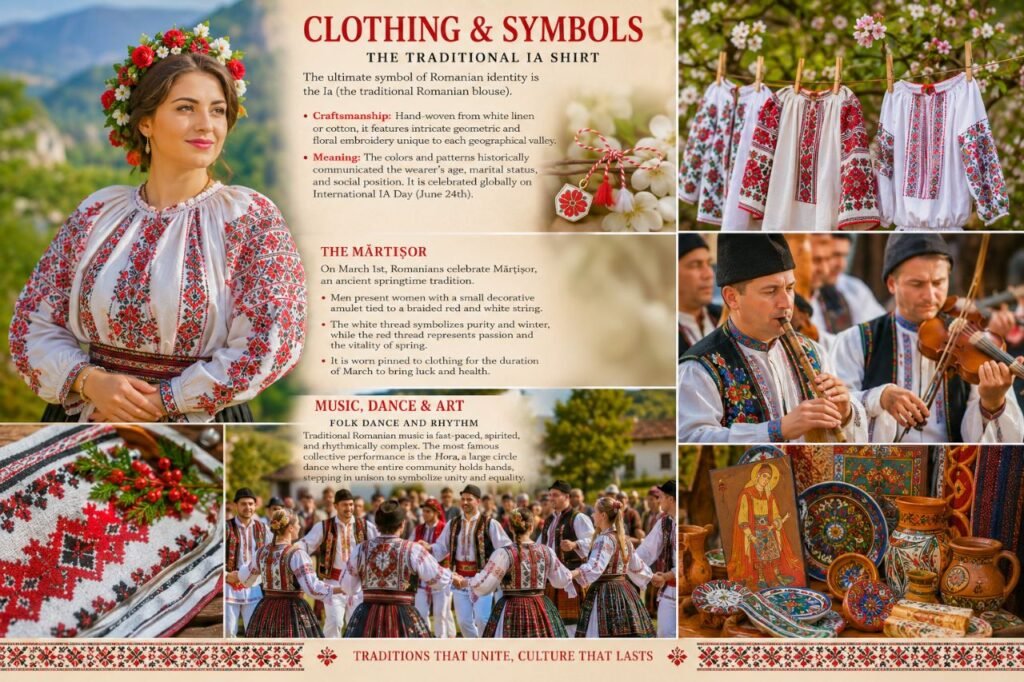
Romanian traditions, clothing, music, and art
The Traditional IA Shirt
The ultimate symbol of Romanian identity is the Ia (the traditional Romanian blouse).
- Craftsmanship: Hand-woven from white linen or cotton, it features intricate geometric and floral embroidery unique to each geographical valley.
- Meaning: The colors and patterns historically communicated the wearer’s age, marital status, and social position. It is celebrated globally on International IA Day (June 24th).
The Mărțișor
On March 1st, Romanians celebrate Mărțișor, an ancient springtime tradition. Men present women with a small decorative amulet tied to a braided red and white string. The white thread symbolizes purity and winter, while the red thread represents passion and the vitality of spring. It is worn pinned to clothing for the duration of March to bring luck and health.
Music, Dance & Art
Folk Dance and Rhythm
Traditional Romanian music is fast-paced, spirited, and rhythmically complex. The most famous collective performance is the Hora, a large circle dance where the entire community holds hands, stepping in unison to symbolize unity and equality.
Monumental Art
- The Painted Monasteries of Bucovina: World-famous 15th-century churches featuring breathtaking, vivid exterior frescoes depicting biblical scenes, preserved perfectly through centuries of elemental exposure.
- Constantin Brâncuși: The pioneer of modern abstract sculpture, whose iconic works like The Endless Column and The Gate of the Kiss transformed the global landscape of 20th-century art.
Summary
The culture of Romania is a beautiful testament to how ancient traditions can thrive within a modernizing European state. By safeguarding their distinct Latin language, preserving ancestral folk arts like the Ia embroidery, and maintaining a deep, respectful connection to the land and faith, the Romanian people have preserved a truly magical cultural landscape. It is a nation that invites travelers to look past superficial myths and discover an enduring world of vibrant folklore, stunning geography, and unmatched hospitality.
At Best Culture Insight, we see culture as the heartbeat of every society – the way people live, connect, and express their identity.