Federated States of Micronesia Culture: History, Traditions, Arts, and Pacific Heritage
Posted in :

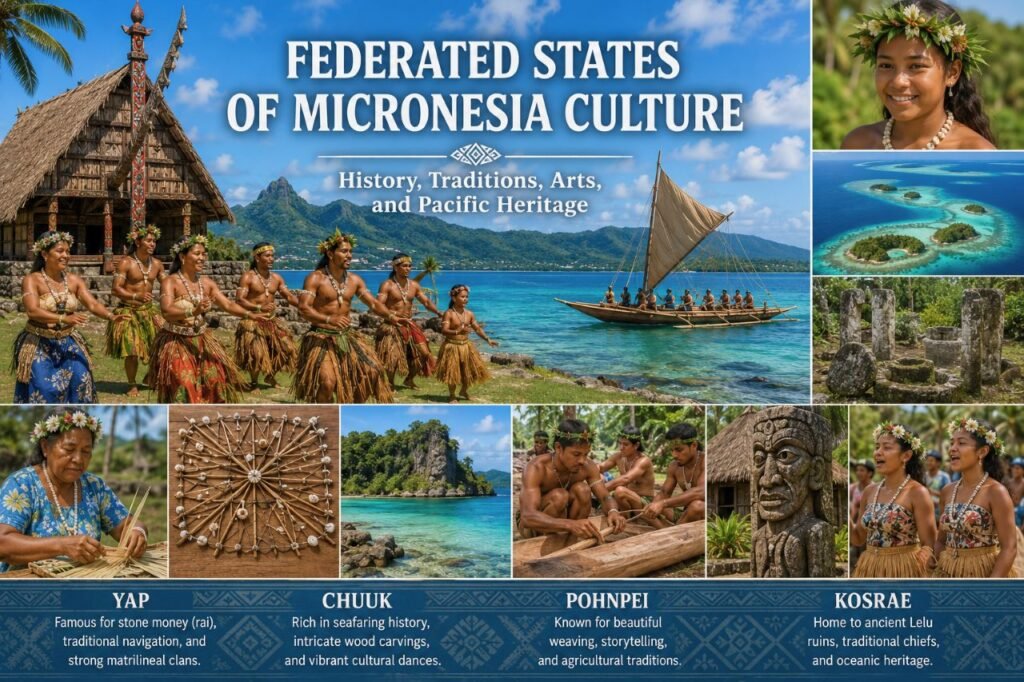
The Culture of the Federated States of Micronesia (FSM) is a fascinating, multifaceted tapestry woven across four distinct island states—Yap, Chuuk, Pohnpei, and Kosrae—in the tropical heart of Oceania. Spanning over 600 islands across 2.6 million square kilometers of the western Pacific Ocean, the FSM is home to diverse indigenous island societies, each safeguarding its own distinct language, social structure, and artistic expressions. Grounded in matrilineal clan lineages, ancient oceanic navigation, traditional chiefdoms, and profound respect for the land and ocean, Micronesian culture balances ancestral traditions with modern self-governance, standing as a testament to Pacific resilience and cultural diversity.
History & Origins
The cultural history of the Federated States of Micronesia spans over four millennia of voyaging, empire building, and colonial contact:
- Austronesian Migrations (circa 2000 BCE – 1000 CE): Ancestors of modern Micronesians migrated from Maritime Southeast Asia in double-hulled outrigger canoes (Proa). Over centuries, these voyagers populated the Caroline Islands, developing sophisticated wayfinding techniques using ocean swells, cloud formations, and star paths (Sidereal compass).
- The Saudeleur Dynasty of Pohnpei (1100–1628 CE): Pohnpei became the center of a powerful centralized empire ruled by the Saudeleur Dynasty. They constructed Nan Madol, a magnificent city of 92 artificial islets made from massive columnar basalt rocks, often called the “Venice of the Pacific.”
- The Yapese Empire & Rai Stones: Yap established an extensive inter-island tributary network across surrounding outer atolls. Yapese navigators sailed over 400 kilometers to Palau to quarry huge limestone discs—Rai Stones—which were carved and navigated back to Yap to serve as valuable ceremonial currency.
- Colonial Encounters (16th–20th Centuries):
- Spanish Rule (1500s–1899): Introduced Roman Catholicism and named the archipelago the Caroline Islands.
- German Era (1899–1914): Focused on commercial copra extraction and land reforms.
- Japanese Mandate (1914–1945): Introduced infrastructure, commercial fisheries, and Asian cultural influences prior to World War II, during which Chuuk Lagoon became a major Japanese naval stronghold (Operation Hailstone, 1944).
- US Trust Territory & Independence (1947–Present): Administered by the United States as part of the Trust Territory of the Pacific Islands after WWII, the four states ratified a joint constitution in 1979 and achieved sovereign independence in 1986 under a Compact of Free Association with the USA.
Culture, Traditions & Customs
Despite political unity, each of the four states retains its own vibrant cultural identity:
- State-Specific Customs:
- Yap: Highly traditional, governed by a strict caste system and traditional councils of chiefs. Village meetings take place in thatch-roofed P’neney (men’s houses).
- Chuuk: Known for strong clan loyalty (Ejin), warrior heritage, and intricate hand-carved love sticks (Kotang) historically used in courtship.
- Pohnpei: Governed by traditional paramount chiefs (Nahnmwarki). Rituals center on the ceremonial preparation of Sakau (a ceremonial drink made from Piper methysticum root pounded on flat basalt stones).
- Kosrae: Known as the “Island of the Sleeping Lady,” Kosrae culture is deeply influenced by early 19th-century Congregationalist Christianity, renowned for choral singing and peaceful community life.
- Matrilineal Clan System: Across most Micronesian islands, lineage, land rights, and chief titles are inherited through the mother’s family line (Matrilineal), giving elder women significant spiritual and economic influence.
- Rites of Passage:
- First Birthday Feasts: Like many Micronesian societies, a child’s first birthday is celebrated with grand village feasts, traditional dances, and gift exchanges.
- Adulthood Initiations: Youth learn traditional gender roles—young men are taught open-ocean fishing, canoe fabrication, and carpentry, while young women master weaving, taro cultivation, and ceremonial food preparation.
Languages & Communication
Languages Spoken
- Indigenous Languages: FSM recognizes several distinct official regional languages:
- Yapese and Outer Island Chuukic/Yapese dialects (Ulithian, Woleaian) in Yap State.
- Chuukese in Chuuk State.
- Pohnpeian and outer island languages (Nukuoro, Kapingamarangi) in Pohnpei State.
- Kosraean in Kosrae State.
- English: The national official language, widely spoken in government administration, commerce, higher education, and inter-state communication.
Greetings, Expressions & Philosophy
- Yapese: “Mogethin” (“What is the news? / Hello”).
- Chuukese: “Ran Annim” (“Good day”).
- Pohnpeian: “Kaselehlie” (“Greetings / Peace”).
- Kosraean: “Len Wo” (“Good day”).
- Communication Philosophy: Micronesian etiquette emphasizes indirect speech, modesty, and deep deference to elders and traditional titles. Raising one’s voice or displaying public anger is viewed as a severe lapse in social decorum.
Geography
The Federated States of Micronesia stretches across 2,700 kilometers of the equator in the Caroline Islands archipelago:
- Four Constituent States:
- Yap: Four main high islands plus 134 outer coral atolls.
- Chuuk: Includes the vast Chuuk Lagoon (a world-famous wreck-diving location) surrounded by high volcanic islands and outer low-lying atolls.
- Pohnpei: Features the main mountainous island of Pohnpei (home to Mount Nanlaud and the national capital, Palikir) surrounded by eight outer atolls.
- Kosrae: A single high volcanic island characterized by lush rainforest peaks, fringing coral reefs, and dense mangrove forests.
Economy
The FSM relies on a combination of foreign assistance, ocean fisheries, and subsistence agriculture:
- Compact Funding & Foreign Aid: Financial support through the Compact of Free Association with the United States forms a major pillar of government revenues and public sector employment.
- Marine Licensing: Revenue is generated by issuing tuna fishing licenses to foreign fleets operating in its expansive Exclusive Economic Zone (EEZ).
- Subsistence Farming & Eco-Tourism: Agriculture (taro, yams, breadfruit, coconuts) and artisanal reef fishing sustain rural islanders. Eco-tourism centers on Chuuk’s WWII wreck diving, Pohnpei’s Nan Madol ruins, and Yap’s cultural tours.
Politics
The FSM is a federal parliamentary republic in free association with the United States:
- Governance Structure: The President and Vice President are elected by the National Congress from among its four at-large senators (representing each state).
- Traditional Chiefly Influence: Customary authority remains powerful. In Yap, the Council of Pilung and Council of Tamol hold constitutional veto power over laws affecting traditional customs. In Pohnpei and Chuuk, local paramount chiefs (Nahnmwarki and village chiefs) exercise major social influence.
Ethnic Groups
- Micronesian Majority: Over 95% of the population is ethnically Micronesian, divided among distinct sub-groups: Chuukese (~48%), Pohnpeian (~24%), Kosraean (~6%), Yapese (~5%), and Outer Islanders (~15%).
- Polynesian Outliers: The southern outer atolls of Pohnpei State—Nukuoro and Kapingamarangi—are inhabited by Polynesian communities who speak Polynesian languages.
Beliefs & Values
Religion & Spirituality
- Christianity: Introduced by 19th-century European and American missionaries, Christianity is practiced by over 95% of the population. Chuuk and Yap have strong Roman Catholic majorities, while Pohnpei is evenly split and Kosrae is predominantly Protestant.
- Traditional Spirits (Seni / Aniti): Indigenous beliefs in ancestral sea spirits, sacred reefs, and mountain guardians persist alongside Christian practices, particularly regarding traditional medicine and fishing taboos.
Core Moral Values
- Respect for Elders & Chiefs: Unwavering deference to traditional rank, titleholders, and family matriarchs.
- Kaping / Shared Responsibility: Deep commitment to clan welfare, ensuring resources, food, and shelter are freely shared among extended families.
Food & Cuisine
Micronesian cuisine is fresh, wholesome, and drawn directly from island soil and surrounding coral reefs.
- Iconic Staples:
- Mahr / Mai (Breadfruit): Prepared baked over hot stone earth ovens (Uhm), boiled, or fermented in pits to make preserved breadfruit paste.
- Ot / Mweng (Swamp Taro & Yams): Cultivated in muddy taro patches; yams are highly prized status symbols in Pohnpeian feast culture.
- Sakau: A ceremonial, relaxing beverage crushed from pepper plant roots and hibiscus bark fiber, served during official Pohnpeian gatherings.
- Fresh Seafood: Coral trout, tuna, octopus, crab, and parrotfish prepared raw with citrus, grilled, or stewed in rich coconut cream.
Clothing & Symbols
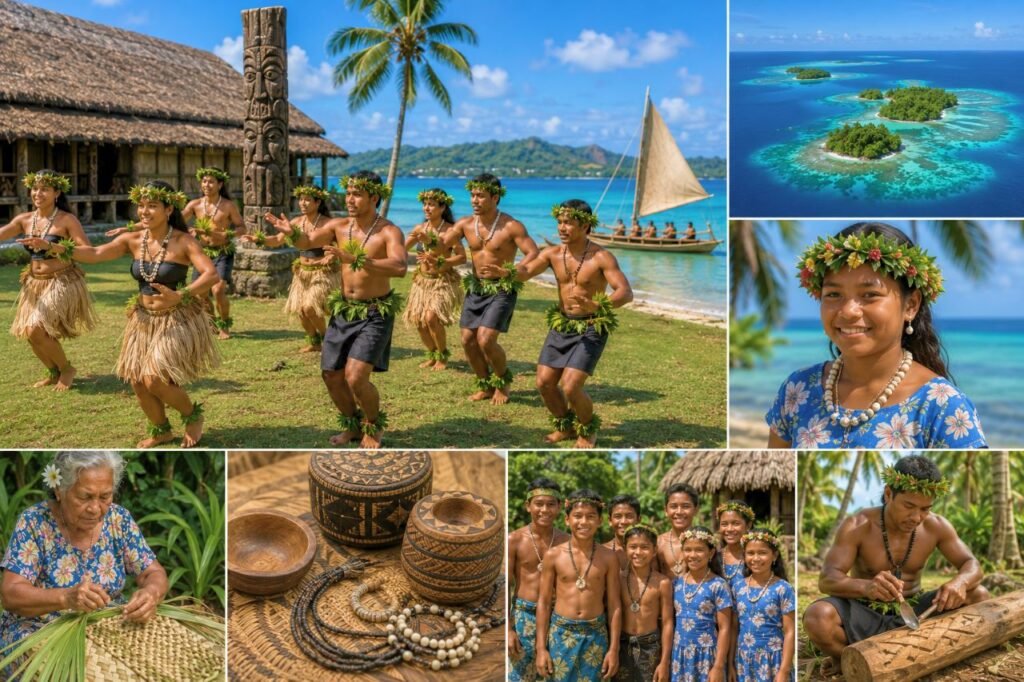
Traditional & Modern Attire
- Thatch Skirts & Grass Costumes: In Yap and Chuuk, traditional dancers wear vibrant grass skirts crafted from shredded hibiscus fiber and palm fronds.
- Marmar / Floral Leis: Hand-woven flower crowns worn on the head or neck during celebrations as symbols of welcome and respect.
- Modern Dress: Modest casual clothing is standard. Women typically wear tropical print dresses (Muumuu or skirts), while men wear light shirts and shorts.
National Symbols
- Four Stars: The national flag features four blue stars on a light blue background, symbolizing the unity of the four states (Yap, Chuuk, Pohnpei, Kosrae) in the Pacific.
- Canoe & Rai Stone: Symbolize navigational genius, enduring tradition, and wealth.
Music, Dance & Art
- Traditional Stick Dances: Famous in Yap and Chuuk, groups of men or women perform rhythmic, energetic dances using decorated bamboo sticks hit together in precise choreography to historical chants.
- Pohnpeian & Kosraean Choral Singing: Famous for breathtaking multi-part church harmonies and traditional welcome songs performed during feast assemblies.
- Carving & Weaving: Artisans produce world-renowned handicrafts, including wooden love sticks, outrigger canoe models, woven pandanus sleeping mats, and shell neckpieces.
Summary
The culture of the Federated States of Micronesia is a extraordinary blend of island tradition, ancient engineering, matrilineal strength, and deep communal harmony. From the megalithic stones of Nan Madol to the giant Rai stones of Yap and the vibrant choral harmonies of Kosrae, the people of the FSM cherish a proud, enduring Oceanic legacy.
At Best Culture Insight, we see culture as the heartbeat of every society – the way people live, connect, and express their identity.