Nauru Culture: History, Traditions, Arts, and Pacific Heritage
Posted in :

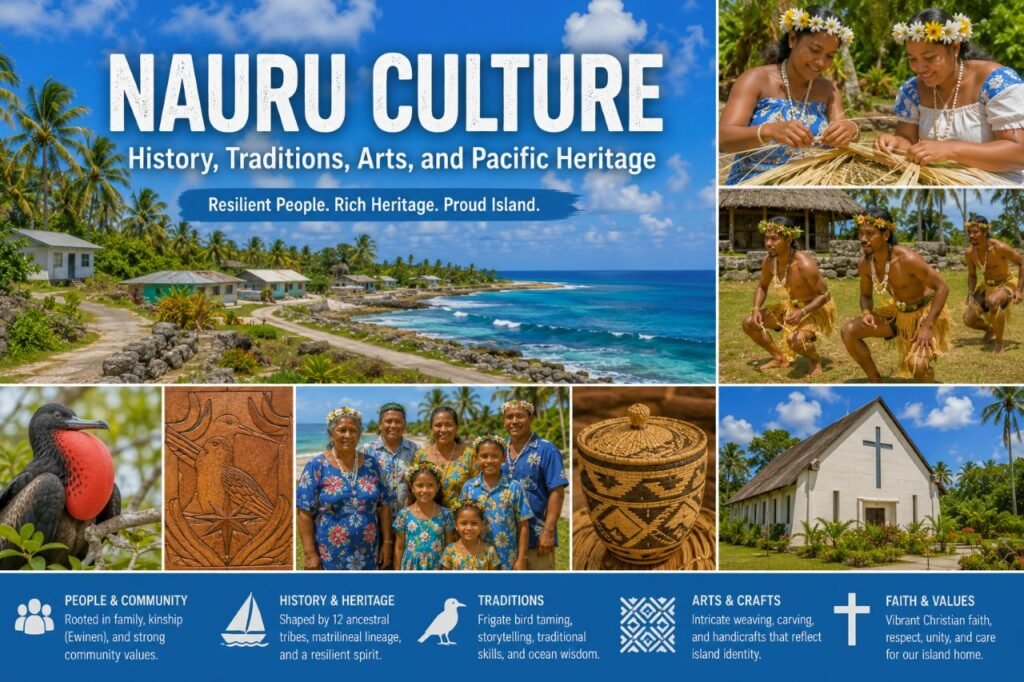
The Culture of Nauru is one of the most distinctive island heritages in Micronesia and the broader Oceania region. Situated just 42 kilometers south of the Equator in the Central Pacific, Nauru is the world’s smallest independent republic, covering an isolated island area of just 21 square kilometers. Historically defined by its 12 ancestral tribes, matrilineal land lineage, frigate bird taming, and deep oceanic resourcefulness, Nauru’s indigenous way of life has survived intense 20th-century geopolitical transformations, foreign occupation, and intensive phosphate mining. Today, Nauruans celebrate a resilient culture rooted in community solidarity, family kinship (Ewinen), vibrant Christian faith, and a renewed commitment to preserving their island home.
History & Origins
The origins of Nauruan society weave together ancient Pacific navigation, tribal traditions, and a dramatic economic boom-and-bust cycle:
- Micronesian & Polynesian Voyagers (circa 1000 BCE): The original inhabitants were seafaring voyagers who arrived on Nauru thousands of years ago. Due to its extreme geographic isolation, Nauruans developed a distinct language (Dorerin Naoero) and unique social structures that blended Micronesian and Polynesian traits.
- The 12 Ancestral Tribes: Traditional Nauruan society was organized into 12 distinct matrilineal tribes: Deiboe, Eamwidamit, Eamwidara, Eamwit, Eamwit, Eano, Eam hostility lines, Eamwidara, Eamwit, Eano, Eanwit, Emangum, Ranibok, Ribwi, and Tebwa. These 12 tribes are represented today as the 12 points of the white star on Nauru’s national flag.
- European Contact & The Nauruan Tribal War (1888): European whalers and traders made contact in the late 18th century, introducing firearms and alcohol. This culminated in the 10-year Nauruan Tribal War (1878–1888), which drastically reduced the population before Germany annexed the island in 1888.
- Phosphate Mining & Colonial Mandates (1900–1968): High-grade phosphate deposits were discovered in 1900. Nauru was subsequently administered by Britain, Australia, and New Zealand under various mandates. During World War II, Japanese forces occupied the island, deporting over 1,200 Nauruans to Chuuk, where many perished.
- Independence & Modern Era (1968–Present): Nauru gained full independence on January 31, 1968. Phosphate mining made Nauru briefly one of the wealthiest countries per capita in the 1970s, though depletion of resources led to significant economic and environmental restructuring in recent decades.
Culture, Traditions & Customs
Nauruan culture is fundamentally built upon matrilineal heritage and communal reciprocity:
- Matrilineal Kinship: Clan membership, land inheritance rights, and social identity pass strictly through the mother’s line. Even if a father is non-Nauruan, a child belongs to the mother’s tribe and inherits her land rights.
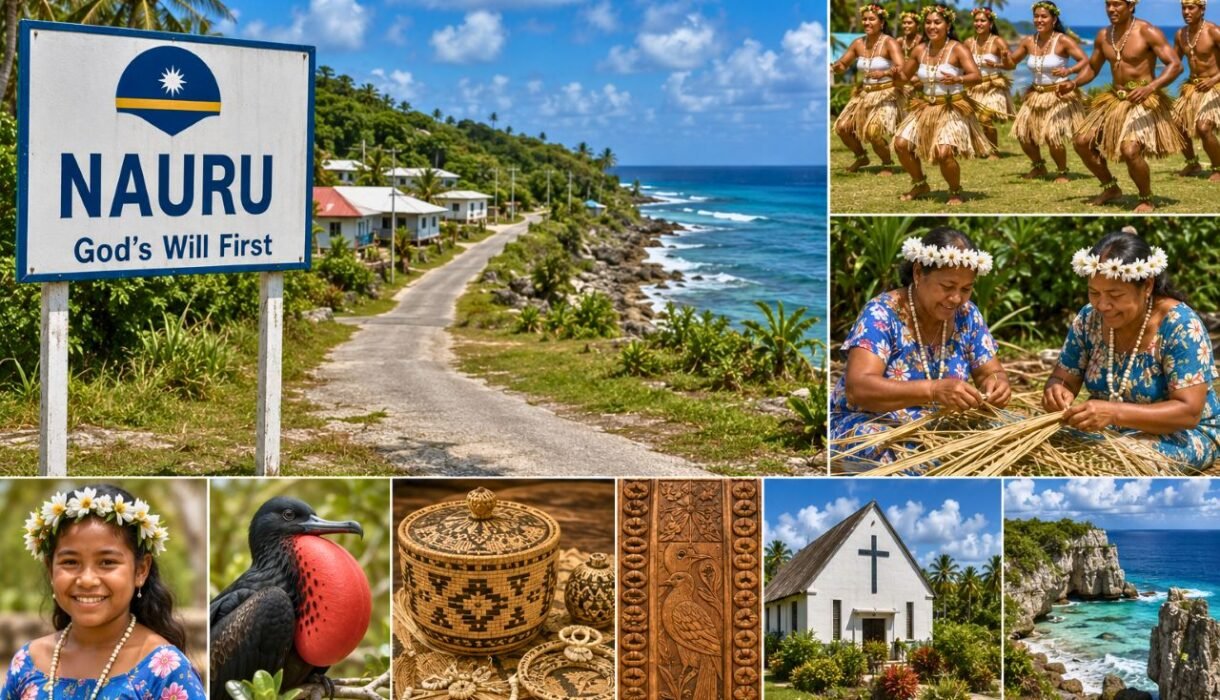
- Frigate Bird Taming (Itsiou): One of Nauru’s most famous traditional customs is the taming and catching of frigate birds (Fregata minor). Men build elevated wooden roosting perches along the coast, using captive birds and tethered lures to attract wild frigate birds. Owning and caring for frigate birds remains a point of high prestige and cultural pride.
- Rites of Passage:
- Angam Day (October 26): A deeply solemn and joyous national holiday. Angam translates to “celebration” or “homecoming.” It commemorates the two historical moments (in 1932 and 1932/1948) when the Nauruan population recovered to the critical minimum threshold of 1,500 people necessary for the survival of the ethnic group after epidemics and World War II.
- Birth & Naming Ceremonies: A newborn child’s birth is celebrated with extended family feasts. Tribal elders bestow traditional names alongside Christian baptismal names.
- Funerals: Mourning period lasts for days, involving family vigils, communal meals, and traditional speeches celebrating the deceased’s contribution to their tribe.
Languages & Communication
Languages Spoken
- Dorerin Naoero (Nauruan): An official national language and a distinct branch of the Austronesian language family. It is spoken at home and in community gatherings across the island.
- English: Widely spoken in government, business, education, and legal proceedings. Most Nauruans are fluently bilingual.
Greetings, Expressions & Philosophy
- “Ekawaw” — The traditional Nauruan greeting meaning “Welcome” or “Greetings.”
- “Tubwa” (pronounced Too-bwah) — Expresses “Thank you.”
- “Ekamowir Omo” — “Good day.”
- Communication Etiquette: Nauruan social interactions place strong emphasis on warmth, humor, and respect for tribal elders. Direct confrontation is avoided in public; consensus and gentle discussion are preferred.
Geography
Nauru is an isolated, oval-shaped coral island in the Southern Pacific Ocean, located just south of the Equator:
- Coastal Belt & Lagoon: The population lives primarily along the narrow 150- to 300-meter coastal strip fringing the ocean, as well as around Buada Lagoon, a picturesque inland freshwater lake surrounded by coconut palms and tropical vegetation.
- The Central Plateau (“Topside”): The interior elevated plateau rises to roughly 60 meters above sea level. Decades of open-pit phosphate mining left a landscape of jagged limestone pinnacles, which is currently undergoing environmental restoration initiatives.
Economy
Nauru has experienced a unique economic history transitioning from resource wealth to diversification:
- Phosphate Industry: Primary revenue historically came from exporting rich phosphate reserves used in global fertilizers. Mining operations continue on a reduced scale via secondary extraction.
- Regional Processing & Banking: In recent decades, revenue has been generated through hosting offshore processing facilities, licensing international fishing access in its Exclusive Economic Zone (EEZ), and foreign aid programs.
- Australian Dollar: The official legal currency used for all commercial transactions on the island is the Australian Dollar (AUD).
Politics
The Republic of Nauru is a parliamentary republic with a unique democratic structure:
- Unicameral Parliament: The Parliament of Nauru consists of 19 members elected for three-year terms from 8 electoral constituencies.
- Executive Branch: Parliament members elect the President from among their ranks. The President serves as both head of state and head of government, appointing a cabinet of ministers.
- No Formal Party System: Politics operate primarily through non-partisan lines, local constituency networks, and family clan ties rather than rigid political parties.
Ethnic Groups
- Nauruan Majority: Approximately 88% to 90% of the population is ethnically Nauruan—a blend of Micronesian, Polynesian, and Melanesian ancestral roots.
- Minority Communities: The remaining population includes Pacific Islanders (from Kiribati, Tuvalu, and Fiji), Chinese, and Australians involved in business, administration, and development services.
Beliefs & Values
Religion & Spirituality
- Christianity: Over 90% of the population practices Christianity. The majority belong to the Nauru Congregational Church, alongside significant Roman Catholic, Assemblies of God, and Independent church communities.
- Indigenous Myth & Cosmology: Ancestral Nauruan religion centered on the goddess Eigigu and a spirit world created by a mythical spider named Areop-Enap. While traditional religion was replaced by Christianity in the late 19th century, folklore and respect for ancestral lands remain integral to local heritage.
Core Values
- Ewinen (Kinship Loyalty): Absolute dedication to family and tribal obligations. Sharing food, housing, and financial support across extended family networks is expected.
- Resilience: A proud sense of survival despite historical hardship, displacement, and environmental challenges.
Food & Cuisine
Traditional Nauruan cuisine relies on local seafood, tropical fruits, and imported Australian goods:
- Traditional Dishes & Staples:
- Fresh Seafood: Coral fish, yellowfin tuna, skipjack, snapper, and coconut crab prepared raw with coconut milk, grilled, or boiled.
- Ibija (Milkfish): Historically farmed in Buada Lagoon, milkfish is a prized traditional delicacy served during family feasts.
- Coconut Products: Fresh coconut water (Ekwane), coconut cream, and sweet toddy harvested from coconut palms.
- Pandanus & Breadfruit: Baked over hot coals or mashed with coconut milk.
- Modern Dietary Influences: Rice, canned meats, barbecue meats, and Chinese-Nauruan fusion dishes are widely consumed in daily life today.
Clothing & Symbols
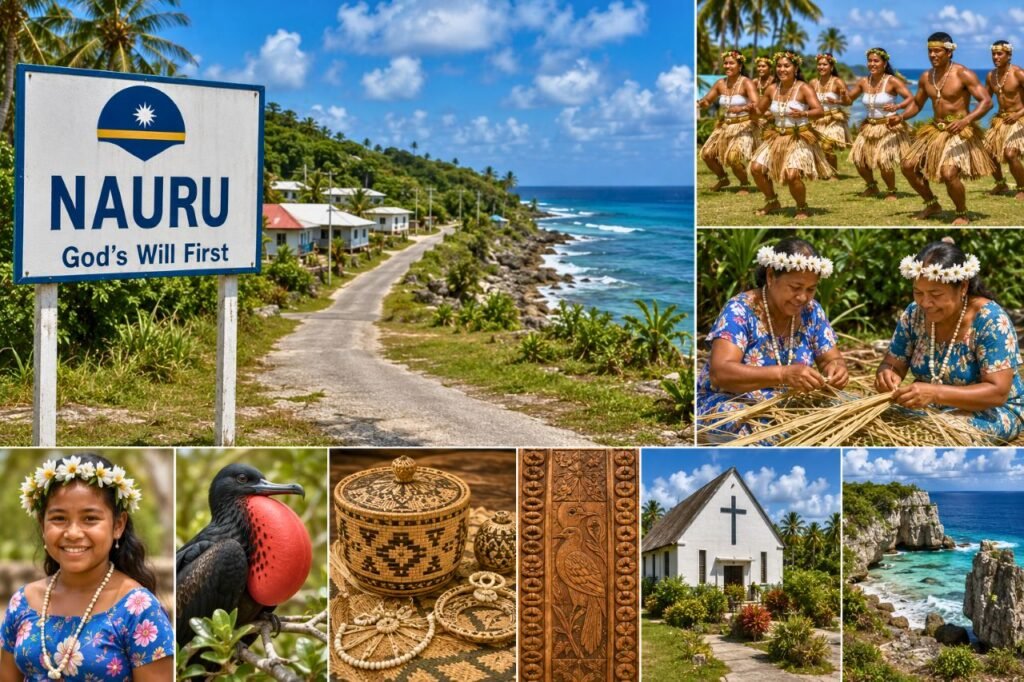
Traditional & Modern Attire
- Traditional Grass Skirts: Historically, Nauruans wore skirts made from woven coconut fiber or hibiscus bark strips, decorated with shell ornaments.
- Modern Attire: Casual, comfortable tropical wear is standard. Light shorts, printed shirts, and cotton dresses are worn daily. During church services and official events, men wear collared shirts with trousers, while women wear formal dresses accompanied by fresh flower headbands (Marmar).
National Symbols
- The 12-Pointed Star: Represents the 12 original tribes and national unity.
- Frigate Bird: Symbolizes freedom, navigation skill, and traditional Nauruan heritage.
- Phosphatic Limestone Pinnacles: Represents Nauru’s unique geological formation and history.
Music, Dance & Art
- Rhythmic Chants & Harmonies: Traditional Nauruan music features rhythmic group chanting, hand-clapping, and multi-part church choirs renowned for their powerful vocal pitch and emotional depth.
- Recreational Dance: Traditional dances feature gentle hand movements telling stories of sea voyages, fishing expeditions, and tribal legends, performed during Angam Day and national celebrations.
- Crafts & String Figures: Nauruans are famous for creating complex String Figures (Ebwara)—intricate geometric patterns formed with woven coconut string around fingers to represent animals, legends, and island landmarks.
Summary
Nauru Culture represents a remarkable story of Pacific island identity, matrilineal heritage, and community endurance. From the ancient practice of frigate bird taming to the celebrated unity of Angam Day, the Nauruan people uphold a unique culture that continues to shine brightly across Oceania.
At Best Culture Insight, we see culture as the heartbeat of every society – the way people live, connect, and express their identity.