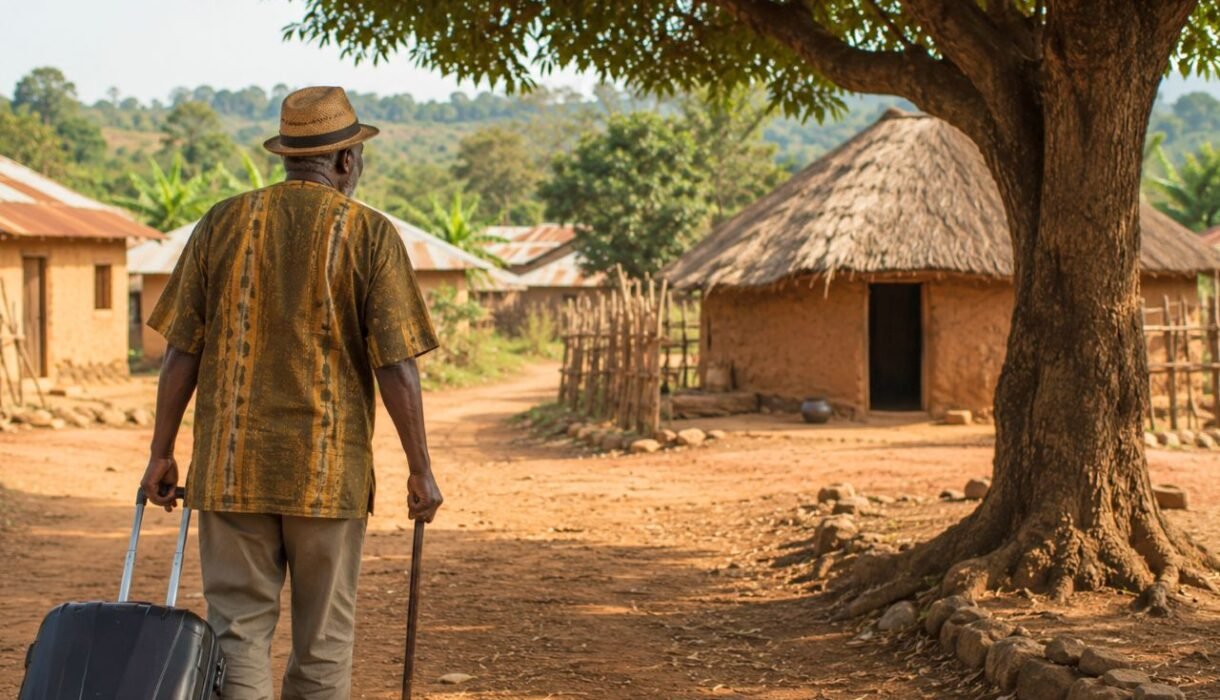

Every year, a quiet, untelevised migration takes place. There are no grand farewell parties or media headlines. Instead, a professional packs up decades of city life into cardboard boxes, looks toward the horizon, and makes a definitive declaration: “It’s time to go back to the village.” – Rural Retirement.
To him, “home” is a place etched in memory. The irony? He hasn’t actually lived there for thirty or forty years. The last time he had any daily responsibilities in that soil, he was a young boy fetching water before school.
Now, he returns as a senior citizen, armed with a pension, urban sensibilities, and lifestyle habits that seem entirely foreign to the local landscape.
The transition reveals a stark, uncomfortable truth: Spending a festive week in the countryside for Christmas is entirely different from actually living there.
The Illusion of the Holiday Visit
Holiday visits are an absolute illusion. When you visit your hometown during the holidays, you arrive as a celebrated guest of honor. Feasts are prepared, distant relatives flock to your doorstep, and you are given a platform to offer grand commentary on politics and world affairs over cold drinks. Then, you pack your bags and drive back to the city.
It is an exhilarating, but ultimately temporary, theater production.
Remove the holiday banners. Strip away the adoring audience. Take away the festive atmosphere.
What you are left with is a quiet, ordinary Tuesday. And this is exactly where reality sets in.
The Village Didn’t Stand Still
Many retirees make the mistake of assuming their hometowns froze in time the moment they left. But the community did not wait for your return; it kept evolving, quietly adapting to its own rhythm.
The peers you once climbed trees with have aged. Sadly, some have passed away. Others have stepped into positions of local authority and view you not as a returning hero, but as an outsider. Even the old childhood nicknames have been forgotten or reassigned to a new generation.
You aren’t making a grand return. You are arriving as a newcomer.
This realization can be incredibly jarring, particularly for professionals who completely detached from their roots during their working years. They never visited for weekend funerals, never dropped in for casual holidays, and built an entirely urban existence. Their networks, comforts, and daily routines were purely metropolitan.
Moving back under those circumstances isn’t retirement. It’s migration.
When the System Disappears
In the concrete jungle, life is governed by automated systems. Tap water flows with the turn of a handle. Electricity is relatively constant. Groceries are neatly packaged on a supermarket shelf.
In the rural countryside, infrastructure operates on its own whims. Water systems require patience. Power grids can be unpredictable. Food requires a direct relationship with either the marketplace or the land itself.
Then, there is the overwhelming weight of time.
Urban Life: Meetings➔Commutes➔Deadlines➔Constant Motion
Rural Life: Sunrise➔Stillness➔Reflection➔Unstructured Hours
In the city, your calendar was your master. In the country, time stretches out into a vast, intimidating ocean. Morning bleeds into late afternoon without a single event marking the passage of hours. You sit on the porch. You stand up. You walk to the gate. You sit back down.
Suddenly, your mind begins to exhume memories, regrets, and unresolved thoughts long buried by the frantic pace of city life.
The Cost of Unexpected Isolation
This psychological shift is where many retirees begin to deteriorate—not dramatically, but incrementally.
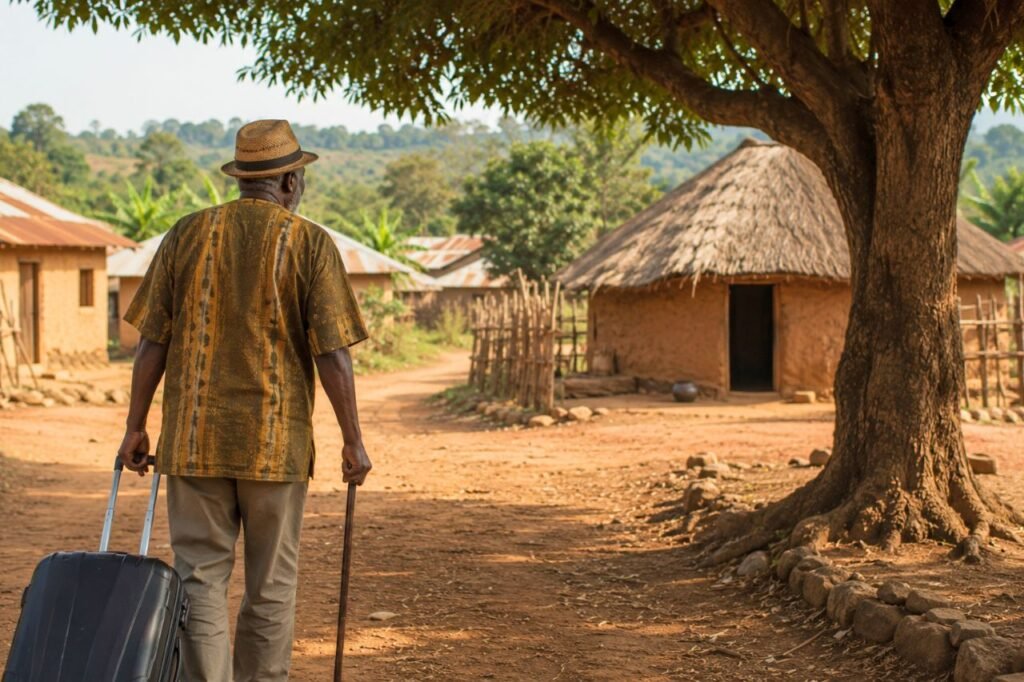
Rural journey through a peaceful village
Retirement without structure isn’t peace; it is profound disorientation. When the body slows down too quickly and the mind loses its daily mission, a person’s sense of purpose evaporates. And without purpose, the human spirit becomes incredibly fragile.
Minor physical complaints morph into major anxieties. Mild aches become permanent fixtures. Many retirees do not last long in the countryside, not because the rural environment is naturally harsh, but because they were completely unprepared for the psychological weight of the transition.
Others survive, but they carry a heavy burden of resentment. They spend their days trapped in nostalgic comparison: “Back in the city, we used to do things this way…”
Memory is a highly selective storyteller. It conveniently makes them forget the grueling traffic jams, the suffocating bills, and the high-stress deadlines of urban life. So, they sit in the quiet country air, complaining and regretting, watching a community move around them like spectators who showed up late to their own movie.
Furthermore, a pension is not an infinite fountain of wealth. Traditional farming is a rigorous, backbreaking trade—not a casual hobby you can master at sixty-five without prior experience. The soil doesn’t care about your corporate titles, hunger doesn’t respect your past achievements, and illness won’t negotiate with your resume.
How to Properly Prepare for the Shift
The takeaway for anyone dreaming of an eventual rural retirement is incredibly straightforward: If you plan to live there tomorrow, you need to start engaging with it today.
Don’t just visit when the festivals are happening. Go when absolutely nothing is on the calendar.
- Sit in the quiet: Let the rural silence unsettle you now, while you still have the option to leave.
- Learn the daily rhythm: Understand how the community breathes before it becomes your only reality.
- Build authentic relationships: Cultivate bonds that aren’t dependent on you handing out cash or gifts. Learn how the local social ecosystem operates when you aren’t being treated like an elite visitor.
The Golden Rule of Longevity: Retirement is not the time to learn an entirely new way of living. It is the time to smoothly transition into a life you have already practiced.
Extend your weekend stays. Get comfortable with stillness. Let your hometown cease to be a vacation postcard and let it become familiar, well-trodden territory.
That way, when the day finally comes to pack your boxes for good, you aren’t taking a blind leap of faith. You are stepping into a landscape that knows your name, and more importantly, into a lifestyle you genuinely understand.
The countryside is an incredible place to spend your golden years—it is peaceful, grounded, and profoundly authentic. But it rewards only those who arrive with an open mind and a prepared spirit. Those who fail to prepare spend their final years trying to fit into a world that learned to move on without them long ago.
At Best Culture Insight, we see culture as the heartbeat of every society—the way people live, connect, and express their identity.