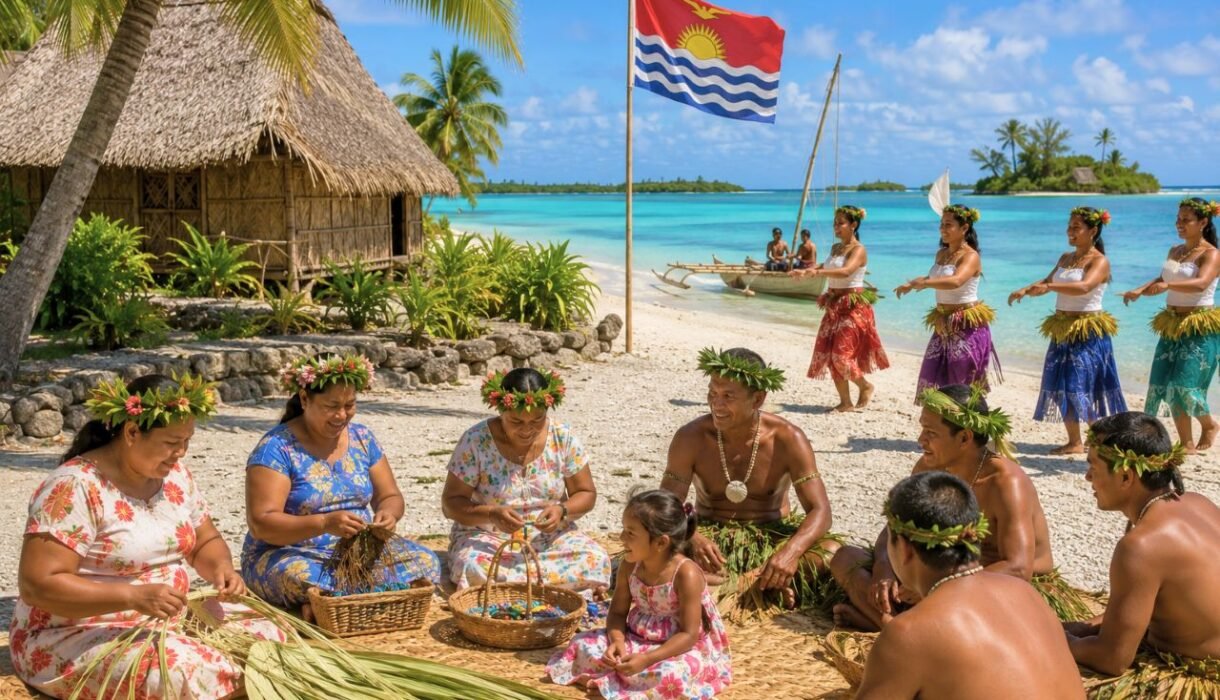
Kiribati Culture: History, Traditions, Arts, and Pacific Heritage
Posted in :

The Culture of Kiribati (pronounced Kee-ree-bas) is an extraordinary, island-born heritage shaped by thousands of years of Micronesian seafaring, deep communal governance, and an intimate connection to the Pacific Ocean. Spanning 33 low-lying coral atolls and reef islands scattered across 3.5 million square kilometers of ocean, Kiribati is home to the I-Kiribati people—masters of open-ocean navigation, traditional thatch architecture, and expressive storytelling dance. Central to Kiribati society is the concept of Mauri (health, peace, and prosperity), lived out inside the sacred village meeting house known as the Maneaba. In the face of modern environmental challenges, Kiribati culture stands as a shining testament to community resilience, oral wisdom, and deep-rooted Pacific solidarity.
History & Origins
The cultural timeline of Kiribati reflects millennia of oceanic navigation and inter-island exchanges across the Pacific:
- Austronesian & Micronesian Settlement (circa 3000 BCE – 1000 CE): The ancestors of the I-Kiribati were seafaring Austronesian navigators who migrated from Southeast Asia into Micronesia. Over thousands of years, these voyagers perfected double-hulled canoe construction (Wa) and star navigation, establishing thriving, self-sufficient communities on nutrient-scarce coral atolls.
- Polynesian & Melanesian Influences: Between the 11th and 14th centuries, voyages from Samoa, Tonga, and Fiji introduced Polynesian social hierarchies, mythological narratives, and inter-island trade networks, blending with native Micronesian traditions.
- European Contact & The Gilbert Islands Era: British explorer Captain Thomas Gilbert sighted the islands in 1788. By the late 19th century, the archipelago became a British protectorate (the Gilbert and Ellice Islands Colony in 1892), bringing Christian missionaries who introduced literacy, Western clothing, and choir singing.
- World War II & The Battle of Tarawa (1943): The Gilbert Islands became a critical Pacific theater during WWII. The fierce Battle of Tarawa in November 1943 left a lasting historic impact on the islands, shaping regional memory and post-war infrastructure.
- Independence (1979–Present): On July 12, 1979, the nation achieved independence, adopting the indigenous name Kiribati (the local rendering of “Gilberts”). Today, Kiribati is an active voice in international climate advocacy while maintaining vibrant local traditions.
Culture, Traditions & Customs
At the core of Kiribati life is the Maneaba—the large, open-air communal meeting house with a high-pitched thatched roof supported by massive coral pillars.
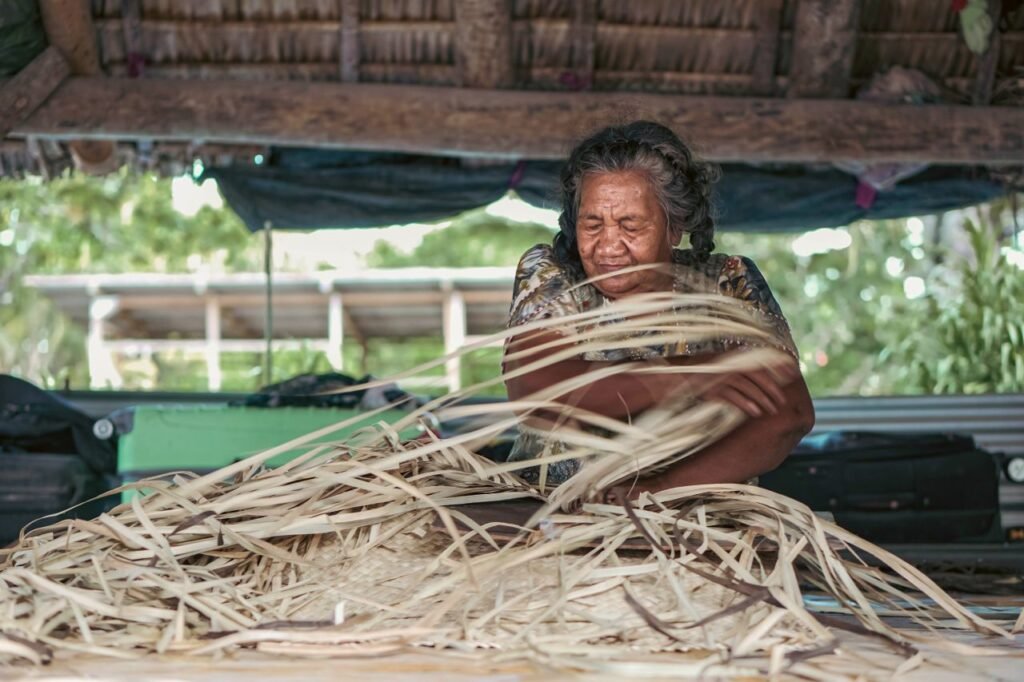
- The Maneaba System & Social Order: The Maneaba is not merely a building; it is a sacred space governed by strict seating protocols (Boti). Elders (Unimwane) sit in designated family locations along the perimeter to deliberate village laws, resolve disputes, and host celebrations. Decorum, soft speech, and humility are mandatory inside.
- Rites of Passage:
- Birth & Naming Rituals (Te Mweaka): Newborns are welcomed with family feasts where elders bestow meaningful ancestral names. The child’s umbilical cord is traditionally buried beneath a coconut palm to tie their spirit permanently to the ancestral land.
- Youth Initiation (Te Riri / Te O): Young men and women undergo rites marking adulthood. Young men learn deep-sea fishing, canoe fabrication, and star navigation, while young women are taught pandanus mat weaving (Riri), cooking, and traditional song protocols.
- Marriage Customs (Te Bairiti): Traditional marriages represent an alliance between extended clans (Mwenga). Proposals involve formal gifts of woven mats, coconut syrup (Kamaimai), and fish, followed by community feasts inside the Maneaba.
- National Festivals:
- Independence Day (July 12): A multi-day national celebration filled with canoe races, track events, choral competitions, and traditional dance performances.
- New Year & Gospel Days: Celebrated across all islands with night-long singing, feast preparations, and church services.
Languages & Communication
Languages Spoken
- Taetae ni Kiribati (Gilbertese): The national language, belonging to the Micronesian branch of the Austronesian language family. It is an endearingly melodic language featuring distinct nasal sounds and phonetic simplicity.
- English: The official second language, widely used in government administration, higher education, and international trade.
Greetings, Proverbs & Communication Style
- “Mauri!” — The primary greeting meaning “health” or “blessing.” The full formal blessing is “Te Mauri, Te Raoi ao Te Tabomoa” (“Health, Peace, and Prosperity”).
- “Ko rabwa” — Expresses “thank you.”
- “Ti a boo” — Means “goodbye” or “until we meet again.”
- Proverbs & Philosophy: Communication in Kiribati prioritizes consensus and gentleness. Loud speech or public displays of anger are strongly discouraged. A common cultural proverb highlights unity: “Te kattonga ao te bootaki” (“Strength is found in gathering and togetherness”).
Geography
Kiribati is the only nation on Earth situated in all four hemispheres (Northern, Southern, Eastern, and Western).
- Three Primary Island Groups:
- Gilbert Islands: The western chain where the vast majority of the population lives, including the densely populated capital atoll, South Tarawa.
- Phoenix Islands: A central group featuring the Phoenix Islands Protected Area (PIPA), one of the world’s largest marine conservation reserves.
- Line Islands: The easternmost chain, including Kiritimati (Christmas Island)—the largest pure coral atoll in land area on Earth and one of the first inhabited places to ring in each new calendar year.
- Atoll Environment: The islands consist of narrow ribbon-like strips of coral sand rising barely 2 to 3 meters above sea level, enclosing shallow, pristine lagoons.
Economy
Kiribati manages an isolated atoll economy with a huge maritime jurisdiction:
- Marine Fishing Licenses & Coconut Production: The primary economic revenue stems from issuing international fishing permits for its vast Exclusive Economic Zone (EEZ), alongside copra (dried coconut meat) production.
- Subsistence Living: Most islanders outside South Tarawa practice traditional subsistence farming (giant swamp taro) and reef fishing.
- Remittances & Trust Fund: Financial stability is supported by overseas seafarer remittances and the Revenue Equalisation Reserve Fund (RERF), an offshore sovereign wealth fund established from historic phosphate mining.
Politics
Kiribati is a stable, sovereign democratic republic combining presidential and parliamentary features:
- Governance Structure: The President (Beretitenti) serves as both head of state and head of government, elected by popular vote from candidates nominated by Parliament (Maneaba ni Maungatabu).
- Island Councils & Elders (Unimwane): Outer island governance relies heavily on local island councils working alongside the Unimwane (council of male elders) to uphold customary law and village harmony.
Ethnic Groups
- I-Kiribati Majority: Over 96% of the population identifies as ethnically I-Kiribati (Micronesian).
- Other Pacific Communities: Small populations of Tuvaluans, Fijians, Banabans (residing on Rabi Island in Fiji), and individuals of mixed European or Asian ancestry live primarily in urban Tarawa.
Beliefs & Values
Religion & Spirituality
- Christianity: Over 90% of the population adheres to Christian denominations, divided mainly between the Roman Catholic Church and the Kiribati Uniting Church (Protestant).
- Ancestral Cosmology: Traditional spiritual beliefs survive alongside Christianity. Many I-Kiribati honor ancestral spirits (Anti) and creator deities like Nareau (the cosmic spider who separated heaven and earth), maintaining taboos (Nakai) regarding sacred fishing grounds and reef rocks.
Core Values
- Karinerinerin (Respect & Modesty): Deference to elders and modesty in speech and dress are fundamental.
- Kanoan te Boti (Family Duty): Unwavering commitment to shared clan obligations, ensuring no family member is left without food, shelter, or support.
Food & Cuisine
Due to sandy atoll soil, Kiribati cuisine relies on the ocean, coconut palms, and hardy native root crops.
- Iconic Staples:
- Te Bwai (Giant Swamp Taro): Grown in deep hand-dug pits fertilized with organic compost leaves, consumed during grand feasts.
- Te Kamaimai (Sweet Coconut Syrup): Unfermented coconut palm sap (Karewe) boiled down into a sweet syrup used in drinks, puddings, and preserves.
- Te Fish / Te Ika: Fresh tuna, flying fish, groupers, and octopus eaten raw, marinated in lime juice, salted, or grilled over coconut husk fires.
Clothing & Symbols
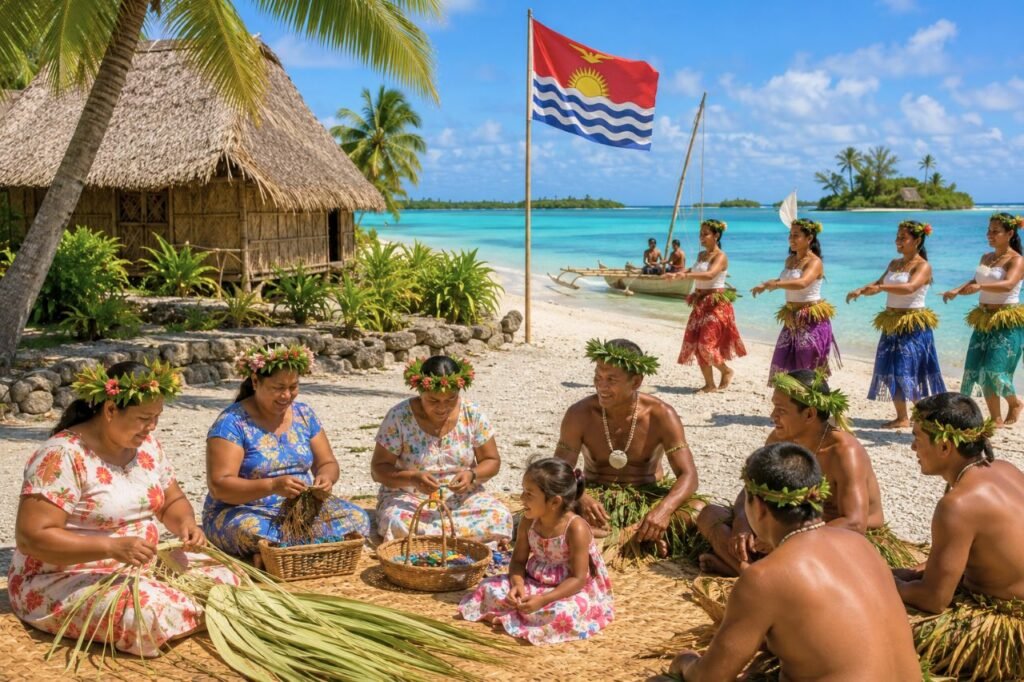
Traditional Attire
- Te Riri (Pandanus Skirts): Skirts intricately woven from dried pandanus leaves, worn by both men and women during ceremonial dances.
- Kabae & Modern Wear: Men traditionally wear woven waist coverings or light cloths (Kabae), while women wear modest long cotton skirts and colorful tops paired with woven pandanus mats.
Cultural Symbols
- Te Itiba & Frigatebird (Te Kina): The national emblem features the Frigatebird flying over a rising sun on ocean waves, symbolizing power, freedom, and masterful navigation.
- Coral Pillars & Woven Mats: Symbolize structural village strength and home hospitality.
Music, Dance & Art
- Te Mwaie (Traditional Kiribati Dance): Kiribati dance is world-renowned for its unique, precise movements. Dancers remain mostly motionless from the waist down while executing sharp, bird-like head snaps and wide arm extensions imitating the flight of the frigatebird.
- Seated Singing (Ruuoia & Kaimatoa): Performances begin seated inside the Maneaba, accompanied by rhythmic clapping on wooden boxes or handclapping, building into powerful, hypnotic vocal chants.
- Artisanal Craftsmanship: Master craftspeople construct outrigger canoes (Wa) using coconut fiber sennit rope without nails, alongside intricately woven floor mats and coconut shell jewelry.
Summary
Kiribati Culture is a testament to human ingenuity, ocean navigation, and deep communal harmony. By cherishing the sacred space of the Maneaba, honoring ancestral wisdom, and maintaining rhythmic dance and song traditions, the I-Kiribati people preserve a vibrant island legacy that continues to inspire the global community.
At Best Culture Insight, we see culture as the heartbeat of every society – the way people live, connect, and express their identity.