United Kingdom Culture: History, Traditions, and Heritage of the British Isles
Posted in :

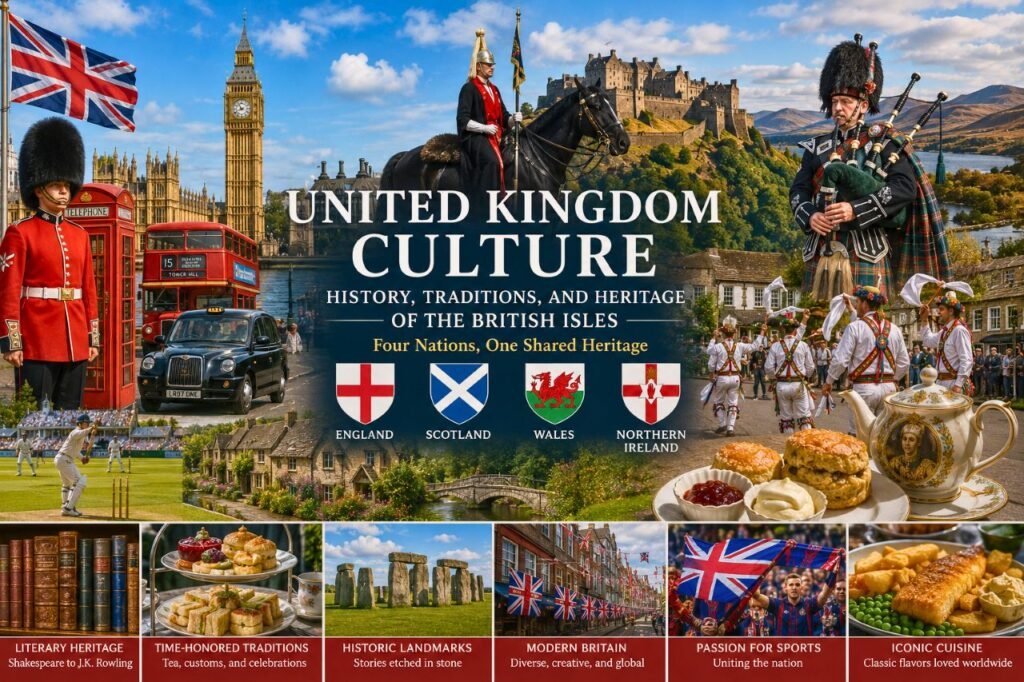
The Culture of the United Kingdom is a rich, dynamic tapestry woven from centuries of history, regional identity, global exchange, and enduring social traditions. Comprising four distinct nations—England, Scotland, Wales, and Northern Ireland—the UK represents a unique blending of distinct regional customs and a shared national character. Known worldwide for its politeness, stoic humor, literary greatness, and passion for sports, the modern British populace balances a deep respect for historic institution with a forward-looking, multicultural spirit. To understand British culture is to explore how a small island nation managed to exert a profound impact on global art, language, governance, and lifestyle.
History & Origins
The roots of British culture stretch back to ancient prehistoric civilizations that built iconic megalithic monuments such as Stonehenge. Over thousands of years, the islands were shaped by successive waves of migration, settlement, and conquest:
- Celts: Settled across the British Isles during the Iron Age, leaving behind language, mythology, and artistic traditions that remain strongly preserved in Scotland, Wales, Northern Ireland, and Cornwall.
- Romans: Conquered much of Britain in 43 CE, introducing urban planning, roads, bathhouses, and early Christianity.
- Anglo-Saxons & Vikings: Following the Roman withdrawal, Germanic tribes (Angles, Saxons, and Jutes) established kingdoms that formed the foundational language of Old English. Norse Viking raids and settlements further influenced northern and eastern regions.
- Normans: The invasion of 1066 led by William the Conqueror introduced Anglo-Norman French culture, feudalism, and castle architecture, permanently transforming the English language and administrative structures.
During the 18th and 19th centuries, the Industrial Revolution reshaped Britain into an urbanized, technological powerhouse, while the expansion of the British Empire spread British legal systems, parliamentary government, sports, and the English language across the globe. Today’s modern United Kingdom reflects both its historic imperial legacy and its post-war evolution into a vibrant, diverse constitutional monarchy.
Culture, Traditions & Customs
British society is anchored by a blend of ancient traditions, royal ceremonies, and lighthearted community events:
- Marriage Traditions: Traditional British weddings usually take place in churches or licensed civil venues. Customary elements include white wedding dresses, flower girls, page boys, a multi-tiered fruitcake, and formal speeches delivered by the groom, father of the bride, and the best man.
- Christenings & Naming: Infant christenings or secular naming ceremonies remain popular ways to welcome a child, often accompanied by appointing godparents or mentors.
- Festivals & Seasonal Celebrations:
- Bonfire Night (Guy Fawkes Night – Nov 5): Commemorates the failed Gunpowder Plot of 1605 with public bonfires, fireworks, and burning effigies of Guy Fawkes.
- Burns Night (Jan 25): A Scottish celebration honoring national poet Robert Burns, featuring haggis, bagpipes, poetry recitations, and whisky.
- Remembrance Sunday (November): A national period of silence marked by red poppy pins to honor military personnel who served in conflicts.
- Notting Hill Carnival: Held every August in London, celebrating Caribbean culture with vibrant parades, soca music, and street food.
- Rites of Passage: Milestone birthdays such as 18 (legal adulthood) and 21, as well as university graduations, are major points of personal celebration.
Languages & Communication
- Languages Spoken:English is the official and predominant language across the UK. However, several regional and indigenous languages hold co-official or recognized status:
- Welsh (Cymraeg): Spoken widely in Wales.
- Scottish Gaelic and Scots: Spoken in Scotland.
- Irish and Ullans (Ulster-Scots): Spoken in Northern Ireland.
- Cornish: Recognized as a minority language in Cornwall.
- Greetings & Etiquette:
- Standard greetings include “Hello”, “Good morning”, or casual regional expressions like “Alright?” or “Cheers”.
- British communication relies heavily on politeness, understatement, and indirectness. Phrases like “Please”, “Thank you”, and “Sorry” are used frequently.
- Queueing (waiting in an orderly line) is a sacred social rule; cutting a queue is considered major social misconduct.
- Proverbs & Expressions:
- “Keep Calm and Carry On” — A classic wartime motto reflecting British composure during adversity.
- “It’s not my cup of tea” — Used to express a polite lack of preference for something.
Geography
The United Kingdom covers an area of roughly 242,495 square kilometers across the British Isles, situated off the northwestern coast of mainland Europe.

- Landscapes: Geography ranges from the rolling green hills and chalk downs of southern England to the rugged mountains, lochs, and glens of the Scottish Highlands. Wales features dramatic coastal cliffs and the Snowdonia mountain range, while Northern Ireland is home to Lough Neagh (the largest lake in the UK) and the famous Giant’s Causeway.
- Climate: A temperate maritime climate brings mild temperatures, frequent rainfall, and highly changeable weather patterns throughout the year.
Economy
The UK possesses one of the world’s largest national economies and serves as a global hub for finance, innovation, and culture:
- Key Sectors: The service sector dominates the economy, led by financial services centered in the City of London. Other key industries include pharmaceuticals, aerospace, creative arts, software development, and higher education.
- Global Trade: The UK exports high-tech machinery, automobiles, chemical products, Scotch whisky, and specialized financial services worldwide.
Politics
The United Kingdom operates under a constitutional monarchy with a parliamentary democracy.
- Head of State: The reigning Monarch (currently King Charles III) serves as the ceremonial head of state, symbolizing national unity and continuity.
- Government: Executive authority is held by the Prime Minister and the Cabinet. Legislative power rests with the bicameral Parliament at the Palace of Westminster in London, consisting of the elected House of Commons and the appointed House of Lords.
- Devolution: Scotland, Wales, and Northern Ireland maintain devolved governments (the Scottish Parliament, Welsh Parliament/Senedd, and Northern Ireland Assembly) with power over local matters such as health, education, and transport.
Ethnic Groups
Modern Britain is an exceptionally diverse society shaped by historical migration and global trade:
- Composition: While white British citizens make up the majority of the population, large multicultural communities enrich major urban centers like London, Birmingham, Manchester, and Glasgow.
- Demographics: Significant ethnic minority populations include British Asian communities (Indian, Pakistani, Bangladeshi), Black British (Caribbean and African heritage), Chinese, and mixed-ethnic backgrounds, fostering a rich fusion of food, music, and art.
Beliefs & Values
- Religion & Faith: Historically grounded in Christianity (represented by the Church of England, the Church of Scotland, Catholic Churches, and various Protestant denominations). Today, the UK is a largely secular society, though it houses vibrant communities of Muslims, Hindus, Sikhs, Jews, and Buddhists.
- Core Values: Primary societal values include individual liberty, tolerance, fair play, democratic freedom, and a dry sense of humor (often characterized by self-deprecation and irony).
Food & Cuisine
British cuisine has experienced a major culinary renaissance, combining comforting traditional staples with global flavors.
- Iconic Dishes:
- Sunday Roast: Roasted meat (beef, chicken, lamb, or pork) served with roast potatoes, vegetables, stuffing, and Yorkshire pudding, smothered in rich gravy.
- Fish and Chips: Deep-fried battered fish (typically cod or haddock) served alongside thick-cut chips, mushy peas, and tartar sauce.
- Full English Breakfast: A hearty plate featuring bacon, sausages, eggs, baked beans, grilled tomatoes, mushrooms, toast, and black pudding.
- Chicken Tikka Masala: An Anglo-Indian curry creation that stands as one of the UK’s most beloved national dishes.
- Afternoon Tea: A traditional mid-afternoon ritual of black tea served alongside finger sandwiches, scones with clotted cream and jam, and sweet pastries.
- Pub Culture: The British Public House (“Pub”) is an essential social hub where friends gather for craft beers, ales, ciders, and comfort meals (pub grub).
Clothing & Symbols
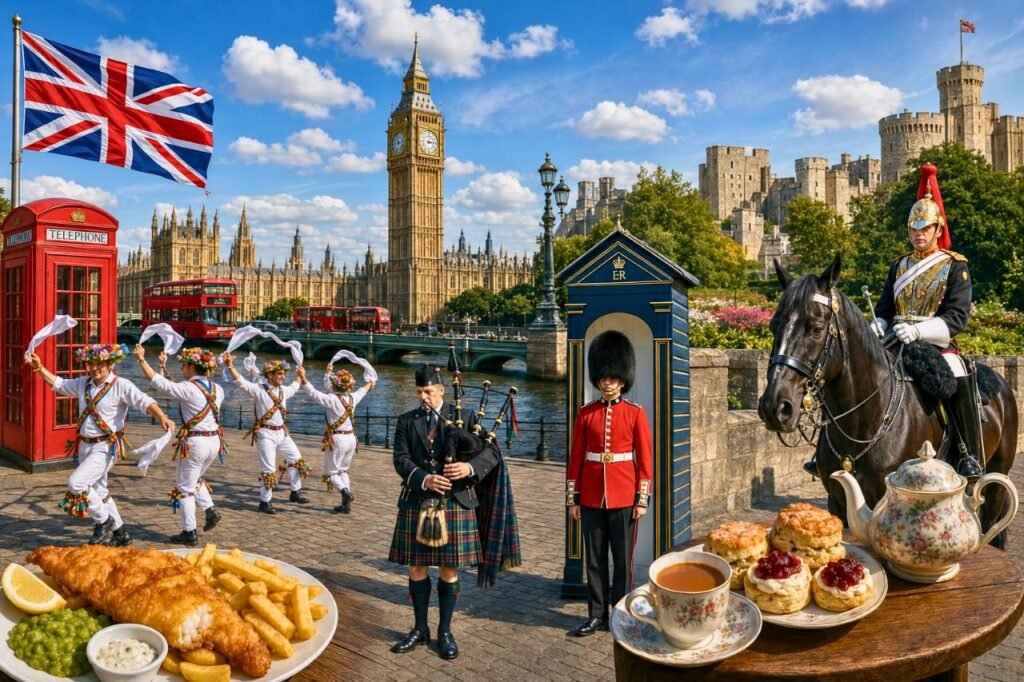
- Attire: Day-to-day dress in the UK is contemporary and modern. However, ceremonial and regional clothing holds high cultural significance:
- The Kilt: Traditional Scottish attire made of woven tartan cloth, worn during formal occasions, weddings, and highland games.
- Royal Guards: Famed for their red tunics and bearskin hats during state ceremonies.
- National Symbols:
- Union Jack (Union Flag): The national flag combining the crosses of St. George (England), St. Andrew (Scotland), and St. Patrick (Northern Ireland).
- Flora: The Rose (England), Thistle (Scotland), Leek/Daffodil (Wales), and Shamrock (Northern Ireland).
- John Bull & Britannia: Personifications of British national character and liberty.
Music, Dance & Art
- Literature & Theatre: Home to literary icons like William Shakespeare, Jane Austen, Charles Dickens, George Orwell, and J.K. Rowling. London’s West End is a world-renowned center for theatrical performance.
- Music: The UK has exercised an enormous influence on popular music history, producing legendary acts such as The Beatles, Queen, David Bowie, Elton John, and modern global pop icons. Traditional folk music remains alive through bagpipes, fiddles, and sea shanties.
- Visual Art & Architecture: Architectural styles span from Romanesque cathedrals and Gothic cathedrals to Victorian architecture and modern skyscraper designs. Notable artists include J.M.W. Turner, John Constable, Henry Moore, and contemporary street artist Banksy.
Summary
The culture of the United Kingdom is a masterclass in balancing ancient heritage with contemporary global influence. From the historic halls of Westminster and medieval castles to world-famous music, culinary traditions, and a multi-ethnic populace, the UK continues to preserve its storied history while serving as a vibrant catalyst for international art, education, and social progress.
At Best Culture Insight, we see culture as the heartbeat of every society – the way people live, connect, and express their identity.