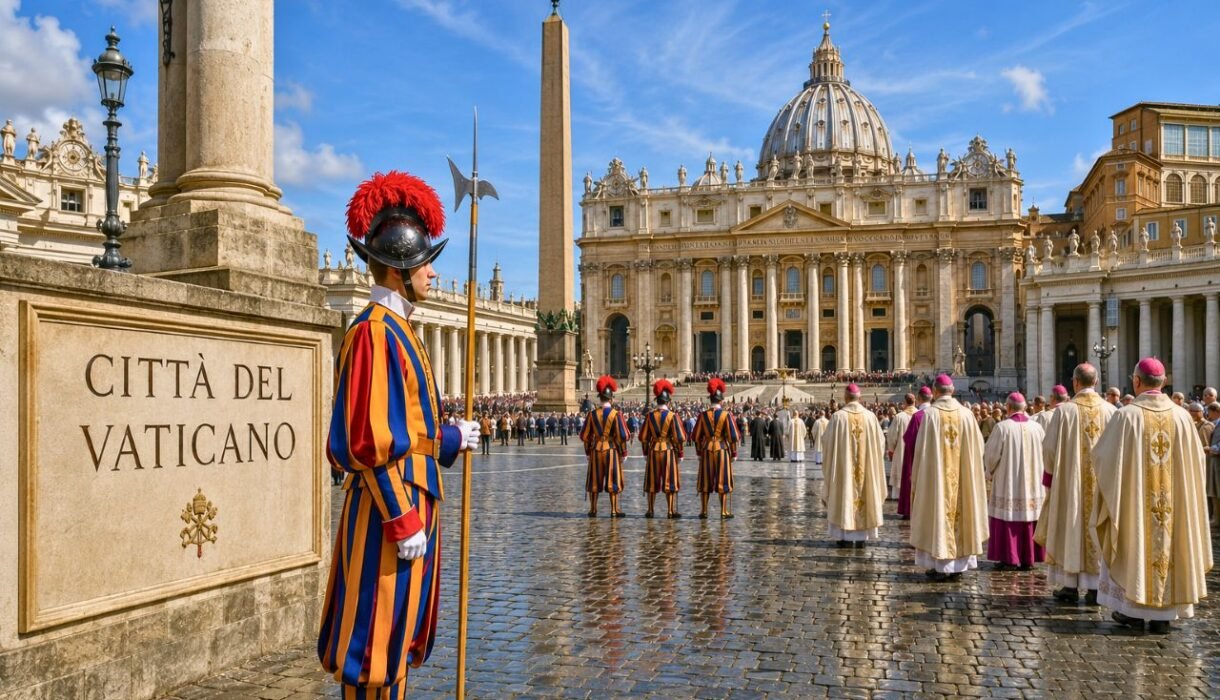
Sanctuary of Faith and Art: An Elaborate Exploration of Vatican City Culture
Posted in :

Enclosed entirely within the city of Rome, Italy, Vatican City is the smallest independent sovereign state in the world, yet it exercises a monumental spiritual and artistic influence globally. The distinct Culture of Vatican City—known officially in Latin as Status Civitatis Vaticanae—is uniquely defined by its role as the spiritual heart of the Roman Catholic Church and the residence of the Pope. Unlike secular nations whose traditions stem from ancestral folk customs, Vatican culture is rooted in sacred liturgy, diplomatic protocol, institutional service, and unmatched patronage of Western classical art. Its populace consists primarily of clergy, diplomatic officials, and the iconic Pontifical Swiss Guard, making it a living monument where faith, history, and artistic genius intertw.
History & Origins
The historic foundations of Vatican City trace back to early Christian antiquity and the evolution of the Papacy over two millennia.
- Antiquity & Martyrdom of St. Peter: In ancient Roman times, the Ager Vaticanus was a hill on the west bank of the Tiber River. Emperor Caligula built a circus here, which was later expanded by Nero. It was in this circus that Saint Peter, one of Jesus’s twelve apostles and the first Bishop of Rome, was martyred around 64 CE and buried in a nearby necropolis.
- The Constantinian Basilica: In the 4th century, Emperor Constantine I constructed a grand basilica over Saint Peter’s tomb, establishing the site as the principal destination for Christian pilgrimage in Europe.
- The Papal States (756–1870): Over centuries, the Popes ruled expansive territories across central Italy known as the Papal States. When the Kingdom of Italy unified in 1870, these papal territories were incorporated into the new Italian state, leading to a long diplomatic standoff known as the “Roman Question.”
- The Lateran Treaty (1929): The political impasse was resolved on February 11, 1929, when the Holy See (led by Pope Pius XI) and the Kingdom of Italy signed the Lateran Pacts. This treaty established Vatican City as an independent sovereign state, guaranteeing the Holy See absolute independence to fulfill its global spiritual mission.
Culture, Traditions & Customs
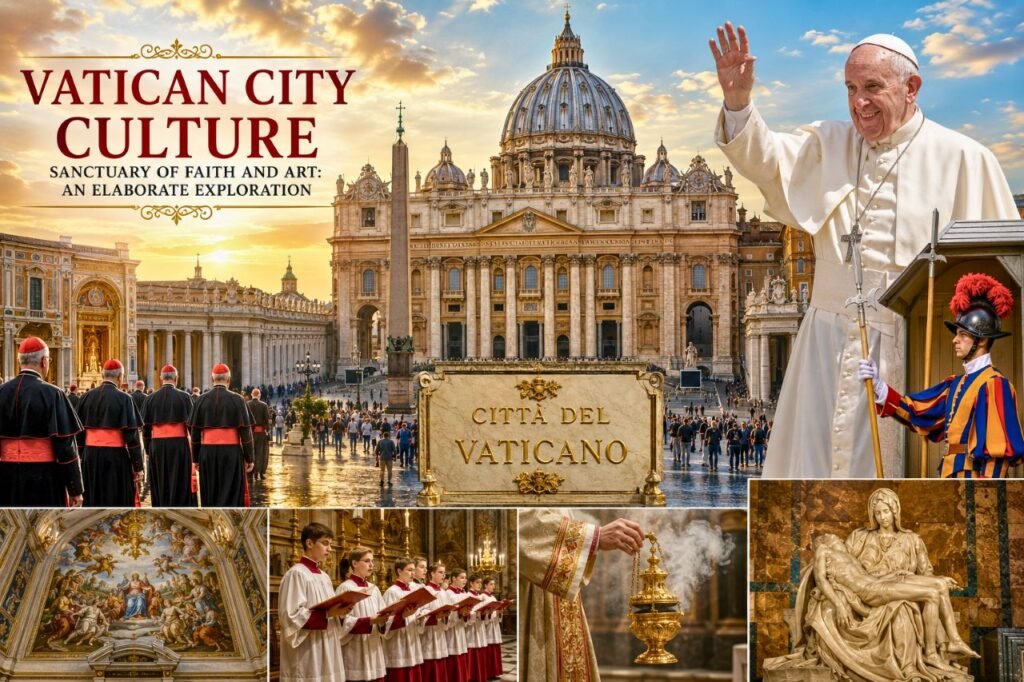
Religious Liturgies & Papal Traditions
Vatican customs revolve around the liturgical calendar of the Catholic Church:
- Papal Masses & Audiences: Tens of thousands of pilgrims gather weekly in St. Peter’s Square for the Wednesday General Audience and the Sunday Angelus blessing delivered by the Pope from his study window.
- Easter & Christmas Liturgies: High solemnities such as Midnight Mass at Christmas and the Urbi et Orbi (“To the City and to the World”) blessing at Easter represent pivotal global moments broadcast worldwide.
- Papal Conclave: Upon the death or resignation of a Pope, the Sacred College of Cardinals gathers in absolute seclusion inside the Sistine Chapel for a Conclave. Ballots are burned in a special stove: black smoke (fumata nera) signals no election, while white smoke (fumata bianca) accompanied by the ringing of St. Peter’s bells announces the election of a new Pope.
Sacramental Customs & Ceremonies
Because Vatican City has no permanent civilian population in the traditional sense, standard rites of passage (marriages, baptisms, and funerals) are performed strictly as religious sacraments:
- Papal Baptisms: Annually on the Feast of the Baptism of the Lord, the Pope baptizes infants—often children of Vatican employees—inside the Sistine Chapel.
- State & Papal Funerals: A reigning Pope’s passing is marked by nine days of official mourning (Novendiali), solemn funeral rites in St. Peter’s Square, and interment in the Vatican Grottoes beneath the basilica.
Languages & Communication
Multilingual Diplomatic Realm
Vatican City operates in a uniquely multilingual administrative environment:
- Italian: The everyday working language, official language of the state government, and primary spoken tongue across departments.
- Latin: The official language of the Holy See (the supreme governing body of the Catholic Church). It is used for solemn papal encyclicals, official decrees, and legal documentation published in the Acta Apostolicae Sedis.
- French: The official diplomatic language used by the Holy See when corresponding with foreign ambassadors and international bodies.
- German: The official command language of the Pontifical Swiss Guard.
Communication Etiquette
Communication in Vatican City is distinguished by formal protocol, deferential titles, and quiet dignity.
- Forms of Address: The Pope is addressed as “Your Holiness” (Sua Santità), Cardinals as “Your Eminence” (Sua Eminenza), and Bishops as “Your Excellency”.
- Key Expressions:
- Pax Vobiscum (Latin for “Peace be with you”)
- Habemus Papam! (“We have a Pope!”—proclaimed from the central balcony of St. Peter’s following a successful conclave)
Geography
Spanning a mere 0.49 square kilometers (approximately 121 acres), Vatican City is the world’s smallest sovereign nation, situated on the Vatican Hill in western Rome.
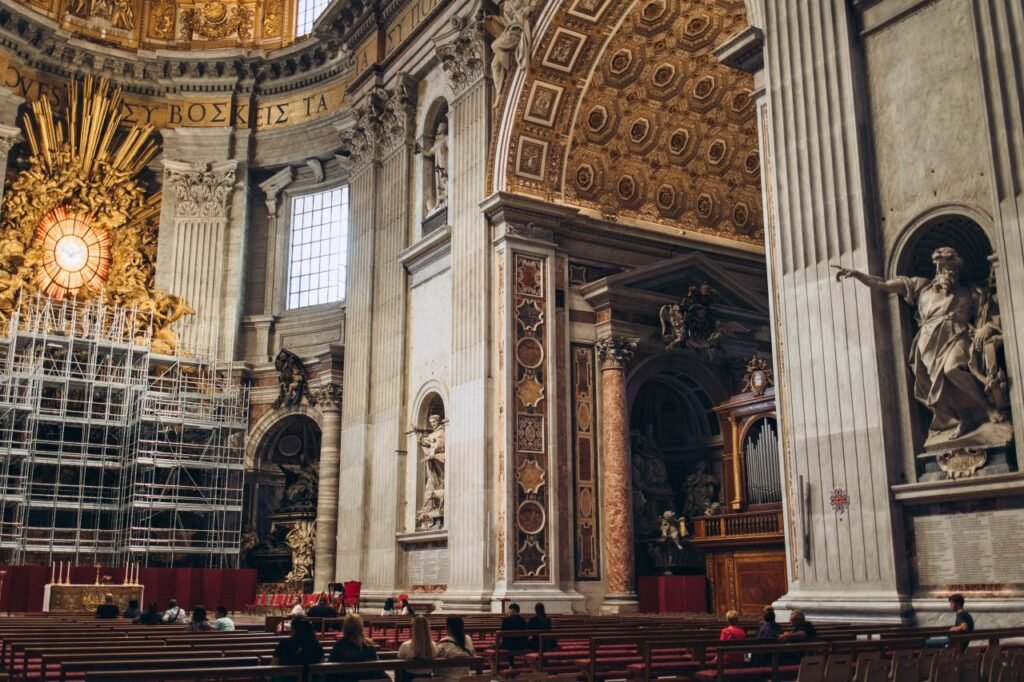
- Enclosed Boundary: The nation is almost entirely enclosed by historic stone medieval and Renaissance defensive walls.
- Key Landmarks: Major physical zones include St. Peter’s Square (Piazza San Pietro), St. Peter’s Basilica, the massive complex of the Vatican Palaces and Museums, and the serene Vatican Gardens (Giardini Vaticani), which cover over half of the enclave’s total land area.
Economy
Vatican City possesses a non-commercial, service-oriented economy structured entirely to support the Holy See’s administration and charitable activities.
Funding comes from four primary sources:
- Museum Ticket Sales & Tourism: Millions of visitors annually purchase tickets to the Vatican Museums and official tour packages.
- Philanthropy & Peter’s Pence: Financial contributions (Peter’s Pence) donated directly by Catholic faithful worldwide to support papal charities and governance.
- Financial Investments & Real Estate: Managed by the Administration of the Patrimony of the Apostolic See (APSA) and the Institute for the Works of Religion (IOR).
- Philatelic & Numismatic Sales: The Vatican issues its own highly collectible postage stamps and commemorative euro coins depicting papal portraits.
Politics
Vatican City is an absolute elective monarchy.
- The Pope: Holds supreme executive, legislative, and judicial power over the state.
- Pontifical Commission for Vatican City State: Legislative authority is delegated on a day-to-day basis to a council of cardinals appointed by the Pope for five-year terms.
- The Holy See vs. Vatican City State: A critical distinction exists in international law—Vatican City is the physical territory, while the Holy See is the sovereign diplomatic entity representing the Catholic Church globally, maintaining full diplomatic relations with over 180 sovereign nations.
Ethnic Groups
Vatican City does not have a native ethnic population. Citizenship is not granted by birth (jus soli) or bloodline (jus sanguinis), but strictly ex officio—granted to individuals based on their employment or official service to the Holy See, and revoked when that service ends.
| Resident Category | Primary National Origins | Primary Role |
| Papal Clergy & Prelates | International (Italy, Europe, Americas, Africa, Asia) | Governance of the Roman Curia and religious services. |
| Pontifical Swiss Guard | Swiss nationals (Catholic males) | Ceremonial honor guard and physical protection of the Pope. |
| Vatican Lay Employees | Italian citizens living nearby | Administrative, technical, security, and restoration staffing. |
Beliefs & Values
Spiritual & Moral Framework
The foundational worldview is 100% Roman Catholic Christianity. Every aspect of public life reflects Catholic doctrine, canon law, and social teachings.
Core Values
- Sanctity of Human Life & Dignity: Universal moral advocacy for peace, social justice, charity, and protection of the vulnerable.
- Stewardship of Heritage: A profound sense of responsibility to preserve two millennia of sacred art, literature, historical archives, and scientific records for future generations.
Food & Cuisine
Because Vatican City has no independent agricultural sector or distinct ethnic culinary style, its food culture is deeply intertwined with regional Roman and Central Italian gastronomy.
- Clerical Dining Rooms & Refectories: Meals inside Vatican residences (like the Domus Sanctae Marthae) feature simple, high-quality Italian fare—fresh pastas, seasonal vegetables, soups, grilled meats, and local wines.
- Classic Roman Staples:
- Cacio e Pepe (Pasta with Pecorino Romano cheese and cracked black pepper)
- Pasta alla Carbonara and Amatriciana
- Minestra di Ceci (Hearty chickpea and vegetable soup enjoyed during Lenten fasts)
- Historical Papal Kitchens: Historically, papal banquets played a key role in European culinary history; famous Renaissance master chefs like Bartolomeo Scappi authored historic cookbooks while serving in papal kitchens.
Clothing & Symbols
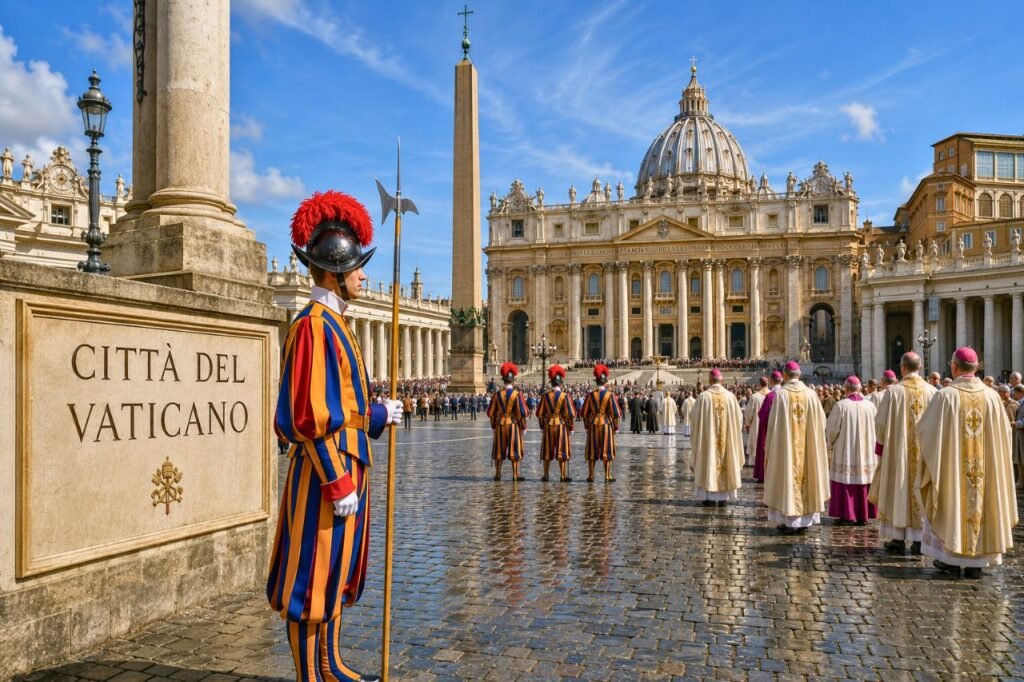
Ecclesiastical Vestments & Official Attire
Clothing in Vatican City carries precise symbolic meaning, color codes, and hierarchy:
- The Pope: Wears a plain white cassock (talare) daily, accessorized with a white zucchetto (skullcap), leather shoes, and a pectoral cross.
- Cardinals & Bishops: Cardinals wear scarlet red cassocks (symbolizing willingness to shed blood for the faith), while Bishops wear amaranth pink/violet accents.
- Pontifical Swiss Guard: Famous for their vibrant gala uniforms featuring blue, red, and yellow stripes—colors associated with the historic Medici family. Designed in the early 20th century, the uniform includes armor, a beret or feathered helmet (morion), and a traditional halberd weapon.
Iconic Symbols
- Keys of Saint Peter: Two crossed keys—one gold (representing spiritual authority) and one silver (representing temporal authority)—bound by a red cord, reflecting the Biblical Gospel of Matthew.
- The Papal Tiara & Mitre: Historically, the three-tiered papal crown (tiara) symbolized papal authority; modern papal coats of arms feature a bishop’s mitre alongside the crossed keys.
Music, Dance & Art
Sacred Music Heritage
Vatican City is a world epicenter for sacred sacred vocal music:
- The Sistine Chapel Choir (Cappella Musicale Pontificia): One of the oldest active choral institutions in the world, renowned for its Renaissance polyphony, including works by Giovanni Pierluigi da Palestrina.
- Liturgical Pipe Organs: St. Peter’s Basilica houses magnificent organ installations used to accompany sacred hymns and classical Masses.
Visual Art & Museums
The Vatican Museums (Musei Vaticani) house one of the greatest collections of art in human history, accumulated over centuries by successive Popes:
- The Sistine Chapel: Features Michelangelo’s world-famous ceiling frescoes (including The Creation of Adam) and his dramatic altar wall fresco, The Last Judgment.
- The Raphael Rooms (Stanze di Raffaello): Four papal reception rooms decorated with Renaissance frescoes by Raphael, including the iconic School of Athens.
- Classical Antiquity: Masterpieces of ancient sculpture, including the Laocoön and His Sons and the Apollo Belvedere.
- Vatican Apostolic Library & Secret Archives: Houses millions of historic manuscripts, papal bulls, and rare incunabula dating back to late antiquity.
Summary
In summary, Vatican City Culture represents a unique intersection of sacred devotion, diplomatic tradition, and unmatched artistic stewardship. Though tiny in geographical size, its commitment to preserving two thousand years of spiritual heritage, Western art, and moral leadership ensures its place as a profound cultural beacon for millions of people around the globe.
At Best Culture Insight, we see culture as the heartbeat of every society – the way people live, connect, and express their identity.