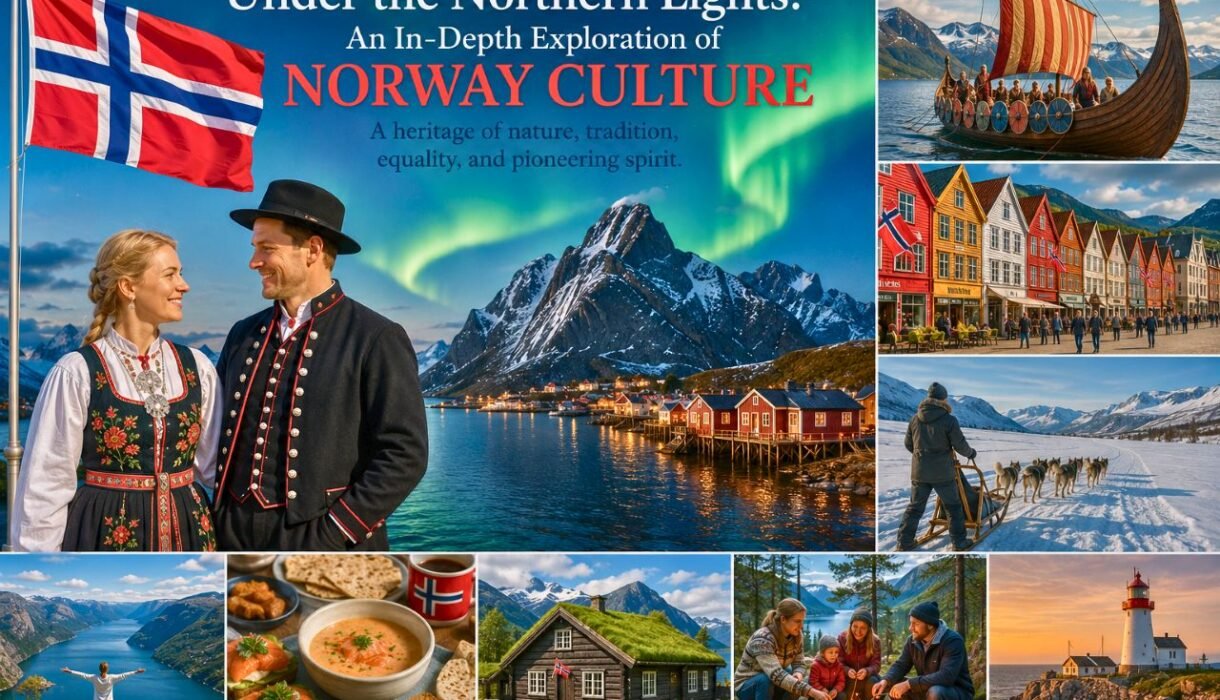

Norway, a majestic jewel of Northern Europe, is globally renowned for its sweeping coastlines, deep-blue fjords, and snow-capped peaks. The fascinating Culture of Norway is profoundly shaped by this extreme, breathtaking landscape and the ancient traditions of those who have carved a life out of it. It is a heritage built on friluftsliv (an innate passion for the outdoors), deep egalitarian principles, and a historical evolution that stretches from fearless Viking explorers to modern, progressive pioneers.
History & Origins
The historical tapestry of Norway has evolved over millennia through distinct, influential epochs:
- The Viking Age (793–1066 AD): Norwegian history is famously rooted in the Viking era. Norwegian seafarers, utilizing advanced shipbuilding, sailed across Europe and reached North America (Leif Erikson). This period was defined by trade, exploration, and a complex polytheistic Norse mythology.
- Christianization and Unification: King Harald Fairhair unified Norway into a single kingdom around 872 AD. By the 11th century, Christianity replaced the old pagan gods, shifting the cultural axis toward mainland Europe.
- The Unions (Denmark and Sweden): Following the black plague, Norway entered the Kalmar Union in 1397. It spent over four centuries under Danish rule (the “400-Year Night”), followed by a union with Sweden starting in 1814.
- Independence and the Oil Era: Norway peacefully dissolved its union with Sweden in 1905, establishing its own modern monarchy. The discovery of North Sea oil in 1969 transformed a historically modest fishing and farming nation into one of the world’s most prosperous, socially progressive societies.
Culture, Traditions & Customs
Key Life Milestones
- Konfirmasjon (Confirmation): A highly significant rite of passage for 15-year-olds. Whether civil or religious, it represents a transition into adulthood, marked by large family gatherings and the gifting of traditional attire or financial foundations.
- Weddings: Traditional Norwegian weddings feature a Kransekake (a ringed almond cake) and often include classical folk music played on the Hardanger fiddle.
Major Festivals and Celebrations
- Syttende Mai (Constitution Day – May 17th): Norway’s national day is unlike most. Instead of military parades, it is celebrated with massive, colorful children’s parades, high school seniors (Russ) celebrating graduation in decorated overalls, and citizens wearing regional folk costumes.
- Midsummer (Sankthansaften): Celebrated on June 23rd, Norwegians gather along beaches and lakeshores to light massive bonfires, celebrating the midnight sun and the peak of summer.
Languages & Communication
Language and Script
The official language is Norwegian, a North Germanic language closely related to Swedish and Danish (so much so that they are mutually intelligible).
Notably, written Norwegian has two official standards:
- Bokmål (Book Tongue): Used by approximately 85-90% of the population, heavily influenced by Danish.
- Nynorsk (New Norwegian): Created in the 19th century by linguist Ivar Aasen, synthesized from regional rural dialects to establish a uniquely Norwegian written voice.
In the northern regions, the indigenous Sami languages hold official status and are actively preserved.
Greetings and Expressions
- “Hei” or “Goddag” are the standard, friendly greetings.
- “Takk” (Thank you) is used constantly; expressing gratitude is a core linguistic and social pillar.
- “Det finnes ikke dårlig vær, bare dårlige klær.”
Meaning: “There is no bad weather, only bad clothing.” This classic proverb perfectly encapsulates the Norwegian outdoor mindset.
Geography
Norway occupies the western and northernmost portions of the Scandinavian Peninsula.
Its geography is famous for its fjords—deep, narrow valleys carved by ancient glaciers and filled with seawater. High mountain plateaus (vidder), pristine forests, and over 50,000 islands characterize the terrain.
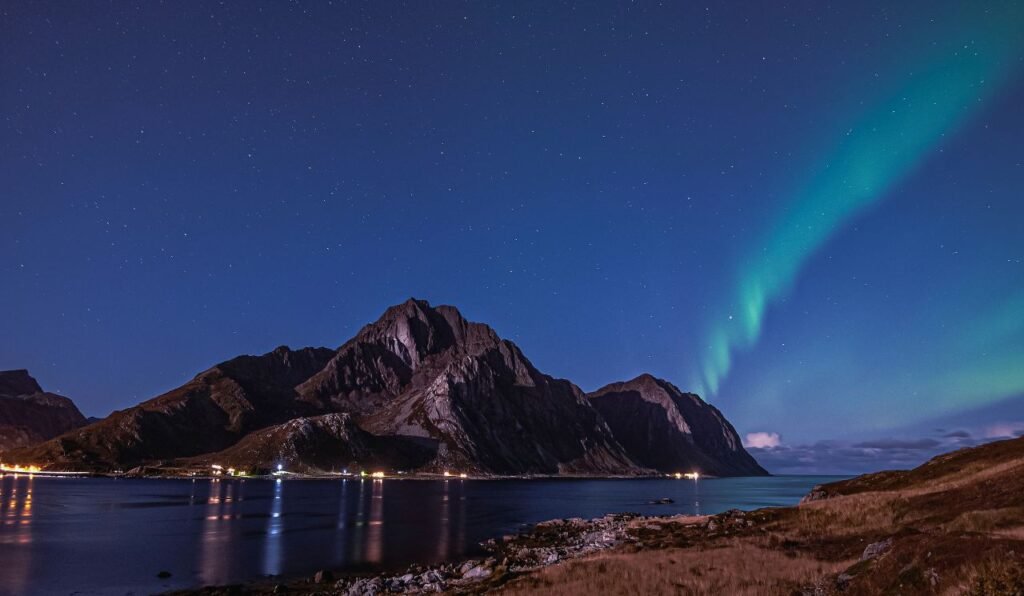
Crucially, Norway sits partially within the Arctic Circle, granting the country the ethereal Midnight Sun in the summer and the mesmerizing Northern Lights (Aurora Borealis) in the dark winter months.
Economy
Norway is a global economic powerhouse powered by a mixed-market economy and a robust state welfare state (the Nordic Model).
- Natural Resources: The nation is a leading exporter of crude oil, natural gas, and hydroelectric power.
- The Sovereign Wealth Fund: Norway responsibly manages its oil wealth through the Government Pension Fund Global—the largest sovereign wealth fund in the world, holding over $1.5 trillion to secure future generations.
- Seafood Industry: As the world’s second-largest exporter of seafood, Norwegian salmon and cod are prized globally.
Politics
Norway is a unitary constitutional monarchy with a parliamentary system.
The King (currently King Harald V) serves as the ceremonial head of state, while the Prime Minister serves as the head of government, exercising executive power.
The parliament, known as the Storting, is elected every four years using proportional representation. Norway consistently ranks at the top of global indexes for democracy, press freedom, and human development.
Ethnic Groups
While historically homogeneous, modern Norway is a multicultural nation.
| Ethnic Group | Cultural Context & Heritage |
| Norwegians | The majority population, possessing Germanic and Nordic cultural roots. |
| Sami People | The indigenous people of northern Scandinavia, with their own languages, reindeer-herding traditions, and parliament (Sámediggi). |
| Immigrant Communities | Making up approximately 15-20% of the population, including diverse communities from Poland, Lithuania, Syria, Somalia, and Iraq. |
Beliefs & Values
Egalitarianism and the Law of Jante
The moral framework of Norway is built on Liklikhet (equality) and mutual respect. This is historically influenced by Janteloven (The Law of Jante), a cultural concept warning against individual vanity, arrogance, or acting superior to one’s peers.
While Norway has a rich Christian heritage through the Church of Norway (Lutheran), modern society is highly secularized, valuing freedom of thought, environmental stewardship, and gender equality.
Food & Cuisine
Traditional Norwegian cuisine, or Husmannskost, relies on preservation techniques (salting, smoking, fermenting) developed to survive the harsh northern winters.
- Fårikål: The national dish, consisting of mutton and cabbage layered with black peppercorns and slow-simmered for hours.
- Brunost: A unique, sweet brown cheese made by boiling down whey, milk, and cream until the milk sugars caramelize. It is sliced thin with an iconic ostehøvel (cheese plane, a Norwegian invention) and eaten on waffles or rye bread.
- Lutefisk & Gravlaks: Aged stockfish treated with lye (Lutefisk) and dry-cured salmon seasoned with dill and salt (Gravlaks) remain holiday staples.
Clothing & Symbols
The Bunad
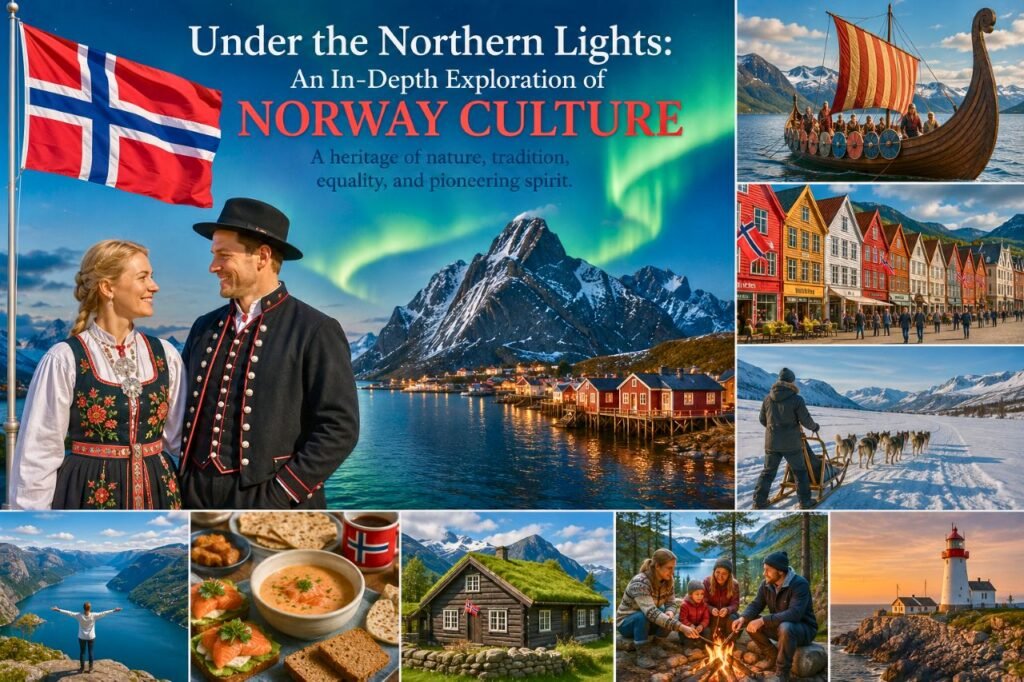
The Bunad is Norway’s cherished traditional folk costume.
- Regional Pride: There are over 200 distinct designs of Bunad, each representing a specific family region or town.
- Design: Made of high-quality wool or silk, they are adorned with elaborate floral embroidery, hand-carved silver buckles, and matching headwear. They are worn with immense pride during weddings, confirmations, and Constitution Day.
Music, Dance & Art
Folk Art and Architecture
- Stave Churches: Medieval wooden churches built without a single metal nail, featuring dragon-headed gables that blend Christian symbolism with pagan Viking artistry.
- Rosemaling: A traditional decorative folk art involving stylized, asymmetrical floral painting on wooden chests, bowls, and interior walls.
Performing Arts
- The Hardanger Fiddle (Hardingfele): Norway’s national instrument, featuring four main strings and four to five sympathetic under-strings that create a haunting, echoing drone.
- Edvard Munch: The world-famous expressionist painter behind The Scream, whose emotionally raw artwork continues to define modern psychological art.
Summary
The culture of Norway is a beautiful balance of ancient heritage and progressive modernity. Deeply tied to the raw elements of nature, Norwegians have cultivated a lifestyle that honors the past while championing social equality, sustainable economics, and the simple joy of outdoor living. Whether through the preservation of the indigenous Sami heritage or the universal pride worn in a regional Bunad, Norway’s cultural diversity remains a brilliant beacon in Europe.
At Best Culture Insight, we see culture as the heartbeat of every society – the way people live, connect, and express their identity.