The Vibrant Soul of Hispaniola: An In-Depth Exploration of Dominican Republic Culture
Posted in :

The Dominican Republic is a land where history breathes through colonial stone, the air carries the rhythmic pulse of bachata, and every meal is a celebration of community. Occupying the eastern two-thirds of the Caribbean island of Hispaniola, this nation stands as a radiant cultural beacon in North America. To truly understand the Dominican Republic is to dive into a centuries-old story of resilience, encounter, and joyful adaptation. – Dominican Republic culture
Introduction: The Spirit of Quisqueya – Dominican Republic Culture
The culture of the Dominican Republic—often affectionately called Quisqueya (the indigenous Taíno name for the island)—is defined by its warmth, vitality, and deep sense of community. The Dominican people are renowned for their infectious hospitality (hospitalidad), greeting neighbors and strangers alike with genuine open arms.
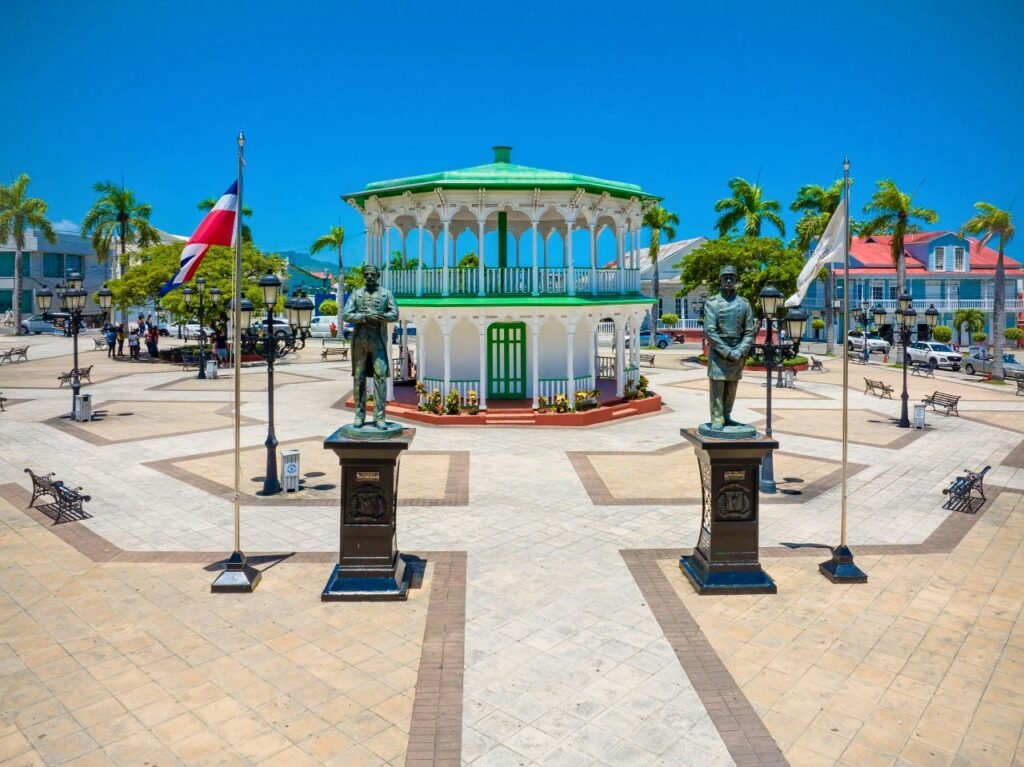
Aerial view of Central Park with statues and gazebo in Puerto Plata, Dominican Republic
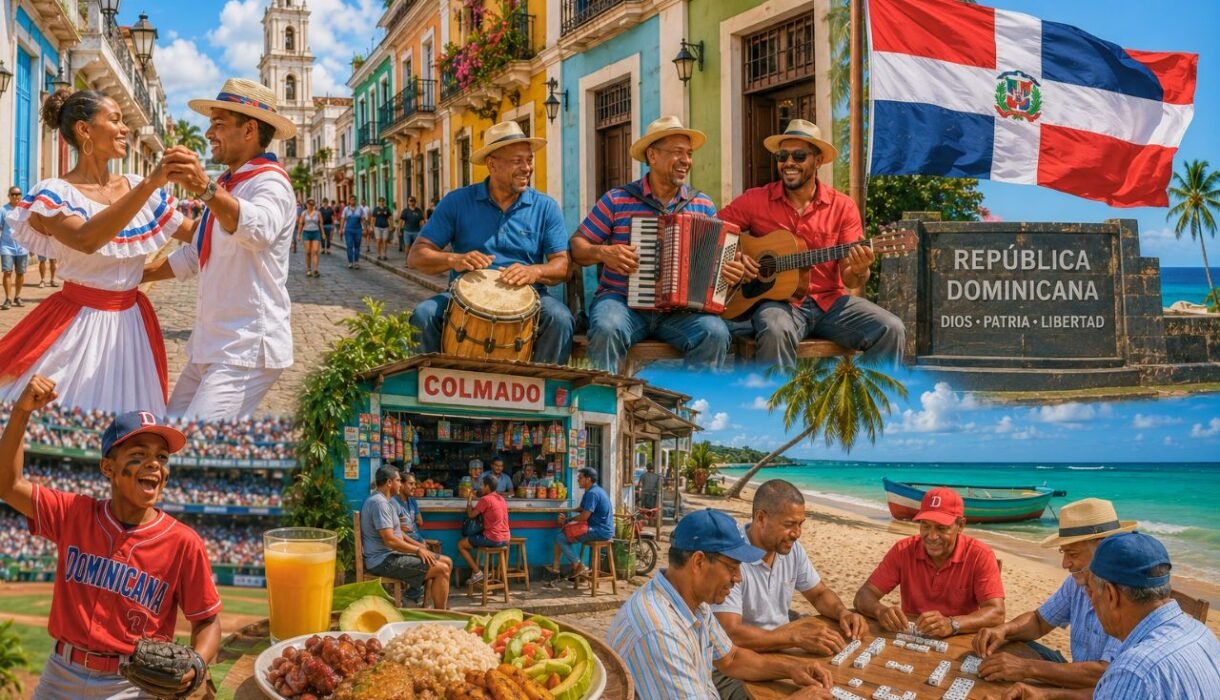
Daily life is lived out loud. From the lively debates over a game of dominoes on a street corner to the impromptu dances outside a local colmado (neighborhood convenience store-turned-social hub), the public square is an extension of the living room. At the core of this vibrant lifestyle is a profound pride in their identity, a passion for baseball, and an unwavering devotion to family.
History & Origins: The Tripartite Fusion
The Dominican identity did not evolve in isolation; it is a profound historical synthesis born from the intersection of three major worlds: the indigenous Taíno, European Spanish colonizers, and West African populations brought over via the transatlantic slave trade.
The Taíno Foundations
Before Christopher Columbus landed on the island in 1492 and named it La Española (Hispaniola), the island was inhabited by the Taíno people, an Arawak-speaking seafaring culture. Though the indigenous population was largely decimated within decades due to forced labor and European diseases, their legacy remains permanently etched in the culture. Words like canoa (canoe), hamaca (hammock), and tabaco (tobacco), along with traditional cassava agricultural practices, trace straight back to Taíno roots.
Spanish Colonialism and African Heritage
Santo Domingo, founded in 1496, became the first permanent European settlement in the Americas, introducing Spanish language, architecture, and Roman Catholicism. Concurrently, the rise of sugar plantations brought a massive influx of enslaved West Africans. They infused the island’s emerging society with complex rhythmic structures, spiritual practices, culinary traditions, and communal values.
Over the centuries, through periods of Spanish neglect, French proximity, a brief Haitian unification (1822–1844), and eventual hard-fought independence in 1844 led by Juan Pablo Duarte, these three distinct currents fused into a unified syncretic society.
Geography: A Diverse Caribbean Matrix
Geographically situated in the Greater Antilles, the Dominican Republic boasts the most diverse topography in the Caribbean.
- The Peaks: It features the highest point in the region, Pico Duarte, rising over $3,000\text{ meters}$ ($10,000\text{ feet}$) above sea level within the Cordillera Central.
- The Lowlands: Conversely, it hosts Lago Enriquillo, a hyper-saline lake that sits over $40\text{ meters}$ below sea level, populated by American crocodiles.
- The Coasts: The country is bordered by the Atlantic Ocean to the north and the Caribbean Sea to the south, ringed by world-famous white-sand coastlines like Punta Cana and Bávaro, while its interior features the fertile Cibao Valley, the nation’s agricultural heartland.
Ethnic Groups: The Mosaic of Identity
The contemporary demographic landscape of the Dominican Republic clearly reflects its history of structural blending. The vast majority of the population—roughly 70% to 75%—identifies as mestizo or indio (terms locally used to describe individuals of mixed European and African lineage). Approximately 15% of the population is of predominant African descent, and roughly 10% is of European descent.
The country has also absorbed historical waves of immigrants, including Middle Eastern lineages (locally called Turcos, mostly Lebanese and Syrian who influenced local commerce and food), Sephardic Jews, East Asian communities, and a significant, continuous labor migration from neighboring Haiti.
Languages & Communication: Melodic Expressions
While Spanish is the official language of the Dominican Republic, Dominican Spanish is a unique, highly melodic dialect shaped by Taíno vocabulary, African speech patterns, and modern coastal idioms.
Linguistic Characteristics
Dominicans are famous for their rapid-fire speech, often dropping final consonants or the letter “s” entirely (e.g., transforming ¿Cómo estás? into ¿Cómo tú tá?). The language is deeply performative, heavily reliant on animated hand gestures, facial expressions, and nose-wrinkling to indicate confusion or directions.
Popular Idioms and Proverbs
- “¿Qué lo qué?” – The ultimate, ubiquitous Dominican greeting, translating roughly to “What’s up?” or “What’s happening?”
- Un chin – A tiny amount of something.
- Guagua – A public bus or shared transport van.
- “Dime a ver” – Literally “Tell me so I can see,” used as a casual greeting meaning “Tell me what’s going on.”
- “Más vale maña que fuerza” – A popular proverb meaning “Skill is worth more than brute strength.”
Beliefs & Values: Faith and Family First
The moral fabric of Dominican society is built on two primary pillars: deep-seated religious faith and fierce family loyalty.
Religion and Folk Spirituality
An estimated 50% to 60% of the population identifies as Roman Catholic, though Evangelical Protestantism has seen explosive growth over recent decades. Religious devotion is deeply woven into national iconography; the Dominican flag is the only national flag in the world to feature a Holy Bible open at the center of its coat of arms.
Beyond institutional religion, many Dominicans practice folk spiritual traditions like 21 Divisiones (Dominican Vudú), a syncretic belief system that mirrors Catholicism by masking African spirits (loas) behind Catholic saints. Major religious pilgrimages occur on January 21st to honor the Virgin of Altagracia, the spiritual protector of the nation.
Core Values
The family unit is multigenerational and strictly interdependent. The concept of personalismo dictates that personal, face-to-face relationships take precedence over formal, cold business contracts. Respect for elders (respeto) is non-negotiable, and social status is tightly bound to how well one fulfills obligations to their extended kin.
Culture, Traditions & Customs: Rites of Passage
Dominican life is structured around milestone celebrations, blending solemn religious devotion with high-energy social gatherings.
Marriage and Family Celebrations
Weddings are massive, festive affairs. Rather than being restricted to the bride and groom’s immediate circle, weddings function as community-wide events. A unique custom includes the Arras ceremony, where the groom gives the bride 13 gold coins symbolizing his commitment to provide for the household and their shared stewardship of wealth.
Quinceañera
The Fiesta de Quince años (or Quinceañera) is a vital rite of passage for 15-year-old girls. It marks the transition from childhood to womanhood. The celebration begins with a religious mass, followed by a lavish reception where the young woman dances a formal waltz with her father and shifts from wearing flat shoes to high heels, symbolizing her maturity.
Carnival (El Carnaval)
The Dominican Carnival is the oldest in the Americas, peaking every Sunday throughout the month of February to culminate around Independence Day (February 27th).
Each region features iconic archetypal characters:
- La Vega: Famous for the Diablos Cojuelos (Limping Devils), characters wearing intricate papier-mâché masks with frightening horns and carrying inflated animal bladders (vejigas) to playfully strike onlookers.
- Santiago: Features the Lechones, pig-masked characters who act as structural guardians of the parade.
Food & Cuisine: The Caribbean Kitchen
Dominican cuisine, known as Comida Criolla, is a savory, comfort-driven culinary art form that relies heavily on sofrito—a sautéed base of garlic, onions, bell peppers, tomato paste, and wild Dominican oregano.
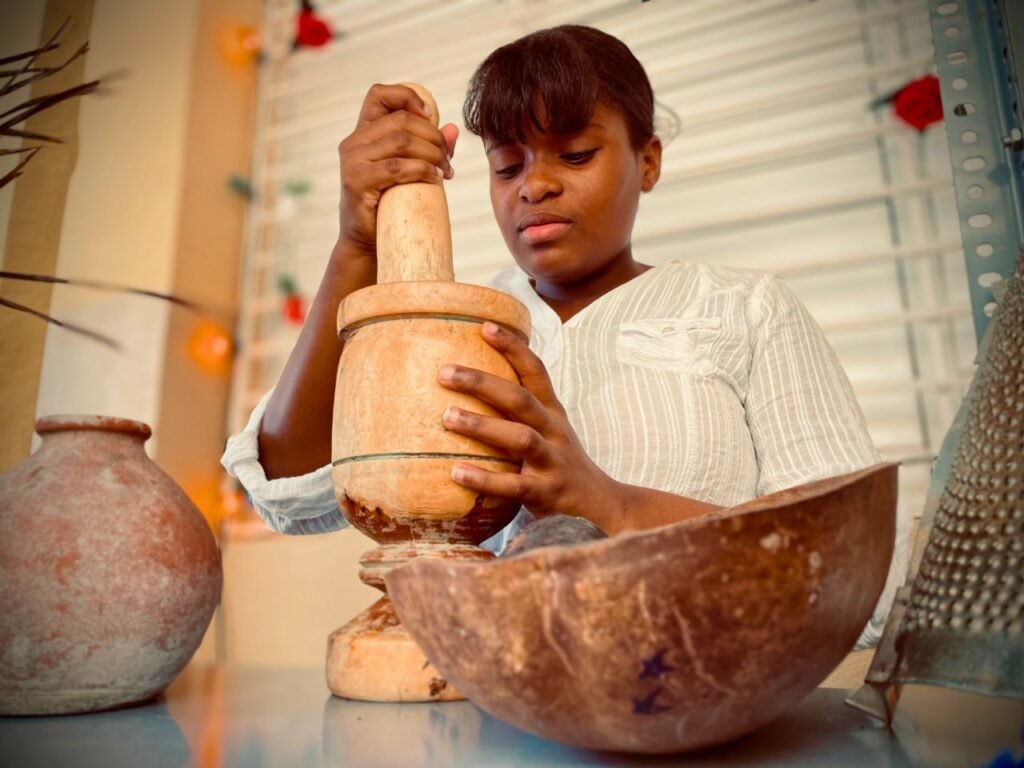
Signature Dishes
- La Bandera Dominicana (The Dominican Flag): The absolute cornerstone of daily life. Eaten almost every single day for lunch, this comforting plate consists of a clean mountain of white rice (arroz blanco), stewed red or black beans (habichuelas guisadas), and seasoned meat (usually chicken or beef), often paired with a side of crispy tostones (twice-fried green plantain wheels).
- Mangú: The undisputed king of Dominican breakfasts. It consists of boiled green plantains thoroughly mashed with butter and cooking water, topped with vinegar-pickled red onions. It is traditionally served alongside Los Tres Golpes (The Three Hits): fried Dominican salami, fried white cheese, and fried eggs.
- Sancocho: A thick, celebratory meat stew reserved for rainy days, family reunions, and New Year’s Eve. The ultimate version, Sancocho de Siete Carnes, simmeringly combines seven varieties of meat (including chicken, pork, beef, and goat) with root vegetables like yuca, yautía, and auyama (pumpkin).
Cultural Drinks
No meal is complete without a Morir Soñando (literally “To Die Dreaming”), a refreshing, creamy beverage made by expertly mixing fresh orange juice, evaporated milk, sugar, and crushed ice without letting the acid curdle the milk. For adults, the country boasts world-class dark rums (like Brugal, Barceló, and Bermúdez) and ice-cold Presidente beer.
Clothing & Symbols: Threads of Pride
While modern Dominicans dress in contemporary Western clothing, traditional attire is proudly worn during national holidays, carnival, and folkloric dance showcases.
Traditional Attire
The traditional women’s garment is the Traje Folclórico, characterized by full, sweeping skirts layered with ruffles, typically rendered in the vibrant red, white, and blue of the national flag. This outfit is frequently paired with a matching headscarf wrap, nodding to African dress styles.
Men wear the Guayabera, a lightweight, structured cotton or linen dress shirt featuring vertical rows of pleats and functional pockets, perfectly adapted to maintain an elegant profile in the tropical heat.
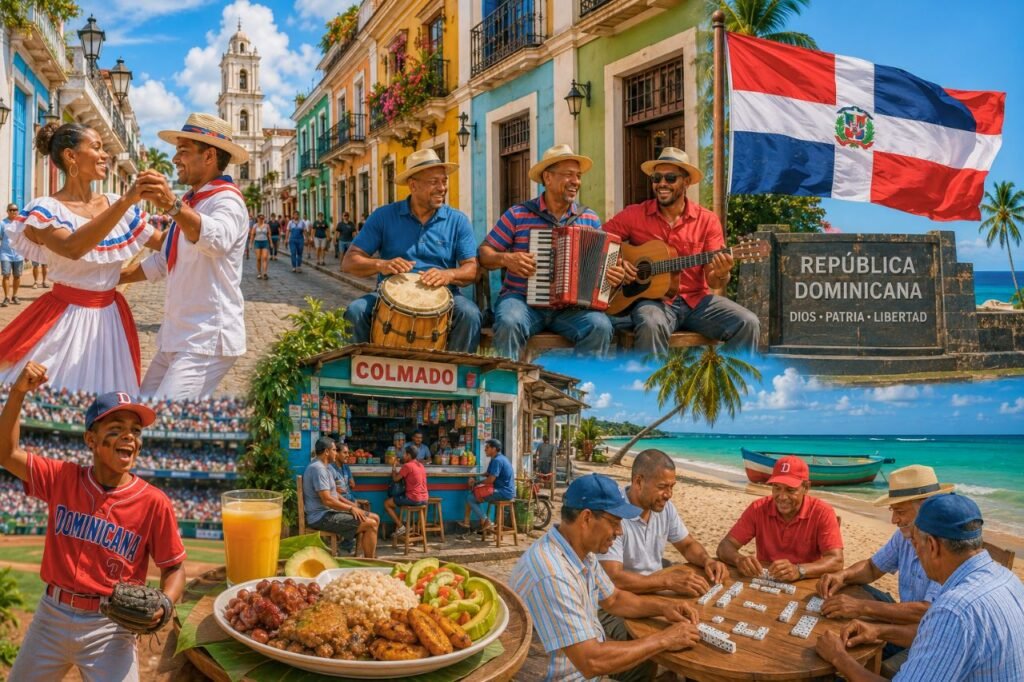
Dominican Republic vibrancy and culture
National Symbols
- The Flag: Features a central white cross extending to the edges, dividing the flag into alternating quarters of ultramarine blue (symbolizing liberty) and vermilion red (symbolizing the blood of heroes).
- Larimar: A stunning, rare turquoise-blue pectolite volcanic stone found exclusively in the mountainous province of Barahona, representing the surrounding Caribbean sea.
- The Mahogany Flower (Flor de la Caoba): The official national flower, symbolizing resilience and structural beauty.
Music, Dance & Art: The Rhythmic Pulse
Music is the absolute lifeblood of the Dominican Republic; it is practically impossible to walk through a Dominican town without hearing melodies spilling from windows, passing cars, and open-air storefronts.
Merengue: The National Dance
Recognized by UNESCO as an Intangible Cultural Heritage of Humanity, Merengue is a fast-paced, high-energy dance tracking a structural $2/4$ beat. Originating in the rural Cibao region in the 19th century, a traditional perico ripiao (folk merengue) ensemble features three core instruments that represent the country’s triple heritage:
- The Accordion: Representing European musical styles.
- The Tambora: A two-headed wooden drum held on the lap, representing African rhythm structures.
- The Güira: A metallic percussion scraper, descending straight from indigenous Taíno scraping instruments.
Bachata: From Marginalization to Global Stage
Also protected by UNESCO, Bachata emerged from rural barrooms and brothels in the mid-20th century as a melancholic, guitar-driven style focused on heartbreak, love, and sorrow (amargue). Driven by intricate, plucking nylon-stringed acoustic guitars and an instantly recognizable syncopated bongo beat, bachata evolved from a marginalized folk style into a massive global dance phenomenon.
Visual Arts
In the realm of visual arts, Dominican painting is known for its bold expressionism and vivid color palettes. Master artists like Cándido Bidó and Yoryi Morel captured the essence of the country’s sun-drenched landscapes, local markets, and Afro-Caribbean facial structures, immortalizing the daily dignity of everyday Dominican life.
Economy & Politics: The Modern Framework
Understanding the modern infrastructure provides crucial context to how this culture thrives today.

Political System
The Dominican Republic operates as a stable presidential representative democratic republic. The government is divided into three distinct branches: executive (led by the President), legislative (a bicameral National Congress composed of the Senate and the Chamber of Deputies), and judicial. The political landscape is highly active, with elections sparking passionate neighborhood campaigning, flags hanging from balconies, and lively public debates.
Economic Pillars
Historically dependent on agricultural exports like sugar, tobacco, coffee, and cacao, the country has successfully transitioned into the largest economy in the Caribbean and Central American region. Today, the economy is driven by:
- Tourism: Welcoming millions of travelers annually to its luxury coastal resorts.
- Free Trade Zones (Zonas Francas): Manufacturing medical devices, electronics, and textiles.
- Remittances: Billions of dollars sent home annually by the dedicated Dominican diaspora living in the United States and Europe, directly fueling local real estate development and family businesses.
Summary
The culture of the Dominican Republic is a brilliant testament to the beauty of cultural synthesis. From the indigenous Taíno roots to the profound contributions of Spanish settlers and African souls, this nation has forged a distinctive identity that radiates warmth, creativity, and resilience. Whether through the delicious communal experience of sharing a Sancocho, the passionate cheers at a winter league baseball game, or the unifying, hip-swiveling joy of a merengue track, the Dominican Republic continues to preserve its heritage while inviting the global community to dance along with its rhythm.
At Best Culture Insight, we see culture as the heartbeat of every society – the way people live, connect, and express their identity.