The Living Heart of the Nature Island: A Deep Dive into Dominica Culture
Posted in :

Dominica stands out as a sanctuary of raw natural beauty and deep-rooted heritage. Known officially as the Commonwealth of Dominica, this hidden gem is often affectionately dubbed the “Nature Island of the Caribbean.” It should not be confused with the Dominican Republic; Dominica is a distinct island nation located in the Windward region of the Lesser Antilles in North America. – Dominica Culture
What makes Dominica truly extraordinary is its human landscape. It is a vibrant, resilient, and beautifully complex synthesis of West African roots, Indigenous Kalinago traditions, and historical European influences. This deep dive explores the customs, history, and daily rhythms that define Dominica’s unique identity.
Introduction
The culture of Dominica is a direct reflection of its geography and its people. Home to roughly 65,500 residents, Dominicans (locally pronounced Dom-in-EE-kans) possess a lifestyle shaped by the island’s rugged mountains, lush rainforests, and rushing rivers. This close relationship with the land has fostered a community that is deeply grounded, highly resourceful, and fiercely independent.
At its core, Dominican culture is defined by warmth, an unhurried approach to daily life, and a profound respect for communal solidarity. It is an identity forged from survival and adaptation. West African traditions brought over during the colonial era form the robust bedrock of modern society, seamlessly blending with the enduring heritage of the region’s last remaining pre-Columbian population.
History & Origins
The historical evolution of Dominica is a fascinating narrative of resistance and cultural convergence. Long before European sails appeared on the horizon, the island was known as Wai‘tukubuli (“Tall is her body”) by the Indigenous Kalinago people, who migrated to the island from South America.

A breathtaking view of rugged cliffs and blue ocean under a sunny sky.
When Christopher Columbus sighted the island on a Sunday in 1493, he named it Dominica (Sunday in Latin). However, the island’s steep, unforgiving terrain and the fierce resistance of the Kalinago warriors prevented immediate European colonization. For over two centuries, Dominica served as a rugged refuge for Indigenous populations and Africans escaping enslavement on neighboring islands.
[Kalinago Era: Wai’tukubuli] ➔ [1493: European Contact] ➔ [1700s: Anglo-French Conflict] ➔ [1838: Liberation] ➔ [1978: Independence]
During the 18th century, Great Britain and France engaged in a bitter tug-of-war for control of the island. While Britain ultimately secured official colonial rule, the French left an indelible imprint on the local language, culinary traditions, and religious landscape.
The turning point for modern Dominican culture occurred following the abolition of slavery in 1834. In 1838, Dominica became the unique British Caribbean colony to establish a Black-controlled legislature. This early political empowerment allowed African traditions to safely surface, adapt, and evolve into the dominant, vibrant cultural identity celebrated across the island today. Dominica achieved full political independence on November 3, 1978.
Culture, Traditions & Customs
Dominican life is anchored by distinct milestones, lively expressions, and community-driven traditions that honor both the past and the present.
Rites of Passage & Family Life
- Birth & Naming Customs: Deeply influenced by Christian and West African traditions, newborns are typically baptized or christened within the first few months of life. A common informal custom is the use of “pet names” or colorful descriptive nicknames within the village, which often stay with a person well into adulthood alongside their official legal name.
- Marriage: Weddings are major community celebrations. Traditional church ceremonies are followed by large receptions featuring an abundance of local foods, punch, and hours of traditional dancing.
Festivals & Celebrations
Dominica’s festive calendar is highly dynamic, anchored by two massive national celebrations:
- Mas Domnik (The Real Mas): Held annually before Ash Wednesday, Dominica’s Carnival is celebrated as one of the most authentic in the Caribbean. Unlike commercialized celebrations elsewhere, Mas Domnik honors historical heritage. It features traditional carnival characters like the Sensay—costumes made from frayed sisal ropes, cow horns, and masks—alongside the infectious rhythms of lapo kabwit bands.
- Independence Celebrations: Spanning from September to November, this season is a powerful showcase of traditional national pride. It culminates on Independence Day (November 3) and National Creole Day (Jounen Kweyol), during which the entire island dresses in traditional attire, speaks the Creole language, and feasts on local delicacies.
Languages & Communication
While English is the official language used in government, education, and formal media, the linguistic soul of Dominica is found in Dominican Creole (known locally as Kwéyòl or Patois).
Kwéyòl is a French-based creole enriched with a West African syntax and vocabulary loans from the Indigenous Kalinago language. It is a living monument to the island’s diverse history.
Everyday Greetings
- Bonswa — Good evening / Good afternoon
- Banjou — Good morning
- Sa ka fete? — What’s happening? / How are you?
- Mwen byen, mèsi — I am well, thank you.
Proverbs & Expressions
Dominican proverbs are practical, witty, and deeply tied to rural island life:
“Piti piti zwazo ka fè nich li.”
Literal Translation: Little by little the bird builds its nest.
Cultural Meaning: Patience, steady effort, and perseverance lead to success.
“Dlo pa ka kouri moute mòn.”
Literal Translation: Water does not run up a hill.
Cultural Meaning: You cannot fight the natural order of things or undeniable truths.
Geography
Dominica is a geologically young, volcanic island spanning approximately 750 square kilometers (290 square miles). Its landscape features jagged mountain peaks, dense virgin rainforests, and an intricate network of 365 rivers.
[ Morne Diablotins: 1,447m Peak ]
/\
/ \ ➔ [ Dense Rainforest Canopy ]
/ \
____________/ \____________
[ Boiling Lake ] [ 365 Rivers & Coastline ]
The island is home to Morne Diablotins, an impressive volcanic peak reaching 1,447 meters, and the famous Boiling Lake, the second-largest flooded fumarole (hot spring) in the world. This dramatic terrain historically insulated Dominica from extensive plantation agricultural systems, helping to preserve both its pristine natural ecosystems and its unique indigenous and maroon cultural pockets.
Economy
Historically heavily reliant on banana cultivation, Dominica’s economy has steadily shifted toward diversification in response to volatile global markets and climate challenges. Today, the economic framework focuses on three main sectors:
| Sector | Primary Focus & Components |
| Eco-Tourism | Scuba diving, hiking (Waitukubuli National Trail), and sustainable wellness resorts. |
| Agriculture | Smallholder farming exporting citrus fruits, root crops, coconuts, and herbal oils. |
| Citizenship by Investment | Public funds utilized to construct resilient infrastructure and sustainable energy projects. |
The nation is also actively investing in geothermal energy development, aiming to leverage its volcanic geology to become entirely self-sufficient in green energy production.
Politics
Dominica is a democratic parliamentary republic. The head of state is the President, while executive authority is held by the Prime Minister, who leads the cabinet.
The legislature is a unicameral House of Assembly consisting of elected representatives and appointed senators. Dominica maintains a legal system based on English Common Law, alongside an independent judiciary. The country holds an influential role within regional bodies, including the Organization of Eastern Caribbean States (OECS) and the Caribbean Community (CARICOM).
Ethnic Groups
The demographic profile of Dominica reflects its complex colonial and pre-colonial history:
- African Descent (approx. 84.5%): The vast majority of the population, descended from enslaved West Africans brought to the island during the 18th century.
- Mixed Heritage (approx. 9%): Reflecting generations of rich multi-ethnic integration.
- The Kalinago (approx. 4%): Dominica is home to the largest remaining population of Indigenous Kalinago people in the Caribbean. They reside primarily within the Kalinago Territory, a collectively owned 3,700-acre territory on the rugged Atlantic coast established in 1903. This territory preserves ancestral crafts, canoe-building techniques, and traditional herbal medicine practices.
Beliefs & Values
Dominica is a deeply spiritual society where faith and everyday life are closely intertwined.
Religion & Spirituality
- Christianity: The overwhelming majority of Dominicans identify as Christian, with Roman Catholicism comprising over 50% of the population, complemented by active Protestant denominations.
- Rastafarianism: A distinct minority practices Rastafarianism, bringing significant influence to the island’s music, eco-conscious philosophy, and agricultural practices.
- Folk Beliefs: Traditional elements of West African spirituality, such as Obeah and a deep-seated belief in ancestral spirits, subtly persist alongside orthodox Christian worship.
Core Values
Dominican worldview places an immense value on Koudmèn (Creole for “helper’s hand”). This foundational cultural practice involves the community volunteering together to complete large tasks, such as clearing a neighbor’s agricultural land, raising a roof, or preparing for severe weather events. It forms a powerful social safety net built on mutual trust and collaboration.
Food & Cuisine
Dominican cuisine is an appetizing celebration of fresh, locally grown ingredients, utilizing a farm-to-table approach long before it became a global trend. The island’s volcanic soil yields an abundance of provisions, including yams, dasheen, tania, and sweet potatoes.
Signature Traditional Dishes
- Callaloo: Considered the definitive national dish, this comforting, creamy soup is crafted from young dasheen leaves, fresh vegetables, coconut milk, local herbs, and spices, often enhanced with crab meat or smoked meats.
- Mountain Chicken (Crapaud): Historically celebrated as a national culinary staple, this dish features a large native frog (Leptodactylus fallax). Due to severe ecological declines caused by a fungal disease, the species is now critically protected, and the dish is rarely consumed today, serving instead as a nostalgic culinary symbol.
- Souse: A seasoned, cold broth featuring pickled pig ears, feet, or tongue, heavily infused with lime juice, cucumber, hot peppers, and fresh parsley.
Cooking Methods & Cultural Meaning
Traditional cooking frequently utilizes iron pots over open “three-stone” wood fires, which infuses stews and bakes with a distinct, rich smoky flavor. Food in Dominica is deeply tied to hospitality and community; preparing a large pot of soup or roasting breadfruit on a Sunday is an invitation for extended family and neighbors to gather, connect, and share a meal.
Clothing & Symbols
Traditional Dominican attire is a vibrant visual celebration of historical heritage, proudly worn during national festivals and official cultural events.
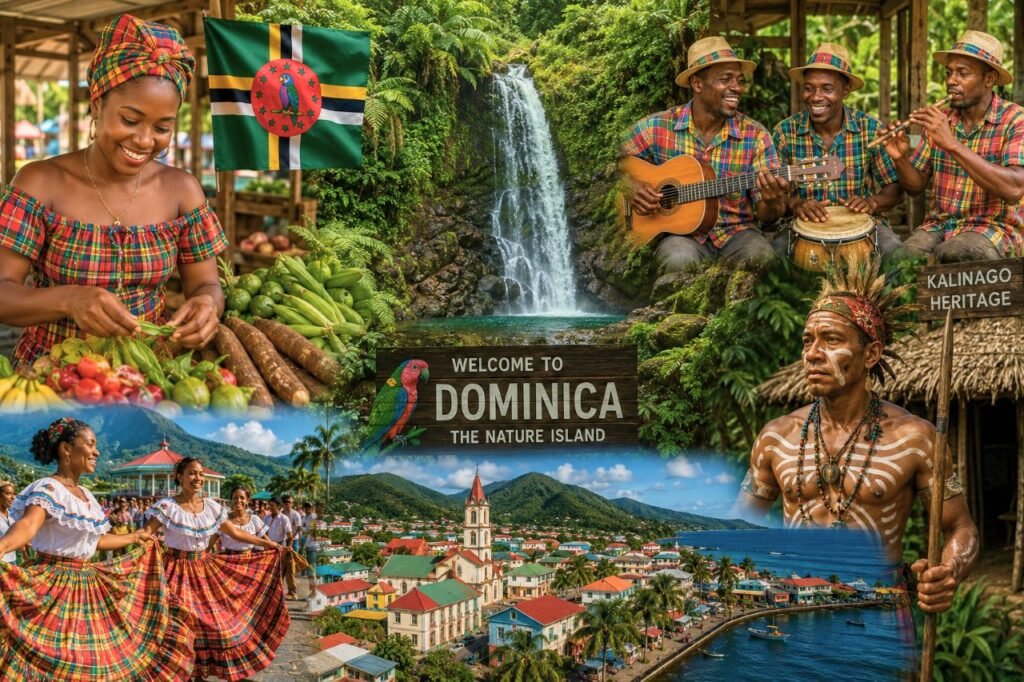
Welcome to Dominica’s vibrant culture.
The National Dress
1.The Wob Dwiyan (Robé Créole):Women’s Traditional Attire.
An elegant, layered dress featuring a bright, striking plaid cotton fabric known as madras. The outfit is paired with a starched white cotton petticoat trimmed with delicate lace.
2.The Jip:Alternative Festival Dress.
A lighter, simplified variant featuring a white blouse, a brilliant madras skirt, and a colorful satin foulard pinned elegantly to the shoulder.
3.The Tête Kassé:The Iconic Headpiece.
The traditional madras headtie is folded with specific, artistic points. Historically, the number of peaks carried a subtle social message regarding the wearer’s availability: one peak indicated single status, while multiple peaks showed the wearer was married or spoken for.
National Symbols
- The Sisserou Parrot (Amazona imperialis): Proudly displayed on the national flag, this rare, magnificent purple-and-green parrot is endemic strictly to Dominica’s mountain rainforests. It serves as an enduring symbol of flight, freedom, and national resilience.
- The Carib Wood (Poitea carinalis): The island’s official national flower, noted for its bright, clusters of scarlet blooms.
Music, Dance & Art
The artistic expressions of Dominica are rhythmically complex, highly infectious, and visually expressive.
Rhythm & Dance Traditions
- Jing Ping: Dominica’s iconic traditional folk music. A lively Jing Ping band features a boom pipe (a long bamboo acoustic bass), an accordion, a tambou (a goatskin drum), and a syyak (a metal scraper). It drives traditional dances like the Quadrille and the Heel-and-Toe.
[ Boom Pipe ] + [ Accordion ] + [ Tambou ] + [ Syyak ] = Jing Ping Rhythm
- Cadence-lypso: Pioneered in the 1970s by the legendary local band Exile One, this style combined Haitian compas with calypso music, creating a smooth, danceable genre that became a massive international movement across the French Antilles and Africa.
- Bouyon Music: Originating in the late 1980s, this modern genre blends traditional Jing Ping rhythms, digital speed, and energetic dancehall beats. It represents the pulse of Dominica’s contemporary youth culture.
Visual Art & Traditional Crafts
Dominica’s visual arts are deeply inspired by its natural environment, featuring landscape paintings and woodwork crafted from local mahogany and red cedar. The Kalinago people maintain an internationally renowned tradition of weaving intricate, waterproof baskets, containers, and mats using the larouma reed. These beautiful pieces utilize natural dyeing techniques that have been passed down intact through generations.
Summary
The culture of Dominica is a masterful celebration of diversity, resilience, and natural harmony. It is a society that has successfully preserved its Indigenous Kalinago roots, embraced its West African foundations, and navigated its complex European colonial history to form a unified, proud, and distinctive identity.
From the energetic rhythms of Jing Ping and the expressive cadence of the Kwéyòl language to the shared community practice of Koudmèn, Dominica proves that true cultural wealth lies in preserving tradition, honoring diversity, and maintaining a profound connection to the land.
At Best Culture Insight, we see culture as the heartbeat of every society – the way people live, connect, and express their identity.