Perched on the edge of the Iberian Peninsula, where the European continent yields to the vast Atlantic Ocean, lies a nation defined by its profound connection to the sea, history, and land. Portugal Culture is a rich tapestry woven from centuries of maritime exploration, deeply rooted traditions, and an enduring artistic spirit. The Portuguese people are renowned for their warm hospitality, gentle demeanor, and a unique national emotional state known as saudade—a bittersweet longing for a person, place, or time that is lost. This complex blend of melancholy and profound joy shapes the everyday life of its citizens, producing a society that treasures old-world family values while moving forward as a progressive European state.
History & Origins
The historical foundations of Portugal are ancient and diverse. Long before it became a unified state, the territory was inhabited by Celtic and Iberian tribes (collectively known as the Lusitanians). By the 2nd century BCE, the Roman Empire conquered the region, integrating “Lusitania” into its vast network, establishing structural infrastructure, and introducing Latin—the linguistic ancestor of the Portuguese language.
Following the collapse of Rome, Germanic tribes migrated through the area, but the next major cultural shift occurred in 711 CE with the Moorish invasion. For centuries, Islamic rule influenced the southern regions (especially the Algarve), leaving indelible marks on architecture, agriculture, and vocabulary.
The definitive birth of Portugal as an independent nation occurred during the Reconquista. In 1139, Afonso Henriques declared himself King of Portugal, making it one of the oldest nation-states in Europe with virtually unchanged borders since the 13th century.
The 15th and 16th centuries marked the golden “Age of Discovery.” Led by visionary explorers like Vasco da Gama and Ferdinand Magellan, Portuguese caravels charted unknown waters, creating a global empire that spanned South America (Brazil), Africa (Angola, Mozambique), and Asia (Goa, Macau). This era brought immense wealth, global perspectives, and multi-ethnic exchanges that permanently reshaped the cultural identity of the homeland.
Culture, Traditions & Customs
Marriage & Family Life
Family is the cornerstone of Portuguese society. Traditional marriages are highly respected milestones, historically heavily tied to Roman Catholic traditions. Wedding celebrations are typically large, lively affairs involving extended family networks and neighborhoods, featuring massive feasts that stretch late into the night. It is customary for the groom to walk to the church with his mother, and the bride with her father, followed by a celebratory showering of rice or flower petals upon exit.
Naming Ceremonies
In accordance with traditional customs, naming a newborn child follows strict legal guidelines governed by the state to preserve linguistic heritage. Parents typically choose from a registry of approved traditional names, often honoring grandparents or Catholic saints. Baptism remains an essential religious and cultural rite of passage, welcoming the infant into both the spiritual community and the extended family structure.
Festivals & Celebrations
Portugal is a country of vibrant, localized street celebrations known as Festas or Romarias. The most famous are the Santos Populares (Popular Saints festivals) in June:
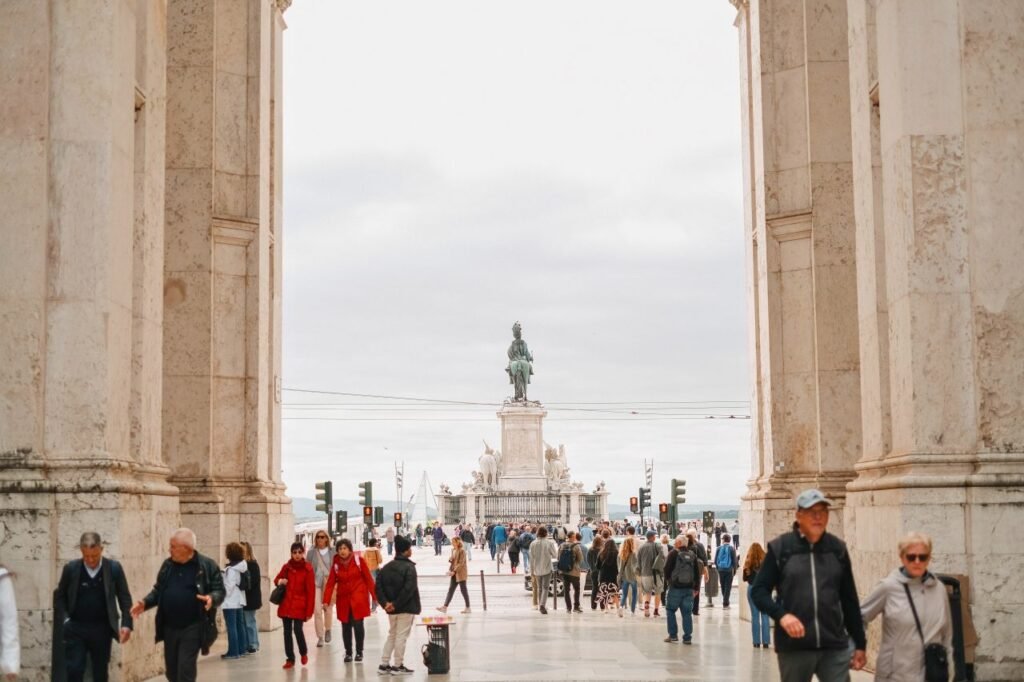
- Festa de Santo António (Lisbon): The capital comes alive on the night of June 12th with colorful street parades (marchas populares), the smell of grilled sardines, and the custom of presenting a pot of aromatic bush basil (manjerico) along with a love poem to a romantic partner.
- Festa de São João (Porto): Celebrated on June 23rd, locals hit the streets of Porto hitting each other with soft plastic hammers, launching illuminated paper lanterns into the sky, and enjoying concerts along the Douro River.
Rites of Passage
Aside from holy sacraments like Confirmation and First Communion, major life milestones include academic rites of passage. The Queima das Fitas (Burning of the Ribbons) is a major week-long university festival celebrated by graduating students across the country, most famously in Coimbra, featuring traditional student attire, parades, and serenades.
Languages & Communication
Language Spoken
Portuguese is the official language. It is a Romance language spoken by over 250 million people worldwide, making it one of the most widely spoken languages in the Southern Hemisphere. Mirandese is also officially recognized as a co-official regional language in a small northeastern pocket of the country.
Greetings & Etiquette
Communication in Portugal is polite, warm, and respectful.
- Formalities: When greeting acquaintances, men typically shake hands firmly, while women greet each other with two kisses (dois beijinhos), starting from the right cheek.
- Common Phrases:
- Bom dia (Good morning)
- Boa tarde (Good afternoon)
- Boa noite (Good evening/night)
- Obrigado (Said by men) / Obrigada (Said by women) for “Thank you.”
Proverbs & Expressions
Portuguese expressions reflect the country’s maritime history and worldview:
- “Quem não arrisca, não petisca” (He who doesn’t risk, doesn’t get a snack)—equivalent to “nothing ventured, nothing gained.”
- “Ter muita lata” (To have a lot of tin)—meaning to have a lot of nerve or face.
Geography
Located on the southwestern tip of Europe, Portugal shares its entire land border with Spain to the north and east, while facing the Atlantic Ocean to the south and west. The country is split geographically by its longest river, the Tagus (Tejo). The northern region is mountainous, rainy, and lush, marked by terraced vineyards like those in the Douro Valley. The southern region, dominated by the rolling plains of the Alentejo and the dramatic cliffs of the Algarve, features a dry, Mediterranean climate.
Portugal also encompasses two volcanic archipelagos in the Atlantic Ocean: Madeira and the Azores, both characterized by unique, dramatic microclimates, thermal springs, and exotic flora.
Economy
Historically reliant on agriculture, fishing, and textile manufacturing, Portugal has successfully modernized into a service-oriented economy. As a member of the European Union and the Eurozone, its modern economic pillars include:
- Tourism: Renowned globally for its beaches, historic landmarks, and world-class golf resorts.
- Renewable Energy: A European leader in wind, solar, and hydro-electric power infrastructure.
- Traditional Trades: Portugal is the world’s largest producer of natural cork, accounting for over 50% of global supply. Wine production, particularly Port wine from the Douro Valley and crisp Vinho Verde, remains a vital global export.
Politics
Portugal is a democratic republic operating under a semi-presidential system. The political structure splits executive power between:
- The President of the Republic: The head of state, elected by popular vote, who holds administrative powers including vetos and dissolving parliament.
- The Prime Minister: The head of government, who oversees executive policy and state administration.
The legislative branch rests with the Assembly of the Republic (Assembleia da República), a unicameral parliament located in Lisbon. Portugal is politically stable and socially progressive, well known internationally for its humanistic approach to social policies.
Ethnic Groups
The population of Portugal is highly homogeneous, with the vast majority of citizens sharing ancestral Portuguese roots stemming from the historical melting pot of Iberians, Celts, Romans, and Moors. However, the legacy of its maritime empire and membership in the European Union has created a cosmopolitan society. Significant immigrant communities have enriched the demographic landscape, hailing primarily from:
- PALOP Countries: Portuguese-speaking African nations including Cape Verde, Angola, and Guinea-Bissau.
- Brazil: Representing the largest single foreign community in the country.
- Eastern Europe & Asia: Notable populations from Ukraine, China, and South and Southeast Asia.
Beliefs & Values
Religion & Spirituality
The historical fabric of Portuguese culture is deeply intertwined with Roman Catholicism. While modern Portugal is a strictly secular state ensuring full religious freedom, over 80% of citizens still identify as Catholic. Religious shrines, such as the Sanctuary of Our Lady of Fátima, draw millions of global pilgrims annually.
Moral Values & Worldview
Portuguese society places extreme emphasis on community ties, humility, and solidarity. There is a general respect for authority and tradition, balanced with a remarkably progressive view on human rights. The concept of Saudade, as noted earlier, serves as an emotional undercurrent, fostering deep empathy, patience, and appreciation for artistic depth over superficial expressions.
Food & Cuisine
Portuguese cuisine is an unpretentious, ingredient-driven culinary tradition heavily celebrated for its seafood, slow-cooked meats, and olive oil.
- Bacalhau (Salted Cod): Affectionately dubbed “o fiel amigo” (the faithful friend), it is said there are over 365 ways to cook cod—one for every day of the year. Notable variations include Bacalhau à Brás (shredded cod with onions, straw potatoes, and scrambled eggs) and Bacalhau com Natas (baked with cream and potatoes).
- Sardinhas Assadas: Fresh, plump sardines grilled whole over charcoal, traditionally eaten directly on top of a slice of sourdough corn bread (broa).
- Cozido à Portuguesa: A comforting, rustic stew combining various meats, sausages (such as chouriço and morcela), and seasonal vegetables.
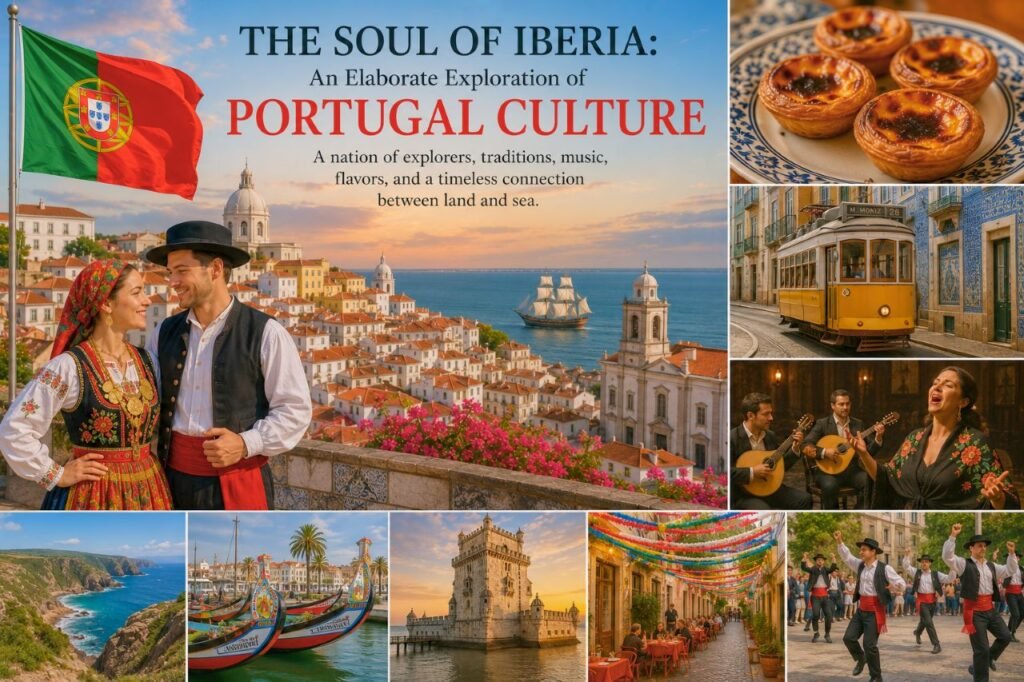
- Pastel de Nata: The crown jewel of Portuguese pastry—a blistered egg custard tart encased in flaky, laminated puff pastry, traditionally dusted with cinnamon and powdered sugar.
Clothing & Symbols
The vibrant culture of Portugal
Traditional Attire
While modern Portuguese dress is identical to Western global fashion, traditional folk garments (trajes típicos) are proudly worn during regional festivals. In the northern Minho region, women wear vibrant red, white, and black skirts paired with heavily embroidered blouses and ornate aprons.
Cultural Symbols
- The Rooster of Barcelos (Galo de Barcelos): The unofficial national symbol representing justice, honesty, and good fortune, originating from a medieval folk legend about a dead rooster miraculously crowing to prove an innocent man’s innocence.
- Gold Filigree (Filigrana): Ornate, delicate jewelry handcrafted from thin threads of gold, notably fashioned into the iconic Heart of Viana (Coração de Viana).
- Azulejos: Exquisite glazed ceramic tiles painted in intricate geometric patterns or blue-and-white historic scenes, decorating the interiors and facades of churches, train stations, and homes across the country.
Music, Dance & Art
Fado Music
Fado is the expressive heart of Portuguese music, inscribed on the UNESCO Intangible Cultural Heritage list. Performed in intimate, dimly lit taverns, a solo singer (fadista) expresses themes of loss, fate, and saudade, accompanied beautifully by the acoustic classical guitar and the tear-shaped Portuguese guitar (guitarra portuguesa).
Folk Dance
Traditional dances vary heavily by region. In the north, the Vira is a fast-paced, swirling dance in triple time where couples dance around each other without touching. In the southern Alentejo, the Cante Alentejano consists of traditional polyphonic choral singing performed a cappella by groups of workers, moving slowly to the rhythm of the rural landscape.
Art & Architecture
In art and architecture, Portugal developed the distinctive Manueline style (late Gothic style) during the Age of Discovery. This architectural style integrates maritime motifs—such as sculpted ropes, anchors, armillary spheres, and sea coral—into majestic stone monuments like the Jerónimos Monastery and Belém Tower in Lisbon.
Summary
In summary, Portugal stands as a testament to how a nation can fiercely safeguard its historical soul while blooming into a modern, forward-thinking society. From the melancholic, haunting strings of Fado to the sun-drenched coastal paths of the Algarve, its unique identity is forged by the sea and seasoned by centuries of cultural convergence. To celebrate Portugal is to appreciate a world where time slows down over a cup of espresso and a pastry, where history is painted beautifully on blue tile walls, and where hospitality is an art form.
At Best Culture Insight, we see culture as the heartbeat of every society – the way people live, connect, and express their identity.