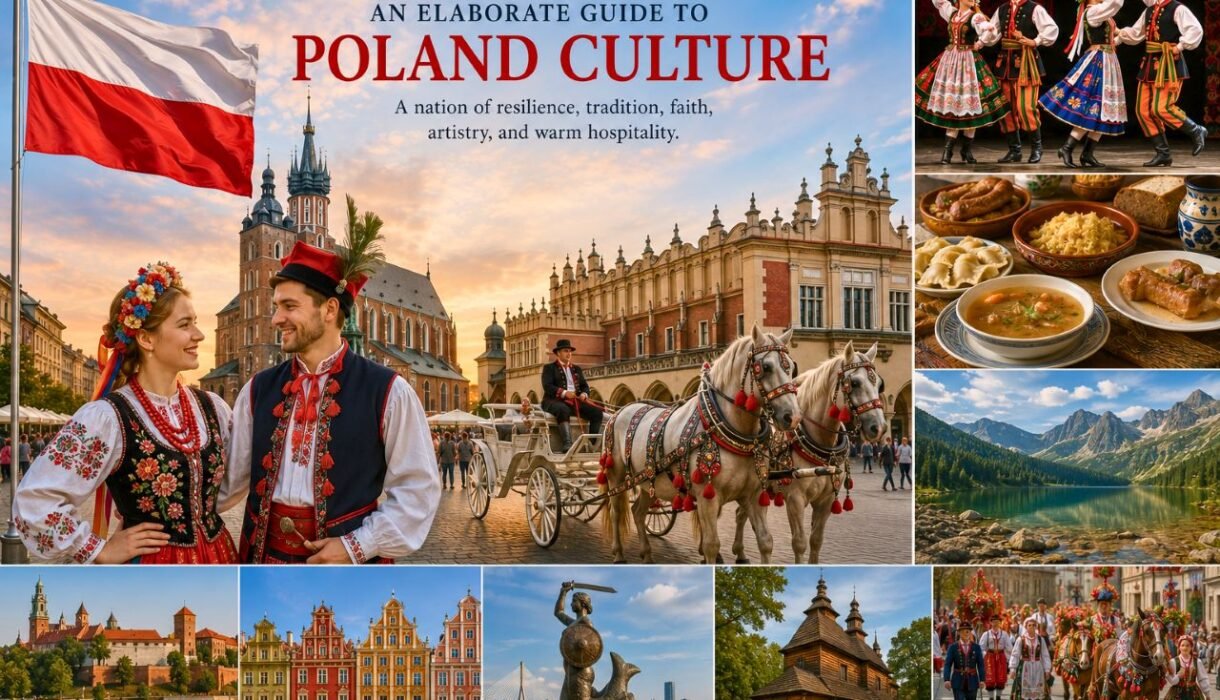

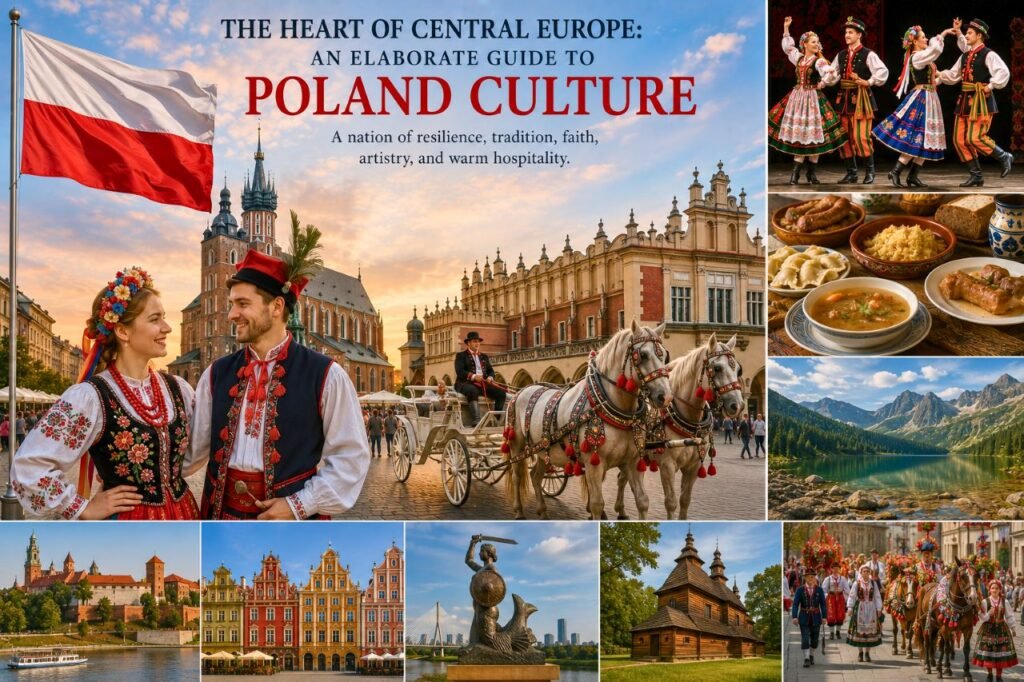
Situated at the geographic and historic crossroads of Europe, the vibrant tapestry of Poland Culture stands as a testament to human resilience, profound spirituality, and artistic brilliance. Shaped by over a millennium of triumphs, complex border shifts, and cultural exchanges, the Polish people have carefully preserved a distinctive identity rooted in deep familial bonds and communal hospitality. From the cobblestone streets of medieval old towns to the untamed wilderness of its primeval forests, Poland offers a cultural landscape where time-honored Slavic customs blend seamlessly with modern European progression. To explore Poland is to discover a nation that has mastered the art of honoring its past while dynamically embracing the future.
History & Origins
The foundational roots of Polish culture took hold in the early Middle Ages with the migration of West Slavic tribes, most notably the Polans, who settled in the fertile basins of the Warta and Vistula Rivers. The definitive birth of the Polish state occurred in 966 CE, when Duke Mieszko I accepted Christianity. This pivotal event, known as the Baptism of Poland, integrated the nation into Western Latin civilization, permanently steering its cultural, architectural, and philosophical trajectories.
By the 16th century, the nation entered its “Golden Age” under the Polish-Lithuanian Commonwealth. This powerful union was unique for its early democratic experiments and unmatched religious tolerance, making it a safe haven for diverse communities during the European Wars of Religion.
However, Poland’s central location also made it vulnerable. The late 18th century brought the tragic Partitions of Poland, during which the country was entirely carved up by neighboring empires (Russia, Prussia, and Austria) and vanished from the world map for 123 years. Remarkably, even without a political state, the Polish people kept their national identity completely alive through literature, music, and underground education. Following a brief period of independence after World War I, the country endured the devastating destruction of World War II and decades of Soviet-dominated communist rule. The indomitable Polish spirit triumphed once again in 1989 with the peaceful Solidarity (Solidarność) movement, restoring democracy and setting the stage for contemporary Poland’s cultural and economic renaissance.
Culture, Traditions & Customs
Marriage & Weddings (Wesele)
A traditional Polish wedding is an unforgettable, multi-day celebration marked by lively music, abundant food, and deeply symbolic rituals. The festivities frequently begin with the Blessing of the Parents at the bride’s family home before the church ceremony. Upon entering the reception venue, newlyweds are formally greeted with Bread and Salt (Chlebem i Solą):
- Bread symbolizes the hope that the couple will never know hunger.
- Salt represents the hardships of life that they must face together.
At the stroke of midnight, the highly anticipated Oczepiny ritual takes place. This historic rite of passage signifies the bride’s transition from a young maiden to a married woman, traditionally marked by the symbolic removal of her bridal veil or flower crown in favor of a married woman’s cap.
Naming Ceremonies & Name Days (Imieniny)
While birthdays are universally celebrated, for many adult Poles, Name Days (Imieniny) hold equal or greater cultural significance. Derived from the Catholic calendar of saints’ feast days, an individual’s Name Day is celebrated on the date associated with the saint they were named after. It is a warm, celebratory occasion where friends, colleagues, and extended family drop by to offer flowers, sweets, and heartfelt toasts.
Major Festivals & Rites of Passage
- Wigilia (Christmas Eve): The most sacred family gathering of the year. The meal begins only after the first star appears in the night sky. Family members share the Opłatek (a thin Christmas wafer), breaking off pieces and expressing personal wishes for health and happiness before enjoying a strict 12-course meatless feast.
- Śmigus-Dyngus (Wet Monday): Celebrated on Easter Monday, this lighthearted tradition involves people splashing each other with water. Rooted in ancient pagan fertility rites and the historic cleansing of springtime, it remains a favorite national pastime.
- All Saints’ Day (November 1st): A solemn and beautiful national holiday where millions of Poles visit cemeteries to cover ancestral graves with glowing glass lanterns and fresh chrysanthemums, transforming entire hillsides into seas of flickering light.
Languages & Communication
The Polish Language
The official language is Polish, a West Slavic tongue written in the Latin alphabet but augmented by unique diacritical marks (such as ą, ć, ę, ł, ń, ó, ś, ź, ż). It is renowned for its complex grammar system and rich consonantal clusters, making it one of the most expressive and phonetically distinct languages in the Slavic world.
Everyday Greetings & Expressions
Politeness and respect form the bedrock of daily communication. When interacting with strangers, older individuals, or in professional settings, formal titles are standard practice:
- Dzień dobry (pronounced jen doh-bry): Good day / Good morning.
- Dobry wieczór (pronounced doh-bry vyeh-choor): Good evening.
- Do widzenia (pronounced doh vee-zen-yah): Goodbye.
- Dziękuję (pronounced jen-koo-yeh): Thank you.
- Proszę (pronounced proh-sheh): Please / You’re welcome.
Cultural Proverbs & Idioms
Polish speech is rich with colorful idiomatic wisdom that reflects the historical worldview of its people:
- “Nie mój cyrk, nie moje małpy” (Literally: “Not my circus, not my monkeys”): Used to state that a problem is none of your business or responsibility.
- “Mądry Polak po szkodzie” (Literally: “A Pole is wise after the damage is done”): A reflective proverb akin to “hindsight is 20/20.”
Geography
Poland is the ninth-largest country in Europe by area, situated in the very heart of the continent. Its geography transitions seamlessly across several distinct environmental zones:
- The Baltic Coast: Striking sandy beaches, shifting dunes, and busy historic maritime ports like Gdańsk line the northern border.
- The Lowlands: The vast Central Polish Lowlands are defined by extensive river networks (including the Vistula and Oder) and primeval forests, notably the Białowieża Forest, home to Europe’s last wild bison populations.
- The Lake Districts: The northeastern Masurian Lake District features over 2,000 pristine lakes carved by ancient glaciers, serving as a hub for eco-tourism.
- The Mountains: The southern border rises sharply into breathtaking alpine ranges, including the Karkonosze, Beskids, and Tatra Mountains, where the resort town of Zakopane serves as Poland’s winter capital.
Economy
Over the past few decades, Poland has built one of the most dynamic and resilient economies in Europe. Transitioning smoothly from a centralized state-controlled communist model to a robust market-driven economy, it is now an influential industrial and technological powerhouse within the European Union.
Major pillars of the Polish economy include advanced manufacturing (automotive parts, heavy machinery, and white goods), information technology, and agriculture. Poland is also a global leader in the video game development sector, producing world-renowned entertainment titles. Furthermore, the nation is rich in natural resources, historically prominent in coal, copper, zinc, and silver extraction, alongside its legendary Baltic amber trade.
Politics
Poland is a democratic parliamentary republic governed under a framework defined by the Constitution of 1997. The political structure is divided into a dual executive branch:
- The President: Elected directly by the citizens for a five-year term, serving as the official Head of State and supreme commander of the armed forces, with key veto powers.
- The Prime Minister: Functions as the Head of Government, leading the Council of Ministers and managing internal governance and policy implementation.
Legislative power is vested in a bicameral parliament consisting of the Sejm (the lower house, with 460 deputies) and the Senat (the upper house, with 100 senators). Poland is a committed member of NATO and the European Union, exercising significant diplomatic and geopolitical influence in Central and Eastern European affairs.
Ethnic Groups
Modern Poland is characterized by high demographic homogeneity, with over 95% of the population identifying as ethnically Polish. This uniform structure is largely a product of post-World War II border shifts and forced population movements.
Despite this general homogeneity, Poland proudly nurtures several small but culturally vibrant indigenous minority groups:
- The Kashubians: Living primarily in the Pomeranian region of northern Poland, they maintain their own distinct Slavic language and striking embroidery traditions.
- The Silesians: Settled in the industrial south, they hold a unique regional identity shaped by centuries of Polish, German, and Czech cross-cultural influences.
- The Highlanders (Górale): Residing in the southern Tatra mountains, they are celebrated across the country for their distinct dialect, energetic folk music, and pastoral lifestyle.
Beliefs & Values
Religious Landscape
Roman Catholicism has played an intertwined role in Polish history and national identity for centuries. For generations, the Church served as a crucial cultural sanctuary during times of foreign occupation and communist oppression. The election of Cardinal Karol Wojtyła as Pope John Paul II in 1978 remains a moment of immense national pride and a powerful catalyst for the fall of iron-curtain communism. While secularization is rising among younger generations today, Catholic holy days and sacraments remain central to the rhythm of Polish public and family life.
Core Moral Values & Worldview
- Hospitality (Gościnność): Expressed perfectly through the classic proverb, “Gość w dom, Bóg w dom” (“A guest in the house is God in the house”). Poles treat visitors with exceptional generosity, offering their finest food and drinks.
- Family Solidism: The nuclear and extended family forms the foundational safety net in Polish society. Decisions are regularly made collectively, and caring for elderly relatives is viewed as a fundamental moral duty.
- Resilience: Centuries of overcoming geopolitical adversity have fostered a national psyche characterized by stoicism, Resourcefulness (zaradność), and an unwavering determination to overcome hardship.
Food & Cuisine
Polish cuisine is hearty, rich, and expertly adapted to the country’s distinct four seasons. It relies heavily on local ingredients like root vegetables, cabbage, wild mushrooms, sour cream, poultry, and expertly cured meats.
Traditional Signature Dishes
- Pierogi: Delicately rolled dough dumplings stuffed with an array of fillings. The most iconic variety is Pierogi Ruskie (filled with potato and farmer’s cheese), though savory minced meat or sweet wild blueberry fillings are equally beloved.
- Bigos (Hunter’s Stew): A comforting, slow-simmered stew combining shredded sauerkraut, fresh cabbage, various cuts of meat, aromatic smoked kielbasa, and dried wild mushrooms.
- Żurek: A uniquely sour, comforting soup crafted from fermented rye flour broth, typically laden with chunks of white sausage, hard-boiled eggs, and marjoram.
Cultural Meaning of Food
In Polish society, food is synonymous with love and security. Leaving a Polish home hungry is considered a social impossibility. Meals are viewed as a sacred space for bonding, storytelling, and reinforcing family ties, with traditional cooking methods passed down proudly through generations.
Clothing & Symbols
Traditional Attire (Stroje Ludowe)
While contemporary Poles wear standard global fashion, regional folk costumes are proudly displayed during major religious processions, national holidays, and folk festivals.
| Folk Costume Region | Distinguishing Visual Characteristics | Cultural Significance |
| Kraków Region (Strój Krakowski) | Men wear white tunics, red striped trousers, and iconic blue vests with intricate embroidery. Women wear pristine white blouses, floral skirts, and heavily beaded velvet bodices. | Historically adopted as the definitive national folk costume during anti-foreign uprisings. |
| Podhale Region (Strój Góralski) | Men wear thick white wool trousers (portki) featuring geometric embroidery, wide leather belts, and felt hats. Women wear vivid, rose-patterned shawls and long skirts. | Designed for utility in the alpine elements; symbolizes fierce independence and mountain heritage. |
National Symbols
- The White Eagle: The premier symbol of the Polish state, featuring a crowned white eagle set against a striking red shield, representing freedom and nobility.
- The Polish Flag: A clean, horizontal bicolor of white (signifying purity and peace) and red (representing courage and the blood spilled for liberty).
- The Crimson Color: Historically, this specific shade of deep red was associated with the Polish aristocracy and remains an enduring symbol of national dignity.
Music, Dance & Art
Classical Music & Fine Art
Poland has gifted the global artistic community with some of its finest creators:
- Frédéric Chopin: The legendary Romantic composer whose piano masterpieces infused classical structures with traditional Polish folk melodies like mazurkas and polonaises.
- The Polish Poster School: An influential mid-20th-century movement in graphic design that combined vivid painterly styles with sharp, concise metaphors, revolutionizing global poster art.
Folk Dances & Visual Art
Poland recognizes five distinct national folk dances, characterized by dramatic tempo shifts, sweeping spins, and intricate footwork: the Polonez, Mazur, Krakowiak, Kujawiak, and Oberek.
In the visual arts, traditional crafts thrive through Wycinanki—the delicate art of multicolor paper cutting depicting stylized birds and vibrant geometric floral designs. Another world-famous craft is the intricate, hand-painted stoneware from the southwestern town of Bolesławiec, renowned for its distinct cobalt blue peacock-eye patterns.
Summary
The culture of Poland stands as an inspiring narrative of survival, cultural depth, and vibrant self-expression. Rooted in its early West Slavic foundations and fortified by a millennium of European history, the nation has protected its core identity through an unwavering commitment to family, faith, and artistic heritage. Whether experienced through the shared breaking of the Christmas Eve opłatek, the warm hospitality of a traditional meal, or the soulful melodies of Chopin, Poland’s cultural tapestry remains a brilliant jewel in the heart of Europe—offering a timeless message of resilience and community to the global stage.
At Best Culture Insight, we see culture as the heartbeat of every society – the way people live, connect, and express their identity.