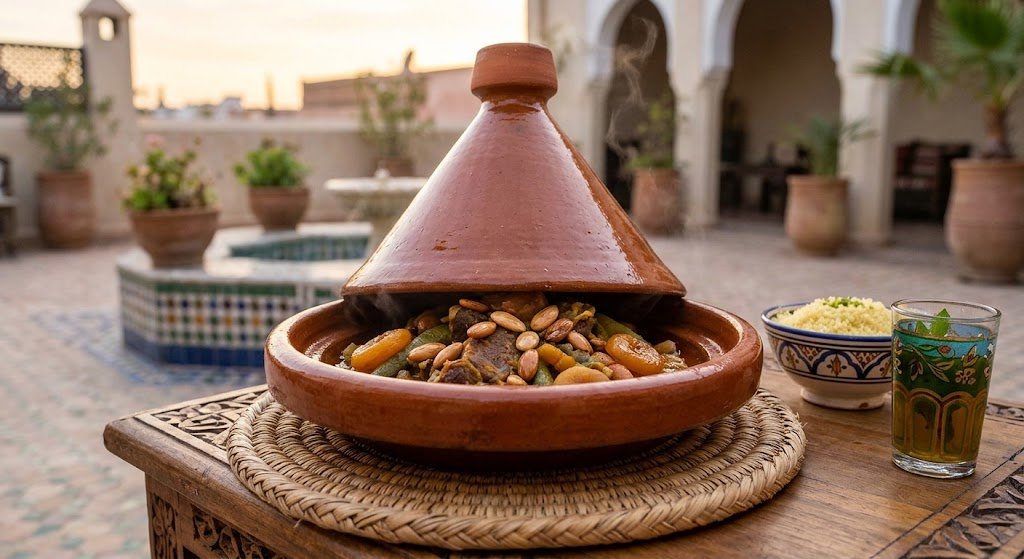

The tagine is perhaps Morocco’s most iconic culinary export, recognized worldwide for its distinctive conical lid and the aromatic stews it produces. It is more than just a pot; it is a synthesis of ancient engineering, cultural philosophy, and a slow-food ritual that has remained unchanged for centuries. Originating with the Amazigh (Berber) people of North Africa, the tagine is a masterclass in adapting to environment and resources, creating extraordinary flavor through ingenious simplicity. To truly appreciate a tagine meal is to understand the “sacred science” that guides its design and the social ritual that governs its consumption.
The Conical Engineering: A Genius of Condensation
The genius of the tagine lies entirely in its shape, a design born of necessity in arid regions where water was historically scarce. The pot consists of two parts: a wide, shallow base and a tall, cone-shaped lid. As the ingredients simmer slowly on low heat, steam rises into the cone. Because the top of the cone is cooler than the base, the steam condenses on the slanted interior surface. This condensation then trickles back down the sides into the stew, constantly basting the ingredients. This creates a self-contained hydrologic cycle, allowing food to cook to tender perfection with only a minimal amount of added water. The design leverages the laws of thermodynamics to conserve moisture and concentrate flavor.
Clay as the Essential Element
The “science” of the tagine is inseparable from its material: earthenware clay. Traditional tagines are made of natural, unglazed clay. This material is an excellent insulator, distributing heat slowly and evenly across the base of the pot. This prevents scorching while allowing for the ultra-slow cooking required to break down tough cuts of meat and meld complex spices. Furthermore, high-quality clay pots are porous; before their first use, they must be seasoned with oil and water, which strengthens the vessel and seals the pores. This seasoning process, combined with repeated use, imbues the pot with a subtle, earthy “patina” that adds a unique depth of flavor to every subsequent meal—a flavor that cannot be replicated in modern metal cookware.
The Alchemy of Slow, Layered Cooking
A tagine is never about flash-frying or speed. The ritual of preparation is a practice in patience. Ingredients are meticulously layered within the base: often starting with a bed of onions and herbs, followed by meat (lamb, chicken, or beef), and crowned with vegetables, dried fruits, and nuts. This stratification allows different textures and flavors to emerge while the low heat works its alchemy. Crucially, the spices—such as cumin, turmeric, ginger, and saffron—are added early, slowly blooming in the moist environment. Because the cone lid is left on throughout the process, these aromatic oils are trapped, deeply infusing the entire dish rather than evaporating into the air.
The Social Ritual of Commensality
When the tagine is ready, the ritual shifts from the kitchen to the table. In Moroccan culture, eating is profoundly communal. The tagine is typically placed in the center of a round table, and the conical lid is ceremoniously lifted, releasing a burst of fragrant steam. Dining is a collective experience; family and guests gather closely, each eating from the portion of the dish directly in front of them, using pieces of fresh khobz (Moroccan bread) as utensils to scoop up the stew. This act of shared commesality reinforces social bonds, encourages conversation, and transforms a simple meal into a sacred act of community and hospitality.
Adapting Ancient Logic for Modern Kitchens
The principles behind the tagine are perfectly suited for today’s growing slow-food movement. While traditionalists still prefer cooking over charcoal for that distinct smoky aroma, modern, flame-proof ceramic tagines can be used effectively on stovetops or in ovens. The logic remains the same: use low, even heat and trust the geometry of the cone. It is a foolproof method for creating complex, restaurant-quality dishes with minimal active effort, making it ideal for the home cook who values both flavor and a mindful cooking process. By understanding this blend of thermodynamics and ancient ritual, cooks today can connect with a profound culinary lineage that honors patience, resourcefulness, and connection.