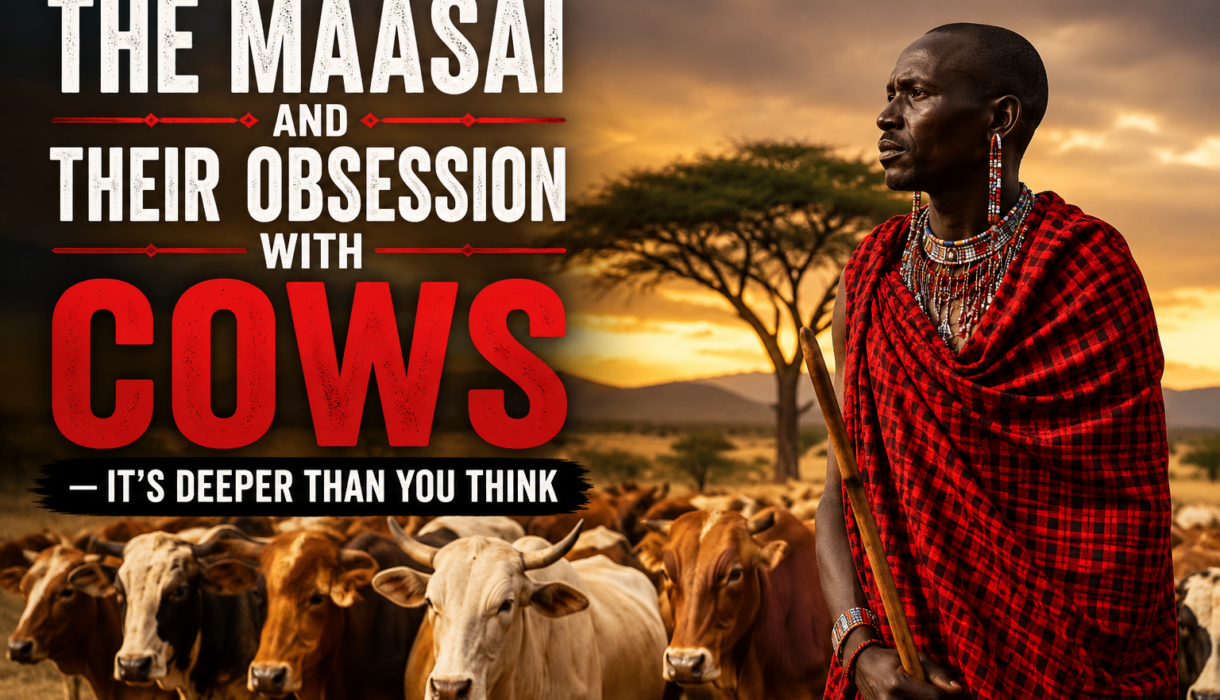

To the casual observer traveling through the sweeping savannahs of Kenya and Tanzania, the sight of a Maasai warrior herding cattle is iconic. However, what many dismiss as a simple pastoral lifestyle or an old-fashioned farming preference is actually one of the most profound cultural relationships on Earth. For the Maasai, cattle are not merely livestock, financial assets, or sources of food. They are the structural pillars of their spiritual universe, the foundation of their social hierarchy, and the very core of their identity.
A Divine Covenant and the Origin of Ownership
To understand why the Maasai value cows above all else, one must look at their creation theology. According to Maasai mythology, the supreme creator god, Enkai, once held the sky and the earth together. When they separated, Enkai sent all the world’s cattle sliding down a long rope made of wild fig bark directly to the Maasai. Because of this divine gift, the Maasai possess a deeply held, ancient belief that all the cattle on Earth belong to them by divine right. Herding is therefore viewed not just as a job, but as a sacred duty to care for God’s direct property.
The Ultimate Currency of Wealth and Status
In Maasai society, paper money and bank accounts play second fiddle to the ultimate traditional currency: a healthy herd. A man’s wealth, social status, and respect within the community are measured entirely by the number of cattle and children he possesses. A large herd dictates political influence and functions as the primary medium for critical life transitions. For instance, traditional marriages require a bride price (Enkaputi) paid exclusively in cattle. Without cows, a Maasai man cannot legally marry, resolve community disputes, or attain the revered status of an elder.
A Sustainable Circle of Life and Survival
The Maasai relationship with cattle is also a masterclass in ecological survival and nutritional efficiency. Their traditional diet leans heavily on the cow, but in a way that minimizes slaughter. Instead of killing the animal for meat, the Maasai have traditionally harvested milk and, during special ceremonies or times of illness, small amounts of blood drawn humanely from the jugular vein. This allows a single cow to sustain a family for years. Every part of the animal is utilized; hides are converted into clothing, bedding, and shields, while dung is used to plaster and insulate their traditional houses (Manyattas).
Preserving Identity in a Changing World
As modern economic pressures, climate change, and land privatization encroach upon traditional grazing territories, the Maasai face severe challenges to their pastoral way of life. Yet, their devotion to their herds remains unwavering. Many modern Maasai who pursue higher education or corporate jobs in urban centers continue to invest their salaries back into buying cattle for their rural homesteads. This enduring bond proves that the Maasai connection to cattle is far from a primitive habit; it is a sophisticated, living philosophy that continues to anchor an entire culture in an ever-shifting global landscape.