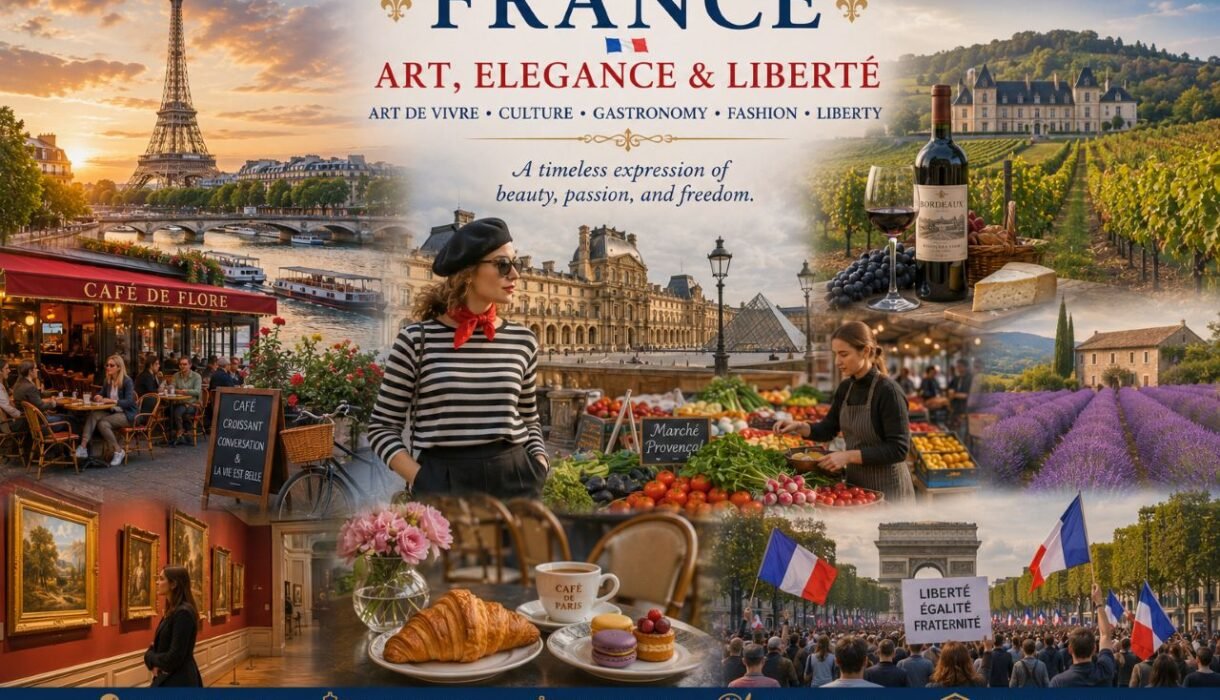

Positioned as Western Europe’s cultural powerhouse, France (La France) represents an unmatched global standard for philosophy, gastronomy, fashion, and artistic expression. The French people (Les Français) are the proud architects of a society that treats daily life as a conscious art form—a philosophy known across the world as art de vivre (the art of living).
Far from being merely a collection of historical monuments or high-fashion boutiques, French culture is deeply anchored in a collective passion for structural beauty, intense intellectual debate, and uncompromised civic liberty. From the iconic, light-strewn avenues of Paris to the fragrant lavender fields of Provence and the sun-soaked vineyards of Bordeaux, France offers a timeless narrative of human refinement, social solidarity, and democratic pride.
History & Origins
The historic development of French culture is an epic journey of Roman integration, absolute monarchy, and revolutionary social upheaval.
[Celtic Gauls & Roman Conquest]➔[Frankish Empire & Charlemagne]➔[The Bourbon Monarchy & Versailles]➔[The French Revolution of 1789]➔[Napoleonic Era]➔[The Five Democratic Republics]
- The Gallo-Roman Foundations: Ancient France was inhabited by Celtic tribes known as the Gauls. Following Julius Caesar’s conquest in the 1st century BC, the region integrated deeply into the Roman Empire, adopting Latin (which gradually evolved into French) and Roman legal systems. By the 5th century AD, Germanic tribes called the Franks swept through the region, giving the land its modern name and establishing a powerful Christian empire under Charlemagne.
- The Zenith of Absolute Monarchy: Throughout the Middle Ages and the Renaissance, France consolidated its position as Europe’s premier cultural center. This era reached its absolute peak under King Louis XIV, the “Sun King,” in the 17th century. He constructed the breathtaking Palace of Versailles, establishing French as the official language of global diplomacy, high fashion, and aristocratic refinement across the western hemisphere.
- The Crucible of the Revolution: The defining turning point of modern history arrived in 1789 with the French Revolution. Fed up with absolute royal power, the citizens of Paris overthrew the monarchy, creating a new societal order based on human rights. This momentous shift, followed by the ambitious legal and structural updates of the Napoleonic Era, systematically broke down feudalism across Europe and established France as a global cradle of modern democratic values.
Culture, Traditions & Customs
The Philosophy of Family and Social Life
French family life is characterized by close-knit relationships that place a premium on polite behavior, structured communication, and shared time. Children are raised to appreciate table manners, artistic education, and critical reasoning from an early age. Social life centers significantly around long, multi-generational weekend lunches where lively political and philosophical debates are actively encouraged.
Milestones, Festivals, and Customs
- Le Mariage (French Weddings): Traditional French weddings feature a distinctive legal requirement: couples must be civilly married at the local town hall (la mairie) by the mayor before any religious or symbolic ceremony can occur. At the reception, instead of a traditional tiered wedding cake, guests are treated to a Croquembouche—a spectacular cone-shaped tower of choux pastry balls bound together with golden threads of caramelized sugar.
- La Fête Nationale (Bastille Day): Celebrated with immense pride on July 14, this national holiday marks the storming of the Bastille prison in 1789, which ignited the French Revolution. The day features Western Europe’s oldest and largest military parade along the Champs-Élysées in Paris, followed by spectacular firework displays near the Eiffel Tower and festive dances held in fire stations (Le Bal des Pompiers) across the entire country.
Languages & Communication
The official language is French (Le Français), a Romance language descended directly from the spoken Latin of the Roman Empire.
Linguistic Identity and Preservation
French is valued by its speakers as a supreme instrument of logic and clarity. The language is rigorously protected from foreign corruption by the Académie Française, an official state institution founded in 1635 that establishes grammar rules and invents native words to replace imported English tech terms.
Spoken French is characterized by its smooth, melodic flow, driven by the unique liaison (pronouncing the normally silent end-letter of a word when the next word starts with a vowel) and a distinct uvular r sound.
Communication Style & Vernacular Idioms
French communication is polite, formal, and deeply respectful of personal boundaries. The use of the formal vous (you) is mandatory when speaking to strangers, colleagues, or elders until explicitly invited to use the casual tu.
- “Impossible n’est pas français.”
Translation: “Impossible is not French.” This legendary proverb, famously attributed to Napoleon Bonaparte, reflects a historic national pride in overcoming complex intellectual and physical challenges.
Geography
France features a highly diverse geographical layout, bordered by the Atlantic Ocean, the English Channel, and the Mediterranean Sea. The country is shaped like a rough Hexagon (L’Hexagone), a term frequently used by locals to describe their homeland.
The territory transitions beautifully from the flat, rolling agricultural fields of the north and west to the massive, snow-capped alpine peaks of the Alps in the southeast (featuring Mont Blanc, Europe’s highest mountain) and the rugged Pyrenees range along the southern border with Spain. The country is drained by four iconic river systems—the Seine, the Loire, the Garonne, and the Rhône—which cultivate exceptionally fertile valleys that feed the nation’s world-famous agricultural and winemaking regions.
Economy
France operates an advanced, high-income social market economy that stands as one of the largest economic powers in the world. Key pillars of French industrial and commercial strength include:
- Aerospace and Advanced Technology: Leading continental aviation through Airbus engineering and satellite launches via Arianespace.
- Luxury Goods and Haute Couture: Dominating the global luxury market via elite conglomerates like LVMH (Moët Hennessy Louis Vuitton) and Kering, which manage iconic fashion houses such as Chanel, Dior, and Saint Laurent.
- Global Tourism: France consistently ranks as the most visited country on Earth, attracting millions of international travelers annually to its heritage sites and resorts.
- Nuclear Energy and Infrastructure: Producing a substantial majority of its national electricity from domestic nuclear power plants, maintaining an innovative, low-carbon industrial grid.
Politics
France is a unitary semi-presidential republic governed under the constitution of the Fifth Republic, established in 1958 by General Charles de Gaulle. The political power dynamic is shared between a powerful, directly elected President (who serves as head of state, manages foreign policy, and commands the military forces) and a Prime Minister (who serves as head of government and directs domestic legislative matters).
The bicameral Parliament consists of the National Assembly (Assemblée Nationale) and the Senate (Sénat). France is a foundational founding member of the European Union, a permanent member of the United Nations Security Council, and a key strategic pillar within NATO.
Ethnic Groups
The modern population of France is a diverse mosaic shaped by its geographical location at the crossroads of Europe and its complex historical global ties. While French law strictly prohibits the collection of official state data based on race or ethnicity to uphold the democratic ideal of universal equality, historians recognize a rich tapestry of heritages.
The historical population baseline combines Celtic, Roman, and Germanic roots, alongside distinct regional groups like the Bretons, Basques, and Corsicans. In the 20th and 21st centuries, this baseline expanded through waves of immigration from Southern Europe, North Africa (including Algeria, Morocco, and Tunisia), West Africa, and the Caribbean, enriching modern French urban culture.
Beliefs & Values
Secularism (Laïcité) as a Civic Pillar
The defining architectural value of modern French public life is Laïcité—a strict, unique form of constitutional secularism established by law in 1905. Laïcité guarantees absolute freedom of conscience and religious practice in private life, while enforcing total neutrality from religious influence within all state institutions, public schools, and government offices.
Liberté, Égalité, Fraternité
The foundational moral worldview of France is summarized by its immortal national motto: Liberté, Égalité, Fraternité (Liberty, Equality, Fraternity).
[Liberty: Individual Autonomy] + [Equality: Strict Legal Parity] + [Fraternity: Collective Social Solidarity] = The French RepublicThis worldview values state-supported social security, public healthcare, and universal education as non-negotiable human rights. It supports a unique culture of civic engagement where peaceful public protests (la manifestation) are viewed as a legitimate and respected democratic tool to hold political institutions accountable.
Food & Cuisine
French gastronomy (La gastronomie française) is so foundational to global culinary culture that it was officially inscribed onto the UNESCO Intangible Cultural Heritage list. It is an art form defined by meticulous preparation, technical precision, and deep respect for the concept of terroir—the unique environmental factors that give an agricultural product its distinct regional flavor profile.
- Le Repas Gastronomique: A traditional French multi-course meal follows a strict ceremonial progression: it begins with an apéritif (a light pre-dinner drink accompanied by small savory bites), followed by an entrée (starter), a plat principal (main course featuring meat or fish cooked with rich, complex reductions), a dedicated cheese course (le fromage), and concludes with an artful dessert and digestif.
- Coq au Vin & Beef Bourguignon: Masterful examples of traditional slow-cooking methods. These dishes braise tough cuts of meat or rooster in rich red Burgundy wine along with mushrooms, lardons, and fresh bouquet garni herbs until perfectly tender.
- The Bread and Pastry Mastery: The crispy Baguette is a daily sacred staple, strictly protected by French law regarding its natural ingredients. Alongside it sits the flaky, laminated Croissant, which represents the pinnacle of French viennoiserie pastry technique.
- The Cheese and Wine Galaxy: France produces over 1,200 distinct varieties of cheese, ranging from creamy Brie and Camembert to sharp Roquefort. Each region pairs its cheeses with world-famous local wines, governed under strict Appellation d’Origine Contrôlée (AOC) certifications to preserve local purity.
Clothing & Symbols
Haute Couture and Everyday Chic
France is the historic and undisputed capital of world fashion. Paris hosts the definitive Haute Couture weeks, where fashion houses like Chanel, Louis Vuitton, and Yves Saint Laurent present custom clothing masterworks.
For the average citizen, clothing is characterized by effortless chic—a style that favors timeless investment pieces, clean tailored lines, neutral palettes, and subtle accessories (such as a beautifully tied silk scarf) over loud, temporary logos.
National Symbols
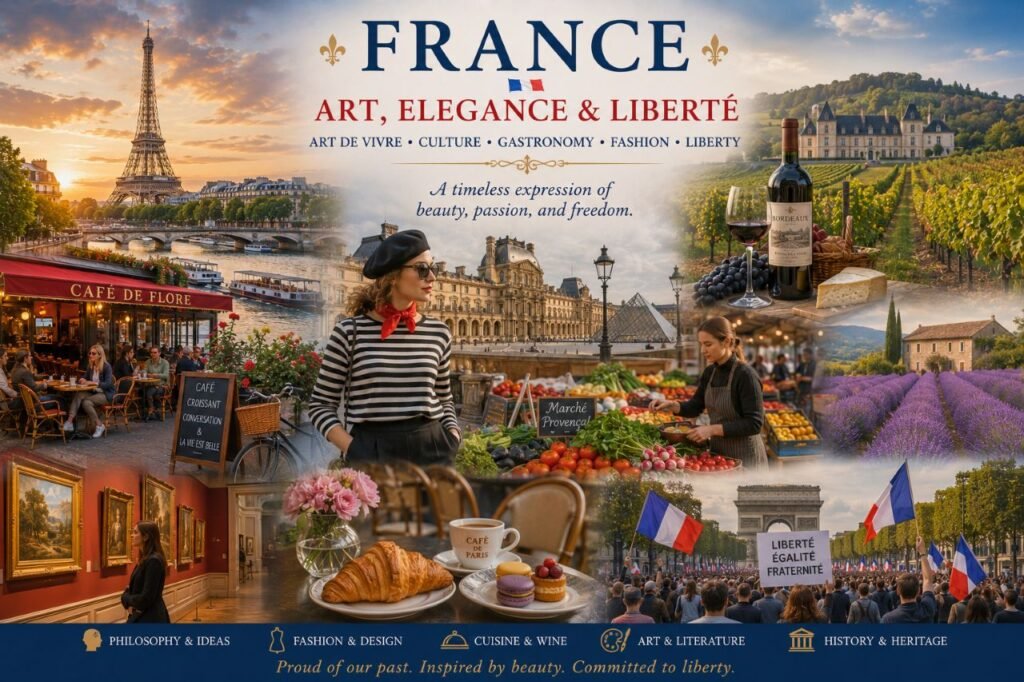
La beauté et l’élégance de la France – Culture
The national flag is the Tricolore, featuring three vertical bands of blue, white, and red. The white represents the historic Bourbon monarchy, while the blue and red represent the traditional revolutionary colors of the city of Paris.
The primary allegorical symbol of the French Republic is Marianne, a proud woman wearing a Phrygian liberty cap, who stands as a visual personification of freedom and reason across all official government seals, coins, and stamps.
Music, Dance & Art
Visual Arts from Impressionism to Modernism
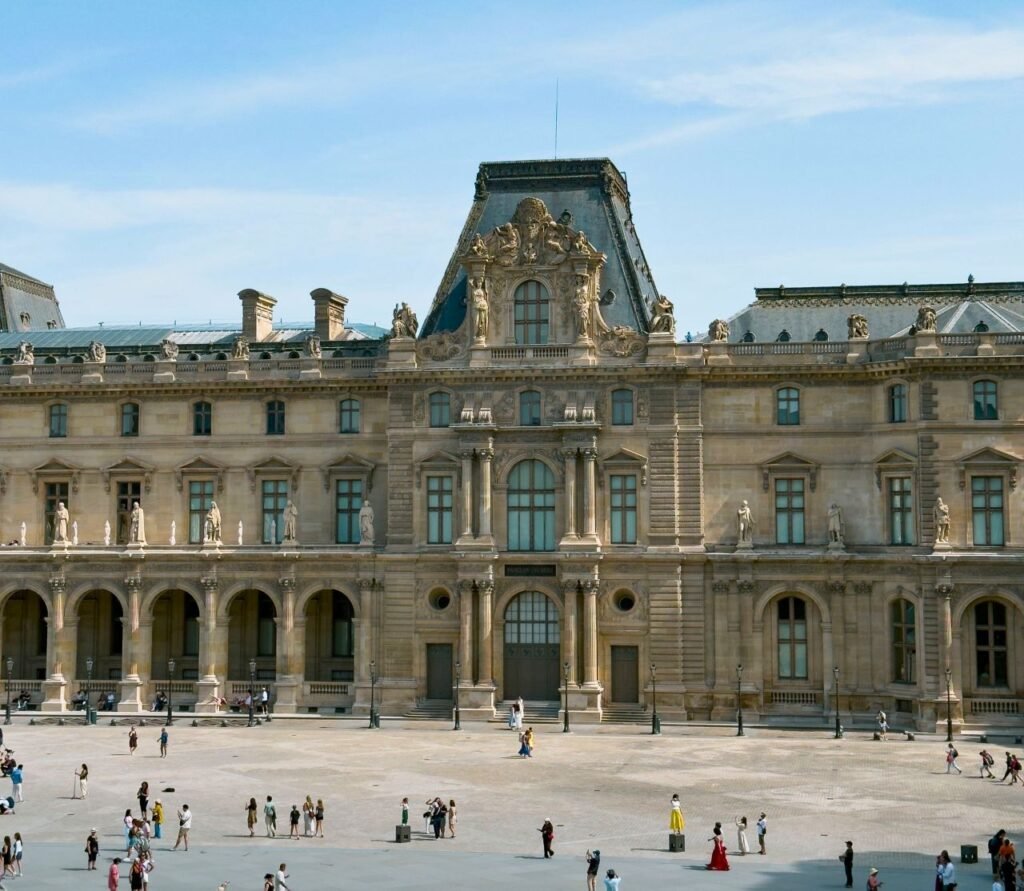
France has served as the legendary epic center for global visual art movements. The country’s historical institutions, notably the Louvre Museum (the world’s largest art museum), house priceless human treasures ranging from the Mona Lisa to ancient classical sculptures. In the 19th and 20th centuries, French painters like Claude Monet and Edgar Degas shattered classical traditions to invent Impressionism, capturing the fluid interplay of light and motion. This was followed by the avant-garde modern revolutions of Cubism and Surrealism centered in the historic neighborhood of Montmartre.
Chanson Française and Literary Giants
- La Chanson Française: Traditional French musical performance is epitomized by Chanson, a lyric-driven music style focused on poetic narrative storytelling. Icons like Édith Piaf (famous for La Vie en Rose) and Charles Aznavour transformed these melodic, accordion-backed songs into global symbols of romantic longing and resilience.
- The Literary Masters: French literature boasts a brilliant lineage of global thinkers, from the Enlightenment philosophies of Voltaire and Rousseau to the monumental 19th-century realist novels of Victor Hugo (Les Misérables) and the deep, stream-of-consciousness modern psychological masterworks of Marcel Proust.
Summary
The culture of France stands as an extraordinary monument to human sophistication, intellectual bravery, and civilizational beauty. By masterfully transforming daily habits—whether it is baking a loaf of bread, choosing a tailored coat, or participating in a heated political debate—into a celebrated art form, the French people have created a lifestyle that continues to capture the imagination of the entire world. By balancing a fierce respect for historic preservation with a relentless commitment to democratic freedom and artistic innovation, France shines bright as an enduring beacon of cultural elegance and humanitarian pride.
At Best Culture Insight, we see culture as the heartbeat of every society – the way people live, connect, and express their identity.


