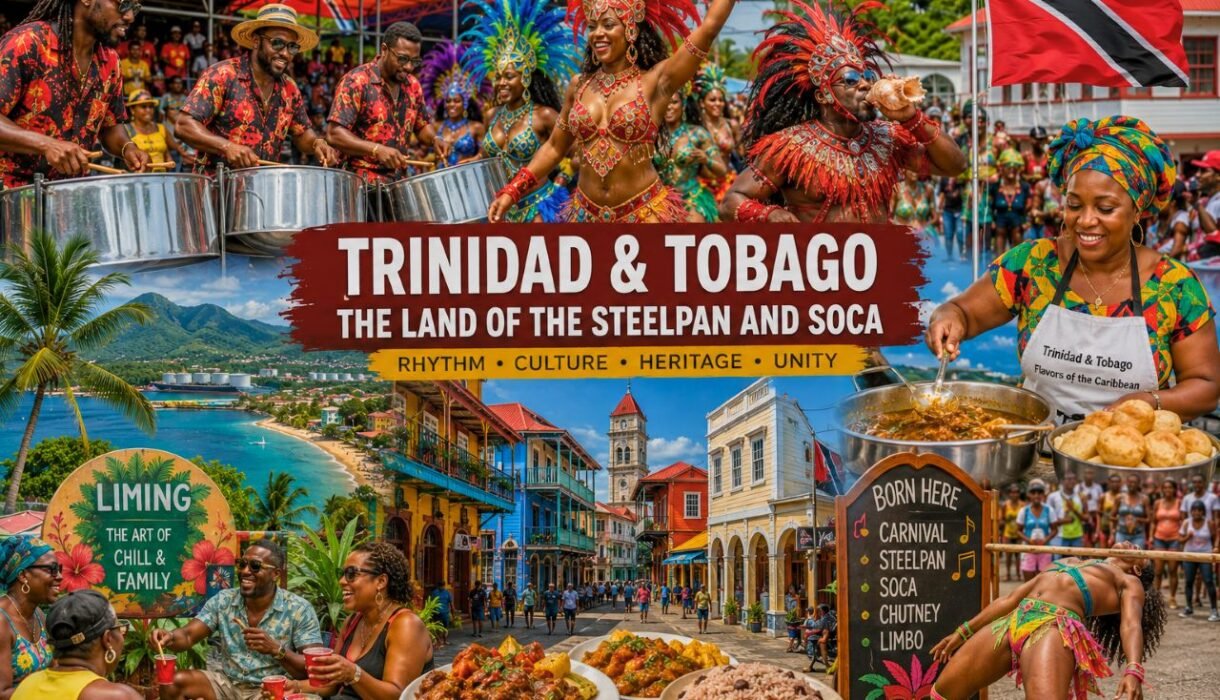
The Land of the Steelpan and Soca: An In-Depth Exploration of Trinidad and Tobago Culture
Posted in :

The twin-island republic of Trinidad and Tobago, anchored at the southernmost tip of the Caribbean archipelago in North America, boasts one of the most energetic, complex, and globally influential cultural landscapes on Earth. – Culture
The culture of Trinidad and Tobago is a brilliant explosion of rhythm, color, and culinary genius. The people—Trinbagonians—live by a philosophy deeply rooted in the concept of “liming” (the art of hanging out, socializing, and sharing stories with friends).
Trinidad and Tobago does not merely participate in culture; it invents it. As the birthplace of Carnival, the steelpan, soca, chutney music, and the limbo dance, this dual-island nation has made a massive impact on global pop culture. It is a society where diverse ethnic traditions do not just coexist, but continuously cross-pollinate to create entirely new forms of human expression.
History & Origins
The historical framework of Trinidad and Tobago is defined by a succession of colonial powers and massive waves of forced and contracted labor.
[Indigenous Indigenous Eras: Saladoid & Carib] ➔ [1498: Spanish Rule & French Influx] ➔ [1797: British Conquest & African Slavery] ➔ [1845: Indian Indentured Labor] ➔ [1962: Sovereignty]
Originally populated by the Amerindian Arawak and Carib peoples, Trinidad was claimed by Spain following the arrival of Christopher Columbus in 1498. In 1783, the Spanish issued the Cedula of Population, inviting French Catholic planters and their enslaved African laborers to develop the island’s agriculture, establishing a deeply rooted French Creole cultural foundation.
The British seized Trinidad in 1797 and combined it administratively with nearby Tobago in 1889. Following the full abolition of slavery across the British Empire in 1838, plantation owners faced severe labor shortages. They turned to the system of indentured labor, importing more than 140,000 workers from India between 1845 and 1917, alongside smaller numbers of Chinese, Portuguese, and Syrian immigrants. This history culminated in full independence on August 31, 1962.
Geography
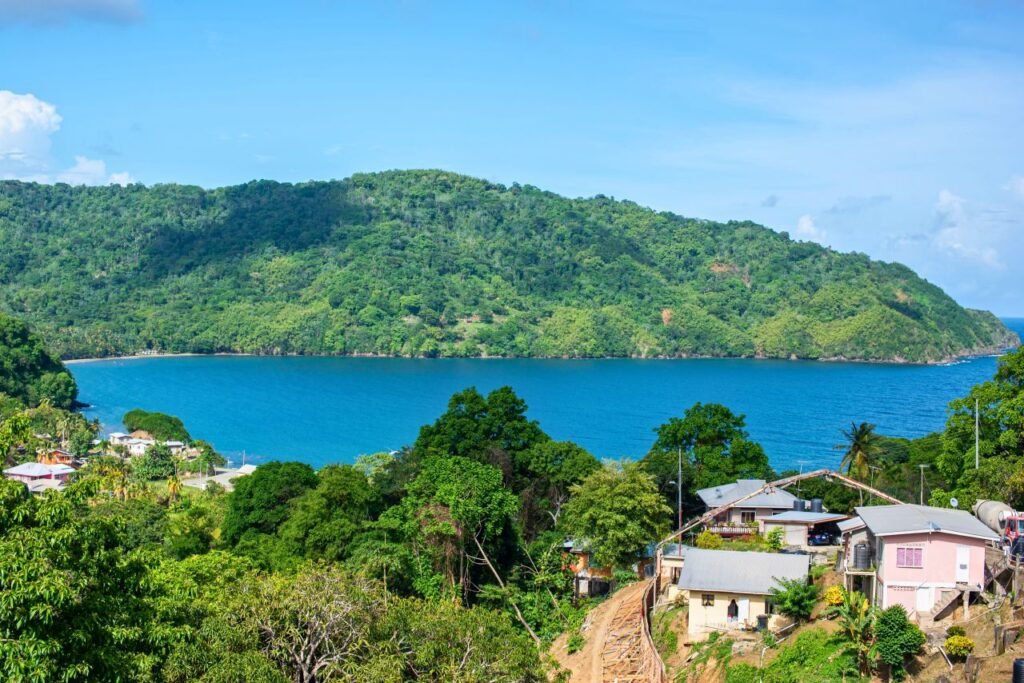
Trinidad and Tobago is positioned just 11 kilometers (7 miles) off the northeastern coast of Venezuela, making it geologically distinct from the rest of the volcanic Caribbean chain.
- Trinidad is the larger island, characterized by three mountain ranges, including the Northern Range, which mirrors Venezuela’s coastal mountains and peaks at El Cerro del Aripo ($940\text{ meters}$ or $3,084\text{ feet}$). It is famous for its dense tropical rainforests and the Pitch Lake, the world’s largest natural deposit of asphalt.
- Tobago is a volcanic island dominated by the Main Ridge Forest Reserve, the oldest legally protected tropical rainforest in the Western Hemisphere, surrounded by pristine coral reefs like Buccoo Reef.
Economy
Trinidad and Tobago possesses one of the most industrialized and robust economies in the Caribbean region, moving far away from the traditional tourism-dependent models of its neighbors.
| Economic Sector | Major Components | Cultural Footprint |
| Petrochemicals | Liquefied Natural Gas (LNG), crude oil, methanol, ammonia | Shapes urban industrial centers like Point Lisas and finances national arts programs. |
| Manufacturing | Food processing, beverages (Angostura Bitters), construction | Drives the urban workforce and supports regional Caribbean trade networks. |
| Tourism & Creative Arts | Eco-tourism in Tobago, global export of Carnival designs | Fuels the creative economy, drawing hundreds of thousands of visitors for Carnival. |
Politics
Trinidad and Tobago operates as a stable parliamentary republic. Head of state duties are held by the President, while executive governing authority rests with the Prime Minister, who leads the cabinet and commands a majority in the House of Representatives.
Tobago maintains an autonomous governance structure via the Tobago House of Assembly (THA), which oversees domestic administration, internal infrastructure, and tourism policies on the smaller island. Politics is highly competitive, characterized by robust democratic traditions and strong civil liberty protections.
Ethnic Groups
The population layout of the republic is evenly balanced between two dominant ancestral lineages, creating a unique demographic dynamic:
- East Indian (~35.4%): Descendants of indentured laborers, who preserved ancestral Hindu and Muslim religious traditions, culinary techniques, and musical forms.
- African Descent (~34.2%): Descendants of enslaved laborers, who forged the bedrock of the country’s folk performance, street theater, and festive rhythms.
- Mixed Heritage (~22.8%): Representing centuries of multi-generational blending across all ethnic lines.
- Other Diasporas (~7.6%): Small but economically influential communities of Chinese, European, Syrian, Lebanese, and remaining indigenous heritages.
Languages & Communication
English is the official language of the country. However, daily interactions are conducted in Trinidadian Creole or Tobagonian Creole, two distinct English-based creole languages infused with French, Spanish, West African, and Hindi terminology.
Popular Expressions & Local Idioms
- “Lime” / “Liming”: The ultimate national verb meaning to hang out, chill, or socialize in a relaxed setting.
- “Gyul” / “Boy”: Ubiquitous terms of endearment used when addressing friends, regardless of age.
- “Macafouchette”: A word of French Creole origin used to describe delicious meals or snacks made entirely from last night’s leftovers.
- “Dotish”: Silly, foolish, or lacking common sense.
Beliefs & Values
Trinbagonian society values tolerance, spiritual pluralism, and an unyielding zest for celebratory life. The country boasts an extraordinary religious landscape where Christian (Catholic and Anglican), Hindu, and Muslim holidays are celebrated equally by the entire populace as official national public holidays.
A prime example of this spiritual blending is the Spiritual Shouter Baptist faith, which infuses Christian liturgy with African drumming and altered states of consciousness. Additionally, the Orisha faith remains highly active, honoring traditional Yoruba deities alongside Catholic saints. This mutual respect is captured in the famous national observation: “Every creed and race find an equal place.”
Culture, Traditions & Customs
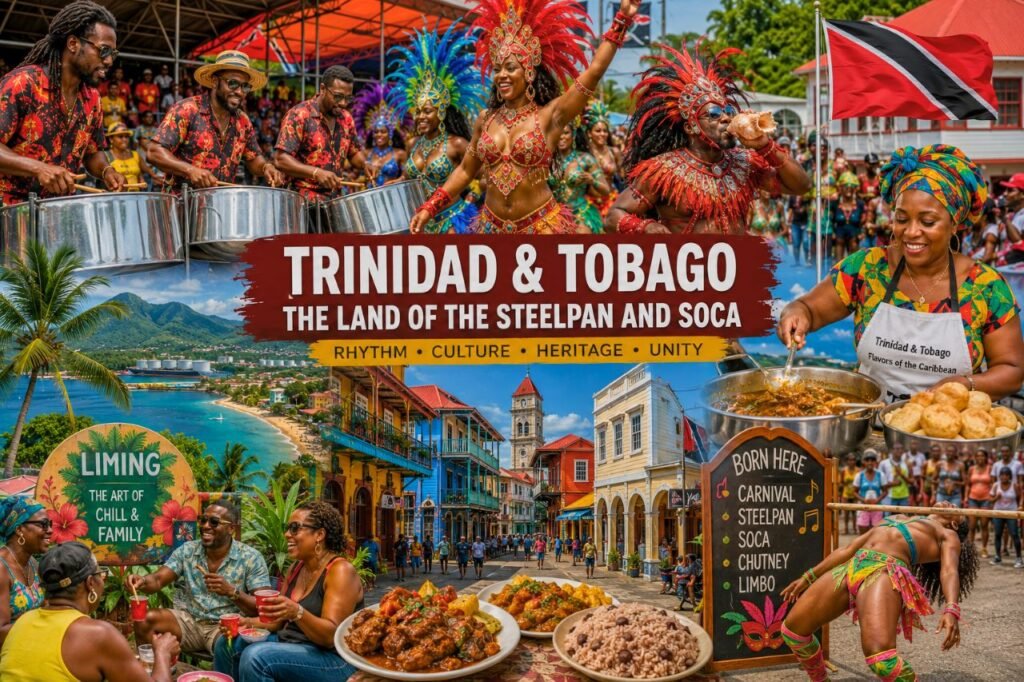
Trinidad & Tobago carnival celebration
Festivals of Light and Reflection
- Divali (Diwali): The Hindu festival of lights turns the village of Felicity into a stunning landscape. Millions of tiny, clay oil lamps (deeyas) are placed on split bamboo structures, lighting up the night to celebrate the victory of light over darkness.
- Hosay: The local commemoration of the martyrdom of Hussein (the grandson of Prophet Muhammad). The community builds beautiful, multi-tiered tadjahs (intricate bamboo and paper towers) and parades them through the streets of St. James to the rhythm of traditional Tassa drums.
The Mother of All Carnivals
The absolute pinnacle of Trinbagonian life is Trinidad Carnival, staged annually on the Monday and Tuesday before Ash Wednesday. Evolving from the 1881 Canboulay Riots—where emancipated Africans fought for their right to drum, dance, and masquerade—modern Carnival is a multi-million-dollar street festival.
Massive bands containing thousands of masqueraders fill the streets of Port of Spain in a sea of beads, sequins, and feathers, dancing to high-energy soca music behind towering sound trucks.
Food & Cuisine
Trinbagonian cuisine is a world-class culinary tradition born from the fusion of East Indian spices and African Creole slow-cooking styles.
Doubles: The Iconic Street Food
The undisputed culinary king of Trinidad street food is Doubles. Eaten at any hour of the day or night, this affordable, incredibly flavorful snack is an adaptation of Northern Indian chole bhature:
- The Anatomy: It consists of two bara (soft, golden-fried flatbreads seasoned with turmeric and cumin) sandwiched together and filled with a rich, savory curried channa (chickpeas).
- The Customization: Locals order their doubles by naming their preferred sauces: “slight pepper,” “heavy pepper,” sweet mango chutney, tamarind sauce, or fresh grated cucumber.
Other Culinary Masters
- Roti: Soft, flaky flatbreads (like Dhalpuri, which is stuffed with seasoned ground split peas) wrapped around deeply spiced curried goat, chicken, beef, or potatoes.
- Crab and Dumpling: The signature dish of Tobago. Fresh blue crabs are simmered in a thick, fragrant coconut curry sauce and served alongside flat, dense flour dumplings designed to soak up the savory gravy.
Clothing & Symbols

Traditional Vestments
Because of the nation’s multicultural heritage, traditional clothing varies by community. During wedding seasons and religious holidays, stunning Indian traditional wear like heavily embroidered silk saris, lehengas, and kurtas are common. During Emancipation celebrations, the streets fill with striking African dashikis and kente cloth headwraps.
[ Sovereign Symbols of Trinidad and Tobago ]
┌───────────────────────────────────────────────────────────────────────────┐
│ NATIONAL FLAG ── Red field with a black diagonal stripe bordered by │
│ two narrow white lines │
├───────────────────────────────────────────────────────────────────────────┤
│ NATIONAL BIRDS─ Scarlet Ibis (Trinidad) & Cocrico (Tobago) │
├───────────────────────────────────────────────────────────────────────────┤
│ NATIONAL FLOWER─ Chaconia / Wild Poinsettia (Warszewiczia coccinea) │
└───────────────────────────────────────────────────────────────────────────┘
The Geometry of the Flag
The Red field represents the warmth of the sun and the vitality and courage of the people. The Black diagonal stripe signifies the earth, the dedication to duty, and the strength of the nation’s unity. The White borders symbolize the surrounding sea, the purity of the country’s aspirations, and the equality of all citizens under the sun.
Music, Dance & Art
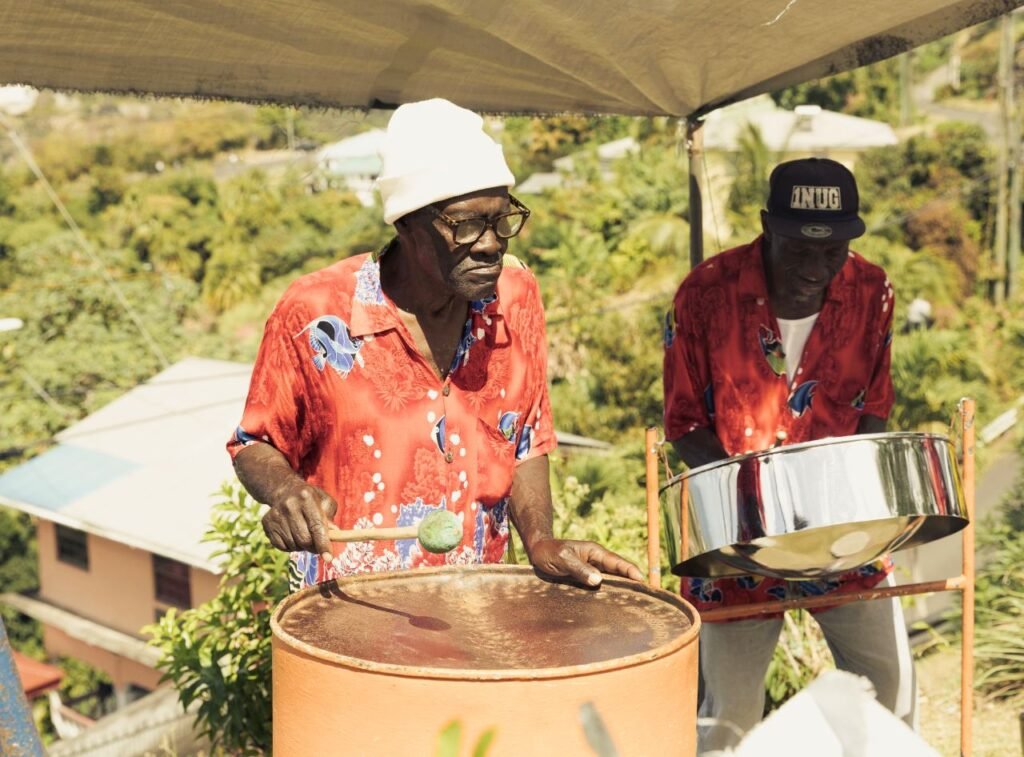
Two musicians play steel drums in a tropical outdoor setting with vibrant shirts and hats – Trinidad and Tobago
Acoustic Engineering: The Steelpan
Trinidad and Tobago holds an unmatched position in music history as the home of the Steelpan—the only acoustic musical instrument invented in the 20th century. Born in the 1930s in the urban communities of Port of Spain, working-class musicians discovered they could hammer the tops of discarded industrial oil drums into precise musical notes.
Today, massive steel orchestras consisting of over 100 pan players perform complex classical symphonies and soca arrangements during the annual Panorama competition.
Musical Evolution: Soca, Chutney, and Calypso
- Calypso: The historic storytelling music of the island, utilizing witty lyrics and social commentary to critique politicians and chronicle daily events.
- Soca: Invented in the 1970s by Garfield Blackman (Lord Shorty), who combined African-derived calypso beats with East Indian rhythmic structures to create “the soul of calypso.”
- Chutney-Soca: A highly energetic, modern fusion genre that blends up-tempo soca beats with traditional Indian folk dholak drums, dhantal rods, and Hindi vocals.
Summary
The culture of Trinidad and Tobago is a brilliant testament to human innovation, artistic resilience, and multicultural unity. By turning oil drums into symphonic steel instruments, bridging continents through the savory perfection of Doubles, and orchestrating the most visually spectacular Carnival on earth, Trinbagonians have forged a world-class identity in North America. The republic continues to march forward with absolute confidence—celebrating its cultural diversity and sharing its irresistible, syncopated rhythm with the global community.
At Best Culture Insight, we see culture as the heartbeat of every society – the way people live, connect, and express their identity.