The Kaleidoscope of Liberty: An In-Depth Exploration of United States Culture
Posted in :

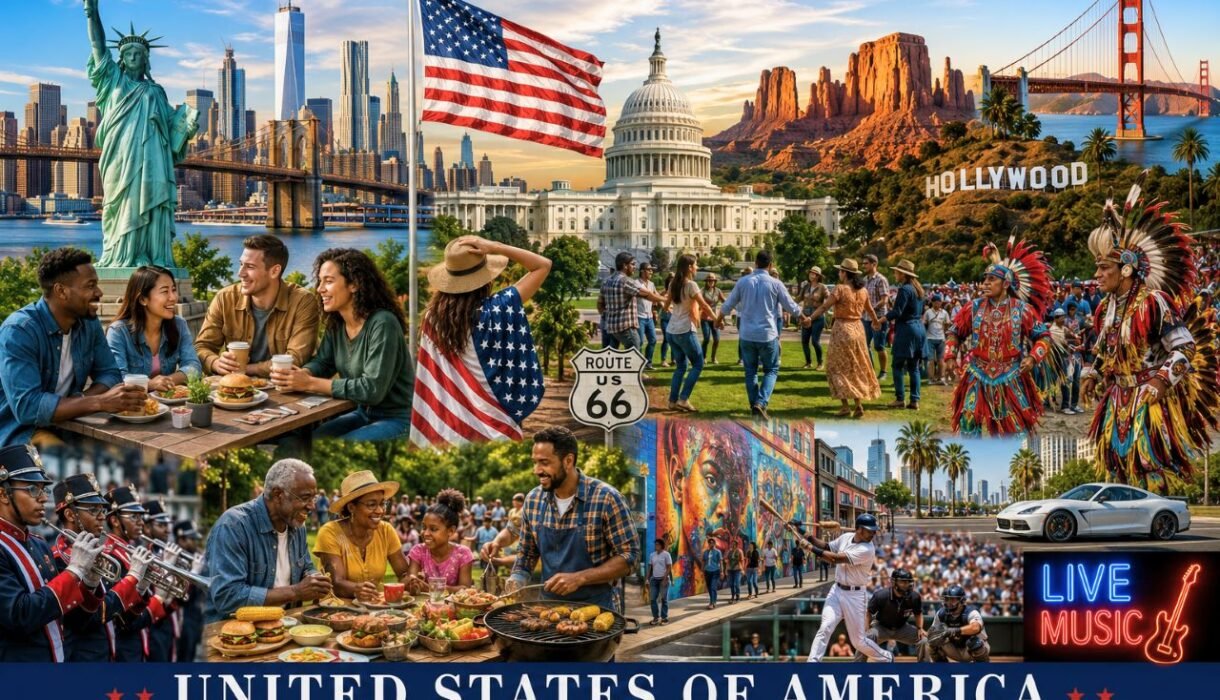
The United States of America, spanning a vast expanse of North America from the Atlantic to the Pacific, possesses a cultural framework that is highly recognizable yet remarkably complex. Often described metaphorically as a “melting pot” or a “salad bowl,” American culture is not a single, uniform tradition. Instead, it is a dynamic tapestry woven from hundreds of distinct cultural threads.
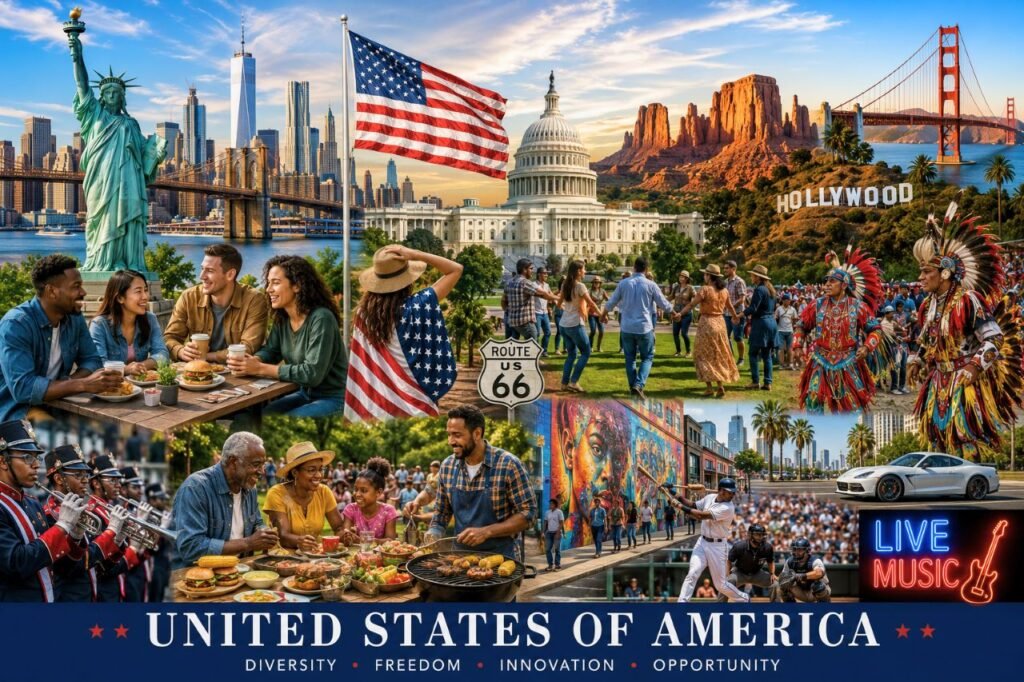
The culture of the United States is defined by its deep commitment to individual liberty, pioneering resilience, and a fast-paced pursuit of innovation. The people—Americans—are bound together less by a shared ancient ancestry and more by a shared set of philosophical ideals.
From the historic, cobblestone streets of New England to the sun-drenched tech hubs of Silicon Valley, the nation is an engine of constant cultural reinvention. Through the global export of its cinema, music, fast-casual dining, and digital platforms, the U.S. has shaped international popular culture while continually absorbing new global influences at home.
History & Origins
The historical blueprint of the United States is characterized by colonial settlement, territorial expansion, systemic struggles for civil rights, and continuous waves of international migration.

[Indigenous Nations: Cherokee, Navajo, Iroquois] ➔ [1600s: British, Spanish, & French Colonization] ➔ [The Transatlantic Slave Trade & Enslavement] ➔ [1776: American Revolution & Independence] ➔ [19th-21st Century: Mass Global Immigration]
The Foundational Strata
Long before European contact, hundreds of complex, sovereign Indigenous Nations inhabited the continent. They developed sophisticated agricultural networks, oral histories, and governance systems (such as the Iroquois Confederacy, which influenced early American democratic thought). European colonization began in earnest in the late 16th and 17th centuries, with the British establishing the dominant administrative framework along the eastern seaboard, while Spanish and French empires claimed vast territories in the south and west.
The Crucible of Modern Identity
The growth of the early agrarian economy relied heavily on the forced migration and labor of enslaved West Africans. Their resilience and creative adaptations laid the foundational bedrock for American music, language, cuisine, and spiritual life. Following the American Revolutionary War and the declaration of independence in 1776, the new republic began expanding westward.
Throughout the 19th and 20th centuries, massive waves of immigration from Ireland, Germany, Italy, Eastern Europe, and later from Asia and Latin America continually reshaped the national identity. Each group introduced distinct traditions, turning the country into a multi-ethnic powerhouse.
Geography
The United States is the world’s third or fourth-largest nation by land area, encompassing a massive range of ecosystems across its fifty states and territories.

- The East & South: Characterized by the ancient, weathered Appalachian Mountains, rolling green hills, and fertile coastal plains.
- The Mid-West: Dominated by the Great Plains, a massive agricultural heartland of flat, rich soils drained by the Mississippi River system.
- The West: Marked by the jagged, snow-capped Rocky Mountains, vast arid deserts (like the Mojave), and the volcanic Pacific Rim, including the distinct ecosystems of Alaska and the tropical archipelago of Hawaii.
This geographical diversity directly influences regional subcultures, dictating everything from local architectural styles to outdoor recreational habits and regional dialects.
Economy
The United States possesses a highly developed, technologically advanced capitalist mixed economy. It stands as a global leader in financial markets, technological innovation, and media production.
| Economic Sector | Core Components | Cultural Footprint |
| Technology & Software | Silicon Valley, Artificial Intelligence, Digital Platforms | Shapes global communication habits and reinforces a fast-paced culture of efficiency. |
| Entertainment & Media | Hollywood, Broadway, Streaming Networks, Gaming | Serves as the primary vehicle for exporting American ideals, fashion, and values worldwide. |
| Heavy Industry & Agribusiness | Aerospace, automotive engineering, industrial corn & wheat | Anchors the historic, hardworking identity of the American Rust Belt and rural Heartland. |
Politics
The United States is a federal constitutional republic operating under a presidential system. Governed strictly by the U.S. Constitution, political power is intentionally split across a tripartite framework: the Executive (President), the Legislative (Congress), and the Judicial (Supreme Court).
The country features a deeply entrenched two-party system, dominated by the Democratic Party (generally leaning center-left and progressive) and the Republican Party (generally leaning center-right and conservative). Individual states retain significant sovereign authority over their own internal laws, education, and public health systems, leading to a varied legal and social landscape across state lines.
Ethnic Groups
The demographic layout of the United States is incredibly diverse, reflecting centuries of global immigration:
- White / European American (~57.8%): Descendants of early British, Irish, German, Italian, and Slavic settlers, forming the historical base of institutions and language.
- Hispanic / Latino (~18.7%): The fastest-growing demographic, bringing deep Spanish-language media networks, vibrant culinary styles, and family-centric celebrations.
- Black / African American (~12.1%): The cultural engine of the nation, whose ancestors pioneered jazz, blues, rock, hip-hop, soul food, and foundational civil rights rhetoric.
- Asian American (~5.9%): Representing diverse lineages from East, South, and Southeast Asia, driving high-tech innovation, educational initiatives, and culinary trends.
- Indigenous / Native American (~1.1%): The original stewards of the land, preserving tribal sovereignty, ecological wisdom, and sacred artistic traditions.
Languages & Communication
While the United States does not have an official national language at the federal level, English functions as the de facto language of government, business, and education. Due to the high concentration of Latin American populations, Spanish is the second most widely spoken language, with many public services and media networks operating bilingually.
American communication is generally direct, informal, and heavily focused on eye contact and personal space. Regional dialects vary significantly across the country:
Iconic Regional Expressions
- “Y’all” — The classic Southern contraction for “you all,” serving as a warm, inclusive plural greeting.
- “Howdy” — A traditional, friendly Western greeting shorthand for “How do you do?”.
- “No worries” — A popular, relaxed coastal phrase used to express reassurance or acceptance.
Proverbial Wisdom
“Actions speak louder than words.”
Meaning: Real intent is proven by tangible efforts and results, not by empty rhetoric.
Beliefs & Values
American society is anchored by a core set of values that prioritize individualism, self-reliance, and egalitarianism. The concept of the “American Dream”—the belief that anyone, regardless of their birth status, can achieve prosperity through hard work and determination—remains a powerful national motivator.
Spiritually, the U.S. is one of the most religiously diverse advanced economies in the world. While rooted in Judeo-Christian traditions, freedom of religion is protected by the First Amendment. Protestantism and Roman Catholicism serve as major community anchors, alongside growing Jewish, Muslim, Hindu, Buddhist, and secular or non-religious communities.
Culture, Traditions & Customs
National Holidays and Gatherings
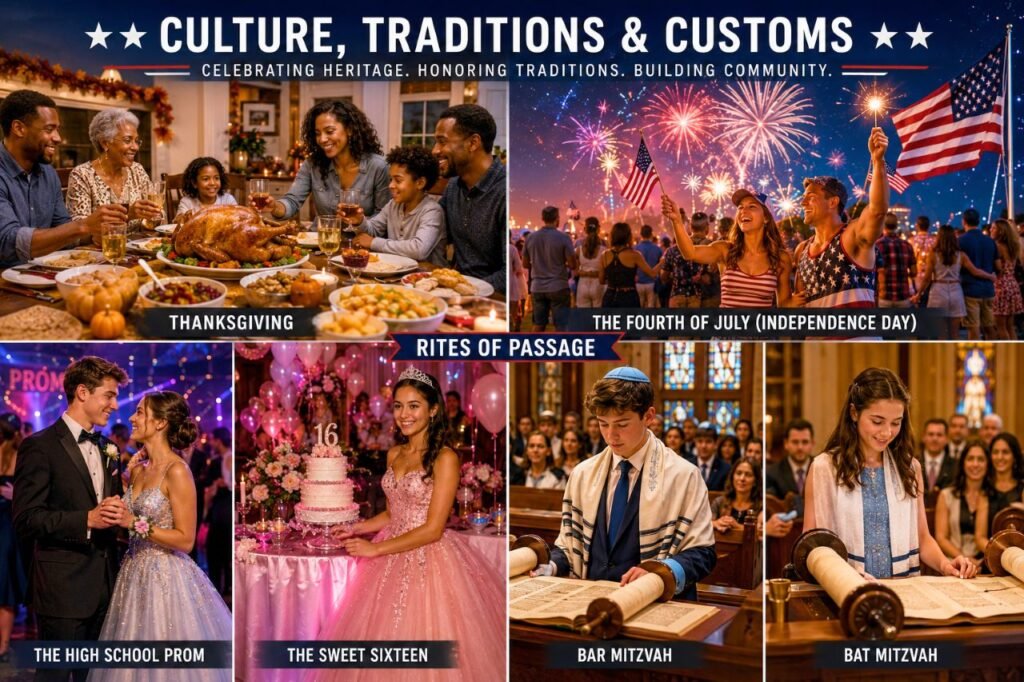
- Thanksgiving: Celebrated on the fourth Thursday of November, this holiday brings families together from across the country for a massive feast centered around roasted turkey, stuffing, and pumpkin pie, focusing entirely on gratitude and family unity.
- The Fourth of July (Independence Day): The ultimate celebration of statehood. Communities mark the day with backyard barbecues, neighborhood parades, and spectacular public fireworks displays.
Rites of Passage
- The High School Prom: A formal dance held near the end of the senior year of high school, serving as a major, cinematic social milestone for American youth.
- The Sweet Sixteen / Bar and Bat Mitzvahs: Significant cultural and religious celebrations marking a teenager’s transition toward young adulthood and civic responsibility.
Food & Cuisine
American cuisine is the ultimate reflection of the nation’s multi-ethnic history. Rather than relying on a single culinary tradition, it specializes in taking international dishes and adapting them into completely new, hyper-regional variations.
American Barbecue: A Regional Art Form
The undisputed king of traditional American cooking techniques is slow-smoked Barbecue (BBQ), an art form developed through the fusion of African wood-smoking methods, Indigenous roasting techniques, and European spice rubs:
- The Method: Tough cuts of meat, such as beef brisket or pork shoulder, are cooked over low indirect heat for up to 16 hours using hardwood logs like hickory, mesquite, or oak.
- The Regional Styles: The nation is divided into distinct flavor zones. Texas BBQ focuses purely on salt, pepper, and beef brisket; Kansas City features sweet, thick tomato-based molasses sauces; while the Carolinas prefer a tangy, vinegar-and-mustard base over pulled pork.
Classic Comfort Foods
- Apple Pie: The definitive national dessert, featuring a flaky pastry crust packed with spiced, sliced apples, serving as a symbol of domestic hospitality.
- Soul Food: Originating in the American South, this comforting style includes crispy fried chicken, baked macaroni and cheese, collard greens, and cornbread.
Clothing & Symbols
Casual Wear and Global Trends
The most significant American contribution to global fashion is undoubtedly blue jeans. Originally invented in 1873 by Jacob Davis and Levi Strauss as durable workwear for miners and cowboys, denim has evolved into the universal uniform of casual daily life worldwide.
[ National Iconography of the United States ]
┌───────────────────────────────────────────────────────────────────────────┐
│ NATIONAL FLAG ── 13 horizontal stripes (Original Colonies), │
│ 50 white stars on a blue field (Current States) │
├───────────────────────────────────────────────────────────────────────────┤
│ NATIONAL BIRD ── Bald Eagle (Haliaeetus leucocephalus) │
├───────────────────────────────────────────────────────────────────────────┐
│ NATIONAL EMBLEM─ The Statue of Liberty (Liberty Enlightening the World) │
└───────────────────────────────────────────────────────────────────────────┘
The Geometry of the Flag
The American Flag features 13 horizontal stripes alternating between red and white, honoring the original colonies that declared independence from Britain. The blue canton holds 50 white stars, representing the fifty current states of the union. Red symbolizes valor and hardiness, white represents purity and innocence, and blue signifies vigilance, perseverance, and justice.
Music, Dance & Art
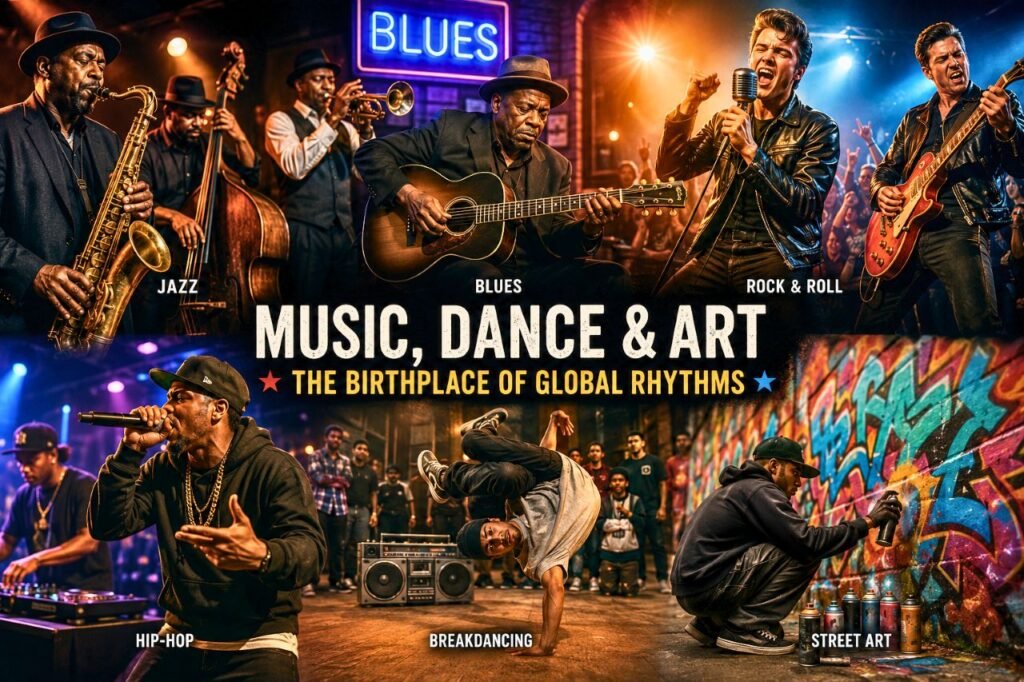
The Birthplace of Global Rhythms
The musical heritage of the United States is one of its greatest gifts to the world, driven largely by African American innovation:
- Jazz and Blues: Born in the American South, particularly New Orleans, these genres blended West African rhythms and spiritual work songs with European classical instrumentation to create a complex, improvisational art form.
- Rock and Roll & Hip-Hop: Rock and roll burst out of the 1950s by fusing rhythm and blues with country music. Decades later, hip-hop emerged from the Bronx in the 1970s, evolving from local block parties into a global cultural movement encompassing rap, turntablism, breakdancing, and street art.
Visual Arts & Cinema
In the visual arts, the U.S. led the mid-20th-century modern art movement through the bold, experimental strokes of Abstract Expressionism (such as Jackson Pollock) and the brilliant commercial critiques of Pop Art (led by Andy Warhol).
Furthermore, the cinematic output of Hollywood has served as a powerful economic and cultural force, capturing the global imagination and shaping trends across every continent.
Summary
The culture of the United States stands as a bold, living experiment in multicultural coexistence and continuous innovation. By turning industrial raw materials into global musical movements like jazz and rock, transforming regional wood-smoking techniques into the culinary art of barbecue, and welcoming diverse global perspectives, Americans have forged an unforgettable identity. The nation moves forward into the future with energy—celebrating its immense cultural diversity and sharing its creative, pioneering spirit with the global community.
At Best Culture Insight, we see culture as the heartbeat of every society – the way people live, connect, and express their identity.