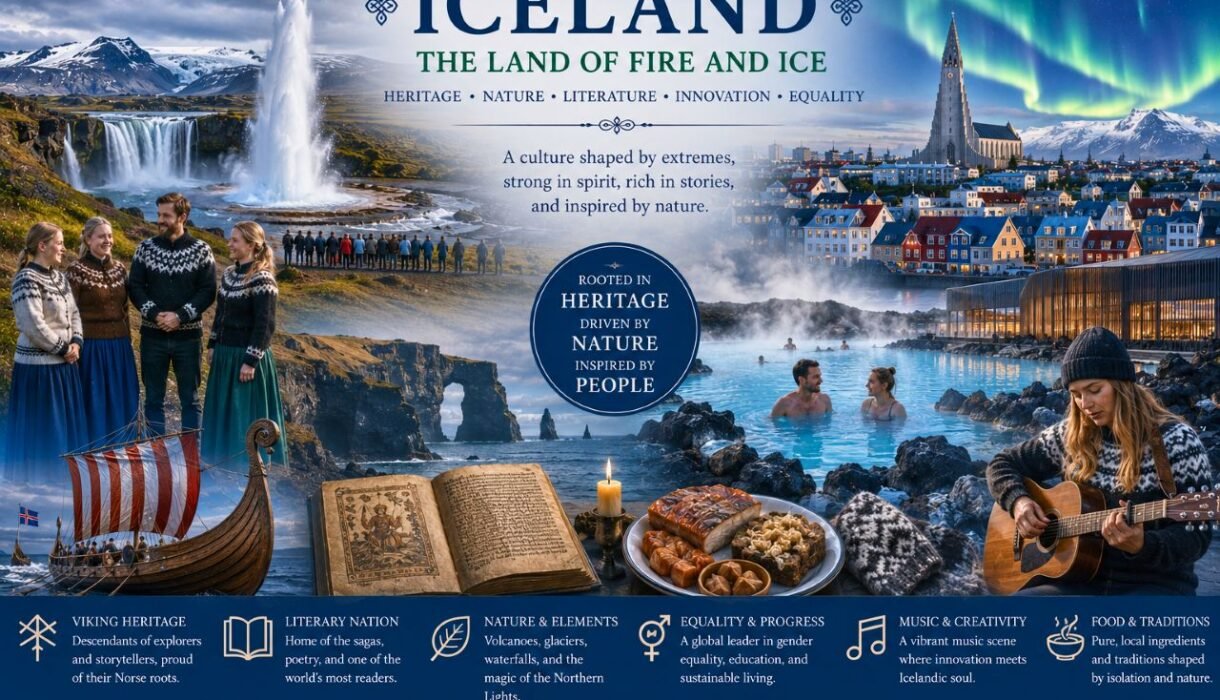

Isolated in the stormy waters of the North Atlantic, Iceland (Ísland) boasts a culture forged by absolute extremes. It is a place where subarctic winds meet boiling geothermal earth, creating a resilient, deeply creative society. The people of Iceland—Icelanders—are the direct descendants of Norse Vikings and Celtic settlers who learned to survive on a volcanic island that felt like the very edge of the known world.
Today, Icelandic culture stands out as a unique mix of ancient heritage and progressive, modern thinking. Known globally for its literary mastery, eco-conscious innovations, and unmatched gender equality, Iceland has transformed its historic isolation into a celebrated cultural identity. From the legendary family sagas written by candlelight in turf houses to the vibrant, avant-garde music scene of Reykjavík, this small island nation proves that geographical isolation can breed incredible creative energy.
History & Origins
The historical arc of Iceland is a testament to human survival against the forces of nature, shifting from a lawless frontier to a modern, independent republic.
[Norse-Celtic Settlement (874 AD)]➔[The Althing Foundation (930 AD)]➔[Christianization (1000 AD)]➔[Norwegian & Danish Monarchy Rule]➔[Sovereignty & Independence (1944)]
- The Age of Settlement: According to the Landnámabók (the Book of Settlement), Iceland’s history began in 874 AD when Norwegian chieftain Ingólfur Arnarson became the first permanent settler, building his homestead in what is now Reykjavík (“Smoky Bay”). He was followed by waves of Norse clans fleeing royal tyranny in Norway, alongside Celtic women and enslaved people captured from Ireland and Scotland.
- The Birth of Democracy: In 930 AD, the settlers established the Althing at Þingvellir—an open-air assembly where independent chieftains met annually to settle disputes and recite laws. The Althing is recognized today as the world’s oldest surviving parliament.
- Foreign Rule and Hardship: Internal conflict eventually brought an end to the early Icelandic Commonwealth, forcing the island under the Norwegian Crown in 1262, and later under Danish rule in 1380. For centuries, Icelanders endured economic monopolies, smallpox epidemics, and devastating volcanic events like the Laki eruption of 1783, which wiped out a quarter of the population.
- Independence: The 19th century sparked a powerful peaceful independence movement led by scholar Jón Sigurðsson. Iceland gained sovereignty in 1918 and officially declared itself a fully independent Republic on June 17, 1944, cutting its final ties with Denmark while Europe was engulfed in World War II.
Culture, Traditions & Customs
Marriage and Family Celebrations
Modern Icelandic weddings lean toward casual, intimate gatherings, though they frequently blend contemporary trends with ancient Nordic folklore. It is common for couples to have lived together or raised children for years before deciding to formalize their marriage. A uniquely Icelandic touch at many receptions is the serving of a Kransekake, a traditional Scandinavian tower cake made of concentric rings of almond macaroon paste, often decorated with miniature Icelandic flags.
Naming Ceremonies and the Patronymic System
Iceland retains a strict, ancient Patronymic Naming System instead of traditional family surnames. A child’s last name is formed by taking their father’s (or occasionally mother’s) first name in the genitive case and adding -son for a boy or -dóttir for a girl.
For example, if a man named Aron has a son named Jón and a daughter named Anna, their full names become Jón Aronsson and Anna Aronsdóttir. Because of this system, all new names must be approved by the official Icelandic Naming Committee (Mannanafnanefnd) to ensure they match historical grammar rules.
Major Festivals and Rites of Passage
- Þorrablót (Thorrablót): Held during the ancient Norse month of Þorri (late January to February), this mid-winter feast preserves traditional Viking culinary methods. Communities gather to sing folk songs, drink local schnapps, and eat preserved historical foods.
- Jólabókaflóð (The Christmas Book Flood): An incredible literary tradition. The vast majority of books in Iceland are published in the final months of the year. On Christmas Eve, family members traditionally exchange books and spend the rest of the night reading in bed while eating chocolate.
Languages & Communication
The official language, Icelandic (Íslenska), is a North Germanic language that has remained remarkably unchanged since the 9th century.
Linguistic Purism
Because of Iceland’s geographical isolation, the language did not experience the foreign influences that reshaped Norwegian and Danish. Today, an modern Icelander can read the 12th-century medieval sagas with relative ease. The government practices strict Linguistic Purism. Instead of adopting foreign loanwords like “computer” or “television,” a dedicated committee crafts brand-new words out of ancient Old Norse roots:
- Computer becomes Tölva (a combination of tala [number] and völva [prophetess]—literally, a “digital prophetess”).
- Television becomes Sjónvarp (from sjón [vision] and varp [projection]).
Everyday Idioms
Icelandic communication is direct, egalitarian, and deeply optimistic.
- “Þetta reddast”
Translation: “It will all work out in the end.” This is the undisputed national motto. It reflects a cultural mindset shaped by centuries of unpredictable volcanic eruptions and sudden arctic storms—a belief that no matter how bad things look, resilience and adaptability will see you through.
Geography
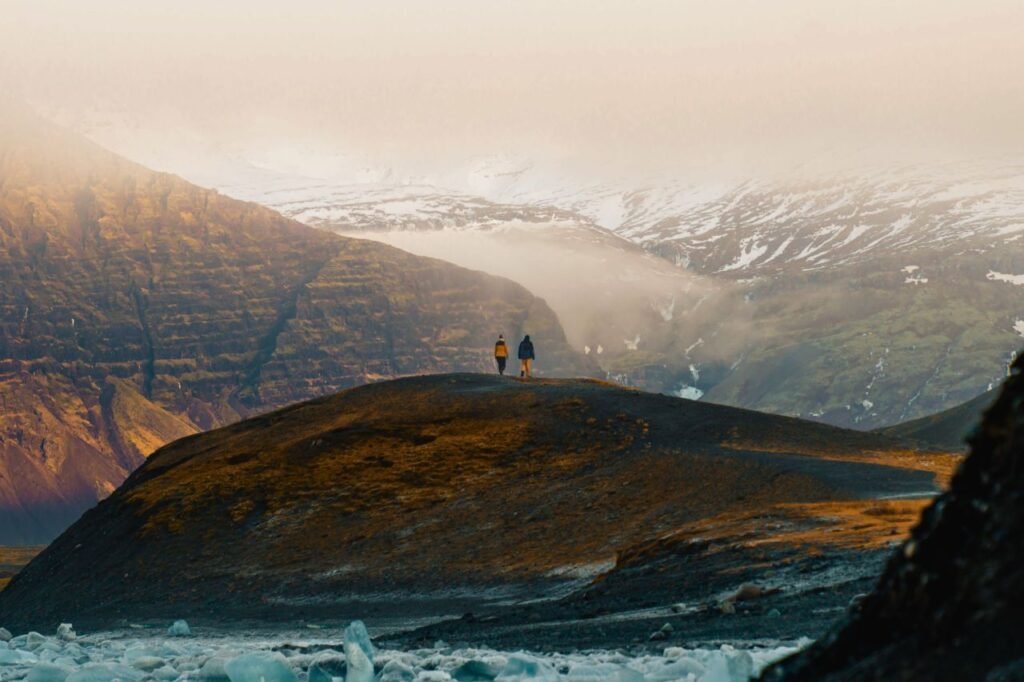
Iceland is a volcanic island sitting directly on the Mid-Atlantic Ridge, where the North American and Eurasian tectonic plates are actively pulling apart. This unique placement creates a stark, dramatic landscape of intense geological activity.
The country is defined by three main terrain types:
- Glaciers and Ice Caps: Glaciers cover over 10% of the island, including Vatnajökull, the largest ice cap in Europe by volume.
- Volcanic Highlands: The unpopulated interior is a stark desert of black volcanic sand, jagged lava fields, and active calderas.
- The Coastal Fjords: The inhabited edges of the island are carved into deep, dramatic sea fjords, punctuated by dramatic black sand beaches and hundreds of roaring waterfalls like Gullfoss and Skógafoss.
Economy
Iceland runs a small, highly developed economy that has evolved from basic survival fishing into a modern powerhouse driven by green innovation.
- Renewable Energy: Thanks to its unique geology, Iceland generates 100% of its electricity and heating from renewable sources (roughly 70% hydropower and 30% geothermal energy), making it a global leader in green tech and sustainability.
- Fisheries: Marine exports remain a cornerstone of the economy, backed by strict, sustainable quotas that protect North Atlantic cod and haddock stocks.
- Tourism and Tech: Tourism has grown rapidly over the last two decades, alongside a booming technology sector focused on carbon capture, high-tech data storage, and gaming software.
Politics
Iceland is a stable parliamentary constitutional republic. Executive power rests with the government, led by the Prime Minister, while the President serves as a ceremonial head of state.
The unicameral parliament, the Althing, consists of 63 members elected every four years. Iceland is world-renowned for its progressive political landscape, consistently ranking number one on the World Economic Forum’s Global Gender Gap Index. It became the first country in the world to democratically elect a female head of state (Vigdís Finnbogadóttir in 1980) and pioneered laws making it illegal to pay women less than men for the same work.
Ethnic Groups
For most of its history, Iceland was a highly homogenous society due to its extreme geographic isolation. Today, around 84% of the population identifies as ethnically Icelandic, tracing their roots directly back to the original Norse-Celtic settlers.
However, the 21st century has brought rapid demographic changes driven by labor needs in the tourism, construction, and tech sectors. The largest international minority group is the Polish community (making up about 5-6% of the total population), followed by smaller communities from Lithuania, Germany, and various Asian nations, introducing new cultural flavors to modern urban life.
Beliefs & Values
Religion and Folklore
The official state church is the Evangelical Lutheran Church of Iceland, though society is largely secular. Alongside mainstream religion, Icelanders maintain a fascinating connection to ancient Norse paganism through Ásatrúarfélagið, an officially recognized neo-pagan movement that honors old gods like Odin and Thor.
The Huldufólk (Hidden People)
One of the most famous aspects of Icelandic folklore is the enduring belief in the Huldufólk—invisible elves and spirits said to live inside large volcanic boulders and hills. While few modern Icelanders openly state they believe in elves, a vast majority deeply respect the folklore. Construction projects, road buildings, and pipe-laying operations are regularly redirected or delayed to avoid disturbing rocks believed to be elven homes, showing a cultural desire to live in harmony with the natural environment.
Food & Cuisine
Traditional Icelandic cuisine (Íslensk matargerð) was born out of a stark necessity to preserve food through long, dark winters without salt, which was historically difficult to harvest on the island.
- Ancient Preservation Methods: To keep meats from spoiling, historical cooks turned to smoking, pickling in fermented whey (músa), or drying. This gave rise to traditional dishes like Hákarl (fermented Greenland shark buried underground and dried for months to remove natural toxins) and Svið (singed and boiled sheep’s heads).
- Skyr: Iceland’s most successful culinary export. Often mistaken for yogurt, Skyr is actually a delicate, high-protein, fat-free cheese made from skimmed milk, consumed on the island since the Viking Age.
- Modern Ocean-to-Table Dining: Today, Icelandic chefs utilize abundant geothermal energy to run greenhouse systems, growing fresh vegetables and herbs year-round. Modern cuisine focuses heavily on ultra-fresh Atlantic cod, langoustines, and free-roaming Icelandic Lamb, which is world-famous for its tender texture and lean flavor, a result of the animals grazing on wild mountain berries and wild herbs.
Clothing & Symbols
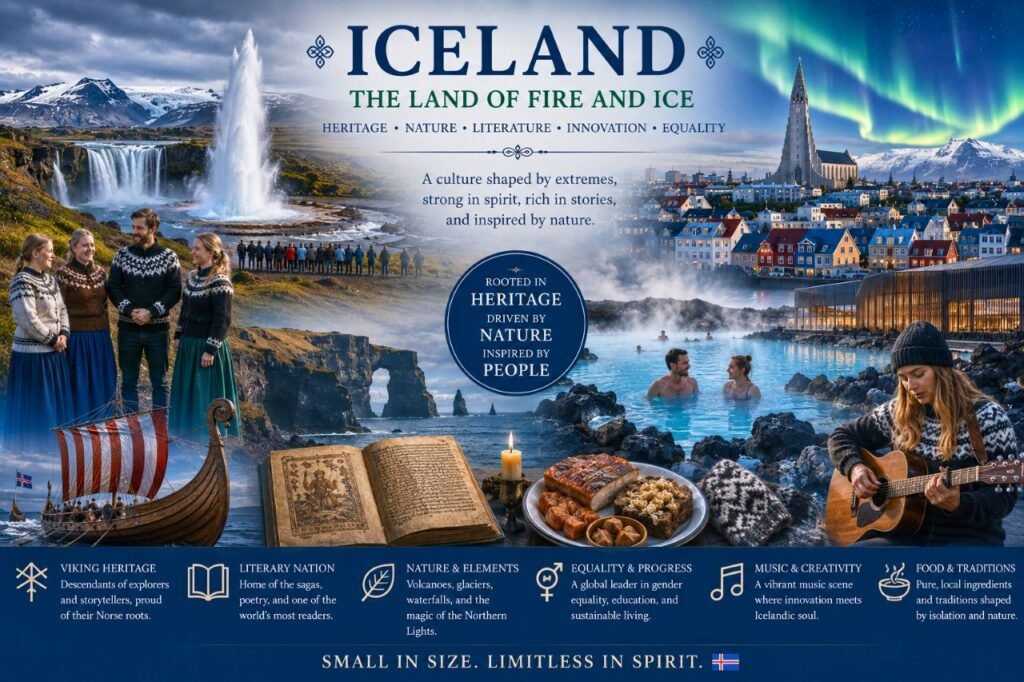
Iceland land of fire and ice – Culture
The Lopapeysa
The absolute definitive symbol of Icelandic fashion is the Lopapeysa—the traditional Icelandic wool sweater. Developed in the mid-20th century, it is characterized by a wide, intricate decorative yoke pattern circling the neck and shoulders.
The sweater is knit exclusively from Lopi, a unique wool sheared from indigenous Icelandic sheep. Because these sheep have adapted to subarctic weather for over a millennium, their fleece contains two distinct layers: a soft, insulating inner layer and a coarse, water-repellent outer layer. This combination makes the Lopapeysa incredibly warm, windproof, and naturally water-resistant.
National Symbols
- The National Dress (Þjóðbúningurinn): Includes elegant historical styles like the Faldbúningur (distinguished by its tall, curved white headdress) and the Peysuföt, featuring a dark wool skirt, a tailored jacket, and a velvet cap woven with fine silver embroidery.
- The Coat of Arms (Skjaldarmerkið): Features the national flag supported by the four mythical guardians (Landvættir) of Iceland: a dragon protecting the east, an eagle guarding the north, a bull watching over the west, and a giant giant securing the southern coast.
Music, Dance & Art
Literature and the Saga Tradition
Literature is the absolute foundation of Icelandic art. During the 12th and 13th centuries, anonymous writers penned the Icelandic Sagas, masterfully detailed prose histories capturing Viking family feuds, voyages, and kingly battles. This deep love for books continues today; statistically, one in ten Icelanders will write and publish a book in their lifetime. In 1955, author Halldór Laxness won the Nobel Prize in Literature, cementing the island’s literary status.
Sonic Innovation
Iceland punches far above its weight in the global music industry, known for an ethereal, experimental sound that feels deeply connected to its landscapes. World-renowned artists like Björk, the cinematic post-rock band Sigur Rós, the indie-folk group Of Monsters and Men, and late classical composer Jóhann Jóhannsson have achieved massive global acclaim by mixing traditional folk sensibilities with cutting-edge electronic experimentation.
Summary
The culture of Iceland is an inspiring story of human resilience, intellectual curiosity, and an enduring respect for nature. By preserving their ancient Viking language and unique naming traditions while simultaneously championing green energy and social progress, Icelanders have built an incredibly forward-thinking society. From the cozy warmth of a hand-knit Lopapeysa to the literary magic of the Christmas Book Flood, Iceland offers a distinct cultural experience that continues to inspire the world.
At Best Culture Insight, we see culture as the heartbeat of every society – the way people live, connect, and express their identity.