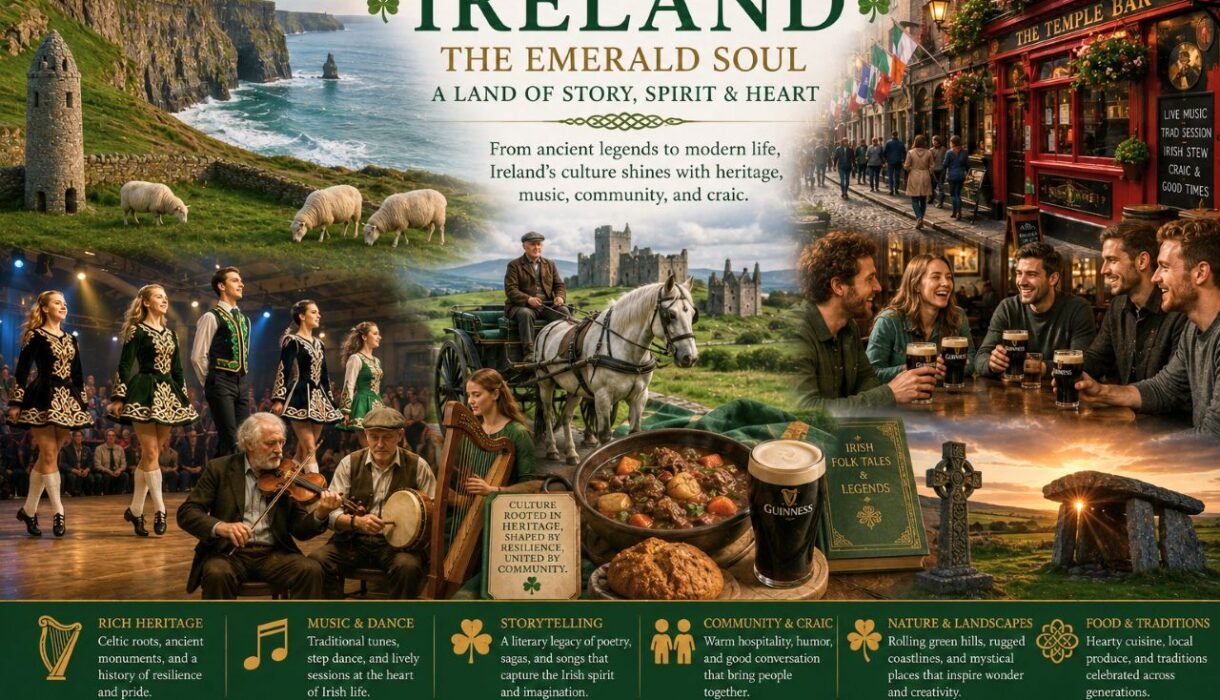

Rising from the mists of the North Atlantic, Ireland (Éire) possesses a culture whose global influence reaches far beyond its geographic borders. Known universally as the “Emerald Isle,” Ireland is a land where ancient stone monuments share fields with vibrant, modern cities. The people of Ireland—the Irish—are defined by an enduring spirit shaped by waves of Celtic settlement, severe historical hardships, and a profound, innate love for storytelling.
Irish culture strikes a rare balance between deep historical reverence and a progressive, forward-looking worldview. It is a heritage celebrated worldwide through festive St. Patrick’s Day parades, mesmerizing traditional step dance, and a literary legacy that has shaped western thought. At its core, Irish culture is anchored in community, warmth, and the concept of craic—a uniquely Irish word encompassing good conversation, humor, and genuine companionship.
History & Origins
Ireland’s history is a multilayered tapestry of epic migrations, cultural assimilation, and a long, determined march toward self-governance.
[Gaelic Celtic Arrival (c. 500 BC)]➔[Christianization by St. Patrick (432 AD)]➔[Viking & Anglo-Norman Invasions]➔[The Great Famine (1845–1852)]➔[Independence & Republic Status (1922/1949)]
- The Celtic Dawn: While Ireland was inhabited by stone-age hunter-gatherers and farming communities who built wonders like Newgrange around 3200 BC, it was the arrival of the Celts around 500 BC that fundamentally established Gaelic culture. They introduced iron tools, tribal kingships (tuatha), and the early forms of the Irish language.
- Monks and Scholars: The arrival of Saint Patrick in 432 AD smoothly integrated Christianity with existing Celtic traditions. During the Dark Ages of mainland Europe, Ireland became an isolated sanctuary for learning, producing beautifully illuminated manuscripts like the Book of Kells.
- Conquest and Colonial Rule: Successive invasions by Vikings in the 8th century and Anglo-Normans in the 12th century gradually eroded Gaelic autonomy. By the 17th century, the British Crown established complete dominance, enforcing the Penal Laws which systematically stripped native Catholic Irish of their land, religion, and political rights.
- The Great Famine and Diaspora: Between 1845 and 1852, a catastrophic potato blight caused the Great Famine (An Gorta Mór). One million people died of starvation, and over a million more emigrated across the globe. This devastating loss halved the island’s population and birthed the vast global Irish diaspora.
- The Path to Freedom: Following centuries of resistance, the Easter Rising of 1916 ignited the Irish War of Independence. This led to the Anglo-Irish Treaty of 1921, partitioning the island into the independent Irish Free State (which became a full Republic in 1949) and Northern Ireland, which remained part of the United Kingdom.
Culture, Traditions & Customs
Marriage and the Handfasting Custom
Modern Irish weddings are festive, elegant affairs, but many couples intentionally weave ancient Celtic customs into their ceremonies. The most famous of these is Handfasting, an ancient Gaelic betrothal ritual where the couple’s wrists are gently bound together with a decorative cord or ribbon to symbolize the binding of their lives—the literal origin of the phrase “tying the knot.”
Traditional Naming Customs
Historically, Irish families adhered to a rigid naming pattern to honor their ancestry across generations:
- The first son was named after the father’s father.
- The second son after the mother’s father.
- The first daughter after the father’s mother.
- The second daughter after the mother’s mother.
Traditional Gaelic first names like Oisín, Sadhbh, Aoife, and Cian have seen a massive modern revival. Surnames frequently carry prefixes reflecting lineage: Ó (meaning “descendant of”) and Mac (meaning “son of”).
Major Festivals and Rites of Passage
- St. Patrick’s Day (March 17th): Originally a solemn religious feast day honoring Ireland’s patron saint, it has evolved into a massive global celebration of Irish identity, culture, and creative expression.
- Samhain (Halloween): Modern Halloween traces its direct roots back to the ancient Celtic festival of Samhain. Held on October 31st, it marked the end of the harvest and a time when the boundary between our world and the supernatural realm thinned, prompting people to wear disguises to ward off wandering spirits.
Languages & Communication
The island of Ireland has a rich bilingual identity, where an ancient language coexists with a universally spoken global tongue.
Gaeilge (The Irish Language)
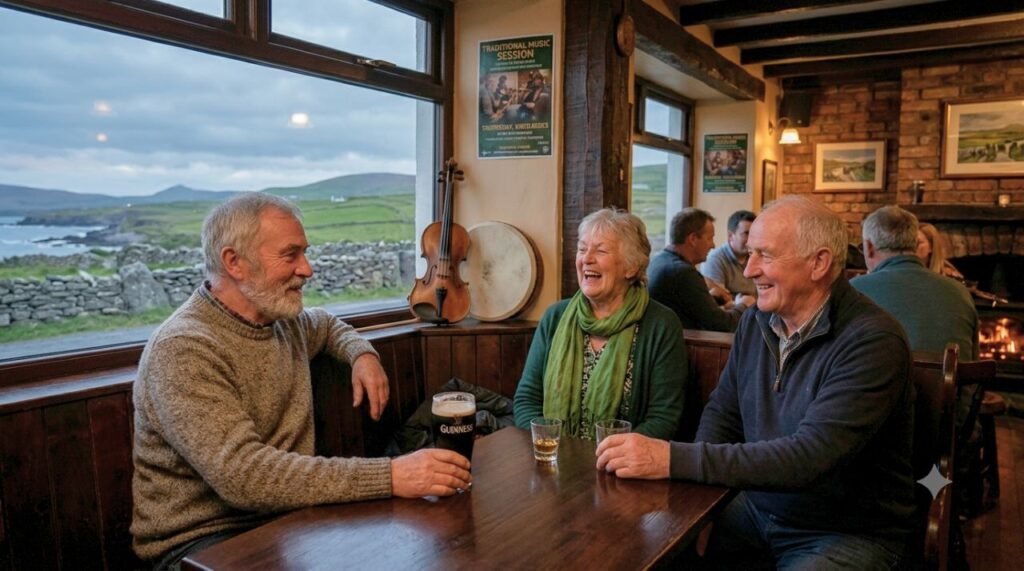
Irish (Gaeilge) is a Goidelic Celtic language and is officially recognized as the first national language of the Republic. While centuries of colonial rule pushed the language to the fringes, it survives dynamically today in coastal communities known as the Gaeltacht. It is a mandatory subject in schools, and a passionate cultural movement continues to revitalize its use in modern media, music, and digital spaces.
Hiberno-English and Idioms
The vast majority of the population speaks English, but it is delivered via Hiberno-English—a distinct dialect that transposes Gaelic grammatical structures and poetic rhythms directly into English speech.
- “Slán”
Translation: The standard Irish Gaelic greeting for “Goodbye,” meaning safety or health.
- “What’s the craic?”
Meaning: One of Ireland’s most common casual greetings, translating roughly to “How are things?” or “What’s the news?”
- “Is fearr rith maith ná drochsheasamh.”
Proverb Translation: “A good run is better than a bad stand.” This classic proverb highlights a practical, witty cultural value: knowing when to gracefully step away from a losing argument or situation is a form of wisdom.
Geography
Ireland is an island nation characterized by a low-lying central limestone plain surrounded by a protective ring of rugged coastal mountains.
The island’s geography can be divided into three distinct zones:
- The Emerald Interior: The center of Ireland features fertile agricultural plains, lush rolling pasturelands, and a vast network of glassy lakes and boglands fed by the River Shannon, the longest river in the British Isles.
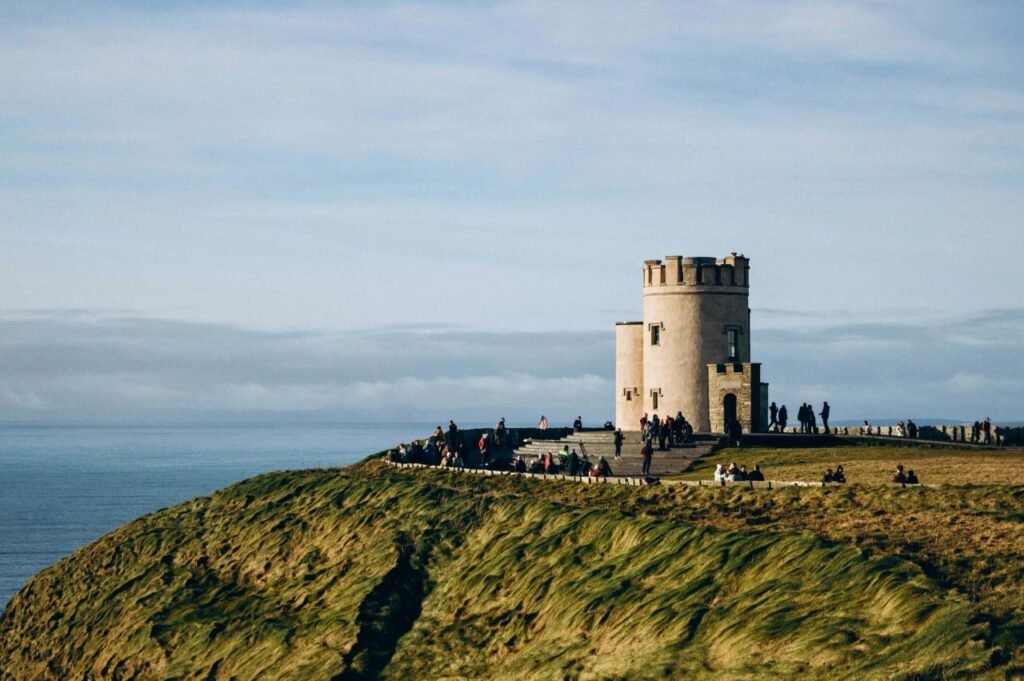
- The Glaciated West: The Atlantic coastline is deeply indented with dramatic bays and sheer rock faces, most famously represented by the soaring Cliffs of Moher and the unique glaciated karst landscape of The Burren.
- The Maritime Weather System: Warmed by the North Atlantic Drift (Gulf Stream), Ireland enjoys a mild, temperate maritime climate. This consistent rainfall keeps the landscape green year-round, earning it the “Emerald Isle” moniker.
Economy
Ireland has undergone a dramatic economic transformation, shifting from a protectionist, agriculture-heavy society into a highly advanced, globalized knowledge economy.
- The Silicon Valley of Europe: Through a combination of strategic European Union membership, a highly educated workforce, and competitive corporate tax rates, Ireland has become the European headquarters for the world’s leading technology, pharmaceutical, and financial giants, including Apple, Google, and Pfizer.
- Traditional Sectors: Despite its rapid technological growth, Ireland maintains a prestigious agricultural export sector, renowned globally for its high-quality grass-fed beef, premium dairy products, and artisanal farmhouse cheeses.
- Beverage Exports: Premium Irish whiskey (spelled with an ‘e’) and stout are major economic drivers, experiencing booming global demand.
Politics
The Republic of Ireland is a stable, democratic parliamentary republic. The President (Uachtarán) serves as the formal head of state with primarily representative duties, while executive political power belongs to the government, led by the Taoiseach (the Prime Minister).
The national parliament, known as the Oireachtas, is bicameral, consisting of the Dáil Éireann (House of Representatives) and the Seanad Éireann (Senate). Over the last few decades, Ireland’s political landscape has shifted significantly toward progressive social liberalism, becoming the first country in the world to legalize same-sex marriage via a popular vote in 2015.
Ethnic Groups
Historically, Ireland’s population was predominantly of Gaelic Celtic origin. However, the economic boom of the late 1900s transformed the country into an attractive destination for global migration.
Today, approximately 87% of the population identifies as white Irish, maintaining a strong cultural link to the island’s historical roots. The remaining population is comprised of diverse international communities, with significant populations from Eastern Europe (particularly Poland and Romania), the United Kingdom, Brazil, and various African and Asian nations. Additionally, the Irish Travellers (Mincéirí) are recognized as a distinct, indigenous ethnic minority within Ireland, possessing a unique nomadic history, culture, and language called Shelta.
Beliefs & Values
Religion and Society
For centuries, Roman Catholicism was deeply intertwined with the social, political, and cultural framework of Ireland. However, modern Ireland has transitioned into a highly secularized society. While many people still observe traditional religious milestones like Communions and Baptisms, regular church attendance has declined significantly, giving way to a modern culture centered on personal freedom and pluralism.
The Fairy Folklore (The Daoine Sidhe)
Beneath the surface of modern life lies a deep, lingering respect for ancient Celtic mythology. Ireland is rich with folklore regarding the Daoine Sidhe (the fairy folk).
Throughout the rural countryside, you will find thousands of “fairy forts”—circular earthen mounds left behind by iron-age farmers. Local superstition strongly dictates that destroying these forts brings terrible misfortune. To this day, farmers, road developers, and landowners routinely bypass these ancient sites out of a respectful desire to preserve the physical folklore of the landscape.
Food & Cuisine
Traditional Irish food is a hearty, comfort-oriented cuisine born from a reliance on fresh, locally farmed ingredients, designed to provide sustained energy for agricultural labor.
- The Power of the Potato: Introduced to the island in the late 1500s, the potato became the core dietary staple of the working class. It remains a beloved cultural symbol, celebrated in traditional comfort dishes like Colcannon (mashed potatoes folded with kale or cabbage and butter) and Boxty (a classic Irish potato pancake).
- The Irish Stew: The undisputed national dish, traditionally slow-simmered in a single pot over an open hearth. It blends tender mutton or beef with potatoes, onions, carrots, and savory herbs.
- Soda Bread: A unique culinary tradition born from necessity. Because Ireland’s soft wheat didn’t rise well with yeast, bakeries used bicarbonate of soda (baking soda) as a leavening agent mixed with buttermilk, producing a dense, crusty bread that remains a staple of the Irish breakfast table.
Clothing & Symbols
The Aran Sweater
The most famous garment in Irish cultural history is the Aran Sweater (Geansaí Árann), originating from the isolated Aran Islands off the rugged coast of County Galway. Knit from unscoured sheep’s wool that retained its natural oils (lanolin), these thick sweaters were naturally water-repellent and wind-resistant, providing vital protection for local fishermen braving the Atlantic.
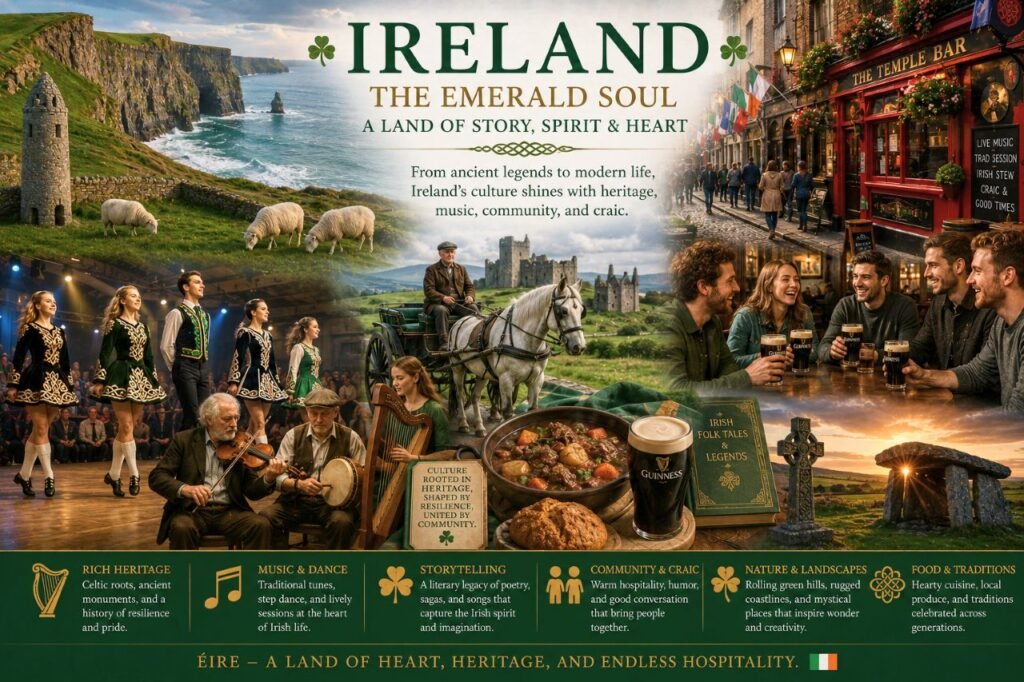
Ireland: a land of heart and heritage
Each sweater features intricate, complex cable and diamond stitches. According to island lore, these unique patterns carried deep symbolic meanings: the cable stitch represents a fisherman’s ropes and a wish for a bountiful catch, while the diamond stitch symbolizes the small, stone-walled fields of the islands, representing a wish for agricultural prosperity.
Iconic Symbols
- The Shamrok (Seamróg): A young three-leaved clover used historically by Saint Patrick to explain the Christian concept of the Holy Trinity to the pagan Celts. Today, it serves as the ultimate global symbol of Irish heritage.
- The Claddagh Ring: A traditional Irish ring representing love (the heart), loyalty (the crown), and friendship (the hands). The way the ring is worn on the hand indicates the wearer’s relationship status.
- The Celtic Harp: Ireland’s official national emblem. It is unique globally as the only country to feature a musical instrument as its national symbol, appearing on state seals, passports, and coinage.
Music, Dance & Art
Traditional Music (Trad)
Music is the absolute heartbeat of Irish social life. Traditional Irish music uses acoustic instruments like the fiddle, the tin whistle, the bodhrán (a goatskin frame drum), and the complex uilleann pipes (Irish bagpipes). Rather than being confined to concert halls, trad music lives dynamically in local pubs, where musicians gather for informal “sessions,” playing lively jigs and reels while patrons sing along to timeless folk ballads.
Step Dance and Literature
- Irish Dance: Characterized by an athletic, rigid upper body coupled with lightning-fast, intricate footwork. The global phenomenon of Riverdance in the 1990s elevated this traditional art form into a world-famous stage spectacle.
- A Literary Powerhouse: Ireland’s greatest artistic contribution to the world is its staggering literary output. The country has produced four Nobel Prize winners in Literature—William Butler Yeats, George Bernard Shaw, Samuel Beckett, and Seamus Heaney—alongside legendary modern masters like James Joyce, whose novel Ulysses fundamentally redefined twentieth-century literature.
Summary
The culture of Ireland is a triumphant celebration of survival, community, and creative expression. By gracefully preserving their ancient Gaelic tongue, traditional music sessions, and deep folkloric roots while simultaneously building a progressive, high-tech European republic, the Irish have created a uniquely magnetic society. From the intricate stitches of an Aran sweater to the lively camaraderie of a local pub session, Ireland’s cultural heritage remains a warm, welcoming gift to the global community.
At Best Culture Insight, we see culture as the heartbeat of every society – the way people live, connect, and express their identity.